
South America Home Hydroponics Market (2025-2030)

The South America Home Hydroponics Market was valued at $52.7 Million in 2025 and projected to reach to $105.8 Million by 2030, representing a compound annual growth rate of 15.0%. South America's home hydroponics market is positioned for substantial growth as urbanization accelerates and consumers prioritize sustainable food production methods.


| Market Size in | USD 26.32 MN |
| Market Forecast in | |
| CAGR | |
| Forecast Period | |
| Units Considered | Value (USD MN) |
South America Home Hydroponics Market Trends and Insights
- South America's growing urban population and increasing interest in sustainable food production are driving adoption of hydroponic systems among residential consumers.
- The region's favorable climate conditions and rising awareness of water-efficient farming techniques position South America as a key growth market for home hydroponics technology. South America's 15.0% compound annual growth rate significantly reflects strong regional demand for indoor farming solutions.
- South America's agricultural innovation sector is increasingly embracing hydroponic systems as consumers seek year-round crop production and reduced pesticide use.
- Between 2025 and 2030, South America is expected to see accelerated market penetration driven by declining equipment costs, improved technology accessibility, and supportive government policies promoting sustainable agriculture..
Key Market Statistics
- CAGR (2025-2030) 15.0% CAGR
- Market Size, 2025 ~USD 52.7 Million
- Forecast, 2030 ~USD 105.8 Million
- Geography South America
South America Home Hydroponics Market Overview
Rapid Market Expansion :
South America's home hydroponics market is projected to double from $52.7 million in 2025 to $105.8 million by 2030, representing a strong 15% CAGR driven by urbanization and sustainability trends.
Urban Agriculture Adoption :
Growing urban populations across South American cities are increasingly adopting hydroponic systems for residential food production, reducing dependency on traditional agriculture and improving food security.
Water Conservation Focus :
Rising awareness of water scarcity in South America is accelerating adoption of hydroponic systems, which use up to 90% less water than conventional farming methods.
Climate Advantage :
South America's diverse and favorable climate conditions across multiple regions enable year-round hydroponic cultivation, making residential systems economically viable for home growers.
South America Home Hydroponics Market Dynamics
- The region's increasing water scarcity concerns and rising environmental consciousness are key catalysts driving residential adoption of hydroponic systems.
- Brazil and Argentina lead the market, with expanding middle-class populations seeking innovative solutions for home gardening and food self-sufficiency. The forecast period through 2030 will see intensified market penetration as technology becomes more affordable and accessible to South American households.
- Government initiatives promoting sustainable agriculture, combined with growing e-commerce infrastructure for hydroponic equipment distribution, will further accelerate market expansion.
- Regional manufacturers are emerging to meet local demand, creating competitive pricing and tailored solutions for South American consumers..
Market Ecosystem
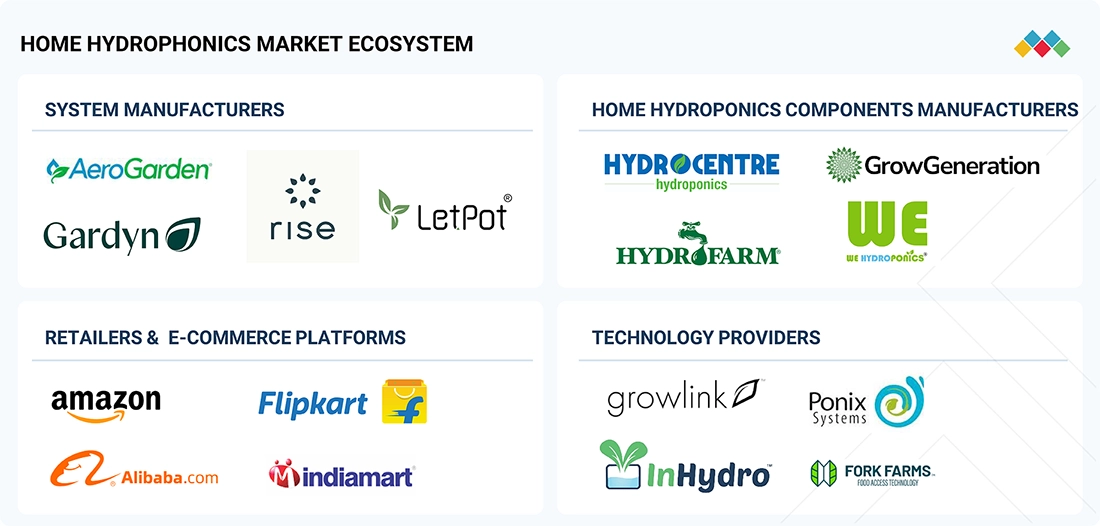
Home Hydroponics Market: COMMERCIAL USE CASES ACROSS INDUSTRIES
| COMPANY | USE CASE DESCRIPTION | BENEFITS |
|---|---|---|
 |
Development of integrated home hydroponic systems and nutrient solutions | Offers user-friendly, scalable systems for indoor vegetable and herb cultivation; enhances plant growth and yield consistency |
 |
Distribution of LED grow lights, climate controls, and nutrient delivery systems for home setups | Ensures optimal growing conditions, energy efficiency, and higher productivity for urban gardeners |
 |
Operation of retail and online platforms for hydroponic equipment and home gardening solutions | Provides one-stop access to hydroponic products; simplifies system setup and maintenance for consumer |
 |
Smart countertop hydroponic gardens with automated water and nutrient control | Enables easy, low-maintenance indoor cultivation for beginners; ensures consistent harvests year-round |
 |
Modular hydroponic units connected with mobile app control and monitoring | Delivers real-time nutrient and water management; supports customized plant growth and home scalability |
Logos and trademarks shown above are the property of their respective owners. Their use here is for informational and illustrative purposes only.
Related Ecosystem
Agrochemicals
- Phosphatic Fertilizers
- Potassic Fertilizers
- Fungicides
- Ammonium Nitrate
- Anticoagulant Rodenticides
- AZELIS HOLDINGS SA
- Basf se
- Origin Enterprises plc
- MITSUI AGRO BUSINESS SACO
- Mitsui & Co., Ltd.
Key Takeaways
- South America's home hydroponics market is valued at $52.7 million in 2025 and will reach $105.8 million by 2030, representing a 15.0% CAGR.
- South America's urban population growth and sustainability focus are primary drivers of residential hydroponic system adoption.
- South America benefits from favorable climate conditions and government support for sustainable agricultural practices.
- South America's market expansion is fueled by decreasing equipment costs and increased consumer awareness of water-efficient farming technologies.
Home Hydroponics Market Report Scope
| Report Metric | Details |
|---|---|
| Base Year | 2025 |
| Fastest Growing Segment | AEROPONICS (Growth Mechanism) |
| Forecast Period | 2025-2030 |
| Growth Rate | CAGR of 16% from 2025 to 2030 |
| Largest Segment | LIQUID SYSTEMS (Type) |
| Market Size Base Year (Billions) | ~USD 1.79 (2025) |
| Revenue Forecast (Billions) | ~USD 3.77 (2030) |
| Segments Covered | Product Type, System Type, Crop Seed Type, Growth Mechanism, Type |
South America Home Hydroponics Market Report Segmentation
5 segment dimensions are covered across the global market.
By Product Type
- Components
- Control Systems & Monitoring Devices
- Grow Lights
- Growing Medium
- Hydroponic Growing Systems
- Hydroponic Kit
- Irrigation Systems
- Nutrient Solutions
- Other Components
- Other Equipment
By System Type
- Aeroponics
- Aggregate Systems
- Deep Water Culture
- Drip Systems
- Ebb & Flow
- Liquid Systems
- Nft
- Wick Systems
- -Aeroponics
- -Deep Water Culture
- -Drip Systems
- -Ebb And Flow
- -Nft
- -Wick Systems
By Crop Seed Type
- Fruits & Vegetables
- Leafy Greens
- Leafy Greens & Herbs
- Ornamental Plants & Others
By Growth Mechanism
- Aeroponics
- Aquaponics
- Hydroponics
By Type
- Aggregate Systems
- Liquid Systems
Target Audience
- Equipment Manufacturers : Hydroponic system and component manufacturers need South America market data to identify expansion opportunities, localize products, and establish regional supply chains.
- Agricultural Investors : Investment firms and venture capitalists require detailed market forecasts and growth metrics for South America to evaluate funding opportunities in agritech and sustainable farming startups.
- Distributors & Retailers : Regional distributors and e-commerce retailers need country-specific market sizing and consumer demand data to optimize inventory, pricing, and marketing strategies.
- Government & Policy Makers : Agricultural ministries and sustainability agencies use market intelligence to design incentive programs, regulations, and infrastructure investments supporting hydroponic adoption.
- Market Consultants : Business consultants and research firms require comprehensive South America market data to advise clients on market entry, competitive positioning, and growth strategies.
Countries within South America - compare and drill down
| Country | 2025 size (native) |
|---|---|
| Brazil | USD 57.9 Million |
| Argentina | USD 28.8 Million |
| Rest Of South America | USD 19 Million |
Country market size visualization
Reasons to Buy this Report
- Market Size & Growth Data : Access precise market valuations for South America ($52.7M in 2025) with detailed 5-year forecasts and regional CAGR analysis to support investment and expansion decisions.
- Country-Level Breakdown : Understand market dynamics across Brazil, Argentina, and other South American nations with individual market size data to identify high-potential markets for product launches.
- Consumer Trend Analysis : Gain insights into South American consumer preferences for sustainable agriculture, urban farming adoption rates, and demographic drivers shaping the home hydroponics sector.
- Competitive Landscape : Benchmark your position against regional and global competitors with comprehensive market share analysis and emerging player identification in South America.
- Strategic Planning : Develop informed go-to-market strategies for South America with actionable intelligence on distribution channels, pricing dynamics, and regulatory considerations.
Frequently asked questions
What is the current market size of home hydroponics in South America?
South America's home hydroponics market was valued at $52.7 million in 2025 and is expected to grow to $105.8 million by 2030.
What is the growth rate for home hydroponics in South America?
South America's home hydroponics market is growing at a compound annual growth rate of 15.0% from 2025 to 2030.
What factors are driving growth in South America's home hydroponics market?
South America's market growth is driven by urbanization, sustainability awareness, declining equipment costs, favorable climate conditions, and government support for sustainable agriculture.
How much will South America's home hydroponics market grow by 2030?
South America's home hydroponics market is projected to double from $52.7 million in 2025 to $105.8 million by 2030, representing a 100.8% increase.
Why is South America a key market for home hydroponics?
South America's combination of growing urban populations, environmental consciousness, supportive policies, and suitable climate conditions make it an attractive market for residential hydroponic farming solutions.
RESEARCH METHODOLOGY
The study involved two major approaches in estimating the current size of the home hydroponics market. Exhaustive secondary research was done to collect information on the market, peer, and parent markets. The next step was to validate these findings, assumptions, and sizing with industry experts across the value chain through primary research. The top-down and bottom-up approaches were employed to estimate the complete market size. Thereafter, market breakdown and data triangulation were used to estimate the market size of segments and subsegments.
Secondary Research
This research study involved the extensive use of secondary sources—directories and databases such as Bloomberg Businessweek and Factiva—to identify and collect information useful for a technical, market-oriented, and commercial study of the market.
In the secondary research process, various sources, such as company annual reports, press releases, investor presentations, white papers, food journals, certified publications, articles from recognized authors, directories, and databases, were used to identify and collect information.
Secondary research was mainly used to obtain key information about the industry’s supply chain, the total pool of key players, and market classification and segmentation as per the industry trends to the bottom-most level, regional markets, and key developments from both market- and technology-oriented perspectives.
Primary Research
After obtaining information regarding the home hydroponics market through secondary research, extensive primary research was conducted. Several primary interviews were conducted with market experts from the demand and supply sides across major countries of North America, Europe, Asia Pacific, South America, and the Rest of the World. Primary data was collected through questionnaires, emails, and telephone interviews.
The primary sources from the supply side included various industry experts, such as Chief X Officers (CXOs), Vice Presidents (VPs), Directors from business development, marketing, research, and development teams, and related key executives from distributors and key opinion leaders. Primary interviews were conducted to gather insights such as market statistics, data on revenue collected from the products and services, market breakdowns, market size estimations, market forecasting, and data triangulation.
Primary research also helped in understanding the various trends related to home hydroponics based on product type, system type, crop seed type, and region. Stakeholders from the demand side, including urban consumers, home décor enthusiasts, wellness consumers, and health-conscious individuals, were interviewed to gain insights into their perspectives on suppliers, products, and their current usage of home hydroponics. This understanding will help us assess the overall market outlook and its impact on business trends.
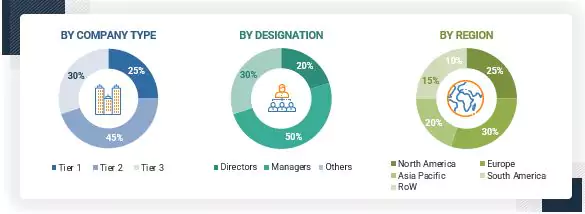
Note: The three tiers of the companies are defined based on their total
revenues in 2022 or 2023, as per the availability of financial data: Tier 1: Revenue > USD 1 billion;
Tier 2: USD 100 million = Revenue = USD 1 billion; Tier 3: Revenue < USD 100 million.
To know about the assumptions considered for the study, download the pdf brochure
|
COMPANY NAME |
DESIGNATION |
|
The Scotts Company LLC (US) |
Sales Manager |
|
Hydrofarm (US) |
Sales Manager |
|
Rise Gardens (US) |
Manager |
|
Gardyn (US) |
Operation Manager |
|
WE Hydroponics (India) |
Marketing Manager |
Market Size Estimation
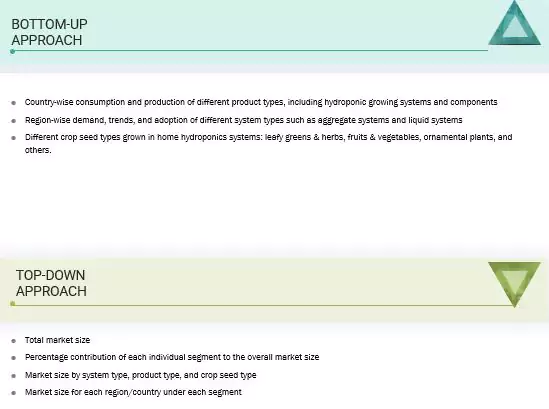
The top-down and bottom-up approaches were used to estimate and validate the total size of the home hydroponics market. These approaches were also used extensively to determine the size of various subsegments in the market. The research methodology used to estimate the market size includes the following details.
- The key players in the industry and the overall markets were identified through extensive secondary research.
- All shares, splits, and breakdowns were determined using secondary sources and verified through primary sources.
- All possible parameters that affect the market covered in this research study were accounted for, viewed in extensive detail, verified through primary research, and analyzed to obtain final quantitative and qualitative data.
- The research included the study of reports, reviews, and newsletters of top market players, along with extensive interviews for opinions from leaders, such as CEOs, directors, and marketing executives.
Home Hydroponics Market : Top-Down and Bottom-Up Approach
Data Triangulation
After determining the overall market size from the estimation process explained above, the total market was split into several segments and subsegments. The data triangulation and market breakdown procedures were employed, wherever applicable, to estimate the overall home hydroponics market and arrive at the exact statistics for all segments and subsegments. The data was triangulated by studying various factors and trends from the demand and supply sides. The market size was also validated using both the top-down and bottom-up approaches.
Market Definition
Home hydroponics refers to a method of growing plants indoors or in residential spaces without soil. It uses nutrient-rich water solutions to deliver essential minerals directly to the plant roots. This technique allows for controlled cultivation of vegetables, herbs, and ornamental plants in compact setups, often enhanced by LED grow lights, automated irrigation systems, and smart monitoring tools.
Stakeholders
- Manufacturers & Suppliers
- Distributors & Retail Channels
- Policy Makers & Regulatory Bodies
- Investors & Venture Capitalists
- Consumers
Report Objectives
- To determine and project the size of the home hydroponics market based on the product type, system type, crop seed type, and regions in terms of value over five years, ranging from 2025 to 2030
- To identify the attractive opportunities in the market by determining the largest and fastest-growing segments across regions
- To provide detailed information about the key factors influencing market growth (drivers, restraints, opportunities, and challenges)
- To analyze the opportunities in the market for stakeholders and provide details of the competitive landscape for market leaders
- To analyze the micromarkets with respect to individual growth trends, prospects, and their contribution to the total market
- To identify and profile the key players in the home hydroponics market
- To understand the competitive landscape and identify the major growth strategies adopted by players across the key regions
Available Customizations
With the given market data, MarketsandMarkets offers customizations according to company-specific scientific needs.
The following customization options are available for the report:
Product Analysis
- Product matrix, which gives a detailed comparison of the product portfolio of each company.
Geographic Analysis as per Feasibility
With the given market data, MarketsandMarkets offers customizations according to company-specific scientific needs.
- Further breakdown of the Rest of Europe home hydroponics market into key countries
- Further breakdown of the Rest of Asia Pacific home hydroponics market into key countries
- Further breakdown of the Rest of South America home hydroponics market into key countries
Company Information
- Detailed analyses and profiling of additional market players (up to five)
Get the Full Home Hydroponics Market Report
Full forecast, segment splits, and company analysis for all Home Hydroponics Market.
- US Home Hydroponics Market
- Canada Home Hydroponics Market
- Mexico Home Hydroponics Market
- France Home Hydroponics Market
- Germany Home Hydroponics Market
- Netherlands Home Hydroponics Market
- UK Home Hydroponics Market
- Spain Home Hydroponics Market
- Italy Home Hydroponics Market
- China Home Hydroponics Market
- Japan Home Hydroponics Market
- India Home Hydroponics Market
- Brazil Home Hydroponics Market
- Argentina Home Hydroponics Market
- Rest Of Europe Home Hydroponics Market
- Rest Of Asia Pacific Home Hydroponics Market
- Rest Of South America Home Hydroponics Market
Need a Tailored Report?
Customize this report to your needs
Get 10% FREE Customization
Customize This Report
