
Germany Hydraulics Market (2025-2030)

The Germany Hydraulics Market was valued at $3434.3 Million in 2025 and projected to reach to $3864.6 Million by 2030, representing a compound annual growth rate of 2.4%. Germany's hydraulics market is poised for steady expansion through 2030, supported by the country's strong manufacturing ecosystem and continued investment in industrial automation.


| Market Size in | USD 26.32 MN |
| Market Forecast in | |
| CAGR | |
| Forecast Period | |
| Units Considered | Value (USD MN) |
Germany Hydraulics Market Trends and Insights
- Germany maintains a significant position within the European hydraulics sector, driven by its robust manufacturing base and advanced industrial infrastructure.
- The market in Germany reflects steady demand from automotive, machinery, and industrial automation sectors that rely on hydraulic systems for precision and reliability. Throughout the forecast period from 2025 to 2030, Germany's hydraulics market is expected to experience moderate but consistent expansion.
- Germany's emphasis on engineering excellence and Industry 4.0 initiatives supports continued investment in hydraulic technologies and system optimization.
- The growth trajectory in Germany aligns with broader European trends while maintaining distinct characteristics shaped by the country's specialized manufacturing capabilities and export-oriented economy..
Key Market Statistics
- CAGR (2025-2030) 2.4% CAGR
- Market Size, 2025 ~USD 3434.3 Million
- Forecast, 2030 ~USD 3864.6 Million
- Country Germany
Germany Hydraulics Market Overview
Market Size & Growth :
Germany's hydraulics market is valued at USD 3,434.3 million in 2025, with projected growth to USD 3,864.6 million by 2030, maintaining a steady CAGR of 2.4% throughout the forecast period.
Manufacturing Excellence :
Germany's robust manufacturing base and advanced industrial infrastructure position it as a key hub for hydraulics innovation, supporting automotive, machinery, and industrial automation sectors.
European Leadership :
Germany maintains a significant position within the European hydraulics sector, leveraging its engineering expertise and established supply chain networks across the continent.
Automotive & Industrial Demand :
Steady demand from automotive manufacturers, industrial equipment producers, and construction machinery sectors drives consistent market growth in Germany's hydraulics landscape.
Germany Hydraulics Market Dynamics
- The market benefits from Germany's leadership in precision engineering and its role as a technology innovator within Europe.
- Key growth drivers include modernization of existing industrial infrastructure, increased adoption of hydraulic systems in renewable energy applications, and sustained demand from the automotive sector.
- The 2.4% CAGR reflects a mature yet resilient market with consistent demand fundamentals.
- Germany's focus on Industry 4.0 and sustainable manufacturing practices will further support market development, positioning the country as a critical market for hydraulics solutions in Europe..
Market Ecosystem
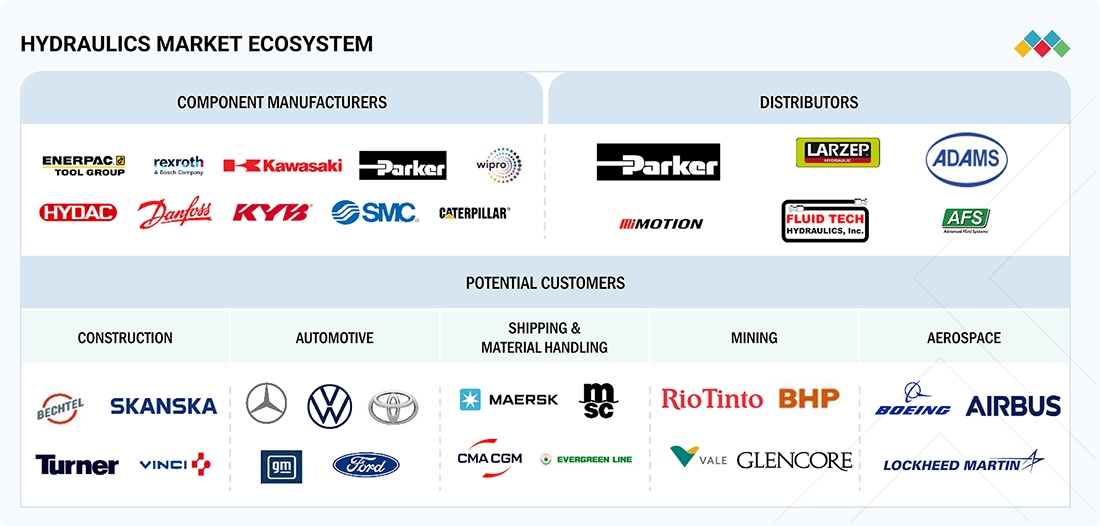
Hydraulics Market Trends: COMMERCIAL USE CASES ACROSS INDUSTRIES
| COMPANY | USE CASE DESCRIPTION | BENEFITS |
|---|---|---|
 |
Bosch Rexroth’s Hägglunds division upgraded Stahl’s hydraulic drive systems with an energy-efficient design and new power units to replace aging components. | Delivered 15% overall energy savings, lowered operating costs, and strengthened sustainability performance. |
 |
Rotec designed a self-contained hydraulic system for a grain ship loader gantry, replacing an obsolete and fire-damaged setup with a high-efficiency containerized solution. | Restored continuous port operations, ensured long-term system reliability, and improved safety standards. |
 |
SMC delivered a custom hydraulic power unit for a seamless-tube production line expansion within a short commissioning timeline. | Enabled on-time start-up, minimized production downtime, and improved system reliability. |
 |
Danfoss supplied over 500 hydraulic systems for Alstom’s high-speed tilting trains to enhance motion control and braking performance. | Increased train stability, reduced maintenance time, and improved operational efficiency. |
 |
Bosch Rexroth modernized an old extrusion press with a high-efficiency pump and control manifold system. | Achieved 14% higher output, reduced energy use, and extended equipment life. |
Logos and trademarks shown above are the property of their respective owners. Their use here is for informational and illustrative purposes only.
Related Ecosystem
Industrial Automation
Key Takeaways
- Germany's hydraulics market is valued at USD 3,434.3 million in 2025 with projected growth to USD 3,864.6 million by 2030.
- Germany maintains a 2.4% CAGR throughout the forecast period, reflecting steady market maturity and consistent industrial demand.
- Germany's advanced manufacturing sector and Industry 4.0 adoption drive sustained investment in hydraulic system technologies.
- Germany's position as a European industrial hub supports both domestic consumption and export opportunities in hydraulics.
Hydraulics Market Report Scope
| Report Metric | Details |
|---|---|
| Base Year | 2025 |
| Fastest Growing Segment | PRESSURE SENSORS (Sensor) |
| Forecast Period | 2025–2030 |
| Growth Rate | CAGR of 2.4% from 2025 to 2030 |
| Largest Segment | MOBILE (Type) |
| Market Size Base Year (Billions) | ~USD 39.31 (2025) |
| Revenue Forecast (Billions) | ~USD 44.26 (2030) |
| Segments Covered | Type, Component, End-Use Industry, Sensor |
Germany Hydraulics Market Report Segmentation
4 segment dimensions are covered across the global market.
By Type
- Industrial
- Mobile
By Component
- Accumulators
- Cylinders
- Filters
- Motors
- Other Components
- Pumps
- Transmissions
- Valves
By End-Use Industry
- Aerospace
- Agriculture
- Automotive
- Construction
- Marine
- Material Handling
- Metal Manufacturing
- Metals Manufacturing
- Mining
- Oil & Gas
- Other End-Use Industries
By Sensor
- Flow Sensors
- Level Sensors
- Position Sensors
- Pressure Sensors
- Temperature Sensors
- Tilt Sensors
Target Audience
- Hydraulics Manufacturers : Manufacturers need Germany-specific market data to assess production capacity requirements, distribution strategies, and competitive positioning within Europe's largest industrial economy.
- Automotive Suppliers : Automotive component suppliers require detailed insights into German market demand to align hydraulics supply chains with OEM requirements and forecast production volumes.
- Industrial Equipment Producers : Equipment manufacturers need Germany market analysis to understand hydraulics integration trends, customer preferences, and growth opportunities in machinery and automation sectors.
- Investment & Private Equity : Investors evaluating German industrial assets need market sizing, growth projections, and sector dynamics to assess acquisition targets and portfolio company performance potential.
- Market Consultants & Analysts : Consultants and research professionals require Germany-specific hydraulics data to support client advisory work, competitive analysis, and strategic planning initiatives.
Key Companies in the Germany Hydraulics Market
| Company | HQ | Ownership | Strongest segments |
|---|---|---|---|
| EATON CORPORATION | Ireland | Public Company | Mobile Hydraulics (construction & agriculture),Industrial Hydraulics,Hydraulic Pumps & Motors, |
| ACTUANT | United States | Public Company | Industrial hydraulics (tools, cylinders, pumps, valves),Hydraulic torque wrenches and bolt tensioners,Heavy lifting technology solutions, |
| DANFOSS | Denmark | Private Company | Mobile hydraulics (pumps, motors, valves, steering units, transmissions),Industrial hydraulics (cylinders, power units, clutches, brakes),Hydraulic valves and actuators, |
| KAWASAKI HEAVY INDUSTRIES, LTD. | Japan | Public Company | Mobile hydraulics,Industrial hydraulics,Hydraulic components aftermarket, |
| KYB CORPORATION | Japan | Public Company | Mobile hydraulics,Industrial hydraulics,Cylinders, |
| PARKER HANNIFIN CORP | United States | Public Company | Mobile hydraulics (construction, agriculture, off-highway),Industrial hydraulics (in-plant, process, energy, HVAC/R-related),Hydraulic components (pumps, valves, motors, cylinders, accumulators, transmissions), |
| ENERPAC TOOL GROUP | United States | Public Company | Industrial hydraulics (cylinders, pumps, valves, torque and lifting systems),Mobile hydraulics-related components (for construction and agriculture equipment),Hydraulic service, rentals, and maintenance solutions, |
| SMC CORPORATION | Japan | Public Company | Industrial hydraulics IT backbone (data-center and cloud servers supporting hydraulic-intensive industries),Mobile hydraulics edge and embedded systems (5G/IoT/Edge platforms on or near equipment),Hydraulic sensor data management and remote system management software, |
| CATERPILLAR | United States | Public Company | Mobile hydraulics – construction equipment,Mobile hydraulics – mining and resource equipment,Industrial hydraulics and transmissions, |
EATON CORPORATION
Eaton Corporation is a diversified power management company headquartered in Ireland, founded in 1911, with approximately 97,303 employees serving electrical, hydraulic, and industrial markets globally.
ACTUANT
Actuant is a publicly traded American company founded in 1910 with 2,100 employees, specializing in industrial tools and hydraulic equipment.
DANFOSS
Danfoss is a privately held Danish engineering company founded in 1933 with 39,360 employees, specializing in climate and energy solutions including hydraulic systems.
KAWASAKI HEAVY INDUSTRIES, LTD.
Kawasaki Heavy Industries, Ltd. is a Japanese public company founded in 1878 with 40,640 employees, operating across aerospace, energy, and industrial equipment sectors including hydraulics.
KYB CORPORATION
KYB Corporation is a publicly traded Japanese company founded in 2019, specializing in hydraulic and suspension systems for automotive and industrial applications.
PARKER HANNIFIN CORP
Parker Hannifin Corp is a publicly traded American manufacturer founded in 1917 with 57,950 employees, providing motion and control technologies including hydraulic systems worldwide.
ENERPAC TOOL GROUP
Enerpac Tool Group is a publicly traded American company founded in 1910 with 2,100 employees, manufacturing hydraulic tools and equipment for industrial applications.
SMC CORPORATION
SMC Corporation is a publicly traded Japanese company founded in 1993 with 6,238 employees, specializing in pneumatic and hydraulic automation equipment.
CATERPILLAR
Caterpillar is a publicly traded American manufacturer founded in 1925 with 118,000 employees, producing construction and mining equipment, engines, and hydraulic systems globally.
Reasons to Buy this Report
- Precise Market Sizing : Access exact market valuations for Germany (USD 3,434.3M in 2025) with detailed forecasts through 2030, enabling accurate budget allocation and investment planning specific to the German market.
- Competitive Intelligence : Understand Germany's position within European hydraulics markets and identify competitive advantages in this key manufacturing hub, critical for market entry and expansion strategies.
- Sector-Specific Insights : Gain detailed analysis of hydraulics demand across German automotive, industrial machinery, and construction sectors, supporting targeted product development and sales strategies.
- Growth Opportunity Assessment : Evaluate the 2.4% CAGR trajectory and identify emerging opportunities in German industrial automation, renewable energy, and Industry 4.0 initiatives through 2030.
- Strategic Decision Support : Make informed decisions on market entry, partnership development, and resource allocation in Germany with comprehensive data on market dynamics and growth drivers.
Frequently asked questions
What is the current size of Germany's hydraulics market in 2025?
Germany's hydraulics market is estimated at USD 3,434.3 million in 2025, reflecting the country's significant industrial and manufacturing base.
What is the projected market size for Germany's hydraulics sector by 2030?
Germany's hydraulics market is forecast to reach USD 3,864.6 million by 2030, representing growth of approximately USD 430.3 million over the five-year period.
What is the CAGR for Germany's hydraulics market from 2025 to 2030?
Germany's hydraulics market is expected to grow at a compound annual growth rate (CAGR) of 2.4% between 2025 and 2030.
Which industries drive demand for hydraulics in Germany?
Germany's hydraulics demand is primarily driven by automotive manufacturing, industrial machinery, construction equipment, and industrial automation sectors that require precision hydraulic systems.
How does Germany's hydraulics market compare to other European markets?
Germany represents a substantial portion of the European hydraulics market due to its advanced manufacturing capabilities, engineering expertise, and strong industrial base across multiple sectors.
RESEARCH METHODOLOGY
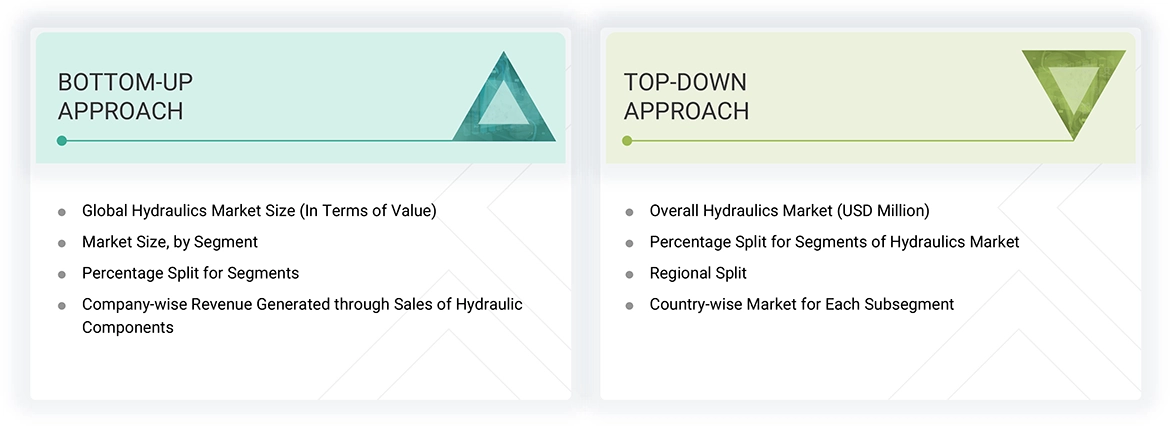
The study involved major activities in estimating the hydraulics market size. Exhaustive secondary research was done to collect information on the market under study. The next step was to validate these findings, assumptions, and sizing from industry experts across the value chain using primary research. Different approaches, such as top-down and bottom-up, were employed to estimate the total market size. After that, the market breakup and data triangulation procedures were followed to estimate the size of the segments and subsegments of the hydraulics market.
Secondary Research
The revenue of companies offering components for hydraulic systems is calculated using secondary data available through paid and unpaid sources, analyzing the product portfolios of the major companies in the ecosystem, and rating them by their performance and quality. Various sources were referred to in the secondary research process to identify and collect information for this study. The secondary sources include annual reports, press releases, investor presentations of companies, white papers, journals, certified publications, and articles from recognized authors, directories, and databases. In the secondary research process, various secondary sources were referred to identify and collect information related to the study. Secondary sources included annual reports, press releases, investor presentations of vendors, forums, certified publications, and whitepapers. The secondary research was used to obtain critical information on the industry's value chain, the total pool of key players, market classification, and segmentation from the market- and technology-oriented perspectives.
Primary Research
Extensive primary research was conducted after understanding and analyzing the current scenario of the hydraulics market through secondary research. Several primary interviews were conducted with the key opinion leaders from the demand and supply sides across four main regions—North America, Europe, Asia Pacific, and Rest of the World. Approximately 30% of the primary interviews were conducted with the demand-side respondents, while approximately 70% were conducted with the supply-side respondents. The primary data was also collected through questionnaires, emails, and telephone interviews.
After interacting with industry experts, brief sessions were conducted with highly experienced independent consultants to reinforce the findings from our primary interview participants. This, along with the in-house subject-matter experts’ opinions, has led us to the findings as described in the remainder of this report. The breakdown of primary respondents is as follows:
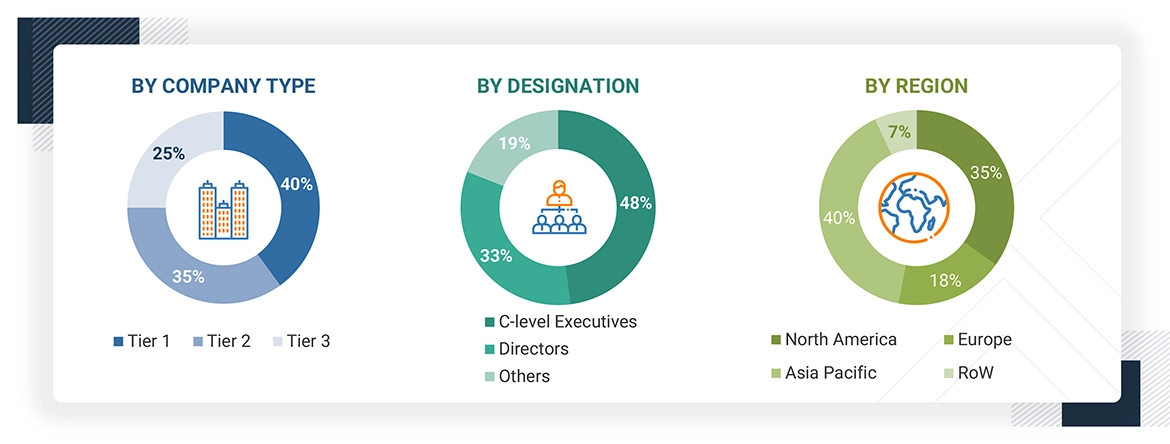
Note: Others include vice presidents, senior managers, project managers, and analysts.
To know about the assumptions considered for the study, download the pdf brochure
Market Size Estimation
Both top-down and bottom-up approaches were used to estimate and validate the total size of the hydraulics market. These methods were also used extensively to estimate the size of various subsegments in the market. The research methodology used to estimate the market size includes the following:
Hydraulics Market : Top-Down and Bottom-Up Approach
Data Triangulation
After arriving at the overall market size using the market size estimation processes explained above, the market was split into several segments and subsegments. Wherever applicable, the data triangulation and market breakdown procedures were employed to complete the overall market engineering process and arrive at the exact statistics of each market segment and subsegment. The data was triangulated by studying various factors and trends from the demand and supply sides.
Market Definition
Hydraulics is a mechanical system utilizing liquid pressure to generate, control, and transmit power. Hydraulic systems use fluid—usually oil or water—to perform tasks such as lifting, pressing, drilling, or moving mechanical components in machinery and equipment. These systems often employ cylinders to move pistons and generate force. They play a pivotal role in multiple industries, including construction, aerospace, and automotive, facilitating efficiency in moving loads. The technology's reliance on liquid power enables the execution of various mechanical actions across industrial and mobile equipment. Hydraulic machinery uses fluid power to generate, control, and transmit force, employing liquids to operate cranes, lifts, and excavators for various industrial applications.
Key Stakeholders
- End-use Industries
- Government bodies, venture capitalists, and private equity firms
- Hydraulic manufacturers
- Hydraulic distributors
- Hydraulic industry associations
- Professional service/solution providers
- Research institutions and organizations
- Standards organizations and regulatory authorities related to the hydraulics market
- System integrators
- Technology consultants
Report Objectives
- To define, describe, and forecast the global hydraulics market, by type, component, sensor, and end-use industries, in terms of value
- To describe and forecast the market for several countries in four main regions—North America, Europe, Asia Pacific, and Rest of the World (RoW), in terms of value
- To provide detailed information regarding drivers, restraints, opportunities, and challenges that influence the market growth
- To strategically analyze micromarkets with respect to individual growth trends, prospects, and contributions to the total market
- To study the complete value chain of the hydraulic ecosystem, along with market trends and use cases
- To study includes US tariff and AI/Gen AI impact analyses, technology trends, average pricing, regulatory landscape, trends/disruptions impacting customer business, and key criteria for buying hydraulic components
- To analyze opportunities for stakeholders by identifying high-growth segments of the global hydraulics market
- To strategically profile key players and comprehensively analyze their core competencies, along with detailing the competitive landscape for market leaders
- To analyze competitive developments, such as product launches, acquisitions, partnerships, and expansions, in the global hydraulics market
- To benchmark market players using the company evaluation matrix, which analyzes players based on various parameters with respect to business categories and product strategies
Available Customizations
With the given market data, MarketsandMarkets offers customizations according to the specific requirements of companies. The following customization options are available for the report:
- Detailed analysis and profiling of additional market players based on various blocks of the value chain.
Get the Full Hydraulics Market Report
Full forecast, segment splits, and company analysis for all Hydraulics Market.
Need a Tailored Report?
Customize this report to your needs
Get 10% FREE Customization
Customize This Report
