
Mexico Hydrogen Detection Market (2025-2030)

The Mexico Hydrogen Detection Market was valued at $2.9 Million in 2025 and projected to reach to $3.7 Million by 2030, representing a compound annual growth rate of 5.3%. Mexico's hydrogen detection market is poised for steady growth driven by expanding industrial safety regulations and the country's increasing role in semiconductor manufacturing.


| Market Size in | USD 26.32 MN |
| Market Forecast in | |
| CAGR | |
| Forecast Period | |
| Units Considered | Value (USD MN) |
Mexico Hydrogen Detection Market Trends and Insights
- Mexico's market growth is driven by increasing adoption of hydrogen detection technologies in industrial safety applications and semiconductor manufacturing processes.
- The country's strategic position in North America and growing investment in clean energy infrastructure are positioning Mexico as an emerging hub for hydrogen-related technologies. During the 2025–2030 forecast period, Mexico is expected to experience steady demand for hydrogen detection solutions across petrochemical facilities, refineries, and electronics manufacturing sectors.
- Mexico's participation in regional supply chains and rising regulatory focus on workplace safety standards are key factors supporting market expansion.
- The hydrogen detection market in Mexico reflects broader North American trends toward energy transition and industrial automation, though at a more measured growth pace compared to global benchmarks..
Key Market Statistics
- CAGR (2025-2030) 5.3% CAGR
- Market Size, 2025 ~USD 2.9 Million
- Forecast, 2030 ~USD 3.7 Million
- Country Mexico
Mexico Hydrogen Detection Market Overview
Market Size & Growth :
Mexico's hydrogen detection market is valued at USD 2.9 million in 2025, with projected growth to USD 3.7 million by 2030, representing a CAGR of 5.3% during the forecast period.
Industrial Safety Adoption :
Increasing implementation of hydrogen detection technologies in Mexican industrial facilities and manufacturing plants is driving market expansion, particularly in safety-critical applications.
Semiconductor Manufacturing Growth :
Mexico's growing semiconductor manufacturing sector is adopting advanced hydrogen detection systems to ensure process safety and compliance with international quality standards.
North American Strategic Position :
Mexico's geographic proximity to the United States and integration into North American supply chains positions it as a key market for hydrogen detection technology adoption and regional distribution.
Mexico Hydrogen Detection Market Dynamics
- The market's 5.3% CAGR reflects growing awareness of hydrogen safety hazards across manufacturing and industrial sectors.
- Investment in infrastructure modernization and compliance with North American safety standards will continue to fuel demand for detection technologies.
- As Mexico strengthens its position in the regional electronics supply chain, hydrogen detection adoption is expected to accelerate, particularly in semiconductor fabrication facilities and chemical processing plants..
Market Ecosystem
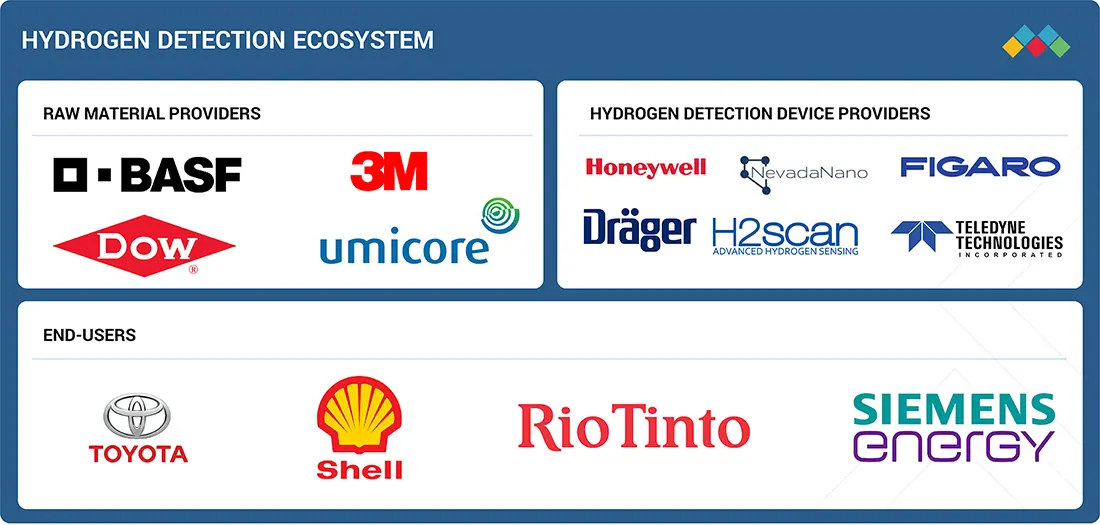
Hydrogen Detection Market: COMMERCIAL USE CASES ACROSS INDUSTRIES
| COMPANY | USE CASE DESCRIPTION | BENEFITS |
|---|---|---|
 |
Deployment of hydrogen leak detectors across fuel cell vehicle R&D labs and production lines, as well as in after-sales service centers. | Enables early leak detection| Improves worker and vehicle safety| Reduces downtime| Ensures compliance with safety regulations |
 |
Installation of hydrogen detection systems at refueling stations and hydrogen hubs to monitor storage tanks, pipelines, and dispensers. | Enhances operational safety| Reduces accident risks| iIproves public confidence in hydrogen refuelling infrastructure| Ensures regulatory compliance |
 |
Integration of advanced hydrogen detection technologies in production plants, storage facilities, and distribution terminals. | Prevents product losses| Enhances asset protection| Supports safe large-scale hydrogen handling| Improves profitability |
 |
Use of hydrogen detection solutions in maintenance depots and refuelling facilities for hydrogen-powered trains in Europe. | Enables safe depot operations| Reduces risk of fire/explosions| Ensures smooth train operations| Supports sustainable rail transport |
 |
Application of cryogenic hydrogen leak detectors at launch pads, storage tanks, and fueling systems for space missions. | Provides real-time monitoring| Prevents catastrophic failures| Improves crew safety| Ensures mission success |
Logos and trademarks shown above are the property of their respective owners. Their use here is for informational and illustrative purposes only.
Related Ecosystem
Sensors And Control
- Sensors
- Image Sensors
- Temperature Sensors
- Pressure Sensors
- Flow Sensors
- BAUMER ELECTRIC AG
- HONEYWELL INTERNATIONAL INC.
- Lenovo
- Stmicroelectronics
- Texas Instruments Incorporated
Key Takeaways
- Mexico's hydrogen detection market is valued at USD 2.9 million in 2025 and will reach USD 3.7 million by 2030.
- Mexico is experiencing a 5.3% CAGR, reflecting steady but moderate growth compared to global expansion rates.
- Mexico's industrial safety regulations and petrochemical sector are primary drivers of hydrogen detection adoption.
- Mexico's position within North American supply chains creates opportunities for regional market integration and technology transfer.
Hydrogen Detection Market Report Scope
| Report Metric | Details |
|---|---|
| Base Year | 2025 |
| Fastest Growing Segment | AUTOMOTIVE & TRANSPORTATION (Application) |
| Forecast Period | 2025–2030 |
| Growth Rate | CAGR of 11.8% from 2025 to 2030 |
| Largest Segment | FIXED (Implementation Type) |
| Market Size Base Year (Billions) | ~USD 0.29 (2025) |
| Revenue Forecast (Billions) | ~USD 0.5 (2030) |
| Segments Covered | Sensor Technology, Application, Implementation Type, Detection Range, Process Stage, Technology |
Mexico Hydrogen Detection Market Report Segmentation
6 segment dimensions are covered across the global market.
By Sensor Technology
- Catalytic
- Electrochemical
- MEMS
- Mos
- Thermal Conductivity
By Application
- Automotive & Transportation
- Chemical
- Energy & Power
- Metal & Mining
- Metals & Mining
- Oil & Gas
- Other Applications
By Implementation Type
- Fixed
- Portable
By Detection Range
- 0–1,000 Ppm
- 0–20,000 Ppm
- 0–5,000 Ppm
- >0–20,000 Ppm
By Process Stage
- Generation
- Storage
- Transportation
- Usage
By Technology
- Catalytic
- Electrochemical
- MEMS
- Mos
- Thermal Conductivity
Target Audience
- Semiconductor Manufacturers : Mexican and multinational semiconductor companies require detailed market data to assess hydrogen detection technology adoption rates and plan safety system upgrades for manufacturing facilities.
- Industrial Safety Equipment Providers : Hydrogen detection equipment manufacturers and safety solution providers need market intelligence to identify growth opportunities and develop localized product offerings for Mexico.
- Chemical & Processing Industries : Industrial plants and chemical processing facilities in Mexico require market insights to understand hydrogen detection technology trends and compliance requirements specific to their operations.
- Business Development & Strategy Teams : Corporate strategists and business development professionals need comprehensive market analysis to evaluate Mexico as a target market and plan regional expansion initiatives.
- Investment & Consulting Firms : Private equity firms, management consultants, and investment advisors require detailed market data to support due diligence, valuation, and strategic recommendations for Mexico-focused opportunities.
Key Companies in the Mexico Hydrogen Detection Market
| Company | HQ | Ownership | Strongest segments |
|---|---|---|---|
| TELEDYNE TECHNOLOGIES INCORPORATED | United States | Public Company | Digital Imaging (visible, IR, X-ray, multispectral systems),Instrumentation (monitoring, test, connectivity),Aerospace and Defense Electronics, |
| HONEYWELL INTERNATIONAL INC. | United States | Public Company | Industrial Automation,Building Automation,Energy and Sustainability Solutions (UOP and related), |
| H2SCAN | United States | Private Company | Transformer and power grid hydrogen monitoring,Industrial process and refinery hydrogen sensing,Hydrogen infrastructure and emerging energy applications, |
| DRäGERWERK AG & CO. KGAA | Germany | Public Company | Medical ventilators and lung monitoring,Anaesthesia machines and perioperative solutions,Patient monitoring and IT connectivity, |
| MSA SAFETY INCORPORATED | United States | Public Company | Breathing apparatus and air-purifying respirators,Fixed gas and flame detection systems,Portable gas detection instruments, |
| BOSCH SENSORTEC GMBH | Germany | Subsidiary | Motion sensors (accelerometers, gyroscopes, IMUs),Environmental sensors (pressure, humidity, gas, air quality),Smart sensor hubs and integrated AI platforms, |
| MEMBRAPOR | Switzerland | Private Company | Toxic gas electrochemical sensors,Oxygen sensors,Combustible gas sensors, |
TELEDYNE TECHNOLOGIES INCORPORATED
Teledyne Technologies Incorporated is a publicly traded U.S. company founded in 1960 with 15,800 employees. The company operates across multiple business segments serving diverse industrial and commercial markets.
HONEYWELL INTERNATIONAL INC.
Honeywell International Inc. is a publicly traded multinational corporation founded in 1885 with 101,000 employees. The company is a diversified technology and manufacturing conglomerate serving aerospace, building technologies, and industrial sectors.
H2SCAN
H2Scan is a private U.S. company founded in 2002 that operates in the hydrogen sensing and detection technology sector.
DRäGERWERK AG & CO. KGAA
Drägerwerk AG & Co. KGaA is a publicly traded German company founded in 1889 with 16,033 employees. The company is a global leader in medical and safety technology solutions.
MSA SAFETY INCORPORATED
MSA Safety Incorporated is a publicly traded U.S. company founded in 1914 with 5,300 employees. The company specializes in safety equipment and protective solutions for industrial and professional markets.
BOSCH SENSORTEC GMBH
Bosch Sensortec GmbH is a German subsidiary founded in 2005 operating in sensor technology and MEMS solutions.
MEMBRAPOR
Membrapor is a private Swiss company founded in 1995 specializing in sensor and membrane technology.
Reasons to Buy this Report
- Market Entry Strategy : Gain detailed insights into Mexico's hydrogen detection market dynamics to develop targeted market entry strategies and identify key growth opportunities in this emerging segment.
- Competitive Landscape Analysis : Understand the competitive positioning of hydrogen detection providers in Mexico, including local players and international competitors, to inform business development decisions.
- Regulatory & Compliance Insights : Access comprehensive information on Mexican industrial safety regulations and semiconductor manufacturing standards driving hydrogen detection adoption and technology requirements.
- Investment & Expansion Planning : Utilize market forecasts and growth projections to evaluate investment opportunities and plan facility expansions or partnerships in Mexico's hydrogen detection sector.
- Supply Chain Optimization : Identify distribution channels, supplier networks, and partnership opportunities specific to Mexico to optimize supply chain operations and market penetration strategies.
Frequently asked questions
What is the current size of Mexico's hydrogen detection market?
Mexico's hydrogen detection market is estimated at USD 2.9 million in 2025, based on verified market data for the Semiconductor & Electronics industry.
What is the projected market size for Mexico by 2030?
Mexico's hydrogen detection market is forecast to reach USD 3.7 million by 2030, representing growth from the 2025 baseline.
What is Mexico's hydrogen detection market CAGR?
Mexico's hydrogen detection market is growing at a compound annual growth rate (CAGR) of 5.3% between 2025 and 2030.
Which industries drive hydrogen detection demand in Mexico?
Mexico's primary demand drivers include petrochemical facilities, oil refineries, semiconductor manufacturing, and industrial safety applications requiring hydrogen leak detection.
How does Mexico's market growth compare to global trends?
Mexico's 5.3% CAGR is more moderate than the global hydrogen detection market CAGR of 11.8%, reflecting Mexico's emerging market status and gradual industrial adoption.
RESEARCH METHODOLOGY
The research study involved four major activities in estimating the size of the hydrogen detection market. Exhaustive secondary research has been done to collect important information about the market and peer markets. The next step has been to validate these findings, assumptions, and sizing with the help of primary research with industry experts across the value chain. Both top-down and bottom-up approaches have been used to estimate the market size. Post which the market breakdown and data triangulation have been adopted to estimate the market sizes of segments and sub-segments.
Secondary Research
In the secondary research process, various secondary sources were referred to identify and collect information required for this study. The secondary sources include annual reports, press releases, investor presentations of companies, white papers, and articles from recognized authors. Secondary research has been mainly done to obtain key information about the market’s value chain, the pool of key market players, market segmentation according to industry trends, regional outlook, and developments from both market and technology perspectives.
In the hydrogen detection market report, the global market size has been estimated using both top-down and bottom-up approaches and several other dependent submarkets. The major players in the market were identified using extensive secondary research, and their presence in the market was determined using secondary and primary research. All the percentage shares splits, and breakdowns have been determined using secondary sources and verified through primary sources.
Primary Research
After understanding the hydrogen detection market scenario through secondary research, extensive primary research has been conducted. Several primary interviews have been conducted with key opinion leaders from demand- and supply-side vendors across four major regions—North America, Europe, Asia Pacific, and the RoW. Approximately 25% of the primary interviews have been conducted with the demand-side vendors and 75% with the supply-side vendors. Primary data was collected mainly through telephonic interviews, which comprised 80% of the total primary interviews; questionnaires and emails were also used to collect the data.
After successful interaction with industry experts, brief sessions were conducted with highly experienced independent consultants to reinforce our primary research findings. This, along with the in-house subject matter experts’ opinions, has led us to the findings as described in the report.
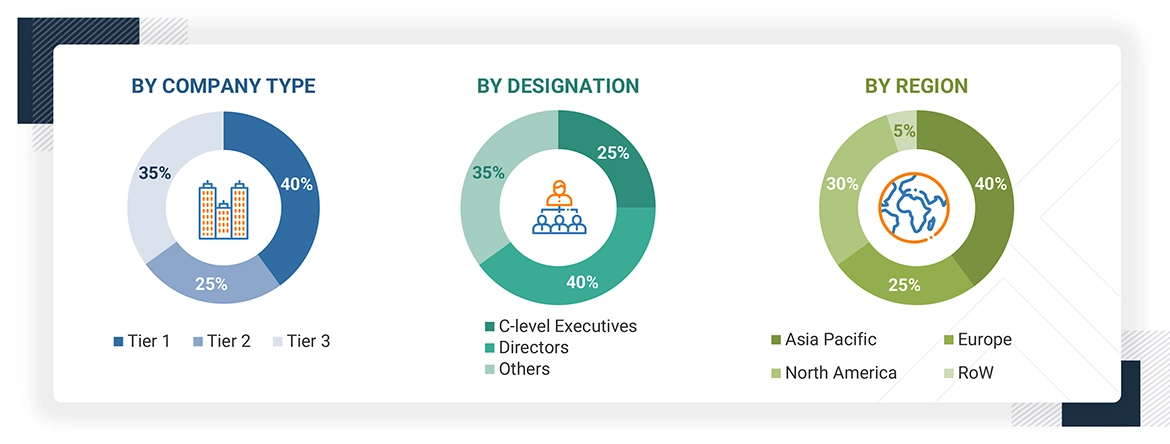
Note: “Others” includes sales, marketing, and product managers
To know about the assumptions considered for the study, download the pdf brochure
Market Size Estimation
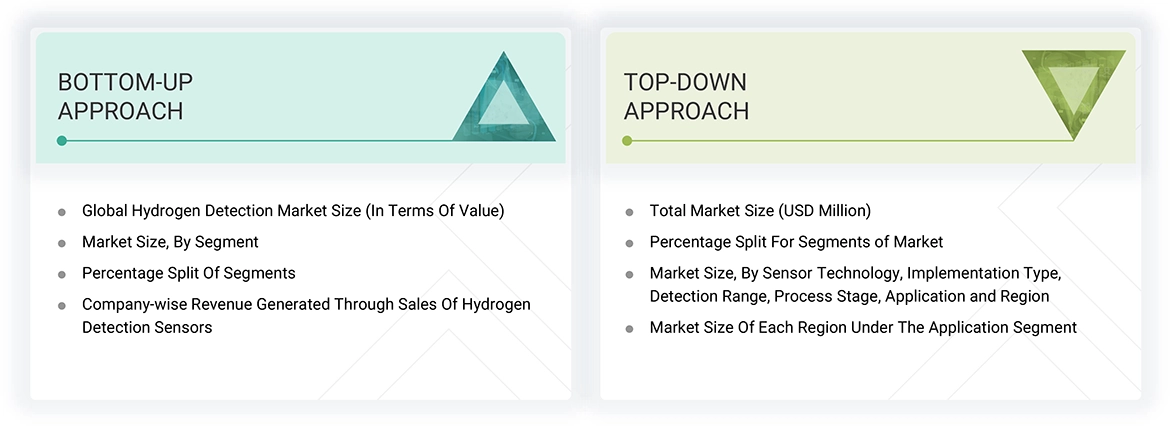
In the market engineering process, both top-down and bottom-up approaches and data triangulation methods have been used to estimate and validate the size of the hydrogen detection market and other dependent submarkets. The research methodology used to estimate the market sizes includes the following:
- Identifying top-line investments and spending in the ecosystem, and considering segment-level splits and major market developments
- Identifying different stakeholders in the hydrogen detection market that influence the entire market, along with participants across the supply chain
- Analyzing major manufacturers in the hydrogen detection market and studying their product portfolio
- Analyzing trends related to the adoption of hydrogen detection products
- Tracking recent and upcoming market developments, including investments, R&D activities, product launches, expansions, acquisitions, partnerships, collaborations, agreements, and investments, as well as forecasting the market size based on these developments and other critical parameters
- Carrying out multiple discussions with key opinion leaders to identify the adoption trends of hydrogen sensors
- Segmenting the overall market into various other market segments
- Validating the estimates at every level through discussions with key opinion leaders, such as chief executives (CXOs), directors, and operations managers, and finally with the domain experts at MarketsandMarkets
Hydrogen Detection Market : Top-Down and Bottom-Up Approach
Data Triangulation
After arriving at the overall market size by the market size estimation process explained in the earlier section, the overall hydrogen detection market has been divided into several segments and subsegments. The data triangulation and market breakdown procedures have been used to complete the overall market engineering process and arrive at the exact statistics for all segments, wherever applicable. The data has been triangulated by studying various factors and trends from both the demand and supply side perspectives. Along with data triangulation and market breakdown, the market has been validated by top-down and bottom-up approaches.
Market Definition
Hydrogen detection refers to the process of detecting the presence or concentration of hydrogen gas as a fuel, as well as non-fuel (inclusive gas or as an ingredient) in the environment. Hydrogen is an odorless and colorless gas, making it difficult to detect with conventional sensing technologies alone. Hydrogen above a certain concentration level is explosive and can cause potential hazards; hence, precise detection of hydrogen becomes a key task in different industrial settings. Various hydrogen detection methods and technologies have been developed to accurately identify and quantify the presence of hydrogen. Several hydrogen detection technologies include electrochemical, catalytic, metal-oxide-semiconductors (MOS), micro-electromechanical systems (MEMS), and thermal conductivity.
The hydrogen detection market is segmented based on sensor technology, implementation type, detection range, process stage, application, and region. The market comprises electrochemical, catalytic, metal-oxide-semiconductor (MOS), thermal conductivity, and micro-electromechanical systems (MEMS) by sensor technology. Each sensor type offers unique advantages, such as fast response time, high sensitivity, and cost-efficiency, making them suitable for various industrial requirements. In terms of implementation type, hydrogen detectors are available as fixed and portable systems, with fixed systems deployed in industrial plants and portable units used for field inspections or emergency response. The market is also categorized by detection range, including 0–1,000 ppm, 0–5,000 ppm, 0–20,000 ppm, and beyond 20,000 ppm, based on the safety threshold and detection needs of different environments. The hydrogen lifecycle is addressed across four process stages: generation, storage, transportation, and usage, each requiring real-time leak monitoring and safety assurance. Key application areas include oil & gas, automotive & transportation, chemicals, metals & mining, power & energy, and other sectors such as semiconductors, food & beverage, and medical industries. Each segment demands tailored detection technologies to meet compliance, safety, and operational efficiency standards.
Key Stakeholders
- Original Equipment Manufacturers (OEMs)
- Industrial Machinery Manufacturers
- Industrial Chemical Manufacturers
- Hydrogen Detection Equipment Manufacturers and Vendors
- Components Suppliers
- Hydrogen Detection Equipment Distributors and Traders
- Research Organizations and Consulting Companies
- Government Bodies, Regulating Authorities, and Policymakers
- Venture Capitalists, Private Equity Firms, and Startup Companies
- Forums, Alliances, and Associations Related to Sensing Equipment
- Governments and Financial Institutions
- Analysts and Strategic Business Planners
- Existing End Users and Prospective Ones
Report Objectives
- To describe and forecast the hydrogen detection market size, in terms of value, based on sensor technology, implementation type, detection range, process stage and application
- To assess the hydrogen detection market size, in terms of value, with respect to four main regions, namely, North America, Europe, Asia Pacific, and Rest of the World (RoW)
- To provide detailed information regarding drivers, restraints, opportunities, and challenges influencing the growth of the hydrogen detection market
- To give a detailed overview of the supply chain of the hydrogen detection market ecosystem
- To strategically analyze the ecosystem, porter’s five forces, key stakeholders & buying criteria, technology analysis, key conferences & events, tariffs and regulations, patent landscape, trade landscape, and case studies pertaining to the market under study
- To estimate impact of AI/Gen AI, impact of 2025 US tariff on the hydrogen detection market.
- To strategically analyze micromarkets with respect to individual growth trends, prospects, and contributions to the overall market
- To study opportunities in the market for various stakeholders by identifying the high-growth segments of the market
- To benchmark the market players using the proprietary company evaluation matrix framework, which analyzes the market players on various parameters within the broad categories of market ranking/share and product portfolio
- To strategically profile the key players and comprehensively analyze their market positions in terms of ranking and core competencies, along with a detailed competitive landscape of the market.
- To analyze competitive developments such as acquisitions, product launches, partnerships, expansions, and collaborations undertaken in the hydrogen detection market
Available customizations:
With the given market data, MarketsandMarkets offers customizations according to the specific requirements of companies. The following customization options are available for the report:
Country-wise Information:
- Country-wise breakdown for North America, Europe, Asia Pacific, and Rest of the World
Company Information:
- Detailed analysis and profiling of additional market players (up to five)
Get the Full Hydrogen Detection Market Report
Full forecast, segment splits, and company analysis for all Hydrogen Detection Market.
Need a Tailored Report?
Customize this report to your needs
Get 10% FREE Customization
Customize This Report
