
Canada Hydrogen Truck Market (2031-2036)

The Canada Hydrogen Truck Market was valued at $339 Million in 2031 and projected to reach to $713 Million by 2036, representing a compound annual growth rate of CAGR 20.4%. The hydrogen truck market is experiencing accelerated growth as the automotive industry transitions toward zero-emission transportation solutions.


| Market Size in | USD 26.32 MN |
| Market Forecast in | |
| CAGR | |
| Forecast Period | |
| Units Considered | Value (USD MN) |
Canada Hydrogen Truck Market Trends and Insights
- This represents a compound annual growth rate of 20.4%, significantly outpacing global trends and reflecting Canada's strategic commitment to zero-emission transportation solutions.
- Canada's abundant hydroelectric and renewable energy resources position the nation as a leader in hydrogen production and adoption across the commercial trucking sector. The expansion of Canada's hydrogen truck market is driven by federal and provincial incentives, stringent emissions regulations, and growing investment in hydrogen refueling infrastructure.
- Canada's logistics and transportation industry is increasingly transitioning to hydrogen fuel cell technology to meet sustainability targets and reduce operational costs.
- By 2036, Canada is expected to capture a substantial share of North American hydrogen truck adoption, supported by major fleet operators and OEM partnerships establishing hydrogen corridors across key trade routes. Canada's competitive advantage in clean hydrogen production, combined with supportive policy frameworks and private sector momentum, positions the country as a critical hub for hydrogen truck innovation and deployment in North America through 2036..
Key Market Statistics
- CAGR (2031-2036) CAGR 20.4%
- Market Size, 2031 ~USD 339 Million
- Forecast, 2036 ~USD 713 Million
- Country Canada
Canada Hydrogen Truck Market Overview
Strong Market Growth :
The hydrogen truck market is projected to grow from 5.78 billion in 2031 to 10.8 billion by 2038, representing a robust CAGR of 16.9% during the forecast period.
Europe Leads Adoption :
Europe emerges as the fastest-growing region with a CAGR of 16.7%, driven by stringent emissions regulations and significant investments in hydrogen infrastructure.
Diverse Segment Coverage :
The market encompasses multiple segments including motor power, range capabilities, hydrogen tank sizes, tank types, and various vehicle classifications for comprehensive market analysis.
Range Expansion Focus :
Market segmentation by range (up to 300 miles and 300-500 miles) reflects growing demand for long-haul hydrogen-powered transportation solutions.
Canada Hydrogen Truck Market Dynamics
- Increasing regulatory pressure, declining fuel cell costs, and expanding hydrogen refueling infrastructure are key drivers propelling market expansion.
- Major manufacturers are investing heavily in hydrogen truck development, with commercial deployments increasing across Europe and North America.
- The forecast period through 2038 will witness significant technological advancements in fuel cell efficiency and hydrogen storage capacity. Regional variations in market growth reflect differing policy frameworks and infrastructure investments.
- Europe's leadership position is supported by EU climate targets and hydrogen strategy initiatives.
- Asia Pacific and North America are rapidly catching up with substantial government incentives and private sector commitments.
- The market's evolution will be shaped by supply chain development, cost competitiveness with battery electric vehicles, and the establishment of comprehensive hydrogen distribution networks globally..
Market Ecosystem
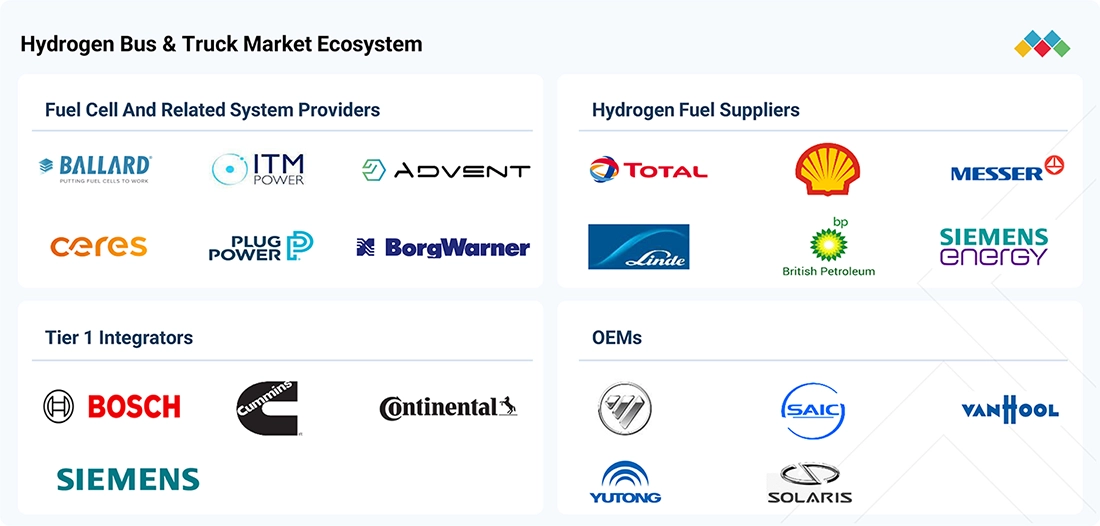
HYDROGEN BUS & TRUCK MARKET: COMMERCIAL USE CASES ACROSS INDUSTRIES
| COMPANY | USE CASE DESCRIPTION | BENEFITS |
|---|---|---|
 |
Foton applies hydrogen fuel cell technology to heavy-duty logistics, with its Auman hydrogen trucks being deployed for zero-carbon freight operations and its new CAVAN BEACON platform targeting medium- and long-haul transport. | Foton's hydrogen truck platforms provide more than 1,000 km of range in the CAVAN BEACON configuration, addressing range and refueling constraints in long-distance commercial trucking. |
 |
Yutong applies hydrogen fuel cell buses to scheduled urban public transport, including commercial operation in Zhengzhou, while extending fuel cell technology into new energy commercial vehicle platforms. | Its low hydrogen consumption, long fuel cell durability, and continuous hydrogen and electrical safety monitoring support lower operating energy use and reliable fleet availability. |
 |
King Long uses hydrogen fuel cell buses for urban public transport and has also developed hydrogen vehicles for highway coaches, heavy tractors, dump trucks, and logistics applications. | Its fuel cell and battery hybrid architecture, rapid hydrogen refueling and real time hydrogen safety monitoring enable longer duty cycles with reduced operational interruptions. |
 |
Solaris deploys Urbino 12 and Urbino 18 hydrogen buses on urban and high capacity public transport routes, with the articulated Urbino 18 designed for high passenger volumes and longer routes. | Hydrogen enables Solaris buses to combine zero tailpipe emissions with up to 600 km range in the Urbino 18 and rapid refueling, supporting intensive routes where battery charging downtime can be restrictive. |
 |
Hyundai uses XCIENT Fuel Cell trucks for heavy-duty freight, port transportation, and medium-distance logistics, while its ELEC CITY Fuel Cell serves urban passenger transport. | Hyundai's fuel cell platforms provide long operating ranges with fast hydrogen refueling, enabling high utilization of heavy trucks and buses without tailpipe emissions. |
Logos and trademarks shown above are the property of their respective owners. Their use here is for informational and illustrative purposes only.
Related Ecosystem
On Highway Off Highway Vehicles
- Internal Combustion Engine (ICE)
- Agricultural Tractors
- Crawler Excavator
- Battery Electric Vehicle (BEV)
- Excavators
- Visteon Corporation
- Deere & Company
- AB VOLVO PENTA
- Honda Motor Co., Ltd.
- Komatsu Ltd.
Key Takeaways
- Canada's hydrogen truck market will more than double from $339.0M (2031) to $713.0M (2036), growing at 20.4% CAGR.
- Canada's renewable energy infrastructure and federal hydrogen strategy create a competitive advantage for hydrogen truck adoption.
- Canada's logistics sector is rapidly deploying hydrogen fuel cell trucks to meet emissions targets and operational efficiency goals.
- Canada is positioned as North America's leading hydrogen truck hub, with expanding refueling infrastructure and OEM partnerships.
Hydrogen Truck Market Report Scope
| Report Metric | Details |
|---|---|
| Base Year | 2031 |
| Fastest Growing Segment | ABOVE 500 MILES (Range) |
| Forecast Period | 2031-2036 |
| Growth Rate | CAGR of 16.9% from 2031 to 2036 |
| Largest Segment | TYPE IV (Type Of Tank) |
| Market Size Base Year (Billions) | ~USD 5.78 (2031) |
| Revenue Forecast (Billions) | ~USD 12.63 (2036) |
| Segments Covered | Motor Power, Range, Hydrogen Tank Size, Type Of Tank, Vehicle Type |
Canada Hydrogen Truck Market Report Segmentation
5 segment dimensions are covered across the global market.
By Motor Power
- 200-400 Kw
- Above 400 Kw
- Up To 200 Kw
By Range
- 300-500 Miles
- Above 500 Miles
- Up To 300 Miles
By Hydrogen Tank Size
- 30-60 Kg
- < 30 Kg
- > 60 Kg
By Type Of Tank
- Type Iii
- Type Iv
By Vehicle Type
- Hydrogen Buses
- Hydrogen Trucks
Target Audience
- Automotive Manufacturers : Develop hydrogen truck strategies, assess market potential, and plan product launches aligned with regional demand and regulatory requirements.
- Fleet Operators & Logistics Companies : Evaluate hydrogen truck adoption feasibility, understand total cost of ownership, and plan fleet transition strategies for sustainable operations.
- Energy & Infrastructure Providers : Identify hydrogen refueling infrastructure investment opportunities and understand demand patterns across geographies and vehicle segments.
- Investment & Financial Analysts : Assess market growth potential, identify investment opportunities, and evaluate the hydrogen truck sector's role in sustainable transportation portfolios.
- Government & Policy Makers : Understand market trends, assess policy effectiveness, and develop informed regulations and incentive programs supporting hydrogen vehicle adoption.
Reasons to Buy this Report
- Comprehensive Market Sizing : Access detailed market valuation data from 2031 to 2038 with precise CAGR calculations, enabling accurate financial forecasting and investment planning.
- Segment-Level Insights : Analyze five key market segments including motor power, range, tank specifications, and vehicle types to identify growth opportunities and market dynamics.
- Geographic Intelligence : Understand regional performance across global markets, North America, Europe, and Asia Pacific with specific growth rates to guide regional expansion strategies.
- Competitive Positioning : Benchmark your organization against market trends and identify emerging opportunities in the fastest-growing segments and regions.
- Strategic Decision Support : Make informed business decisions regarding product development, market entry, partnerships, and resource allocation based on comprehensive market research.
Frequently asked questions
What is the current size of Canada's hydrogen truck market?
Canada's hydrogen truck market was valued at $339.0 million in 2031 and is projected to grow to $713.0 million by 2036.
What is the growth rate of Canada's hydrogen truck market?
Canada's hydrogen truck market is growing at a compound annual growth rate (CAGR) of 20.4% from 2031 to 2036.
Why is Canada's hydrogen truck market growing faster than the global average?
Canada benefits from abundant renewable energy resources, supportive federal and provincial policies, and strategic investments in hydrogen infrastructure that accelerate truck fleet electrification.
What are the main drivers of hydrogen truck adoption in Canada?
Key drivers include emissions regulations, federal hydrogen strategy incentives, logistics industry sustainability commitments, and expanding hydrogen refueling networks across Canada.
Which regions in Canada are leading hydrogen truck deployment?
Canada's major trade corridors, including routes between major cities and cross-border logistics hubs, are prioritizing hydrogen truck infrastructure and fleet deployment.
RESEARCH METHODOLOGY
The study involved four major activities in estimating the current size of the hydrogen bus & truck market. Exhaustive secondary research was done to collect information on the market, the peer market, and the parent market. The next step was to validate these findings, assumptions, and sizing with industry experts across value chains through primary research. The top-down and bottom-up approaches were employed to estimate the complete market size. Thereafter, market breakdown and data triangulation processes were used to estimate the market size of segments and subsegments.
Secondary Research
Secondary sources referred to for this research study included hydrogen bus & truck industry organizations; corporate filings such as annual reports, investor presentations, and financial statements; trade and business whitepapers and databases; and articles from recognized associations and government publishing sources. The secondary data was collected and analyzed to arrive at the overall market size, which was further validated by primary research.
Primary Research
Extensive primary research was conducted after acquiring an understanding of this market scenario through secondary research. Several primary interviews were conducted with market experts from the demand- and supply-side OEMs (in terms of component supply, country-level government associations, and trade associations) and component manufacturers across four major regions, namely, Asia Pacific, Europe, and North America. Approximately 25% and 75% of primary interviews were conducted with the demand and supply sides, respectively. Primary data was collected through questionnaires, emails, LinkedIn, and telephonic interviews. In the canvassing of primary data, various departments within organizations, such as sales, operations, and administration, were covered to provide a holistic viewpoint in the report.
Brief sessions with highly experienced independent consultants were conducted to reinforce findings from primaries after interacting with industry experts. This, along with in-house subject matter experts’ opinions, led to the findings described in the remainder of this report.
In the primary research process, various primary sources from the supply and demand sides were interviewed to obtain qualitative and quantitative information for the report. The primary sources from the supply side included industry experts, such as Vice Presidents (VPs), marketing directors, technology and innovation directors, and related key executives from various key companies and organizations. The primary sources from the demand side included end users, such as Chief Information Officers (CIOs), consultants, service professionals, technicians and technologists, and managers at public and investor-owned utilities.
Breakdown of Primary Interviews
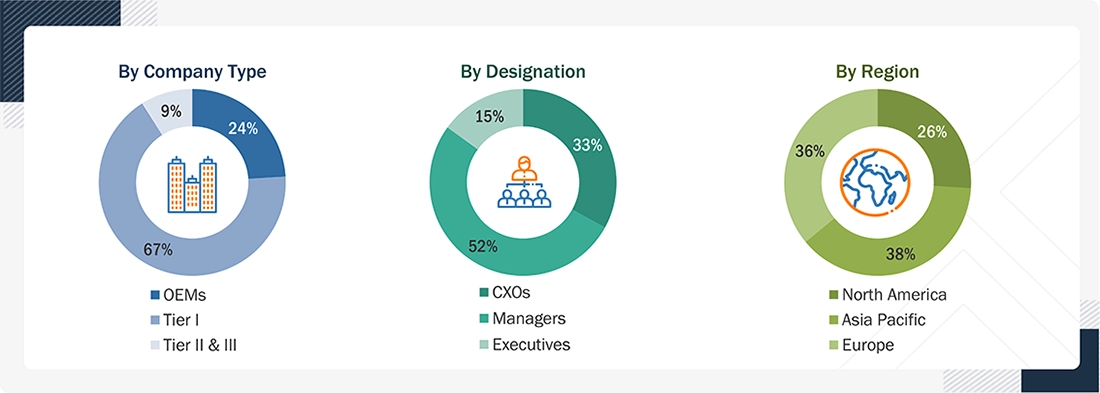
Note: Others include purchase and sales managers, marketing managers, and product managers.
To know about the assumptions considered for the study, download the pdf brochure
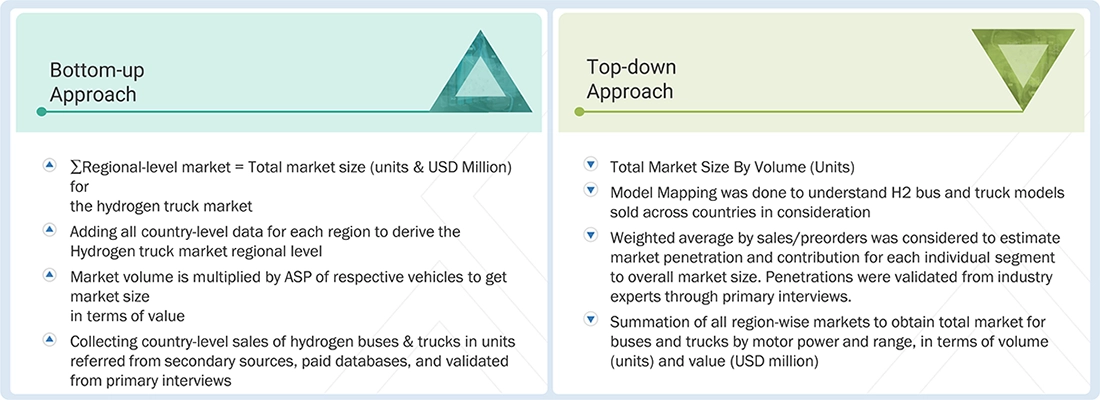
Market Size Estimation
- Bottom-up Approach
The bottom-up approach was used to estimate and validate the size of the hydrogen bus & truck market. In this approach, the vehicle sales statistics for each vehicle type (buses and trucks) were considered at a country level. A model mapping of fuel cell vehicles was carried out for each country and vehicle type to determine the market size in terms of volume. The number of FCEV models varied from country to country. After analyzing the models, the segments were classified further into power output type, component, and region. From the model mapping, the market penetration of the automotive fuel cell segments was multiplied by the country-level FCEV sales considered in the study, giving the volume of each segment type. The country-level data were summed up to arrive at the region-level data in terms of volume. The summation of the country-level market sizes gave the regional market size, and further summation provided the global hydrogen bus & truck market size.
- Top-Down Approach
The top-down approach was used to estimate and validate the size of the hydrogen bus & truck market at the global level by range, motor power, tank type, and hydrogen tank size, in terms of volume. This approach identifies key range, motor power, tank type, and hydrogen tank size segments of the hydrogen bus & truck market at the regional level. The penetration of each identified segment was multiplied by the volume of each vehicle at the regional level to derive the total segment volume.
The hydrogen bus & truck market for tank types was derived using a top-down approach to estimate the subsegments, namely type III and type IV tanks. This method derived the market size, in terms of volume, at the regional level for each segment. The total volume of the hydrogen bus & truck market was multiplied by the adoption rate break-up percentage of these segments at the regional level (range, motor power, hydrogen tank size, tank type, fuel cell type).
Data Triangulation
After arriving at the overall market size using the market size estimation processes as explained above, the market was split into several segments and subsegments. To complete the overall market engineering process and arrive at the exact statistics of each market segment and subsegment, data triangulation and market breakdown procedures were employed, wherever applicable. The data were triangulated by studying various factors and trends from both the demand and supply sides.
Market Definition
Hydrogen buses and trucks are medium and heavy-duty vehicles powered by hydrogen fuel cells. A hydrogen fuel cell generates electricity through a chemical reaction between hydrogen and oxygen, which powers the vehicle’s electric motor. Hydrogen buses & trucks offer zero-emission transportation, helping to reduce air pollution in urban areas. These buses can be quickly refueled and provide a range comparable to or better than traditional diesel buses. Hydrogen buses are used for long-haul and short-distance commercial and passenger travel. Hydrogen trucks are designed for various applications, such as long-haul transportation, construction, and delivery services. They provide the benefits of zero emissions and can be refueled quickly.
Key Stakeholders
- Automobile OEMs
- Automotive fuel cell raw material suppliers
- Automotive fuel cell suppliers
- Environmental Protection Agency (EPA)
- Government departments
- Hydrogen gas suppliers
- Hydrogen station service providers
- Industry associations
- Transit agencies
Report Objectives
- To analyze and forecast the hydrogen bus & truck market in terms of value (USD million) and volume (thousand units) from 2026 to 2035
- To segment the market by vehicle type, motor power, range, hydrogen tank size, type of tank, and region
- To provide detailed information about the factors influencing market growth (drivers, challenges, restraints, and opportunities)
- To strategically analyze the market for individual growth trends, prospects, and contributions to the total market
- To study the following with respect to the market:
- Value Chain Analysis
- Ecosystem Analysis
- Technology Analysis
- Trade Analysis
- Pricing Analysis
- Case Study Analysis
- Patent Analysis
- Tariff and Regulatory Landscape
- Key Stakeholders and Buying Criteria
- MNM Insights on key OEMs
- Hydrogen Refueling Station Setup Trends, By Region
- Hydrogen Commercial Vehicles’ Fuel Capacity and Range
- Country-Level Targets of Hydrogen Buses/Trucks and Refueling Stations
- H2ICE Buses & Trucks
- Total Cost of Ownership Comparison of ICE and FCEV Buses and Trucks
- Bill of Material Comparison Between FCEVs, ICE Vehicles, and BEVs
- OEMs Vs. Existing and Upcoming Hydrogen Vehicle Models
- Regulatory Landscape
- Key Conferences and Events
- Investment and Funding Scenario
- To strategically profile the key players and comprehensively analyze their market share and core competencies
- To analyze the opportunities for stakeholders and the competitive landscape for market leaders
- To track and analyze competitive developments, such as deals, product launches/developments, expansions, and other activities undertaken by the key industry participants
Available customizations:
With the given market data, MarketsandMarkets offers customizations in line with company-specific needs.
- Hydrogen bus & truck market, by vehicle class at the regional level
- Hydrogen bus & truck market in additional countries (up to three)
- Profiling of additional market players (up to five)
Get the Full Hydrogen Truck Market Report
Full forecast, segment splits, and company analysis for all Hydrogen Truck Market.
- China Hydrogen Truck Market
- Japan Hydrogen Truck Market
- South Korea Hydrogen Truck Market
- India Hydrogen Truck Market
- France Hydrogen Truck Market
- Germany Hydrogen Truck Market
- Italy Hydrogen Truck Market
- Spain Hydrogen Truck Market
- UK Hydrogen Truck Market
- US Hydrogen Truck Market
- Asia Pacific Hydrogen Truck Market
- Europe Hydrogen Truck Market
- North America Hydrogen Truck Market
Need a Tailored Report?
Customize this report to your needs
Get 10% FREE Customization
Customize This Report
