
Canada Incident and Emergency Management Market (2024-2029)

The Canada Incident and Emergency Management Market was valued at $10178.7 Million in 2024 and projected to reach to $14274.7 Million by 2029, representing a compound annual growth rate of 5.8%. Canada's Incident and Emergency Management Market is experiencing robust growth fueled by heightened awareness of operational resilience and disaster preparedness across all governance levels.


| Market Size in | USD 26.32 MN |
| Market Forecast in | |
| CAGR | |
| Forecast Period | |
| Units Considered | Value (USD MN) |
Canada Incident and Emergency Management Market Trends and Insights
- This growth trajectory reflects Canada's increasing investment in digital infrastructure and regulatory compliance frameworks across federal, provincial, and municipal levels.
- Canada's market expansion is driven by heightened demand for integrated emergency response systems, cloud-based incident management platforms, and real-time communication solutions that address the country's diverse geographic and operational challenges. The Canadian market benefits from strong government initiatives, including investments in critical infrastructure protection and disaster resilience programs.
- Canada's emphasis on cybersecurity integration within emergency management systems and adoption of artificial intelligence-powered predictive analytics are key differentiators.
- Organizations across Canada are prioritizing interoperability standards and cross-jurisdictional coordination capabilities, positioning Canada as a mature market with sophisticated end-user requirements and sustained technology investment..
Key Market Statistics
- CAGR (2024-2029) 5.8% CAGR
- Market Size, 2024 ~USD 10178.7 Million
- Forecast, 2029 ~USD 14274.7 Million
- Country Canada
Canada Incident and Emergency Management Market Overview
Market Valuation :
Canada's Incident and Emergency Management Market is valued at $10,178.7 million in 2024, with strong growth momentum driven by federal and provincial digital transformation initiatives.
Regulatory Compliance Drivers :
Increasing regulatory requirements across federal, provincial, and municipal levels are compelling Canadian organizations to invest in comprehensive incident and emergency management solutions.
Digital Infrastructure Investment :
Canada's commitment to modernizing critical infrastructure and cybersecurity frameworks is accelerating adoption of advanced incident management technologies across public and private sectors.
Growth Trajectory :
The Canadian market is projected to reach $14,274.7 million by 2029, representing a 5.8% CAGR, outpacing global growth trends and reflecting regional market maturity.
Canada Incident and Emergency Management Market Dynamics
- Federal agencies, provincial governments, and municipalities are prioritizing investments in integrated emergency response systems, cybersecurity incident management, and business continuity solutions.
- The market benefits from Canada's stringent regulatory environment and increasing frequency of climate-related emergencies requiring sophisticated management capabilities. Looking ahead to 2029, the Canadian market will be shaped by cloud-based incident management platforms, artificial intelligence-driven predictive analytics, and cross-jurisdictional collaboration frameworks.
- Public-private partnerships and shared services models are expected to drive adoption among smaller municipalities and organizations.
- Continued investment in critical infrastructure protection and pandemic preparedness will sustain market expansion at a steady 5.8% CAGR through the forecast period..
Market Ecosystem
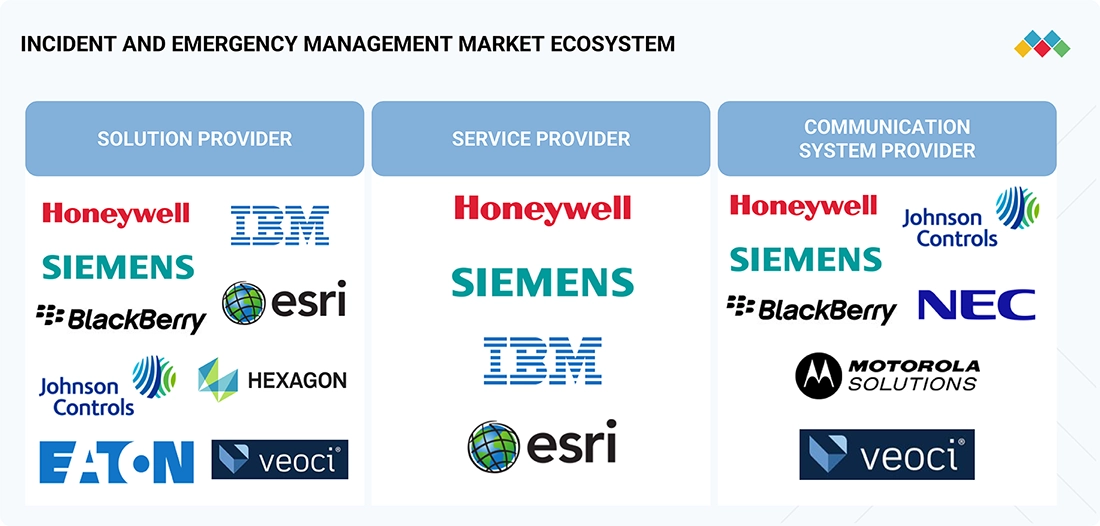
incident and emergency management market: COMMERCIAL USE CASES ACROSS INDUSTRIES
| COMPANY | USE CASE DESCRIPTION | BENEFITS |
|---|---|---|
 |
Deploys integrated command-and-control platforms that fuse satellite imagery, geospatial analytics, and real-time sensor data to support rapid situational awareness and coordinated emergency response for defense and civil agencies | Enhances decision-making speed, improves incident detection accuracy, and enables faster resource mobilization in disaster or crisis situations |
 |
Provides intelligent building management systems integrated with emergency evacuation protocols, fire detection, and real-time alerts across facilities to protect occupants during critical events | Improves occupant safety, streamlines emergency response operations, and reduces potential loss of life and property during emergencies |
 |
Offers mission-critical communications networks, computer-aided dispatch (CAD), and body-worn cameras that support first responders in coordinating actions and tracking incidents in real time | Ensures uninterrupted communication during crises, accelerates emergency response times, and improves situational visibility for responders |
 |
Delivers industrial-grade gas detection, hazardous material monitoring, and building-integrated life safety systems to manage risks in chemical plants, airports, and urban infrastructure | Minimizes environmental hazards, safeguards personnel and assets, and ensures compliance with safety standards during emergencies |
 |
Develops secure aviation communication and surveillance systems for emergency air traffic management, enabling rapid rerouting and coordination in the event of natural disasters or security threats | Enhances operational continuity, improves the safety of passengers and crew, and supports coordinated disaster relief logistics in aviation environments |
Logos and trademarks shown above are the property of their respective owners. Their use here is for informational and illustrative purposes only.
Related Ecosystem
Application Security
- Cloud Security
- Security Analytics
- Network Testing
- Web Application Security
- Biometric Security and Authentication System
- International Business Machines Corporation
- MICROSOFT CORPORATION
- Cisco Systems, Inc.
- PALO ALTO NETWORKS, INC
- Fortinet, Inc.
Cyber Security
- Cloud Security
- Biometric Systems
- Multi-Factor Authentication
- Security Analytics
- Data Loss Prevention (DLP)
- International Business Machines Corporation
- Cisco Systems, Inc.
- MITSUI BUSSAN SECURE DIRECTIONS INC
- MICROSOFT CORPORATION
- Allot Ltd.
Endpoint Security
- Cloud Security
- Security Analytics
- Multi-Factor Authentication
- Biometric Security and Authentication System
- Critical Communication Network
- International Business Machines Corporation
- MICROSOFT CORPORATION
- Cisco Systems, Inc.
- PALO ALTO NETWORKS, INC
- Fortinet, Inc.
Key Takeaways
- Canada's Incident and Emergency Management Market will grow from $10.18B (2024) to $14.27B (2029) at a 5.8% CAGR.
- Canada's market is driven by government mandates for critical infrastructure protection and multi-jurisdictional emergency coordination.
- Cloud-based platforms and AI-powered analytics are accelerating adoption across Canada's public and private sectors.
- Canada's regulatory environment and geographic diversity create sustained demand for integrated, interoperable emergency management solutions.
Incident and Emergency Management Market Report Scope
| Report Metric | Details |
|---|---|
| Base Year | 2024 |
| Fastest Growing Segment | TRAINING AND SIMULATION SERVICES (Service) |
| Forecast Period | 2024–2029 |
| Growth Rate | CAGR of 6.1% from 2024 to 2029 |
| Largest Segment | SOLUTIONS (Offering) |
| Market Size Base Year (Billions) | ~USD 137.53 (2024) |
| Revenue Forecast (Billions) | ~USD 184.92 (2029) |
| Segments Covered | Offering, Solution, Service, Communication Tools And Devices, Vertical, Communication Tool And Device |
Canada Incident and Emergency Management Market Report Segmentation
6 segment dimensions are covered across the global market.
By Offering
- Communication Tools And Devices
- Services
- Solutions
By Solution
- Disaster Recovery And Business Continuity Solution
- Emergency/Mass Notification System
- Fire And Hazmat Solution
- Geospatial Solution
- Other Solutions
- Perimeter Intrusion Detection Solution
- Web-Based Emergency Management System
By Service
- Consulting Services
- Eoc Design And Integration Services
- Support And Maintenance Services
- Training And Simulation Services
By Communication Tools And Devices
- Emergency Response Radars
- First Responder Tools
- Satellite-Assisted Equipment
- Vehicle-Ready Gateways
By Vertical
- Defense & Military
- Energy & Utilities
- Government & Public Sector
- Healthcare & Life Sciences
- It & Telecom
- Manufacturing
- Other Verticals
- Real Estate & Construction
- Transportation & Logistics
By Communication Tool And Device
- Emergency Response Radars
- First Responder Tools
- Satellite-Assisted Equipment
- Vehicle-Ready Gateways
CANADA: INCIDENT AND EMERGENCY MANAGEMENT, BY VERTICAL, 2024–2030
| Segment | 2024 | 2025 | 2026 | 2027 | 2028 | 2029 | 2030 | CAGR (%) |
|---|---|---|---|---|---|---|---|---|
| DEFENSE & MILITARY | 1636.7 | 1725 | 1816.4 | 1910.9 | 2008.5 | 2109.1 | 2212.6 | 5.2 |
| ENERGY & UTILITIES | 1437.4 | 1564.9 | 1702.1 | 1849.6 | 2004.7 | 2170.2 | 2345.8 | 8.5 |
| GOVERNMENT & PUBLIC SECTOR | 1952.2 | 2057.8 | 2167.1 | 2280.1 | 2396.7 | 2517 | 2640.8 | 5.2 |
| HEALTHCARE & LIFE SCIENCES | 1412.7 | 1507 | 1606.2 | 1710.4 | 1819.4 | 1933.6 | 2052.9 | 6.4 |
| IT & TELECOM | 763.1 | 790.9 | 819 | 847.3 | 874.6 | 901.6 | 928.1 | 3.3 |
| MANUFACTURING | 728.3 | 784.3 | 843.9 | 907.1 | 974.2 | 1045.3 | 1120.6 | 7.4 |
| OTHER VERTICALS | 1101.5 | 1140.4 | 1176.6 | 1209.8 | 1244.2 | 1276 | 1305.7 | 2.9 |
| REAL ESTATE & CONSTRUCTION | 741.6 | 785.8 | 831.8 | 879.8 | 929.6 | 981.3 | 1034.9 | 5.7 |
| TRANSPORTATION & LOGISTICS | 405.3 | 437.9 | 472.6 | 509.6 | 548.5 | 589.8 | 633.4 | 7.7 |
| TOTAL | 10178.7 | 10794 | 11435.8 | 12104.6 | 12800.5 | 13523.9 | 14274.7 | 5.8 |
Target Audience
- Government & Public Sector Agencies : Federal, provincial, and municipal government bodies need Canada-specific market intelligence to optimize emergency management budgets, evaluate vendor solutions, and ensure regulatory compliance across jurisdictions.
- Enterprise IT & Security Leaders : CIOs and security executives in Canadian organizations require market insights to benchmark incident management capabilities, justify technology investments, and align with national cybersecurity standards.
- Solution Vendors & Technology Providers : Incident management software vendors and service providers need Canadian market data to identify growth opportunities, understand competitive landscape, and develop region-specific go-to-market strategies.
- Management Consulting Firms : Consultants advising Canadian clients on digital transformation and operational resilience require detailed market analysis to support strategic recommendations and business case development.
- Investment & Private Equity Firms : Investors evaluating opportunities in Canada's emergency management sector need market sizing, growth forecasts, and trend analysis to assess portfolio companies and identify acquisition targets.
Key Companies in the Canada Incident and Emergency Management Market
| Company | HQ | Ownership | Strongest segments |
|---|---|---|---|
| KUDELSKI GROUP | Switzerland | Public Company | Core Digital Security (CAS/DRM, middleware, digital TV solutions, IP licensing),Cybersecurity (advisory, resale, managed security services),Internet of Things (IoT security and related services), |
| ENGHOUSE INTERACTIVE | United States | Private Company | Omnichannel Contact Center Platforms,Telecommunications Technology Applications,EnghouseAI and CX Automation, |
| WNS GLOBAL SERVICES | India | Private Company | Finance & Accounting (F&A) BPM,Customer Experience and Voice/Omnichannel Services,Research, Analytics, and Data-led Services, |
| ATOS SE | France | Public Company | Infrastructure & Cloud Managed Services,Digital Workplace & Business Process Services,Business & Platform Integration / Consulting, |
| ALLOT COMMUNICATIONS LTD. | Israel | Public Company | Allot Secure (NetworkSecure, HomeSecure, DNSecure, IoTSecure, EndpointSecure, BusinessSecure, Secure Cloud, NPaaS),AllotSmart (Smart5G, SmartVisibility, SmartTraffic QoE, SmartPCC, SmartSentinel),DDoS Secure, NetProtect, 5GNetProtect and network protection solutions, |
| ZENSAR TECHNOLOGIES LTD | India | Public Company | Digital and Application Services,Cloud Infrastructure and Security,Brand, Creative, and Marketing/Insights, |
| LOCKHEED MARTIN | United States | Public Company | Aeronautics,Missiles and Fire Control,Rotary and Mission Systems, |
| JOHNSON CONTROLS | Ireland | Public Company | HVAC equipment and controls,Building management and digital solutions,Fire detection and suppression, |
| MOTOROLA SOLUTIONS | United States | Public Company | Mission-Critical Networks, Radios, and Infrastructure,Video Security and Access Control,Command Center and Unified Communications Software, |
| HONEYWELL | United States | Public Company | Industrial Automation (control, sensing, smart energy, PPE, software and analytics),Building Automation (building control software, energy management, security, fire, services),Energy and Sustainability Solutions / UOP (licensed process technology, catalysts, low-carbon energy), |
| COLLINS AEROSPACE | United States | Private Company | Commercial Systems (avionics and cabin management),Interior Systems,Government Systems, |
| AT&T | United States | Public Company | U.S. Wireless Service (postpaid, prepaid, Cricket, AT&T PREPAID),U.S. Wireline Broadband & Fiber (AT&T Fiber, AT&T Internet Air),Enterprise & Wholesale (Dedicated Internet, VPN, Ethernet, managed services), |
| EATON | Ireland | Public Company | Electrical components, power distribution and assemblies,Power quality, connectivity, and circuit protection,Hazardous duty, emergency lighting, and safety systems, |
| IBM | United States | Public Company | Software (Hybrid Cloud & AI Platforms),Consulting (Strategy, Technology, Managed Services),Infrastructure (Servers, Storage, Hybrid Cloud Infrastructure Services), |
| HEXAGON AB | Sweden | Public Company | Geosystems and Digital Realities (surveying, mapping, AEC, monitoring),Manufacturing Intelligence (metrology, CAD/CAM, CAE, QA software),Autonomous Solutions and Positioning (GNSS, machine control, autonomy), |
| NEC | Japan | Public Company | Systems Integration, Outsourcing, and DX Consulting,Network Infrastructure (Core, RAN, Optical, Submarine, Netcracker),Enterprise IT Platforms (Cloud, Servers, HPC, Middleware, ERP/PLM/Management Tools), |
| SIEMENS | Germany | Public Company | Digital Industries (automation, control, PLM, simulation),Smart Infrastructure (electrification, buildings, grid solutions),Mobility (rail systems, automation, services), |
| BAE SYSTEMS | United Kingdom | Public Company | Electronic Systems,Air,Maritime, |
| EVERBRIDGE | United States | Private Company | Core Critical Event Management Platform & Mass Notification,Risk Intelligence & Traveler Risk Management,Safety Compliance, Lone Worker & e911 Solutions, |
| DEKRA | Germany | Private Company | Vehicle inspection, appraisals, and driving assessments,Industrial inspection, NDT, and asset integrity,Product testing and certification, |
KUDELSKI GROUP
KUDELSKI GROUP is a Swiss public company founded in 1951 with 110 employees, operating in the technology and security sectors.
ENGHOUSE INTERACTIVE
ENGHOUSE INTERACTIVE is a United States-based private company founded in 1984 with 243 employees, specializing in interactive software solutions.
WNS GLOBAL SERVICES
WNS GLOBAL SERVICES is an Indian private company founded in 1998 with 66,085 employees, providing business process management and IT services.
ATOS SE
ATOS SE is a French public company founded in 1997, operating in the technology and IT services sector.
ALLOT COMMUNICATIONS LTD.
ALLOT COMMUNICATIONS LTD. is an Israeli public company founded in 1996 with 362 employees, specializing in network intelligence and cybersecurity solutions.
ZENSAR TECHNOLOGIES LTD
ZENSAR TECHNOLOGIES LTD is an Indian public company founded in 1963 with 10,066 employees, providing IT services and digital transformation solutions.
LOCKHEED MARTIN
LOCKHEED MARTIN is a United States-based public company founded in 1912 with 123,000 employees, specializing in aerospace, defense, and security solutions.
JOHNSON CONTROLS
JOHNSON CONTROLS is an Ireland-based public company founded in 1885 with 87,000 employees, providing building efficiency and energy management solutions.
MOTOROLA SOLUTIONS
MOTOROLA SOLUTIONS is a United States-based public company founded in 1928 with 23,000 employees, specializing in communications and enterprise mobility solutions.
HONEYWELL
HONEYWELL is a United States-based public company founded in 1885 with 101,000 employees, operating in aerospace, building technologies, and industrial automation.
COLLINS AEROSPACE
COLLINS AEROSPACE is a United States-based private company founded in 1933 with 31,200 employees, providing aerospace systems and components.
AT&T
AT&T is a United States-based public company founded in 1983 with 133,030 employees, operating as a major telecommunications and media company.
EATON
EATON is an Ireland-based public company founded in 1911 with 97,303 employees, specializing in electrical and industrial power management solutions.
IBM
IBM is a United States-based public company founded in 1911 with 264,300 employees, providing IT services, cloud computing, and enterprise solutions.
HEXAGON AB
HEXAGON AB is a Swedish public company founded in 1975 with 16,118 employees, specializing in digital solutions and sensor technologies.
NEC
NEC is a Japanese public company founded in 1899 with 101,800 employees, operating in IT services, telecommunications, and electronics.
SIEMENS
SIEMENS is a German public company founded in 1847 with 310,312 employees, operating in electrification, automation, and digitalization across multiple industries.
BAE SYSTEMS
BAE SYSTEMS is a United Kingdom-based public company founded in 1979 with 111,400 employees, specializing in defense, aerospace, and security solutions.
EVERBRIDGE
EVERBRIDGE is a United States-based private company founded in 2002 with 1,577 employees, providing critical event management and enterprise resilience software.
DEKRA
DEKRA is a German private company founded in 1925 with 47,803 employees, specializing in testing, inspection, and certification services.
Reasons to Buy this Report
- Regional Market Sizing : Obtain precise market valuation data specific to Canada ($10.2B in 2024) with detailed forecasts through 2029, enabling accurate budget allocation and investment planning for Canadian operations.
- Regulatory Landscape Intelligence : Understand federal, provincial, and municipal compliance requirements driving market growth, helping organizations align incident management strategies with Canada's evolving regulatory frameworks.
- Competitive Positioning : Identify market dynamics, vendor strategies, and adoption patterns unique to Canada's public and private sectors, enabling informed competitive differentiation and market entry strategies.
- Growth Opportunity Assessment : Leverage 5.8% CAGR insights to identify high-growth segments within Canada's market, from municipal emergency services to enterprise cybersecurity incident management.
- Strategic Decision Support : Access Canada-specific market trends, investment drivers, and technology adoption patterns to support executive decision-making for market expansion, partnerships, and product development.
Frequently asked questions
What is the current size of Canada's Incident and Emergency Management Market?
Canada's Incident and Emergency Management Market is valued at $10,178.7 million in 2024.
What is the projected market size for Canada by 2029?
Canada's Incident and Emergency Management Market is forecast to reach $14,274.7 million by 2029.
What is the CAGR for Canada's Incident and Emergency Management Market?
Canada's Incident and Emergency Management Market is expected to grow at a compound annual growth rate of 5.8% from 2024 to 2029.
What are the primary drivers of growth in Canada's market?
Growth in Canada's market is driven by government investments in critical infrastructure protection, demand for cloud-based platforms, AI-powered analytics adoption, and multi-jurisdictional coordination requirements.
How does Canada's market compare to global trends?
Canada's 5.8% CAGR is slightly below the global average of 6.1%, reflecting Canada's mature market status with sophisticated infrastructure and regulatory frameworks already in place.
RESEARCH METHODOLOGY
Secondary research was conducted to collect information useful for this technical, market-oriented, and commercial study of the global incident and emergency management market. The next step was to validate these findings, assumptions, and sizing with industry experts across the value chain using primary research. Different approaches, such as top-down and bottom-up, were employed to estimate the total market size. After that, the market breakup and data triangulation procedures were used to estimate the market size of the segments and subsegments of the incident and emergency management market.
Secondary Research
In the secondary research process, various secondary sources were referred to identify and collect information related to the study. Secondary sources included Federal Emergency Management Agency (FEMA), annual reports, press releases, investor presentations of incident and emergency management vendors, forums, certified publications, and whitepapers. The secondary research was used to obtain critical information on the industry's value chain, the total pool of key players, market classification, and segmentation from the market and technology-oriented perspectives.
Primary Research
In the primary research process, various primary sources from the supply and demand sides of the incident and emergency management market were interviewed to obtain qualitative and quantitative information. The primary sources from the supply side included industry experts, such as Chief Executive Officers (CEOs), Vice Presidents (VPs), marketing directors, technology and innovation directors, and related key executives of various vendors providing incident and emergency management solutions and services, associated service providers, and system integrators operating in the targeted regions. All possible parameters that affect the market covered in this research study have been accounted for, viewed in extensive detail, verified through primary research, and analyzed to obtain the final quantitative and qualitative data.
After the complete market engineering process (including calculations for market statistics, market breakups, market size estimations, market forecasting, and data triangulation), extensive primary research was conducted to gather information and verify and validate the critical numbers arrived at. The primary research helped identify and validate the segmentation types, industry trends, key players, a competitive landscape of incident and emergency management solutions and services offered by several market vendors, and fundamental market dynamics, such as drivers, restraints, opportunities, challenges, industry trends, and key strategies.
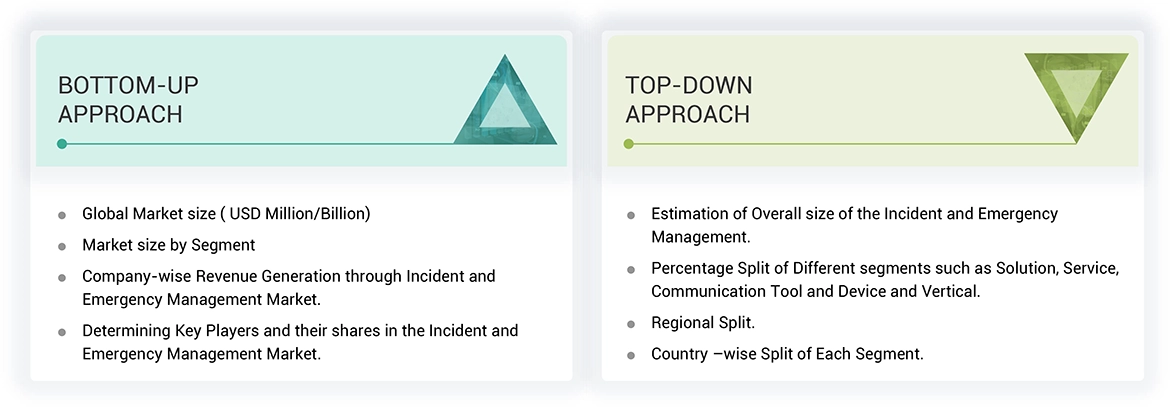
In the complete market engineering process, the bottom-up and top-down approaches and several data triangulation methods were extensively used to estimate and forecast the overall market segments and subsegments listed in this report. An extensive qualitative and quantitative analysis was performed on the complete market engineering process to list the key information/insights throughout the report.
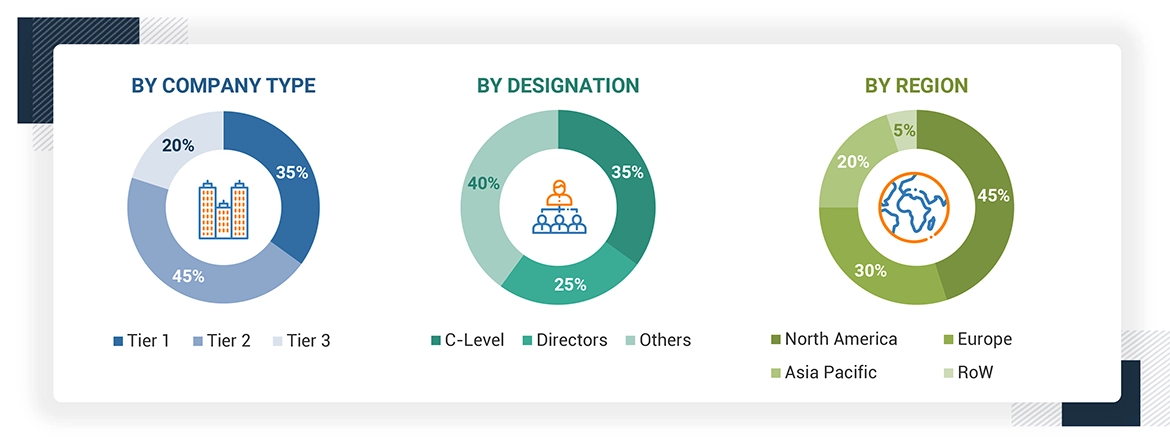
Note: Other levels include sales, marketing, and product managers.
Tier 1 companies receive revenues higher than USD 10 billion; Tier 2 companies' revenues range between USD 1 and 10 billion;
and Tier 3 companies' revenues range between USD 500 million and USD 1 billion.
Source: Industry Experts
To know about the assumptions considered for the study, download the pdf brochure
Market Size Estimation
Top-down and bottom-up approaches were used to estimate and validate the size of the incident and emergency management market and the size of various dependent sub-segments in the overall incident and emergency management market. The research methodology used to estimate the market size includes the following details: critical players in the market were identified through secondary research, and their market shares in the respective regions were determined through primary and secondary research. This entire procedure included the study of the annual and financial reports of the top market players, and extensive interviews were conducted for key insights from the industry leaders, such as CEOs, VPs, directors, and marketing executives.
All percentage splits and breakdowns were determined using secondary sources and verified through primary sources. All possible parameters that affect the market covered in this research study have been accounted for, viewed in extensive detail, verified through primary research, and analyzed to get the final quantitative and qualitative data. This data is consolidated and added to detailed inputs and analysis from MarketsandMarkets.
Incident and Emergency Management Market : Top-Down and Bottom-Up Approach
Data Triangulation
The market was split into several segments and subsegments after arriving at the overall market size using the market size estimation processes explained above. The data triangulation and market breakup procedures were employed, wherever applicable, to complete the overall market engineering process and arrive at the exact statistics of each market segment and subsegment. The data was triangulated by studying various factors and trends from both the demand and supply sides.
Market Definition
According to MarketsandMarkets, an incident and emergency management plan helps organizations, officers, and responders to prepare and act for any kind of disaster/emergency caused by earthquakes, hurricanes, epidemics, explosions, floods, terrorist attacks, and other devastating events. The incident and emergency management solutions ensure the preparation, response, recovery, and mitigation of daily incidents, emergencies, and disasters. The solution ensures proper management of incidents along with situational awareness during emergency response and recovery phases.
Stakeholders
- Information Technology (IT) Professionals
- Government Agencies
- Investors and Venture Capitalists
- Small and Medium-sized Enterprises (SMEs) and Large Enterprises
- Managed and Professional Service Providers
- Incident and Emergency Management Vendors
- Independent Software Vendors
- Consultants/Consultancies/Advisory Firms
- System Integrators
- Third-party Providers
- Value-added Resellers (VARs)
- Project Managers
- Business Analysts
Report Objectives
- To define, describe, and forecast the incident and emergency management market by component, solution, service, communication tool and device, simulation, vertical, and region
- To provide detailed information about the major factors (drivers, opportunities, restraints, and challenges) influencing the growth of the market
- To analyze the opportunities in the market for stakeholders by identifying the high-growth segments of the market
- To forecast the size of the market segments with respect to five main regions: North America, Europe, Asia Pacific, Middle East & Africa, and Latin America
- To analyze the subsegments of the market with respect to individual growth trends, prospects, and contributions to the overall market
- To profile the key players of the market and comprehensively analyze their market size and core competencies
- To track and analyze competitive developments, such as product launches/enhancements, acquisitions, and partnerships and collaborations, in the market.
Available Customizations
With the given market data, MarketsandMarkets offers customizations based on company-specific needs. The following customization options are available for the report:
Geographic Analysis
- Further breakup of the Asia Pacific market into countries contributes to the rest of the regional market size.
- Further breakup of the North American market into countries contributes to the rest of the regional market size.
- Further breakup of the Latin American market into countries contributing to the rest of the regional market size
- Further breakup of the Middle East & African market into countries contributing to the rest of the regional market size
- Further breakup of the European market into countries contributes to the rest of the regional market size
Company Information
- Detailed analysis and profiling of additional market players (up to 5)
Get the Full Incident and Emergency Management Market Report
Full forecast, segment splits, and company analysis for all Incident and Emergency Management Market.
- US Incident and Emergency Management Market
- UK Incident and Emergency Management Market
- Germany Incident and Emergency Management Market
- France Incident and Emergency Management Market
- Italy Incident and Emergency Management Market
- China Incident and Emergency Management Market
- Japan Incident and Emergency Management Market
- India Incident and Emergency Management Market
- UAE Incident and Emergency Management Market
- South Africa Incident and Emergency Management Market
- Brazil Incident and Emergency Management Market
- Mexico Incident and Emergency Management Market
- Rest Of Europe Incident and Emergency Management Market
- Australia And New Zealand (Anz) Incident and Emergency Management Market
- Rest Of Asia Pacific Incident and Emergency Management Market
Need a Tailored Report?
Customize this report to your needs
Get 10% FREE Customization
Customize This Report
