
US Industrial Metaverse Market (2024-2029)

The US Industrial Metaverse Market was valued at $9115.6 Million in 2024 and projected to reach to $72715 Million by 2029, representing a compound annual growth rate of 51.5%. The US Industrial Metaverse Market is poised for sustained double-digit growth through 2029, driven by increasing adoption among Fortune 500 manufacturers and mid-market electronics companies.


| Market Size in | USD 26.32 MN |
| Market Forecast in | |
| CAGR | |
| Forecast Period | |
| Units Considered | Value (USD MN) |
US Industrial Metaverse Market Trends and Insights
- This explosive growth reflects the US semiconductor and electronics sector's accelerating adoption of immersive digital technologies for manufacturing, design, and workforce training.
- The US market is driven by substantial investments from leading technology companies, advanced infrastructure capabilities, and a highly skilled workforce positioned to leverage metaverse applications across industrial operations. During the 2024-2029 forecast period, the US will maintain a compound annual growth rate (CAGR) of 51.5%, significantly outpacing traditional digital transformation initiatives.
- The US industrial metaverse ecosystem benefits from early-mover advantages, robust venture capital funding, and strategic partnerships between semiconductor manufacturers and metaverse platform developers.
- Key applications in the US include virtual factory simulations, remote equipment maintenance, collaborative design environments, and immersive training programs that enhance operational efficiency and reduce downtime across manufacturing facilities..
Key Market Statistics
- CAGR (2024-2029) 51.5% CAGR
- Market Size, 2024 ~USD 9115.6 Million
- Forecast, 2029 ~USD 72715 Million
- Country US
US Industrial Metaverse Market Overview
Explosive US Market Growth :
The US Industrial Metaverse Market is projected to grow from $9,115.6 million in 2024 to $72,715.0 million by 2029, representing a 51.5% CAGR. This exceptional growth trajectory positions the US as a critical hub for immersive industrial technologies.
Semiconductor & Electronics Leadership :
US semiconductor and electronics manufacturers are aggressively adopting metaverse solutions for design optimization, virtual prototyping, and production simulation. Major tech hubs in Silicon Valley, Austin, and Boston are driving innovation and deployment across the sector.
Enterprise Investment Surge :
Leading US technology companies and industrial manufacturers are investing heavily in immersive digital infrastructure. These investments span virtual design environments, remote collaboration platforms, and AI-powered training simulations for workforce development.
Workforce Training & Skill Development :
US manufacturers are leveraging industrial metaverse platforms for employee training, safety protocols, and skill certification. This addresses critical labor shortages in semiconductor fabrication and electronics assembly while improving operational efficiency.
US Industrial Metaverse Market Dynamics
- Investment in extended reality (XR) infrastructure, coupled with advancements in 5G connectivity and edge computing, will accelerate deployment across design, manufacturing, and supply chain operations.
- The US government's focus on semiconductor self-sufficiency and advanced manufacturing initiatives further supports market expansion. Key growth catalysts include rising labor costs driving automation investments, competitive pressures requiring faster product development cycles, and the need for remote collaboration capabilities.
- US companies are increasingly recognizing metaverse solutions as strategic differentiators for operational excellence, innovation acceleration, and talent retention.
- Market consolidation among platform providers and integration with existing enterprise systems will mature the ecosystem, enabling broader adoption across diverse industrial verticals..
Market Ecosystem
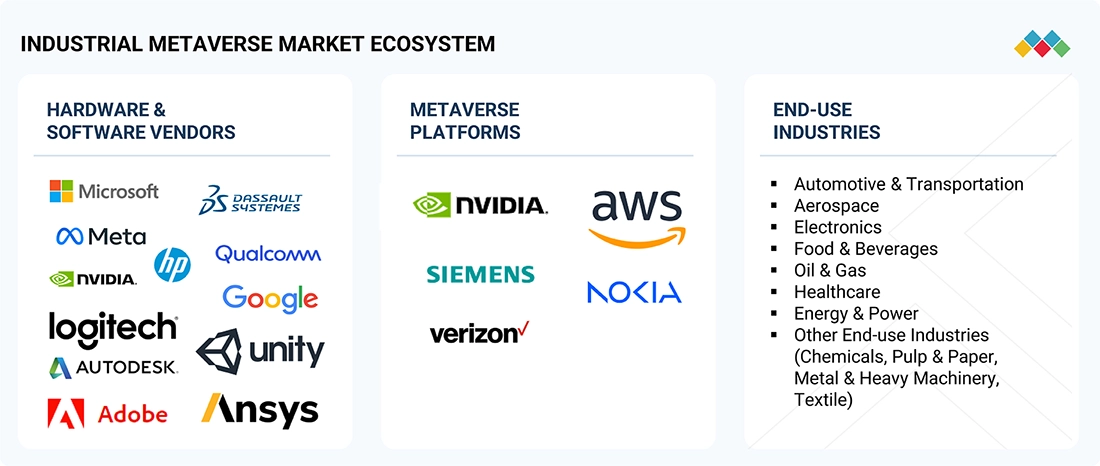
INDUSTRIAL METAVERSE MARKET SIZE, SHARE & TRENDS: COMMERCIAL USE CASES ACROSS INDUSTRIES
| COMPANY | USE CASE DESCRIPTION | BENEFITS |
|---|---|---|
 |
NVIDIA offers Omniverse-based industrial metaverse platforms enabling real-time 3D simulation, collaborative digital twins, and AI-driven robotics training. It supports virtual factory design, workflow optimization, and simulation-based automation testing. | Improves production accuracy with high-fidelity simulation and AI modelling. Reduces prototyping time and cost while enabling faster decision-making and operational optimization. |
 |
Siemens provides an integrated industrial metaverse ecosystem combining digital twins, automation software, and real-time data orchestration. It enables immersive factory planning, remote operations, and predictive maintenance using virtual replicas of production assets. | Accelerates design-to-deployment cycles and reduces downtime through virtual commissioning. Enhances workforce collaboration and asset reliability with simulation-driven analytics. |
 |
Microsoft delivers industrial metaverse applications via Azure, HoloLens, and digital twin cloud solutions. The platform supports remote maintenance, AR-assisted operations, immersive training, and connected manufacturing workflows. | Improves worker productivity with hands-free guidance and remote collaboration. Reduces maintenance cost, enhances safety, and increases equipment uptime with real-time monitoring. |
 |
Meta offers immersive industrial metaverse solutions using AR/VR platforms such as Meta Quest and Horizon Workrooms. Their technology enables virtual collaboration for factory planning, workforce training, and remote design reviews. Meta’s ecosystem supports 3D environment simulation and real-time digital interactions for industrial teams. | Enhances workforce productivity through immersive training and remote collaboration. Reduces travel and communication costs, accelerates decision-making, and improves knowledge transfer with interactive virtual environments. |
 |
Alphabet supports industrial metaverse deployment using Google Cloud, AR technologies, and AI-driven data models. It enables digital twins for logistics, manufacturing, and energy facilities with scalable edge-cloud connectivity. | Improves factory forecasting accuracy with advanced analytics. Lowers operational costs through workflow automation and enhances remote collaboration for distributed teams. |
Logos and trademarks shown above are the property of their respective owners. Their use here is for informational and illustrative purposes only.
Related Ecosystem
Key Takeaways
- The US Industrial Metaverse Market will grow from $9.1B in 2024 to $72.7B by 2029, representing an 8-fold expansion driven by semiconductor and electronics sector adoption.
- The US maintains a 51.5% CAGR throughout the forecast period, reflecting aggressive enterprise investment in immersive manufacturing and design technologies.
- The US benefits from early-mover advantages, venture capital support, and strategic partnerships that position American companies as global leaders in industrial metaverse solutions.
- Key US applications include virtual factory simulations, remote maintenance, collaborative design, and immersive workforce training that drive operational efficiency gains.
Industrial Metaverse Market Report Scope
| Report Metric | Details |
|---|---|
| Base Year | 2024 |
| Fastest Growing Segment | BLOCKCHAIN (Technology) |
| Forecast Period | 2024-2029 |
| Growth Rate | CAGR of 51.5% from 2024 to 2029 |
| Largest Segment | INDUSTRIAL SENSORS (Enabling Technology) |
| Market Size Base Year (Billions) | ~USD 28.64 (2024) |
| Revenue Forecast (Billions) | ~USD 228.6 (2029) |
| Segments Covered | Technology, End-Use Industry, Offering, Device Type, Enabling Technology, Process Industry, Discrete Industry, Type |
US Industrial Metaverse Market Report Segmentation
8 segment dimensions are covered across the global market.
By Technology
- Artificial Intelligence
- Augmented Reality
- Blockchain
- Digital Twin
- Edge Computing
- Private 5G
- Virtual Reality
By End-Use Industry
- Aerospace
- Automotive & Transportation
- Electronics
- Energy & Power
- Food & Beverages
- Healthcare
- Oil & Gas
- Other End-Use Industries
By Offering
- Hardware
- Services
- Software
By Device Type
- Edge Devices
- Edge Sensors
- Gesture Tracking Devices
- Head-Mounted Displays
- Head-Up Displays
- Projectors & Display Walls
By Enabling Technology
- AI In Manufacturing
- Automated Guided Vehicles
- Digital Twin
- Industrial 3D Printing
- Industrial Cybersecurity
- Industrial Machine Vision
- Industrial Robots
- Industrial Sensors
- Machine Condition Monitoring
By Process Industry
- Chemical
- Chemical And Manufacturing
- Chemicals
- Energy & Power
- Food
- Food & Beverage
- Food & Beverages
- Food & Packaging
- Metal & Mining
- Metals
- Metals & Mining
- Oil & Gas
- Other Process Industries
- Pharmaceuticals
- Power
- Pulp & Paper
By Discrete Industry
- Aerospace
- Automobile
- Automotive
- Electrical & Electronics
- Electronics & Semiconductors
- Machine Manufacturing
- Machinery
- Medical Devices
- Other Discrete Industries
- Semiconductor & Electronics
By Type
- Collaborative Robots
- Traditional Robots
Target Audience
- Technology & Software Companies : Metaverse platform developers, XR software providers, and enterprise solution vendors need US market data to prioritize product development, identify customer segments, and forecast revenue opportunities in the high-growth industrial sector.
- Semiconductor & Electronics Manufacturers : US-based chip makers and electronics producers require market intelligence to evaluate metaverse adoption ROI, benchmark against competitors, and plan digital transformation investments for manufacturing and design operations.
- Investment & Private Equity Firms : Investors seeking exposure to industrial metaverse growth need comprehensive US market analysis to identify acquisition targets, evaluate portfolio company performance, and allocate capital to high-potential startups and established players.
- Consulting & Systems Integration Firms : Management consultants and IT integrators advising US manufacturers require detailed market insights to develop client strategies, justify technology investments, and position metaverse solutions as competitive differentiators.
- Government & Policy Organizations : US government agencies and policy makers overseeing semiconductor initiatives and advanced manufacturing programs need market data to inform industrial policy, funding decisions, and competitiveness strategies in emerging immersive technologies.
Reasons to Buy this Report
- Market Size & Growth Validation : Obtain precise US market valuation ($9.1B in 2024) and verified 51.5% CAGR projections through 2029. Make data-driven investment and expansion decisions backed by comprehensive market analysis specific to the American industrial sector.
- Competitive Landscape Intelligence : Understand market positioning of US-based metaverse platform providers, semiconductor manufacturers, and electronics companies. Identify key players, market share distribution, and competitive strategies to inform partnership and acquisition decisions.
- Sector-Specific Adoption Insights : Access detailed analysis of how US semiconductor and electronics companies are implementing metaverse solutions. Learn about use cases, ROI metrics, and implementation challenges specific to American manufacturing environments and regulatory frameworks.
- Investment & Funding Trends : Track venture capital, private equity, and corporate investment flows into US industrial metaverse startups and established players. Identify emerging technologies, funding gaps, and high-growth opportunity areas for strategic capital allocation.
- Strategic Planning & Roadmapping : Develop informed go-to-market strategies, product development roadmaps, and partnership frameworks aligned with US market dynamics. Leverage regional insights on regulatory requirements, talent availability, and customer preferences for competitive advantage.
Frequently asked questions
What is the current size of the US Industrial Metaverse Market in 2024?
The US Industrial Metaverse Market is valued at $9,115.6 million in 2024, representing significant early-stage adoption within the US semiconductor and electronics sector.
What is the projected size of the US Industrial Metaverse Market by 2029?
The US Industrial Metaverse Market is forecast to reach $72,715.0 million by 2029, reflecting an 8-fold increase from 2024 levels.
What is the CAGR for the US Industrial Metaverse Market?
The US Industrial Metaverse Market is projected to grow at a compound annual growth rate (CAGR) of 51.5% from 2024 to 2029.
Which industries in the US are driving Industrial Metaverse adoption?
The US semiconductor and electronics industries are primary drivers, with applications expanding into automotive, aerospace, pharmaceuticals, and heavy manufacturing sectors.
What are the main use cases for the Industrial Metaverse in the US?
Key US use cases include virtual factory floor simulations, remote equipment maintenance and diagnostics, collaborative product design environments, and immersive workforce training programs.
RESEARCH METHODOLOGY
The study involved four major activities for estimating the industrial metaverse market size. Exhaustive secondary research has been conducted to collect information relevant to the market, its peer markets, and its child market. Primary research has been undertaken to validate key findings, assumptions, and sizing with industry experts across the value chain of the industrial metaverse market. Both top-down and bottom-up approaches have been employed to estimate the complete market size. It has been followed by the market breakdown and data triangulation methods to estimate the size of different segments and subsegments of the market.
Secondary Research
The research methodology used to estimate and forecast the size of the industrial metaverse market began with the acquisition of data related to the revenues of key vendors in the market through secondary research. Various secondary sources have been referred to in the secondary research process for identifying and collecting information for this study. Secondary sources include annual reports, press releases, and investor presentations of companies; white papers, journals, certified publications, and articles by recognized authors; websites; directories; and databases. Secondary research has mainly been used to obtain key information about the supply chain of the industrial metaverse market, the value chain of the market, key players, market classification, and segmentation according to the industry trends to the bottom-most level, geographic markets, and key developments from both market and technology-oriented perspectives. Secondary data has been collected and analyzed to determine the overall market size, further validated through primary research. The secondary research referred to for this research study involves the The VR/AR Association (VRARA), Metaverse Association, Institute of Electrical and Electronics Engineers (IEEE), and Metaverse Standards Forum, Inc. Moreover, the study involved extensive use of secondary sources, directories, and databases, such as Hoovers, Bloomberg Businessweek, Factiva, and OneSource, to identify and collect valuable information for a technical, market-oriented, and commercial study of the industrial metaverse market. Vendor offerings have been taken into consideration to determine market segmentation.
Primary Research
In the primary research, various primary sources from both the supply and demand sides have been interviewed to obtain the qualitative and quantitative information relevant to this report. Primary sources from the supply side include the key industry participants, subject-matter experts (SMEs), and C-level executives and consultants from various key companies and organizations in the industrial metaverse ecosystem. After the complete market engineering (including calculations for the market statistics, the market breakdown, the market size estimations, the market forecasting, and the data triangulation), extensive primary research has been conducted to verify and validate the critical market numbers obtained. Extensive qualitative and quantitative analyses have been performed during the market engineering process to list key information/insights throughout the report. Extensive primary research has been conducted after understanding the industrial metaverse market scenario through secondary research. Several primary interviews have been conducted with market experts from the demand and supply-side players across key regions, namely, North America, Europe, Asia Pacific, and the Rest of the World (Middle East, Africa and South America). Various primary sources from both the supply and demand sides of the market have been interviewed to obtain qualitative and quantitative information. Following is the breakdown of the primary respondents.
Primary data has been collected through questionnaires, emails, and telephonic interviews. In the canvassing of primaries, various departments within organizations, such as sales, operations, and administration, were covered to provide a holistic viewpoint in our report. After interacting with industry experts, brief sessions were conducted with highly experienced independent consultants to reinforce the findings from our primaries. This and the in-house subject matter experts’ opinions have led us to the findings described in the remainder of this report.
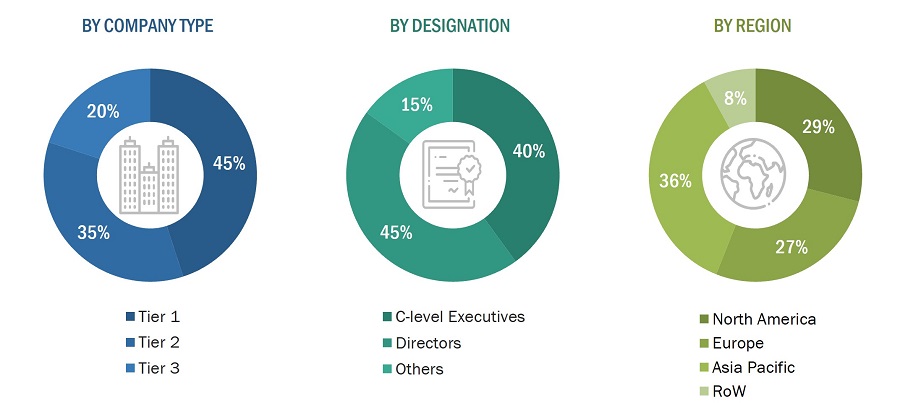
To know about the assumptions considered for the study, download the pdf brochure
Market Size Estimation
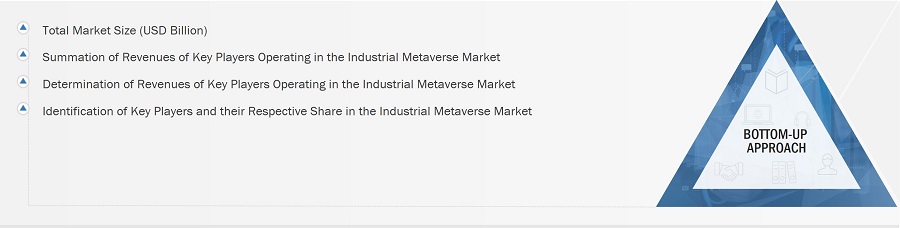
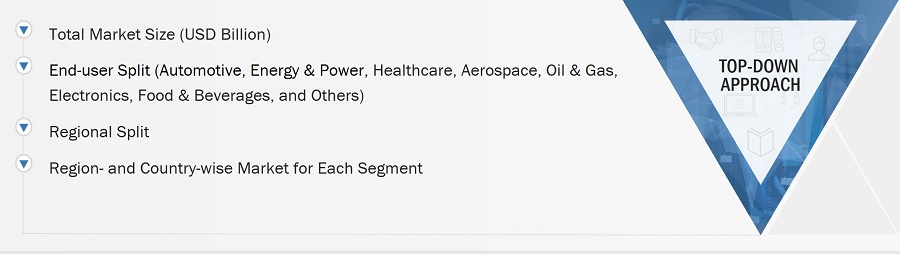
The total size of the industrial metaverse market has been estimated and validated using both top-down and bottom-up approaches. Furthermore, these methods have also been used extensively to estimate the size of various subsegments in the market. The research methodology used to estimate the market size is as follows:
- Identifying different technologies influencing the value chain of the industrial metaverse market
- Identifying major companies, system integrators, and service providers operating in the market
- Estimating the size of the industrial metaverse market for each technology, further by end user and region based on demand for industrial metaverses
- Tracking the ongoing and upcoming industrial metaverse projects to forecast the market size based on these developments and other critical parameters
- All percentage shares, splits, and breakdowns have been determined using secondary sources and verified through primary sources.
- Qualitative aspects such as market drivers, restraints, opportunities, and challenges have been taken into consideration while calculating and forecasting the market size.
Global Industrial metaverse Market Size: Bottom-Up Approach
Global Industrial metaverse Market Size: Top-Down Approach
Data Triangulation
After arriving at the overall size of the industrial metaverse market from the market size estimation process explained above, the total market has been split into several segments and subsegments. Data triangulation and market breakdown procedures have been employed, wherever applicable, to complete the overall market engineering process and arrive at the exact statistics for all segments and subsegments of the market. The data has been triangulated by studying various factors and trends from both the demand and supply sides. Along with this, the market size has been validated using both top-down and bottom-up approaches.
Market Definition
Industrial metaverse market refers to the usage of metaverse technologies for industrial applications, especially for manufacturing processes. The market covers a wide range of products and solutions to facilitate the integration of various technologies into the industrial applications. Industrial metaverse is a blend of digital and physical world formed using technologies such as digital twin, AI, AR &VR, and edge computing. Industrial Metaverse is used for enhancing connectivity, real time collaboration among production systems, processes, and teams working in a complex industrial environment.
Stakeholders:
- Industrial Metaverse solution and service providers
- Augmented reality (AR), virtual reality (VR), and mixed reality (MR) device manufacturers
- Professional service providers and consulting companies
- Raw material suppliers
- Semiconductor foundries
- Original Equipment Manufacturers (OEM)
- Government organizations, forums, alliances, and associations
- System Integrators (SIs) and Value-added Resellers (VARs)
- Research organizations
- Technology standard organizations, forums, alliances, and associations
- Technology investors
- End-use industries (Automotive, aerospace, electronics, healthcare, Oil & gas, energy & power, food & beverages, and others (chemicals and pulp and paper))
- Research organizations
- Technology standard organizations, forums, alliances, and associations
- Venture capitalists, private equity firms, and startups
Report Objectives
- To define, describe, segment, and forecast the size of the industrial metaverse market by technology, and end-user in terms of value
- To describe and forecast the market for four main regions, namely, the North America, Asia Pacific, Europe, and Rest of the World, in terms of value
- To provide detailed information regarding the drivers, restraints, opportunities, and challenges influencing the growth of the market
- To provide a detailed overview of the value chain of the industrial metaverse ecosystem
- To strategically analyze micro-markets with respect to individual growth trends, prospects, and their contributions to the overall market
- To strategically analyze the ecosystem, Porter’s five forces, regulations, region-wise regulations, upcoming technologies in the market, revenue shift model in the market, patent landscape, trade landscape, and case studies pertaining to the market under study
- To analyze opportunities in the market for the stakeholders by identifying high-growth segments in the market
- To strategically profile key players and provide details of the current competitive landscape
- To analyze strategic approaches adopted by players in the industrial metaverse market, such as product launches and developments, acquisitions, collaborations, agreements, contracts, expansions, and partnerships
Available Customizations:
With the given market data, MarketsandMarkets offers customizations according to the company’s specific needs. The following customization options are available for the report:
Company Information:
- Detailed analysis and profiling of additional market players based on various blocks of the value chain.
Get the Full Industrial Metaverse Market Report
Full forecast, segment splits, and company analysis for all Industrial Metaverse Market.
- Canada Industrial Metaverse Market
- Mexico Industrial Metaverse Market
- Germany Industrial Metaverse Market
- UK Industrial Metaverse Market
- France Industrial Metaverse Market
- Rest Of Europe Industrial Metaverse Market
- China Industrial Metaverse Market
- Japan Industrial Metaverse Market
- South Korea Industrial Metaverse Market
- Rest Of Asia Pacific Industrial Metaverse Market
- GCC Countries Industrial Metaverse Market
- Rest Of Middle East Industrial Metaverse Market
Need a Tailored Report?
Customize this report to your needs
Get 10% FREE Customization
Customize This Report
