
US Industrial Oxygen Generator Market (2025-2030)

The US Industrial Oxygen Generator Market was valued at $93925 Million in 2025 and projected to reach to $130977 Million by 2030, representing a compound annual growth rate of 6.9%. The US industrial oxygen generator market is poised for sustained growth through 2030, supported by recovery in manufacturing sectors, continued healthcare infrastructure investments, and rising demand from semiconductor and specialty chemical producers.


| Market Size in | USD 26.32 MN |
| Market Forecast in | |
| CAGR | |
| Forecast Period | |
| Units Considered | Value (USD MN) |
US Industrial Oxygen Generator Market Trends and Insights
- The US market benefits from strong demand across healthcare, manufacturing, and energy sectors, where oxygen generation plays a critical role in operational efficiency.
- In 2025, the US industrial oxygen generator market is characterized by mature infrastructure and established supply chains that support diverse end-user applications. Driving growth through 2030, the US market is experiencing increased adoption of on-site oxygen generation systems, which offer cost savings and operational flexibility compared to traditional liquid oxygen delivery.
- The US industrial oxygen generator market is supported by technological advancements in pressure swing adsorption (PSA) and membrane-based systems.
- By 2030, the US market is expected to see continued expansion fueled by rising healthcare demands, industrial production recovery, and investments in sustainable oxygen generation technologies that reduce carbon footprints..
Key Market Statistics
- CAGR (2025-2030) 6.9% CAGR
- Market Size, 2025 ~USD 93925 Million
- Forecast, 2030 ~USD 130977 Million
- Country US
US Industrial Oxygen Generator Market Overview
Market Valuation :
The US industrial oxygen generator market is valued at $93.9 billion in 2025, with projections reaching $131.0 billion by 2030, driven by robust demand across healthcare, manufacturing, and energy sectors.
Growth Trajectory :
The US market is experiencing a CAGR of 6.9% through 2030, outpacing many developed economies due to increased industrial automation, healthcare expansion, and energy sector modernization initiatives.
Sector Drivers :
Healthcare facilities, steel manufacturing plants, chemical processors, and power generation facilities are primary consumers, with oxygen generation critical to operational efficiency and regulatory compliance across these industries.
Technology Adoption :
US manufacturers are increasingly investing in advanced PSA and membrane-based oxygen generation technologies, driven by sustainability goals, cost reduction pressures, and the shift toward on-site production capabilities.
US Industrial Oxygen Generator Market Dynamics
- The market benefits from established supply chains, technological innovation hubs, and regulatory frameworks that encourage efficient oxygen production.
- Key growth catalysts include post-pandemic healthcare expansion, industrial decarbonization initiatives, and the adoption of cleaner production technologies.
- However, market growth may be tempered by energy cost volatility and competition from alternative gas supply models, requiring manufacturers to focus on efficiency improvements and integrated solutions..
Market Ecosystem
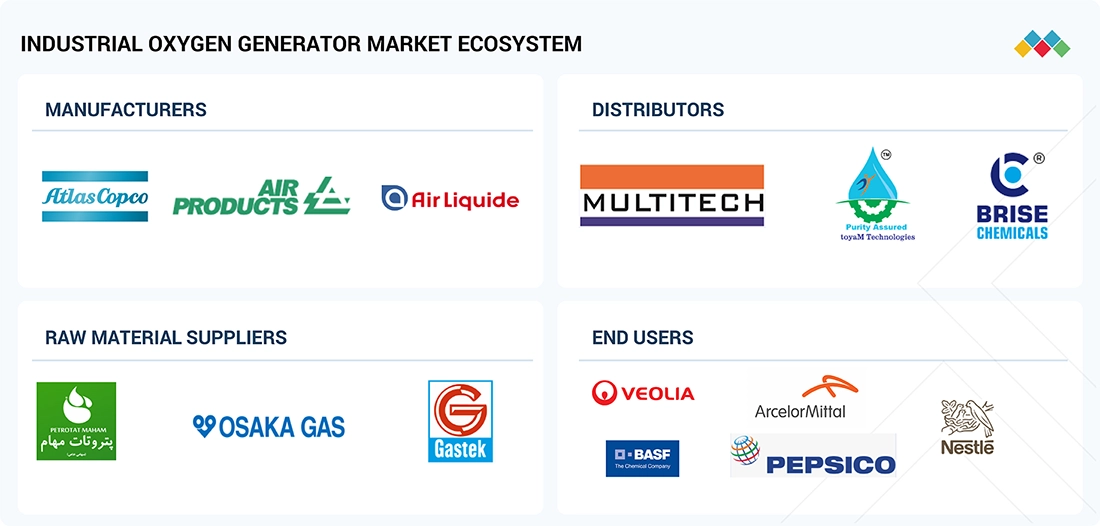
Industrial Oxygen Generator Market: COMMERCIAL USE CASES ACROSS INDUSTRIES
| COMPANY | USE CASE DESCRIPTION | BENEFITS |
|---|---|---|
 |
Uses oxygen generators to supply medical-grade oxygen for hospitals, clinics, and mobile healthcare units | Reliable on-site supply, reduced dependence on cylinders, ensures compliance with medical standards |
 |
Deploys oxygen generators in chemical processing and oxidation reactions within specialty chemical plants | Continuous high-purity oxygen flow, improved process efficiency, lower logistics and energy costs |
 |
Integrates oxygen generators into steelmaking and metallurgy operations for combustion, oxidation, and decarburization | Enhanced furnace efficiency, reduced fuel consumption, consistent oxygen availability on-site |
 |
Utilizes oxygen generators in wastewater treatment plants for aeration and biological processes | Improved water quality, reduced chemical usage, sustainable operations, lower operating costs |
Logos and trademarks shown above are the property of their respective owners. Their use here is for informational and illustrative purposes only.
Related Ecosystem
Equipment Machine And Tooling
- Wastewater Treatment
- Air Cooled Heat Exchangers
- Diaphragm Pumps
- Fiberglass
- HVAC System
- Alfa Laval Corporate AB
- Veolia
- Johnson Controls International plc
- Daikin Industries,Ltd.
- Parker-Hannifin Corporation
Key Takeaways
- The US industrial oxygen generator market is valued at $93.9 billion in 2025 and will reach $131.0 billion by 2030, growing at a 6.9% CAGR.
- The US market is driven by on-site oxygen generation adoption, offering cost efficiency and operational advantages over traditional liquid oxygen supply models.
- The US industrial oxygen generator market benefits from strong demand in healthcare, manufacturing, and energy sectors with established supply chain infrastructure.
- The US market is expected to expand through 2030 via technological innovations in PSA and membrane systems, alongside sustainability-focused oxygen generation solutions.
Industrial Oxygen Generator Market Report Scope
| Report Metric | Details |
|---|---|
| Base Year | 2025 |
| Fastest Growing Segment | AQUACULTURE (End-Use Industry) |
| Forecast Period | 2025-2030 |
| Growth Rate | CAGR of 8.3% from 2025 to 2030 |
| Largest Segment | PSA-BASED (Technology) |
| Market Size Base Year (Billions) | ~USD 8.37 (2025) |
| Revenue Forecast (Billions) | ~USD 12.47 (2030) |
| Segments Covered | Gas Type And Flow Rate, Size, Design, Technology, End-Use Industry |
US Industrial Oxygen Generator Market Report Segmentation
5 segment dimensions are covered across the global market.
By Gas Type And Flow Rate
- Industrial
- Medical
By Size
- Portable
- Stationary
By Design
- Cylinder
- Plug & Play
By Technology
- Cryogenic-Based
- Membrane-Based
- Psa-Based
By End-Use Industry
- Aquaculture
- Chemical & Petrochemical
- Medical & Healthcare
- Metal Processing & Mining
- Other End-Use Industries
- Power Generation
- Water Treatment
US: INDUSTRIAL OXYGEN GENERATOR MARKET, BY END-USE INDUSTRY, 2025–2030
| Segment | 2025 | 2026 | 2027 | 2028 | 2029 | 2030 | CAGR (%) |
|---|---|---|---|---|---|---|---|
| AQUACULTURE | 148.3 | 160.9 | 178.8 | 199.4 | 222.1 | 247 | 10.8 |
| CHEMICAL & PETROCHEMICAL | 194.7 | 207.1 | 221.5 | 237.6 | 254.6 | 272.4 | 6.9 |
| MEDICAL & HEALTHCARE | 889.5 | 954.2 | 1025.8 | 1106.3 | 1191.4 | 1281.3 | 7.6 |
| METAL PROCESSING & MINING | 110.6 | 119.2 | 128.9 | 139.8 | 151.5 | 163.9 | 8.2 |
| OTHER END-USE INDUSTRIES | 102.8 | 112.9 | 119.2 | 125.8 | 132.3 | 138.5 | 6.1 |
| POWER GENERATION | 59 | 65 | 71.7 | 79.4 | 87.8 | 97 | 10.4 |
| WATER TREATMENT | 72.1 | 78.1 | 84.7 | 92.1 | 100 | 108.5 | 8.5 |
| TOTAL | 1577 | 1697 | 1831 | 1981 | 2140 | 2309 | 7.9 |
Target Audience
- Equipment Manufacturers : Oxygen generator manufacturers need US-specific market data to optimize product portfolios, identify high-growth customer segments, and develop targeted sales strategies for the American industrial market.
- Healthcare Providers : Hospital networks and medical facilities require market intelligence on oxygen generation costs, technology options, and supply chain trends to make informed procurement decisions and optimize operational budgets.
- Industrial Operators : Manufacturing plants, chemical processors, and energy facilities need insights on oxygen generation efficiency, cost structures, and technology innovations to improve production economics and sustainability performance.
- Investment & Private Equity : Investors evaluating opportunities in the US industrial gases sector need comprehensive market sizing, growth projections, and competitive dynamics to assess investment returns and portfolio positioning.
- Consultants & System Integrators : Engineering firms and solution providers require detailed US market data to advise clients on oxygen generation system selection, ROI analysis, and technology roadmaps aligned with market trends.
Reasons to Buy this Report
- Market Size & Growth Data : Access precise US market valuations ($93.9B in 2025) and 2030 forecasts with detailed CAGR analysis, enabling accurate financial planning and investment decisions specific to the American market.
- Sector-Specific Insights : Understand demand patterns across US healthcare, manufacturing, energy, and chemical sectors with actionable intelligence on which industries drive growth and where expansion opportunities exist.
- Competitive Landscape Analysis : Identify leading US oxygen generator manufacturers, technology preferences, and market positioning strategies to benchmark against competitors and identify differentiation opportunities in the American market.
- Technology & Innovation Trends : Stay informed on PSA, membrane, and cryogenic technology adoption rates in the US, sustainability initiatives, and emerging production methods shaping the future of industrial oxygen generation.
- Strategic Planning & Risk Assessment : Leverage comprehensive US market data to develop go-to-market strategies, assess regulatory compliance requirements, and identify potential market disruptions affecting your business operations.
Frequently asked questions
What is the current size of the US industrial oxygen generator market in 2025?
The US industrial oxygen generator market is valued at approximately $93.9 billion in 2025.
What is the projected size of the US industrial oxygen generator market by 2030?
The US industrial oxygen generator market is projected to reach $131.0 billion by 2030.
What is the growth rate of the US industrial oxygen generator market?
The US industrial oxygen generator market is expected to grow at a compound annual growth rate (CAGR) of 6.9% from 2025 to 2030.
Which sectors drive demand in the US industrial oxygen generator market?
The US industrial oxygen generator market is primarily driven by healthcare, manufacturing, and energy sectors that rely on oxygen generation for operational efficiency.
What technologies are shaping the US industrial oxygen generator market?
The US industrial oxygen generator market is shaped by pressure swing adsorption (PSA) and membrane-based oxygen generation systems that offer improved efficiency and sustainability.
RESEARCH METHODOLOGY
The study involves two major activities in estimating the current market size for the industrial oxygen generator market. Exhaustive secondary research was done to collect information on the market, peer market, and parent market. The next step was to validate these findings, assumptions, and sizing with industry experts across the value chain through primary research. Both top-down and bottom-up approaches were employed to estimate the complete market size. After that, market breakdown and data triangulation were used to estimate the market size of segments and subsegments.
Secondary Research
Secondary sources referred to for this research study include financial statements of companies offering industrial oxygen generators and information from various trade, business, and professional associations. Secondary research has been used to obtain critical information about the industry’s value chain, the total pool of key players, market classification, and segmentation according to industry trends, to the bottom-most level and regional markets. The secondary data was collected and analyzed to arrive at the overall size of the industrial oxygen generator market, which was validated by primary respondents.
Primary Research
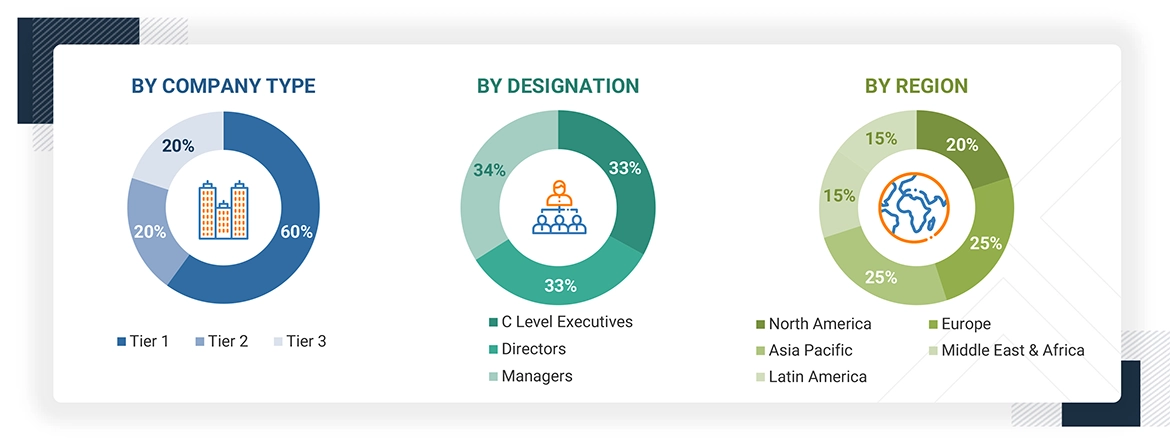
Extensive primary research was conducted after obtaining information regarding the industrial oxygen generator market scenario through secondary research. Several primary interviews were conducted with market experts from both the demand and supply sides across major countries of North America, Europe, Asia Pacific, the Middle East & Africa, and South America. Primary data was collected through questionnaires, emails, and telephonic interviews. The primary sources from the supply side included various industry experts, such as Chief X Officers (CXOs), Vice Presidents (VPs), Directors from business development, marketing, product development/innovation teams, and related key executives from industrial oxygen generator industry vendors, material providers, distributors, and key opinion leaders. Primary interviews were conducted to gather insights such as market statistics, data on revenue collected from the products and services, market breakdowns, market size estimations, market forecasting, and data triangulation. Primary research also helped in understanding the various trends related to product type, application, end-use industry, and region. Stakeholders from the demand side, such as CIOs, CTOs, CSOs, and installation teams of the customer/end users who are seeking industrial oxygen generator services, were interviewed to understand the buyer’s perspective on the suppliers, products, component providers, and their current usage of industrial oxygen generator and future outlook of their business which will affect the overall market.
Breakup of Primary Research:
To know about the assumptions considered for the study, download the pdf brochure
Market Size Estimation
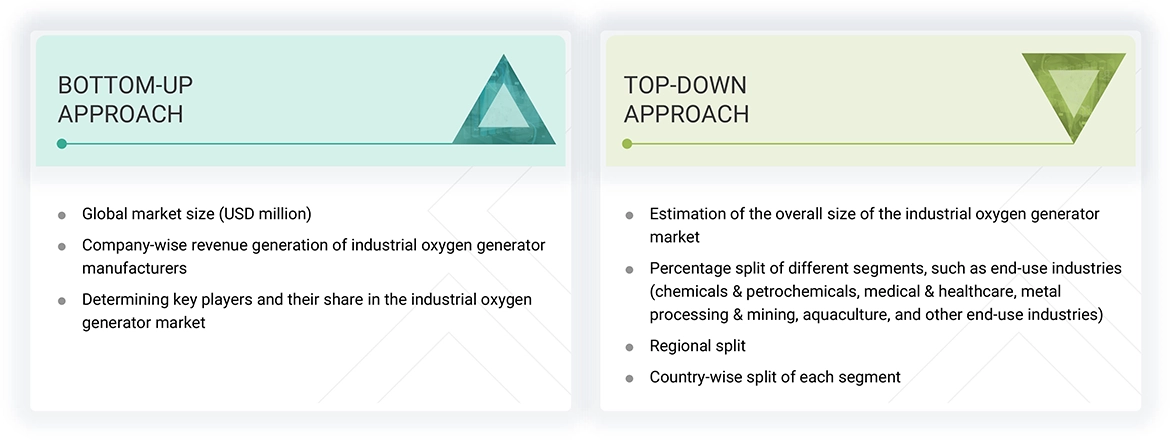
The research methodology used to estimate the size of the industrial oxygen generator market includes the following details. The market sizing of the market was undertaken from the demand side. The market was upsized based on the demand for industrial oxygen generator in different end-use industries at a regional level. Such procurements provide information on the demand aspects of the industrial oxygen generator industry for each application. For each end-use, all possible segments of the industrial oxygen generator market were integrated and mapped.
Data Triangulation
After arriving at the overall size from the market size estimation process explained above, the total market was split into several segments and subsegments. The data triangulation and market breakdown procedures explained below were implemented, wherever applicable, to complete the overall market engineering process and arrive at the exact statistics for various market segments and subsegments. The data was triangulated by studying various factors and trends from the demand and supply sides. Along with this, the market size was validated using both the top-down and bottom-up approaches.
Market Definition
The industrial oxygen generator market encompasses the design, manufacturing, distribution, and servicing of systems that produce oxygen on-site for a wide range of industrial applications. These generators are most commonly based on pressure swing adsorption (PSA), vacuum PSA (VPSA), and cryogenic separation technologies that extract oxygen from ambient air and deliver it at required purity levels, typically ranging from 90% to 99.5%. Industrial oxygen generators are used extensively across sectors such as metal processing, chemicals, glass manufacturing, pulp and paper, aquaculture, wastewater treatment, and food & beverage processing, where oxygen is essential for combustion efficiency, oxidation processes, or water quality enhancement. Unlike bulk liquid oxygen or compressed gas cylinders, on-site generators provide a continuous, cost-effective, and reliable supply, reducing dependency on external deliveries and minimizing storage and transportation risks. The market also includes after-sales services, spare parts supply, maintenance contracts, and integration with process automation systems, making it a capital-intensive but operationally efficient segment. Growing emphasis on energy efficiency, sustainability, and operational autonomy is further shaping the demand and technological evolution of industrial oxygen generation systems worldwide.
Stakeholders
- Industrial Oxygen Generator Manufacturers
- Industrial Oxygen Generator Distributors and Suppliers
- End-use Industries
- Universities, Governments, and Research Organizations
- Associations and Industrial Bodies
- R&D Institutes
- Environmental Support Agencies
- Investment Banks and Private Equity Firms
- Research and Consulting Firms
Report Objectives
- To define, describe, and forecast the industrial oxygen generator market size in terms of volume and value
- To provide detailed information regarding the key factors, such as drivers, restraints, opportunities, and challenges influencing market growth
- To analyze and project the global industrial oxygen generator market, by gas type and flow rate, size, design, technology, end-use industry, and region
- To forecast the market size in five main regions (along with country-level data), North America, Europe, Asia Pacific, Middle East & Africa, and South America, and analyze the significant region-specific trends
- To strategically analyze micromarkets with respect to individual growth trends, prospects, and contributions of the submarkets to the overall market
- To analyze the market opportunities and the competitive landscape for stakeholders and market leaders
- To assess recent market developments and competitive strategies, such as agreements, contracts, acquisitions, partnerships & collaborations, and product developments/launches, to draw the competitive landscape
- To strategically profile the key market players and comprehensively analyze their core competencies
Get the Full Industrial Oxygen Generator Market Report
Full forecast, segment splits, and company analysis for all Industrial Oxygen Generator Market.
- Canada Industrial Oxygen Generator Market
- Mexico Industrial Oxygen Generator Market
- Germany Industrial Oxygen Generator Market
- France Industrial Oxygen Generator Market
- UK Industrial Oxygen Generator Market
- Italy Industrial Oxygen Generator Market
- Spain Industrial Oxygen Generator Market
- China Industrial Oxygen Generator Market
- Japan Industrial Oxygen Generator Market
- India Industrial Oxygen Generator Market
- South Korea Industrial Oxygen Generator Market
- Australia Industrial Oxygen Generator Market
- Brazil Industrial Oxygen Generator Market
- Argentina Industrial Oxygen Generator Market
- Chile Industrial Oxygen Generator Market
- South Africa Industrial Oxygen Generator Market
- Rest Of Europe Industrial Oxygen Generator Market
- Rest Of Asia Pacific Industrial Oxygen Generator Market
- GCC Countries Industrial Oxygen Generator Market
- -Rest Of The GCC Countries Industrial Oxygen Generator Market
- Columbia Industrial Oxygen Generator Market
- Rest Of South America Industrial Oxygen Generator Market
Need a Tailored Report?
Customize this report to your needs
Get 10% FREE Customization
Customize This Report
