
–Rest Of The GCC Countries Industrial Wax Market (2025-2030)

The –Rest Of The GCC Countries Industrial Wax Market was valued at $44.6 Million in 2025 and projected to reach to $53 Million by 2030, representing a compound annual growth rate of CAGR 3.5%. Rest Of The GCC Countries industrial wax market demonstrates steady growth trajectory supported by regional petrochemical capabilities and expanding industrial base.


| Market Size in | USD 26.32 MN |
| Market Forecast in | |
| CAGR | |
| Forecast Period | |
| Units Considered | Value (USD MN) |
–Rest Of The GCC Countries Industrial Wax Market Trends and Insights
- –Rest Of The GCC Countries benefits from regional petrochemical infrastructure and growing demand across packaging, cosmetics, and industrial applications.
- The market in –Rest Of The GCC Countries is supported by established oil and gas sectors that facilitate wax production and refining capabilities. –Rest Of The GCC Countries industrial wax sector is experiencing steady expansion driven by increasing consumption in candle manufacturing, adhesives, and coatings industries.
- –Rest Of The GCC Countries market dynamics reflect regional economic diversification efforts and rising manufacturing activity.
- Between 2025 and 2030, –Rest Of The GCC Countries is expected to maintain moderate growth momentum, with market participants focusing on product innovation and sustainability initiatives to capture emerging opportunities..
Key Market Statistics
- CAGR (2025-2030) CAGR 3.5%
- Market Size, 2025 ~USD 44.6 Million
- Forecast, 2030 ~USD 53 Million
- Country –Rest Of The GCC Countries
–Rest Of The GCC Countries Industrial Wax Market Overview
Market Size & Growth :
Rest Of The GCC Countries industrial wax market valued at USD 44.6 million in 2025, projected to reach USD 53.0 million by 2030 with a steady CAGR of 3.5%.
Petrochemical Infrastructure Advantage :
Region benefits from established petrochemical infrastructure enabling cost-effective wax production and processing, supporting competitive market positioning across GCC nations.
Diverse Application Demand :
Growing consumption across packaging, cosmetics, and industrial applications drives market expansion in Rest Of The GCC Countries, reflecting diversified end-user base.
Regional Market Dynamics :
Rest Of The GCC Countries represents emerging growth opportunity within broader GCC region, with localized demand patterns distinct from major Gulf economies.
–Rest Of The GCC Countries Industrial Wax Market Dynamics
- The market's 3.5% CAGR reflects moderate but consistent demand expansion driven by packaging sector modernization, cosmetics industry growth, and diverse industrial applications across smaller GCC economies.
- Local manufacturing capacity and regional trade dynamics position the market for sustainable development. Future growth in Rest Of The GCC Countries will be shaped by increasing industrialization, rising consumer goods demand, and integration with broader GCC supply chains.
- Investment in downstream wax processing facilities and growing adoption in specialty applications present opportunities for market participants.
- Regional economic diversification initiatives and infrastructure development will further support market expansion through 2030..
Market Ecosystem
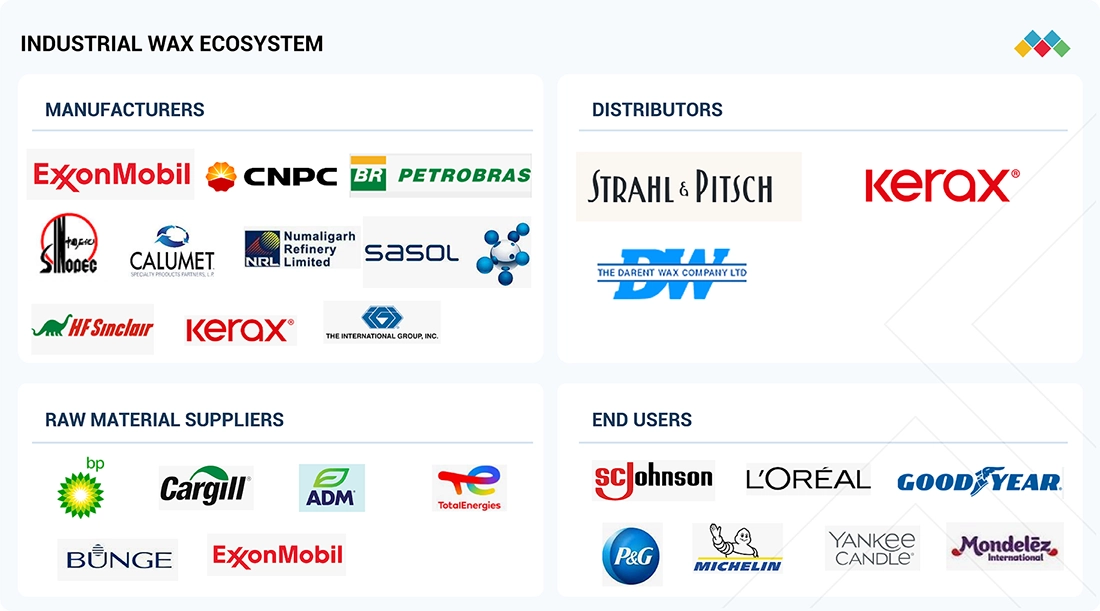
Industrial Wax Market: COMMERCIAL USE CASES ACROSS INDUSTRIES
| COMPANY | USE CASE DESCRIPTION | BENEFITS |
|---|---|---|
 |
Utilizes microcrystalline and synthetic waxes in lipsticks, balms, and creams to enhance texture, stability, and smooth application. | Improved product stability and shelf life Enhanced sensory appeal and moisturization Reduced product returns and higher consumer satisfaction |
 |
Incorporates Fischer-Tropsch (FT) and paraffin waxes into tire rubber compounds to protect against ozone, UV radiation, and mechanical stress. | Enhanced tire durability and crack resistance Improved heat and oxidation stability Reduced maintenance costs and longer service life |
Logos and trademarks shown above are the property of their respective owners. Their use here is for informational and illustrative purposes only.
Related Ecosystem
Bulk Chemicals And Inorganics
- Corrosion Inhibitors
- Glycol Ethers
- Acetic Acid
- Acetone
- Ammonium Nitrate
- Basf se
- DOW CHEMICAL COMPANY
- Exxon Mobil Corporation
- AZELIS HOLDINGS SA
- Sinopec limited
Lubricants
- Polyalkylene Glycol (PAG)
- Tankers
- Exxon Mobil Corporation
- Chevron Corporation
- AZELIS HOLDINGS SA
- PETROLIAM NASIONAL BERHAD (NATIONAL PETROLEUM LIMITED)
- Idemitsu Kosan Co.,Ltd.
Key Takeaways
- –Rest Of The GCC Countries industrial wax market valued at USD 44.6 million in 2025, growing to USD 53.0 million by 2030 at 3.5% CAGR
- –Rest Of The GCC Countries market benefits from strong petrochemical infrastructure and regional oil and gas sector integration
- –Rest Of The GCC Countries demand is driven by packaging, cosmetics, candles, adhesives, and coatings applications
- –Rest Of The GCC Countries market participants are increasingly focusing on sustainability and product innovation to maintain competitive advantage
Industrial Wax Market Report Scope
| Report Metric | Details |
|---|---|
| Base Year | 2025 |
| Fastest Growing Segment | COSMETICS & PERSONAL CARE (Application) |
| Forecast Period | 2025–2030 |
| Growth Rate | CAGR of 4.4% from 2025 to 2030 |
| Largest Segment | SOLID (Form) |
| Market Size Base Year (Billions) | ~USD 11.45 (2025) |
| Revenue Forecast (Billions) | ~USD 14.2 (2030) |
| Segments Covered | Application, Type, Form, Fossil-Based Wax Type, Synthetic Wax Type, Synthetic-Based Wax Type, Process |
–Rest Of The GCC Countries Industrial Wax Market Report Segmentation
7 segment dimensions are covered across the global market.
By Application
- Candles
- Coatings & Polishing
- Cosmetics & Personal Care
- Food & Pharmaceuticals
- Hot-Melt Adhesive
- Hot-Melt Adhesives
- Ink & Coating
- Other Applications
- Packaging
- Plastic Processing
- Tire & Rubber
By Type
- Bio-Based Wax
- Fishcher-Tropsch Wax
- Fossil-Based Wax
- Hdpe Wax
- Ldpe Wax
- Microcrystalline Wax
- Mineral Wax
- Other Types
- Oxidized Wax
- Paraffin Wax
- Synthetic Wax
- Synthetic-Based Wax
By Form
- Emulsions & Liquids
- Powdered
- Solid
By Fossil-Based Wax Type
- Microcrystalline Wax
- Mineral Wax
- Paraffin Wax
By Synthetic Wax Type
- Fischer-Tropsch Wax
- Other Types
By Synthetic-Based Wax Type
- Fischer-Tropsch Wax
- Other Types
By Process
- Modification
- Polymerization
- Thermal Cracking
Target Audience
- Industrial Wax Manufacturers : Evaluate market entry opportunities and expansion potential in Rest Of The GCC Countries, assess local demand patterns, and identify growth segments for production planning.
- Packaging & Cosmetics Companies : Understand wax supply availability and pricing dynamics in Rest Of The GCC Countries to optimize sourcing strategies and ensure consistent material supply for operations.
- Chemical Distributors & Traders : Identify distribution opportunities and market gaps in Rest Of The GCC Countries, assess demand trends across end-user segments, and plan inventory management strategies.
- Investment & Private Equity Firms : Evaluate investment potential in Rest Of The GCC Countries wax sector, assess market growth trajectory, and identify acquisition or partnership targets in emerging GCC markets.
- Government & Trade Organizations : Support policy development and trade initiatives for Rest Of The GCC Countries by understanding market structure, growth drivers, and industrial development opportunities.
Key Companies in the –Rest Of The GCC Countries Industrial Wax Market
| Company | HQ | Ownership | Strongest segments |
|---|---|---|---|
| KRATON CORPORATION | United States | Private Company | |
| MOL GROUP | Hungary | Public Company | Fossil-based Wax (mainly solid forms),Synthetic Wax,Bio-based Wax, |
| MIRKA LTD | Finland | Private Company | Coatings & Polishing,Packaging and Building Materials Finishing,Candles and Other Wax-Intensive Niche Uses, |
| ZSCHIMMER & SCHWARZ GROUP | Germany | Private Company | Fossil-based Wax,Synthetic Wax,Bio-based Wax, |
| SHELL PLC | United Kingdom | Public Company | Fossil-based Wax,Synthetic Wax,Bio-based Wax, |
| CNPC | China | Private Company | Fossil-based Wax,Synthetic Wax,Bio-based Wax, |
| EXXON MOBIL CORPORATION | United States | Public Company | Fossil-based Wax,Synthetic Wax,Bio-based Wax, |
| SASOL | United States | Public Company | Fossil-based Wax,Synthetic Wax,Bio-based Wax, |
| PETROBRAS | Brazil | Public Company | Fossil-based Wax (primarily solid forms),Synthetic Wax,Bio-based Wax, |
| MOEVE | Spain | Private Company | Fossil-based Wax,Synthetic Wax,Bio-based Wax, |
| CHINA PETROLEUM & CHEMICAL CORPORATION | China | Public Company | Fossil-based Wax,Synthetic Wax,Bio-based Wax, |
| HF SINCLAIR CORPORATION | United States | Public Company | Fossil-based Wax,Synthetic Wax,Bio-based Wax, |
| CALUMET, INC. | United States | Public Company | Fossil-based Wax,Synthetic Wax,Bio-based Wax, |
| GANDHAR OIL REFINERY (INDIA) LIMITED | India | Public Company | Industrial Wax (all types and forms),White Oils and Jellies,Lubricants (Automotive and Industrial), |
| EVONIK INDUSTRIES AG | Germany | Public Company | Fossil-based Wax,Synthetic Wax,Bio-based Wax, |
| PROQUINAT | Spain | Private | Fossil-based Wax,Synthetic Wax,Bio-based Wax, |
| THE BLAYSON GROUP LTD. | United Kingdom | Private Company | Fossil-based Wax,Synthetic Wax,Bio-based Wax, |
KRATON CORPORATION
KRATON CORPORATION is a private company founded in 2000 in the United States with 1,875 employees.
MOL GROUP
MOL GROUP is a public company founded in 1991 in Hungary with 24,744 employees.
MIRKA LTD
MIRKA LTD is a private company founded in 1988 in Finland with 913 employees.
ZSCHIMMER & SCHWARZ GROUP
Insufficient data available for ZSCHIMMER & SCHWARZ GROUP.
SHELL PLC
SHELL PLC is a public company founded in 1897 in the United Kingdom with 84,000 employees.
CNPC
CNPC is a private company founded in 1955 in China with 30,173 employees.
EXXON MOBIL CORPORATION
EXXON MOBIL CORPORATION is a public company founded in 1870 in the United States with 57,900 employees.
SASOL
SASOL is a public company founded in 1950 in the United States with 27,107 employees.
PETROBRAS
PETROBRAS is a public company founded in 1953 in Brazil with 43,199 employees.
MOEVE
MOEVE is a private company founded in 1929 in Spain with 10,890 employees.
CHINA PETROLEUM & CHEMICAL CORPORATION
CHINA PETROLEUM & CHEMICAL CORPORATION is a public company founded in 2000 in China with 351,104 employees.
HF SINCLAIR CORPORATION
HF SINCLAIR CORPORATION is a public company founded in 1947 in the United States with 5,165 employees.
CALUMET, INC.
CALUMET, INC. is a public company founded in 1919 in the United States with 1,540 employees.
GANDHAR OIL REFINERY (INDIA) LIMITED
GANDHAR OIL REFINERY (INDIA) LIMITED is a public company founded in 1992 in India with 410 employees.
EVONIK INDUSTRIES AG
EVONIK INDUSTRIES AG is a public company founded in 1847 in Germany with 30,643 employees.
PROQUINAT
Insufficient data available for PROQUINAT.
THE BLAYSON GROUP LTD.
THE BLAYSON GROUP LTD. is a private company founded in 1988 in the United Kingdom with 50 employees.
Reasons to Buy this Report
- Localized Market Intelligence : Gain specific insights into Rest Of The GCC Countries market dynamics, distinct from broader GCC analysis, enabling targeted business strategy and market entry planning.
- Growth Opportunity Identification : Identify emerging segments and applications within Rest Of The GCC Countries driving the 3.5% CAGR, supporting investment and expansion decisions in underserved markets.
- Competitive Positioning Data : Understand regional competitive landscape, petrochemical infrastructure advantages, and supply chain dynamics specific to Rest Of The GCC Countries for strategic advantage.
- Demand Forecasting Accuracy : Access detailed 2025-2030 projections for Rest Of The GCC Countries across packaging, cosmetics, and industrial sectors for precise capacity planning and resource allocation.
- Regional Partnership Strategy : Leverage country-specific market data to identify partnership opportunities, distribution channels, and customer segments within Rest Of The GCC Countries market.
Frequently asked questions
What is the market size of industrial wax in –Rest Of The GCC Countries?
–Rest Of The GCC Countries industrial wax market is estimated at USD 44.6 million in 2025 and is projected to reach USD 53.0 million by 2030.
What is the expected growth rate for –Rest Of The GCC Countries industrial wax market?
–Rest Of The GCC Countries industrial wax market is expected to grow at a CAGR of 3.5% from 2025 to 2030.
Which industries drive demand in –Rest Of The GCC Countries industrial wax market?
–Rest Of The GCC Countries industrial wax demand is primarily driven by packaging, cosmetics, candle manufacturing, adhesives, and coatings industries.
What factors support growth in –Rest Of The GCC Countries industrial wax market?
–Rest Of The GCC Countries market growth is supported by established petrochemical infrastructure, regional oil and gas sectors, economic diversification, and rising manufacturing activity.
What trends are shaping –Rest Of The GCC Countries industrial wax market?
–Rest Of The GCC Countries market trends include increased focus on sustainability, product innovation, and expansion of end-use applications across diverse industrial sectors.
RESEARCH METHODOLOGY
The study involved four major activities to estimate the current size of the global industrial wax market. Exhaustive secondary research was carried out to collect information on the market, the peer product market, and the parent product group market. The next step was to validate these findings, assumptions, and sizes with the industry experts across the value chain of industrial wax through primary research. The top-down and bottom-up approaches were employed to estimate the overall size of the industrial wax market. After that, market breakdown and data triangulation procedures were used to determine the size of different segments and subsegments of the market.
Secondary Research
The market for the companies offering industrial wax is arrived at through secondary data available through paid and unpaid sources, analyzing the product portfolios of the major companies in the ecosystem, and rating the companies by their performance and quality. Various secondary sources, such as Business Standard, Bloomberg, World Bank, and Factiva, were referred to identify and collect information for this study on the industrial wax market. In the secondary research process, various secondary sources were referred to identify and collect information related to the study. Secondary sources included annual reports, press releases, and investor presentations of vendors, forums, certified publications, and whitepapers. Secondary research was used to obtain critical information on the industry’s value chain, the total pool of key players, market classification, and segmentation from market and technology-oriented perspectives.
Primary Research
In the primary research process, various primary sources from both the supply and demand sides were interviewed to obtain qualitative and quantitative information for this report. The primary sources from the supply side included industry experts, such as Chief Executive Officers (CEOs), Vice Presidents (VPs), marketing directors, technology and innovation directors, and related key executives from several key companies and organizations operating in the industrial wax market. After the complete market engineering (calculations for market statistics, market breakdown, market size estimations, market forecasting, and data triangulation), extensive primary research was conducted to gather information and verify and validate the critical numbers arrived at. Primary research was also conducted to identify the segmentation types, industry trends, competitive landscape of industrial wax offered by various market players, and key market dynamics, such as drivers, restraints, opportunities, challenges, industry trends, and key player strategies. In the complete market engineering process, the top-down and bottom-up approaches and several data triangulation methods were extensively used to perform the market estimation and market forecasting for the overall market segments and subsegments listed in this report. Extensive qualitative and quantitative analysis was performed on the complete market engineering process to list the key information/insights throughout the report.
The following is the breakdown of interviews with experts:
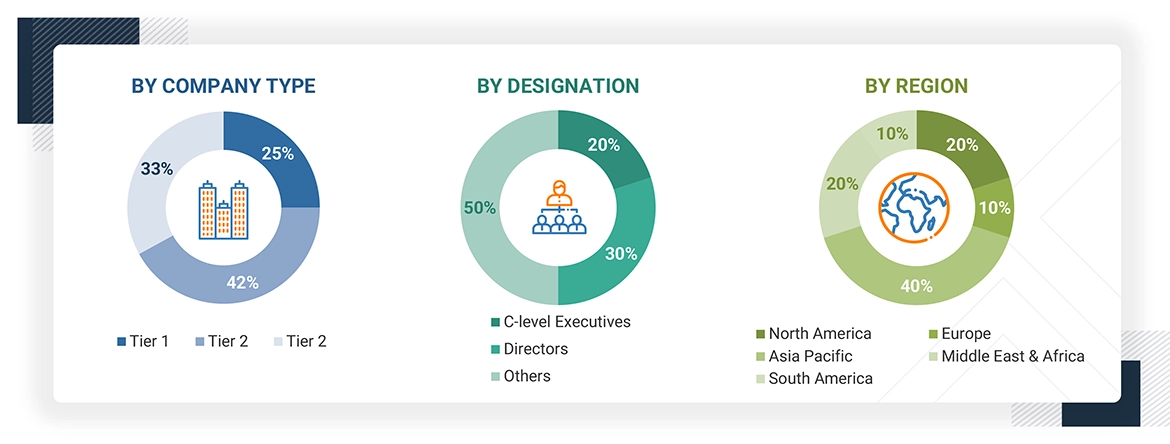
Note: Other designations include sales, marketing, and product managers.
Tier 1: >USD 1 Billion; Tier 2: USD 500 million–1 Billion; and Tier 3: < USD 500 million.
To know about the assumptions considered for the study, download the pdf brochure
Market Size Estimation
The top-down and bottom-up approaches were used to estimate and validate the size of the global industrial wax market. These approaches were also used extensively to estimate the size of various dependent market segments. The research methodology used to estimate the market size included the following:
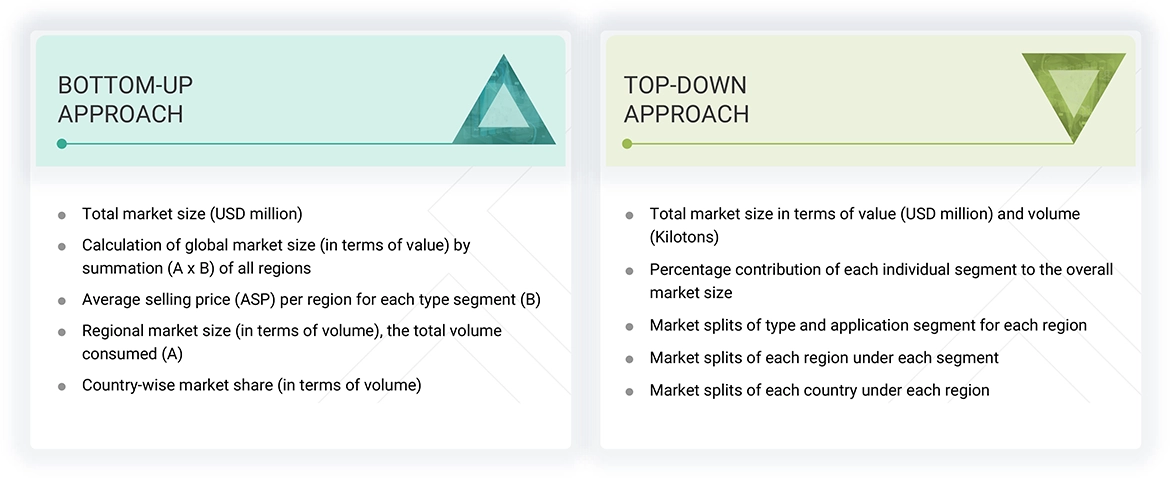
Data Triangulation
After arriving at the overall market size using the market size estimation processes, the market was split into several segments and subsegments. The data triangulation and market breakup procedures were employed, wherever applicable, to complete the overall market engineering process and arrive at the exact statistics of each market segment and subsegment. The data was triangulated by studying various factors and trends from both the demand and supply sides.
Market Definition
Industrial waxes include a very broad group of organic compounds that are solid under room temperature, usually white or yellowish-colored, and that become free-flowing liquids at moderately high temperatures. These waxes consist mainly of complex mixtures of hydrocarbons with carbon chains usually having more than 20 atoms and have melting points that depend on their individual chemical compositions. Industrial waxes are broadly categorized into three main types based on their origin: fossil-based, synthetic, and bio-based. Fossil-based waxes include both mineral and petroleum-derived varieties, such as paraffin wax and microcrystalline wax. Synthetic waxes, such as Fischer-Tropsch (FT) wax, are chemically engineered to meet specific performance criteria. Bio-based waxes are sourced naturally, implying both animal and vegetable waxes, and hence would be considered more sustainable options for waxes. Owing to their particular physical properties, including hydrophobicity, lustrous finish, lubrication, and resistance to chemicals, these waxes serve as basic raw materials for industries, such as packaging, rubber, adhesives, cosmetics, and coatings.
Stakeholders
- Industrial Wax Manufacturers
- Raw Material Suppliers
- Converters and Processors
- Distributors and traders
- Industry Associations and Regulatory Bodies
- End Users
Report Objectives
- To define, describe, and forecast the global industrial wax market in terms of value and volume
- To provide detailed information regarding the key factors influencing the growth of the market (drivers, restraints, opportunities, and industry-specific challenges)
- To analyze the market segmentation and forecast the market size based on type, form, and application
- To analyze and forecast the market segments, with respect to size in five key regions, namely, North America, Europe, Asia Pacific (APAC), the Middle East & Africa, and South America, along with the major countries in each region
- To strategically analyze micromarkets concerning individual growth trends, growth prospects, and contribution to the total market
- To analyze the opportunities in the market for stakeholders and provide details of the competitive landscape
- To analyze recent developments, such as expansions, mergers & acquisitions, in the market and draw a competitive landscape
- To strategically profile the key players and comprehensively analyze their market shares and core competencies
- To provide the impact of AI/Gen AI on the market
Get the Full Industrial Wax Market Report
Full forecast, segment splits, and company analysis for all Industrial Wax Market.
- -Rest Of The GCC Countries Industrial Wax Market
- Argentina Industrial Wax Market
- Brazil Industrial Wax Market
- Canada Industrial Wax Market
- China Industrial Wax Market
- France Industrial Wax Market
- GCC Countries Industrial Wax Market
- Germany Industrial Wax Market
- India Industrial Wax Market
- Indonesia Industrial Wax Market
- Japan Industrial Wax Market
- Mexico Industrial Wax Market
- Poland Industrial Wax Market
- Rest Of Asia Pacific Industrial Wax Market
- Rest Of Europe Industrial Wax Market
- Rest Of South America Industrial Wax Market
- Russia Industrial Wax Market
- South Africa Industrial Wax Market
- South America Industrial Wax Market
- South Korea Industrial Wax Market
- UK Industrial Wax Market
- US Industrial Wax Market
Need a Tailored Report?
Customize this report to your needs
Get 10% FREE Customization
Customize This Report
