
Argentina Industrial Wax Market (2025-2030)

The Argentina Industrial Wax Market was valued at $19.7 Million in 2025 and projected to reach to $23.3 Million by 2030, representing a compound annual growth rate of 3.4%. Argentina's industrial wax market demonstrates steady growth potential driven by expanding demand from packaging, cosmetics, and automotive sectors.


| Market Size in | USD 26.32 MN |
| Market Forecast in | |
| CAGR | |
| Forecast Period | |
| Units Considered | Value (USD MN) |
Argentina Industrial Wax Market Trends and Insights
- Argentina's market is driven by demand from packaging, cosmetics, and automotive sectors, where industrial wax serves as a critical material for coatings, polishes, and protective applications.
- The steady growth trajectory reflects Argentina's expanding manufacturing base and increasing adoption of wax-based solutions across industrial verticals. During the forecast period from 2025 to 2030, Argentina is expected to experience moderate but consistent market expansion.
- Argentina's industrial wax sector benefits from regional trade dynamics within South America and growing consumer demand for quality-finished products.
- Key end-use industries in Argentina, including food packaging and personal care manufacturing, continue to drive consumption of specialty and paraffin waxes.
- The market's resilience in Argentina underscores the importance of wax as a foundational material in multiple industrial applications..
Key Market Statistics
- CAGR (2025-2030) 3.4% CAGR
- Market Size, 2025 ~USD 19.7 Million
- Forecast, 2030 ~USD 23.3 Million
- Country Argentina
Argentina Industrial Wax Market Overview
Market Size & Growth :
Argentina's industrial wax market is valued at USD 19.7 million in 2025, with projected growth to USD 23.3 million by 2030, reflecting a steady CAGR of 3.4%.
Key End-Use Sectors :
Packaging, cosmetics, and automotive industries are the primary drivers of industrial wax demand in Argentina, utilizing wax for coatings, polishes, and protective applications.
Growth Trajectory :
Argentina's market growth rate of 3.4% CAGR is slightly below the global average of 4.4%, indicating moderate but consistent expansion in the regional industrial wax sector.
Application Diversity :
Industrial wax in Argentina serves multiple critical functions across sectors, from protective coatings in packaging to cosmetic formulations and automotive surface treatments.
Argentina Industrial Wax Market Dynamics
- The market's 3.4% CAGR reflects consistent adoption of industrial wax applications across manufacturing and consumer-facing industries.
- Local manufacturers and importers are capitalizing on the region's growing packaging and cosmetics production, where wax-based solutions provide cost-effective protection and finishing properties. Looking ahead to 2030, Argentina's market is expected to benefit from increased industrialization and rising consumer demand for packaged goods and personal care products.
- While growth rates remain moderate compared to global benchmarks, the market presents stable opportunities for suppliers and manufacturers targeting South American distribution networks.
- Strategic partnerships with local packaging and cosmetics producers will be essential for capturing market share in this developing segment..
Market Ecosystem
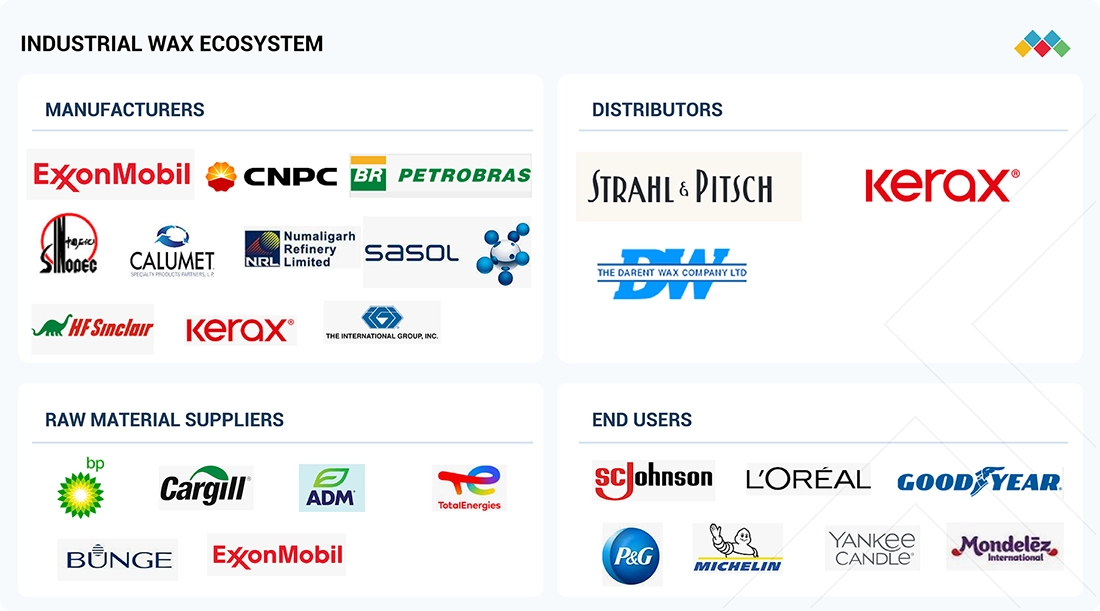
Industrial Wax Market: COMMERCIAL USE CASES ACROSS INDUSTRIES
| COMPANY | USE CASE DESCRIPTION | BENEFITS |
|---|---|---|
 |
Utilizes microcrystalline and synthetic waxes in lipsticks, balms, and creams to enhance texture, stability, and smooth application. | Improved product stability and shelf life Enhanced sensory appeal and moisturization Reduced product returns and higher consumer satisfaction |
 |
Incorporates Fischer-Tropsch (FT) and paraffin waxes into tire rubber compounds to protect against ozone, UV radiation, and mechanical stress. | Enhanced tire durability and crack resistance Improved heat and oxidation stability Reduced maintenance costs and longer service life |
Logos and trademarks shown above are the property of their respective owners. Their use here is for informational and illustrative purposes only.
Related Ecosystem
Bulk Chemicals And Inorganics
- Corrosion Inhibitors
- Glycol Ethers
- Acetic Acid
- Acetone
- Ammonium Nitrate
- Basf se
- DOW CHEMICAL COMPANY
- Exxon Mobil Corporation
- AZELIS HOLDINGS SA
- Sinopec limited
Lubricants
- Polyalkylene Glycol (PAG)
- Tankers
- Exxon Mobil Corporation
- Chevron Corporation
- AZELIS HOLDINGS SA
- PETROLIAM NASIONAL BERHAD (NATIONAL PETROLEUM LIMITED)
- Idemitsu Kosan Co.,Ltd.
Key Takeaways
- Argentina's industrial wax market is valued at USD 19.7 million in 2025 and will reach USD 23.3 million by 2030.
- Argentina exhibits a 3.4% CAGR, reflecting steady but moderate growth compared to global expansion rates.
- Argentina's market is supported by packaging, cosmetics, and automotive industries requiring wax-based materials.
- Argentina's regional position within South America provides trade advantages and access to broader Latin American demand.
Industrial Wax Market Report Scope
| Report Metric | Details |
|---|---|
| Base Year | 2025 |
| Fastest Growing Segment | COSMETICS & PERSONAL CARE (Application) |
| Forecast Period | 2025-2030 |
| Growth Rate | CAGR of 4.4% from 2025 to 2030 |
| Largest Segment | SOLID (Form) |
| Market Size Base Year (Billions) | ~USD 11.45 (2025) |
| Revenue Forecast (Billions) | ~USD 14.2 (2030) |
| Segments Covered | Application, Type, Form, Fossil-Based Wax Type, Synthetic Wax Type, Synthetic-Based Wax Type, Process |
Argentina Industrial Wax Market Report Segmentation
7 segment dimensions are covered across the global market.
By Application
- Candles
- Coatings & Polishing
- Cosmetics & Personal Care
- Food & Pharmaceuticals
- Hot-Melt Adhesive
- Hot-Melt Adhesives
- Ink & Coating
- Other Applications
- Packaging
- Plastic Processing
- Tire & Rubber
By Type
- Bio-Based Wax
- Fishcher-Tropsch Wax
- Fossil-Based Wax
- Hdpe Wax
- Ldpe Wax
- Microcrystalline Wax
- Mineral Wax
- Other Types
- Oxidized Wax
- Paraffin Wax
- Synthetic Wax
- Synthetic-Based Wax
By Form
- Emulsions & Liquids
- Powdered
- Solid
By Fossil-Based Wax Type
- Microcrystalline Wax
- Mineral Wax
- Paraffin Wax
By Synthetic Wax Type
- Fischer-Tropsch Wax
- Other Types
By Synthetic-Based Wax Type
- Fischer-Tropsch Wax
- Other Types
By Process
- Modification
- Polymerization
- Thermal Cracking
ARGENTINA: INDUSTRIAL WAX MARKET, BY APPLICATION, 2024–2030
| Segment | 2024 | 2025 | 2026 | 2027 | 2028 | 2029 | 2030 | CAGR (%) |
|---|---|---|---|---|---|---|---|---|
| CANDLES | 4.87 | 5.05 | 5.25 | 5.45 | 5.67 | 5.89 | 6.11 | 3.9 |
| COATINGS & POLISHING | 2.17 | 2.22 | 2.28 | 2.34 | 2.4 | 2.46 | 2.53 | 2.6 |
| COSMETICS & PERSONAL CARE | 3.36 | 3.5 | 3.63 | 3.77 | 3.92 | 4.07 | 4.23 | 3.9 |
| FOOD & PHARMACEUTICALS | 1.03 | 1.06 | 1.1 | 1.13 | 1.17 | 1.21 | 1.25 | 3.3 |
| HOT-MELT ADHESIVES | 1.98 | 2.04 | 2.1 | 2.17 | 2.23 | 2.3 | 2.37 | 3 |
| OTHER APPLICATIONS | 2 | 2.06 | 2.12 | 2.18 | 2.25 | 2.31 | 2.38 | 3 |
| PACKAGING | 2.65 | 2.75 | 2.85 | 2.96 | 3.07 | 3.18 | 3.3 | 3.7 |
| TIRE & RUBBER | 0.95 | 0.97 | 1 | 1.02 | 1.05 | 1.08 | 1.1 | 2.5 |
| TOTAL | 19.01 | 19.66 | 20.33 | 21.03 | 21.75 | 22.5 | 23.27 | 3.4 |
Target Audience
- Industrial Wax Manufacturers : Manufacturers need Argentina-specific market data to evaluate production capacity investments, identify key customer segments in packaging and cosmetics, and plan regional expansion strategies.
- Chemical Distributors & Importers : Distributors require localized market insights to optimize inventory levels, forecast demand from Argentine end-users, and identify growth opportunities in underserved sectors.
- Packaging & Cosmetics Companies : End-users in Argentina's packaging and cosmetics sectors need market intelligence to benchmark wax sourcing costs, identify supplier alternatives, and plan product formulation strategies.
- Business Development & Strategy Teams : Strategic planners need Argentina market data to evaluate market entry feasibility, assess competitive landscapes, and support go-to-market decisions for regional operations.
- Investment & Private Equity Firms : Investors require Argentina-specific market forecasts and growth projections to evaluate acquisition targets, assess portfolio company performance, and identify sector consolidation opportunities.
Reasons to Buy this Report
- Localized Market Intelligence : Gain Argentina-specific insights on market size, growth rates, and sector-specific demand patterns unavailable in global reports, enabling targeted regional strategy development.
- Sector-Specific Opportunity Mapping : Identify high-potential applications in Argentina's packaging, cosmetics, and automotive sectors with detailed demand analysis and growth forecasts through 2030.
- Competitive Positioning Data : Understand Argentina's market dynamics relative to global trends (3.4% vs. 4.4% CAGR) to benchmark competitive positioning and identify market gaps for entry or expansion.
- Investment & Expansion Planning : Support capital allocation decisions with reliable market projections showing USD 3.6 million growth potential by 2030, justifying regional manufacturing or distribution investments.
- Supply Chain Strategy : Develop Argentina-focused sourcing and distribution strategies by understanding local end-user demand patterns, sector concentration, and growth trajectories for industrial wax applications.
Frequently asked questions
What is the current size of Argentina's industrial wax market?
Argentina's industrial wax market is estimated at USD 19.7 million in 2025.
What is the projected market size for Argentina by 2030?
Argentina's industrial wax market is forecast to reach USD 23.3 million by 2030.
What is the CAGR for Argentina's industrial wax market?
Argentina's industrial wax market is expected to grow at a CAGR of 3.4% from 2025 to 2030.
Which industries drive demand for industrial wax in Argentina?
Argentina's primary demand drivers include packaging, cosmetics, automotive, and personal care manufacturing sectors.
How does Argentina's market growth compare to global trends?
Argentina's 3.4% CAGR is lower than the global industrial wax market CAGR of 4.4%, indicating more conservative regional growth.
RESEARCH METHODOLOGY
The study involved four major activities to estimate the current size of the global industrial wax market. Exhaustive secondary research was carried out to collect information on the market, the peer product market, and the parent product group market. The next step was to validate these findings, assumptions, and sizes with the industry experts across the value chain of industrial wax through primary research. The top-down and bottom-up approaches were employed to estimate the overall size of the industrial wax market. After that, market breakdown and data triangulation procedures were used to determine the size of different segments and subsegments of the market.
Secondary Research
The market for the companies offering industrial wax is arrived at through secondary data available through paid and unpaid sources, analyzing the product portfolios of the major companies in the ecosystem, and rating the companies by their performance and quality. Various secondary sources, such as Business Standard, Bloomberg, World Bank, and Factiva, were referred to identify and collect information for this study on the industrial wax market. In the secondary research process, various secondary sources were referred to identify and collect information related to the study. Secondary sources included annual reports, press releases, and investor presentations of vendors, forums, certified publications, and whitepapers. Secondary research was used to obtain critical information on the industry’s value chain, the total pool of key players, market classification, and segmentation from market and technology-oriented perspectives.
Primary Research
In the primary research process, various primary sources from both the supply and demand sides were interviewed to obtain qualitative and quantitative information for this report. The primary sources from the supply side included industry experts, such as Chief Executive Officers (CEOs), Vice Presidents (VPs), marketing directors, technology and innovation directors, and related key executives from several key companies and organizations operating in the industrial wax market. After the complete market engineering (calculations for market statistics, market breakdown, market size estimations, market forecasting, and data triangulation), extensive primary research was conducted to gather information and verify and validate the critical numbers arrived at. Primary research was also conducted to identify the segmentation types, industry trends, competitive landscape of industrial wax offered by various market players, and key market dynamics, such as drivers, restraints, opportunities, challenges, industry trends, and key player strategies. In the complete market engineering process, the top-down and bottom-up approaches and several data triangulation methods were extensively used to perform the market estimation and market forecasting for the overall market segments and subsegments listed in this report. Extensive qualitative and quantitative analysis was performed on the complete market engineering process to list the key information/insights throughout the report.
The following is the breakdown of interviews with experts:
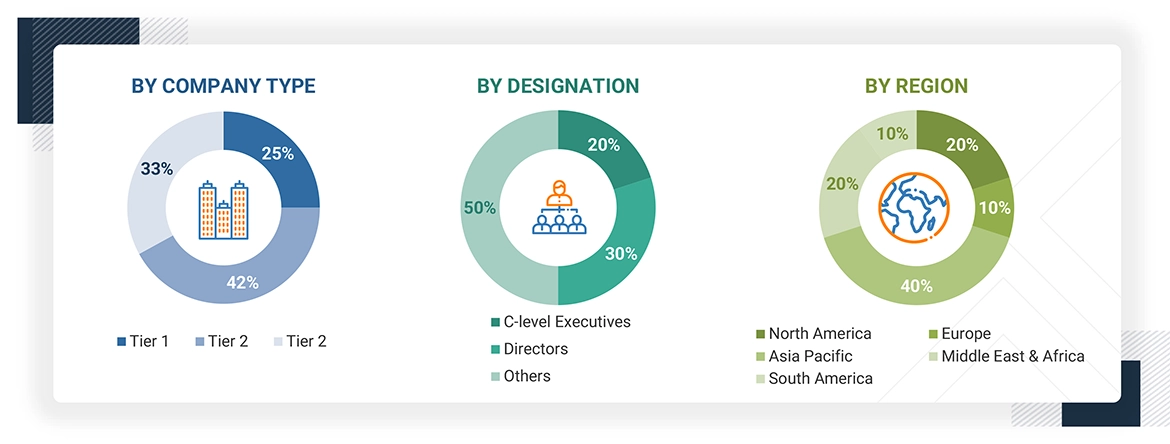
Note: Other designations include sales, marketing, and product managers.
Tier 1: >USD 1 Billion; Tier 2: USD 500 million–1 Billion; and Tier 3: < USD 500 million.
To know about the assumptions considered for the study, download the pdf brochure
Market Size Estimation
The top-down and bottom-up approaches were used to estimate and validate the size of the global industrial wax market. These approaches were also used extensively to estimate the size of various dependent market segments. The research methodology used to estimate the market size included the following:
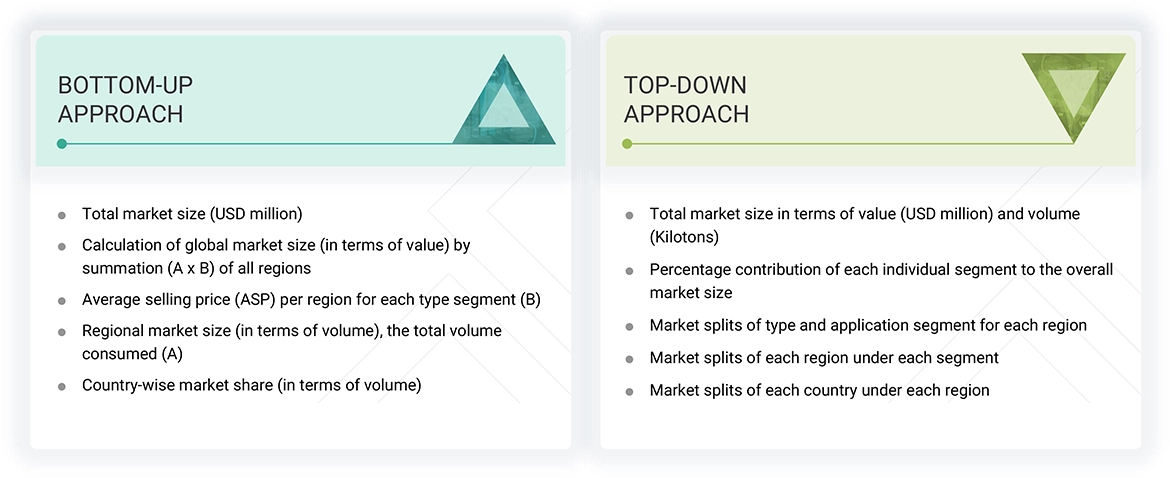
Data Triangulation
After arriving at the overall market size using the market size estimation processes, the market was split into several segments and subsegments. The data triangulation and market breakup procedures were employed, wherever applicable, to complete the overall market engineering process and arrive at the exact statistics of each market segment and subsegment. The data was triangulated by studying various factors and trends from both the demand and supply sides.
Market Definition
Industrial waxes include a very broad group of organic compounds that are solid under room temperature, usually white or yellowish-colored, and that become free-flowing liquids at moderately high temperatures. These waxes consist mainly of complex mixtures of hydrocarbons with carbon chains usually having more than 20 atoms and have melting points that depend on their individual chemical compositions. Industrial waxes are broadly categorized into three main types based on their origin: fossil-based, synthetic, and bio-based. Fossil-based waxes include both mineral and petroleum-derived varieties, such as paraffin wax and microcrystalline wax. Synthetic waxes, such as Fischer-Tropsch (FT) wax, are chemically engineered to meet specific performance criteria. Bio-based waxes are sourced naturally, implying both animal and vegetable waxes, and hence would be considered more sustainable options for waxes. Owing to their particular physical properties, including hydrophobicity, lustrous finish, lubrication, and resistance to chemicals, these waxes serve as basic raw materials for industries, such as packaging, rubber, adhesives, cosmetics, and coatings.
Stakeholders
- Industrial Wax Manufacturers
- Raw Material Suppliers
- Converters and Processors
- Distributors and traders
- Industry Associations and Regulatory Bodies
- End Users
Report Objectives
- To define, describe, and forecast the global industrial wax market in terms of value and volume
- To provide detailed information regarding the key factors influencing the growth of the market (drivers, restraints, opportunities, and industry-specific challenges)
- To analyze the market segmentation and forecast the market size based on type, form, and application
- To analyze and forecast the market segments, with respect to size in five key regions, namely, North America, Europe, Asia Pacific (APAC), the Middle East & Africa, and South America, along with the major countries in each region
- To strategically analyze micromarkets concerning individual growth trends, growth prospects, and contribution to the total market
- To analyze the opportunities in the market for stakeholders and provide details of the competitive landscape
- To analyze recent developments, such as expansions, mergers & acquisitions, in the market and draw a competitive landscape
- To strategically profile the key players and comprehensively analyze their market shares and core competencies
- To provide the impact of AI/Gen AI on the market
Get the Full Industrial Wax Market Report
Full forecast, segment splits, and company analysis for all Industrial Wax Market.
- China Industrial Wax Market
- India Industrial Wax Market
- Japan Industrial Wax Market
- Indonesia Industrial Wax Market
- South Korea Industrial Wax Market
- Canada Industrial Wax Market
- Mexico Industrial Wax Market
- US Industrial Wax Market
- Germany Industrial Wax Market
- France Industrial Wax Market
- UK Industrial Wax Market
- Russia Industrial Wax Market
- Poland Industrial Wax Market
- South Africa Industrial Wax Market
- Brazil Industrial Wax Market
- South America Industrial Wax Market
- Rest Of Europe Industrial Wax Market
- Rest Of Asia Pacific Industrial Wax Market
- GCC Countries Industrial Wax Market
- -Rest Of The GCC Countries Industrial Wax Market
- Rest Of South America Industrial Wax Market
Need a Tailored Report?
Customize this report to your needs
Get 10% FREE Customization
Customize This Report
