
Rest Of Europe IT Service Management (ITSM) Market (2023-2028)

The Rest Of Europe IT Service Management (ITSM) Market was valued at $609 Million in 2023 and projected to reach to $1292 Million by 2028, representing a compound annual growth rate of 16.2%. The Rest Of Europe ITSM market is positioned for sustained growth through 2028, fueled by accelerating digital transformation initiatives and increasing IT complexity across diverse industries.


| Market Size in | USD 26.32 MN |
| Market Forecast in | |
| CAGR | |
| Forecast Period | |
| Units Considered | Value (USD MN) |
Rest Of Europe IT Service Management (ITSM) Market Trends and Insights
- Rest Of Europe is experiencing accelerated digital transformation across enterprises, driving demand for integrated ITSM solutions that streamline IT operations and enhance service delivery.
- The region's diverse regulatory environment and increasing cloud adoption are compelling organizations in Rest Of Europe to modernize their IT service frameworks. By 2028, Rest Of Europe's ITSM market is projected to reach $1,292.0 million, representing a compound annual growth rate of 16.2%.
- This robust expansion reflects Rest Of Europe's commitment to IT infrastructure modernization and the rising complexity of managing hybrid IT environments.
- Rest Of Europe organizations are increasingly investing in automation, AI-driven service management, and integrated platforms to optimize operational efficiency and reduce costs.
- The forecast period underscores Rest Of Europe's pivotal role in the broader European ITSM landscape, with enterprises prioritizing service quality and business continuity..
Key Market Statistics
- CAGR (2023-2028) 16.2% CAGR
- Market Size, 2023 ~USD 609 Million
- Forecast, 2028 ~USD 1292 Million
- Country Rest Of Europe
Rest Of Europe IT Service Management (ITSM) Market Overview
Market Valuation Growth :
Rest Of Europe ITSM market reached $609.0 million in 2023 and is projected to grow to $1,292 million by 2028, representing a robust 16.2% CAGR, outpacing the global average of 15.9%.
Digital Transformation Acceleration :
Enterprises across Rest Of Europe are rapidly adopting integrated ITSM solutions to streamline IT operations, enhance service delivery, and modernize legacy infrastructure amid increasing digital complexity.
Regulatory Compliance Drivers :
Diverse regulatory frameworks across Rest Of Europe countries are compelling organizations to implement comprehensive ITSM platforms that ensure compliance, data governance, and operational transparency.
SME and Enterprise Adoption :
Growing adoption among mid-market and enterprise organizations in Rest Of Europe is driven by cost optimization pressures, remote work enablement, and the need for unified IT service management platforms.
Rest Of Europe IT Service Management (ITSM) Market Dynamics
- Organizations are prioritizing integrated ITSM solutions to optimize operational efficiency, reduce service delivery costs, and improve IT-business alignment.
- The region's varied regulatory environment continues to drive demand for compliant, scalable platforms. Key growth catalysts include cloud migration adoption, hybrid workforce management requirements, and heightened focus on IT service quality.
- Rest Of Europe's competitive landscape is intensifying as vendors expand localized offerings and partnerships.
- Investment in AI-driven automation and self-service capabilities will further accelerate market expansion, with enterprises seeking solutions that deliver measurable business value and operational resilience..
Market Ecosystem
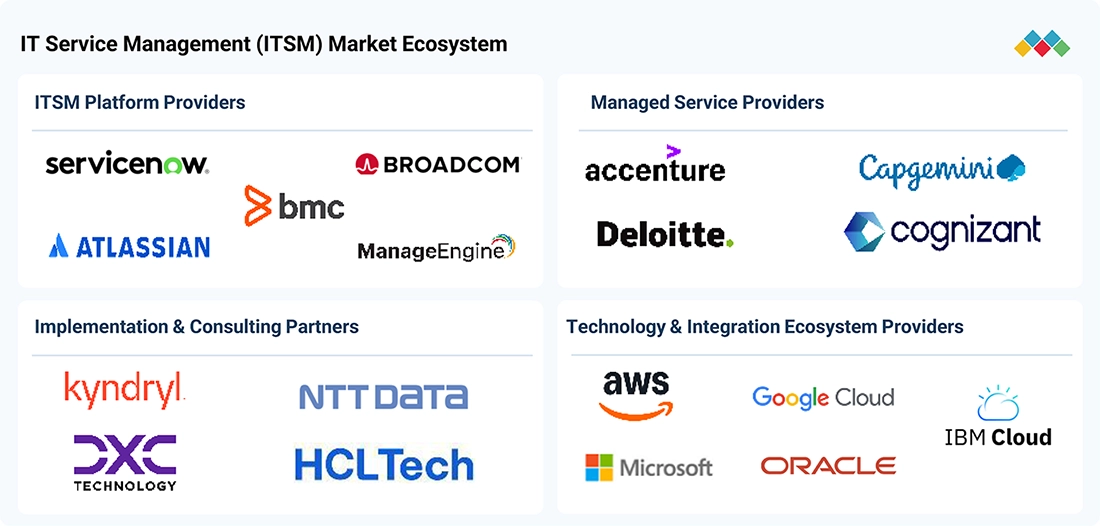
IT SERVICE MANAGEMENT (ITSM) MARKET: COMMERCIAL USE CASES ACROSS INDUSTRIES
| COMPANY | USE CASE DESCRIPTION | BENEFITS |
|---|---|---|
 |
Mindsprint deployed ServiceNow ITSM Pro and related workflow automation to create a unified service-management environment, automate ticket routing, improve incident handling, and expand employee self-service. | Up to 95% of incidents automatically remediated | 57% reduction in time to close P0/P1 incidents | 30% reduction in MTTR | 99% ticket-routing accuracy | 40% incident deflection through self-service |
 |
The University of Aberdeen modernized legacy ITSM using Freshservice and Freddy AI to automate routine service-desk activities, improve ticket management, expand self-service, and increase support capacity. | 81% reduction in ticket-resolution time | 10,200 tickets deflected | 208% increase in ticket capacity | Automation generated an estimated 405 working days of annual staff-time savings |
 |
EnerSys implemented ServiceDesk Plus to improve request categorization, automated ticket dispatch, technician assignment, workflow management, and SLA control across its service environment. | Average ticket-resolution time reduced from 48 hours to 5–6 hours | 98.9% SLA compliance | Improved request routing and service visibility |
Logos and trademarks shown above are the property of their respective owners. Their use here is for informational and illustrative purposes only.
Related Ecosystem
Software And Services
- Natural Language Processing (NLP)
- Machine Learning
- Supply Chain Management
- Predictive Analytics
- Image Sensors
- International Business Machines Corporation
- MICROSOFT CORPORATION
- Oracle Corporation
- SAP SE
- Amazon.com, Inc.
Cloud Computing
- Software as A Service (SaaS)
- Natural Language Processing (NLP)
- Platform as A Service (PaaS)
- Machine Learning
- Supply Chain Management
- International Business Machines Corporation
- MICROSOFT CORPORATION
- Oracle Corporation
- Amazon.com, Inc.
Digitalization And Iot
- Sensors
- Remote Monitoring
- Supply Chain Management
- Passenger Information System (PIS)
- Platform as A Service (PaaS)
- International Business Machines Corporation
- Cisco Systems, Inc.
- MICROSOFT CORPORATION
- Oracle Corporation
- HUAWEI TECHNOLOGIES CO LTD
Key Takeaways
- Rest Of Europe's ITSM market is projected to double from $609.0M (2023) to $1,292.0M (2028), driven by digital transformation initiatives across the region.
- A 16.2% CAGR positions Rest Of Europe as a high-growth ITSM market, outpacing mature Western European economies with accelerating cloud and automation adoption.
- Rest Of Europe enterprises are increasingly adopting AI-powered service management and hybrid IT solutions to address operational complexity and regulatory compliance requirements.
- The region's diverse IT landscapes and modernization priorities create significant opportunities for ITSM vendors offering scalable, integrated, and cost-effective solutions.
IT Service Management (ITSM) Market Report Scope
| Report Metric | Details |
|---|---|
| Base Year | 2023 |
| Fastest Growing Segment | SERVICES (Component) |
| Forecast Period | 2023-2028 |
| Growth Rate | CAGR of 15.9% from 2023 to 2028 |
| Largest Segment | CLOUD (Deployment Model) |
| Market Size Base Year (Billions) | ~USD 10.57 (2023) |
| Revenue Forecast (Billions) | ~USD 22.1 (2028) |
| Segments Covered | Offering, Solution, Service, Organization Size, Deployment Model, Vertical, Component, Module, System, Enterprise Size, End-Use Vertical |
Rest Of Europe IT Service Management (ITSM) Market Report Segmentation
11 segment dimensions are covered across the global market.
By Offering
- Services
- Solutions
By Solution
- Configuration & Change Management
- Dashboard, Reporting, And Analytics
- Operations & Performance Management
- Service Desk Software
- Service Portfolio Management
By Service
- Managed Services
- Professional Services
By Organization Size
- Large Enterprises
- Services
- Smes
- Solutions
By Deployment Model
- Cloud
- On-Premises
By Vertical
- Bfsi
- Education
- Energy & Utilities
- Energy And Utilities
- Government & Public Sector
- Government And Public Sector
- Healthcare
- Healthcare And Life Sciences
- It & Ites
- It And Ites
- Manufacturing
- Media & Entertainment
- Media And Entertainment
- Other Verticals
- Retail & Consumer Goods
- Retail And Consumer Goods
- Telecommunications
By Component
- Services
- Solutions
By Module
- Cmdb
- Others*
- Service Catalog
- Service Definition
By System
- Servers
- Software And Applications
- Storage
By Enterprise Size
- Large Enterprises
- Smes
By End-Use Vertical
- Bfsi
- Government And Public Sector
- Healthcare And Life Sciences
- Manufacturing
- Others*
- Retail And Consumer Packaged Goods
- Telecom And Ites
Target Audience
- ITSM Software Vendors : Vendors need Rest Of Europe-specific market data to identify growth opportunities, benchmark competitive positioning, and develop localized product strategies aligned with regional regulatory requirements.
- IT Consulting & Systems Integrators : Consultants require detailed market insights to understand client demand patterns, competitive offerings, and implementation trends across Rest Of Europe to enhance service delivery and advisory capabilities.
- Enterprise IT Decision Makers : CIOs and IT directors need market intelligence to evaluate ITSM solution options, understand industry best practices, and justify technology investments within Rest Of Europe's business context.
- Investment & Private Equity Firms : Investors require comprehensive market analysis of Rest Of Europe ITSM sector to identify acquisition targets, assess growth potential, and evaluate portfolio company positioning and expansion opportunities.
- Market Research & Strategy Teams : Corporate strategists need region-specific ITSM market data to support competitive analysis, market entry planning, and long-term business strategy development for Rest Of Europe operations.
Reasons to Buy this Report
- Regional Market Sizing & Forecasts : Obtain precise market valuation data specific to Rest Of Europe ($609M in 2023, $1,292M by 2028) with detailed CAGR analysis to support strategic planning and investment decisions.
- Competitive Landscape Intelligence : Understand vendor positioning, market share dynamics, and localized competitive strategies unique to Rest Of Europe's diverse regulatory and business environments.
- Growth Driver Analysis : Identify key growth catalysts including digital transformation initiatives, regulatory compliance requirements, and enterprise adoption patterns specific to Rest Of Europe markets.
- Segment & Vertical Insights : Access detailed breakdowns by ITSM solution types, deployment models, and industry verticals to identify high-growth opportunities within Rest Of Europe.
- Strategic Market Entry Planning : Leverage region-specific insights on customer needs, purchasing behaviors, and market maturity levels to develop targeted go-to-market strategies for Rest Of Europe expansion.
Frequently asked questions
What is the current size of the ITSM market in Rest Of Europe?
In 2023, Rest Of Europe's ITSM market was valued at $609.0 million, reflecting strong demand for IT service management solutions across the region.
What is the projected ITSM market size for Rest Of Europe by 2028?
Rest Of Europe's ITSM market is forecast to reach $1,292.0 million by 2028, representing significant growth from the 2023 baseline.
What is the CAGR for the ITSM market in Rest Of Europe?
Rest Of Europe's ITSM market is expected to grow at a compound annual growth rate of 16.2% between 2023 and 2028.
What factors are driving ITSM market growth in Rest Of Europe?
Key drivers include digital transformation initiatives, cloud adoption, hybrid IT complexity, automation investments, and regulatory compliance requirements across Rest Of Europe enterprises.
How does Rest Of Europe's ITSM growth compare to global trends?
Rest Of Europe's 16.2% CAGR slightly exceeds the global ITSM CAGR of 15.9%, indicating the region is a high-growth market with accelerating modernization momentum.
RESEARCH METHODOLOGY
This research study on the IT Service Management (ITSM) market involved extensive secondary and primary research. Secondary sources included company annual reports, SEC and regulatory filings, investor presentations, product documentation, pricing pages, press releases, white papers, technology journals, government publications, industry associations, cloud adoption databases, IT service management standards and frameworks, and paid databases. Primary sources primarily included industry experts from ITSM software vendors, managed service providers, system integrators, consulting organizations, cloud service providers, enterprise users, and related technology companies. In-depth interviews with market participants and subject-matter experts were conducted to gather and validate critical qualitative and quantitative information and assess the market’s growth prospects.
Secondary Research
During the secondary research process, multiple sources were reviewed to identify and collect information relevant to the study. These sources included annual reports, regulatory filings, investor presentations, earnings transcripts, press releases, product portfolios, acquisition announcements, pricing pages, customer references, and technology documentation from ITSM vendors.
Additional information was gathered from recognized journals, industry associations, government websites, technology publications, cloud provider materials, and certified publications. Data relating to enterprise IT spending, cloud adoption, digital transformation, service desk modernization, IT outsourcing, managed services, artificial intelligence adoption, workflow automation, cybersecurity spending, and enterprise software expenditure across major countries was also extracted from relevant secondary sources.
Secondary research was used to develop preliminary market estimates, understand competitive positioning, identify vendor offerings, establish market segmentation, analyze technology trends, and determine regional adoption patterns.
Primary Research
During the primary research process, respondents from both the supply and demand sides were interviewed to obtain qualitative and quantitative information about the market. Supply-side participants included chief executive officers, vice presidents, directors, product managers, ITSM platform leaders, engineering executives, business development executives, marketing executives, service-management specialists, implementation consultants, and solution architects.
Breakup of Primary Profiles:
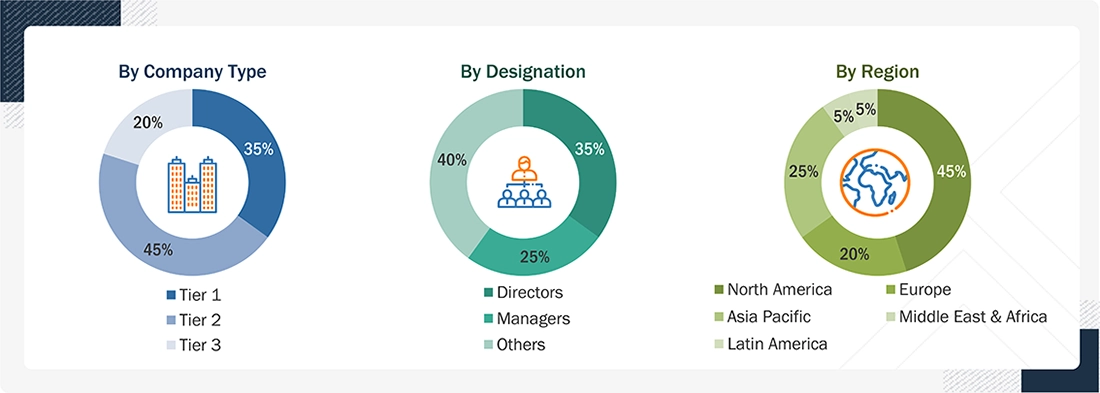
Note: Tier 1 companies’ revenues are more than USD 1 billion; Tier 2 companies’ revenues range between USD 100 million and USD 1 billion; and Tier 3 companies’ revenues range between USD 10 million and USD 100 million. Other designations include sales, marketing, engineering, product, operations, consulting, and research managers.
Source: Industry Experts
To know about the assumptions considered for the study, download the pdf brochure
Market Size Estimation
Multiple approaches were used to estimate and forecast the IT Service Management market. The first approach involved estimating market size based on revenues generated by companies from ITSM software products, platform subscriptions, associated professional services, and managed services.
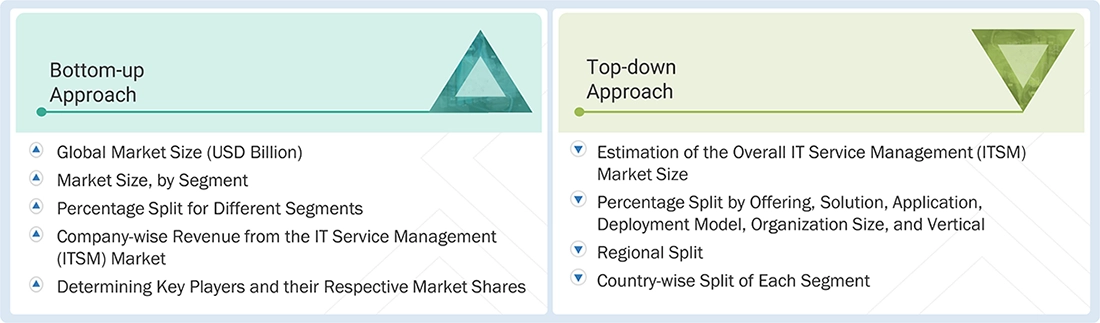
Market Size Estimation Methodology: Top-down Approach
The top-down approach involved preparing an exhaustive list of vendors offering ITSM platforms, service desk software, workflow automation, configuration and change management, service management analytics, managed services, and related offerings.
Market Size Estimation Methodology: Bottom-up Approach
The bottom-up approach assessed the adoption of IT Service Management platforms across major verticals and countries contributing significantly to the market. Enterprise deployments were evaluated across service desk software, incident & problem management, change & release management, service request & catalog management, configuration management, knowledge & self-service management, and service level management. Adoption levels across large enterprises and SMEs were estimated and extrapolated using cloud maturity, enterprise IT spending, service-management penetration, workforce size, service volumes, SaaS adoption, and managed service utilization.
Regional splits were determined through primary and secondary sources. The process included analysis of regional ITSM penetration, enterprise software spending, cloud adoption, digital transformation activity, IT outsourcing, service desk modernization, and managed services adoption. Strategic analysis of major global and regional ITSM vendors, together with their organic and inorganic developments, was also incorporated into the market estimates.
IT Service Management (ITSM) Market : Top-Down and Bottom-Up Approach
Data Triangulation
After determining the overall IT Service Management market size using the top-down and bottom-up estimation approaches, the market was divided into segments and subsegments. Data triangulation and market breakup procedures were applied to validate each market segment and subsegment. Vendor revenues, customer adoption patterns, deployment preferences, application penetration, service revenues, regional indicators, pricing structures, and primary interview findings were compared to identify inconsistencies and refine the estimates. The final market size was then used to estimate individual segments by applying validated percentage splits across the market segmentation. The resulting figures were cross-checked against supply-side revenues, demand-side ITSM adoption indicators, enterprise technology spending, cloud software penetration, managed services usage, product pricing, and regional economic conditions.
Market Definition
The IT Service Management market comprises software solutions and associated services that enable organizations to design, deliver, manage, support, govern, and continuously improve IT services across enterprise environments. ITSM platforms provide structured workflows for incident and problem management, change and release management, service request and catalog management, configuration management, knowledge and self-service management, service-level management, and service portfolio management. These platforms help enterprises standardize service processes, improve service availability, automate repetitive support activities, increase employee productivity, and strengthen governance across increasingly complex technology environments.
ITSM platforms include capabilities such as service desk software, CMDB, service catalogs, workflow orchestration, AI-enabled virtual agents, automated ticket classification and routing, knowledge recommendations, SLA monitoring, service analytics, change-risk assessment, and increasingly agentic and autonomous service-management capabilities. The market includes on-premises and cloud deployment models and supports enterprises operating traditional infrastructure, public cloud, private cloud, hybrid environments, SaaS applications, distributed endpoints, and modern digital workplaces.
Key Stakeholders
- ITSM platform providers
- Service desk software providers
- Service portfolio management vendors
- Configuration and change management vendors
- Managed service providers
- Professional service providers
- System integrators
- Cloud service providers
- IT operations management providers
- IT asset management providers
- AI and automation technology providers
- Enterprise software and workflow automation vendors
- Consulting organizations
- CIOs, CTOs, and enterprise IT leaders
- IT service management and service desk teams
Report Objectives
- To define and describe the IT Service Management market by offering, solution, services, application, deployment model, organization size, vertical, and region.
- To provide detailed information on major factors influencing market growth, including drivers, restraints, opportunities, and challenges across the ITSM ecosystem.
- To strategically analyze micro-markets with respect to individual growth trends, adoption patterns, and their contribution to the overall ITSM market.
- To analyze market opportunities for stakeholders and present the competitive landscape of ITSM platform vendors, managed service providers, enterprise software vendors, and technology partners.
- To project the market size and its submarkets in terms of value across North America, Europe, Asia Pacific, Middle East & Africa, and Latin America.
- To analyze major countries within each region based on cloud adoption, enterprise IT spending, digital maturity, ITSM penetration, and service-management modernization.
- To strategically profile leading companies and evaluate their product portfolios, platform capabilities, geographic presence, growth strategies, and market positioning.
- To examine competitive developments, including product launches, platform enhancements, partnerships, collaborations, acquisitions, investments, and geographic expansions.
- To assess the impact of generative AI, agentic AI, autonomous service desks, enterprise service management, workflow automation, cloud migration, and ITSM–ITOM convergence on market development.
- To analyze adoption across incident & problem management, change & release management, service request & catalog management, configuration management, knowledge & self-service management, and service level management.
- To assess deployment trends across on-premises and cloud environments.
- To identify high-growth segments, emerging use cases, and evolving technology requirements across the ITSM market.
Available customizations:
With the given market data, MarketsandMarkets offers customizations as per the company’s specific needs. The following customization options are available for the report:
Product Analysis
- The product matrix provides a detailed comparison of the product portfolios, ITSM capabilities, deployment models, AI capabilities, and integrations of each company.
Geographic Analysis based on feasibility
- Further breakup of the North American IT Service Management market
- Further breakup of the European IT Service Management market
- Further breakup of the Asia Pacific IT Service Management market
- Further breakup of the Middle East & Africa IT Service Management market
- Further breakup of the Latin American IT Service Management market
Company Information
-
Detailed analysis and profiling of additional market players (up to five)
Get the Full IT Service Management (ITSM) Market Report
Full forecast, segment splits, and company analysis for all IT Service Management (ITSM) Market.
- Canada IT Service Management (ITSM) Market
- US IT Service Management (ITSM) Market
- UK IT Service Management (ITSM) Market
- Germany IT Service Management (ITSM) Market
- France IT Service Management (ITSM) Market
- Netherlands IT Service Management (ITSM) Market
- Italy IT Service Management (ITSM) Market
- China IT Service Management (ITSM) Market
- Japan IT Service Management (ITSM) Market
- Australia IT Service Management (ITSM) Market
- Singapore IT Service Management (ITSM) Market
- South Africa IT Service Management (ITSM) Market
- Brazil IT Service Management (ITSM) Market
- Mexico IT Service Management (ITSM) Market
- Rest Of Asia Pacific IT Service Management (ITSM) Market
- Rest Of Latin America IT Service Management (ITSM) Market
- GCC IT Service Management (ITSM) Market
Need a Tailored Report?
Customize this report to your needs
Get 10% FREE Customization
Customize This Report
