
Canada Laser Interferometer Market (2025-2030)

The Canada Laser Interferometer Market was valued at $16.33 Million in 2025 and projected to reach to $21.5 Million by 2030, representing a compound annual growth rate of 5.7%. Canada's laser interferometer market is poised for steady expansion through 2030, supported by the country's robust semiconductor and electronics manufacturing ecosystem.


| Market Size in | USD 26.32 MN |
| Market Forecast in | |
| CAGR | |
| Forecast Period | |
| Units Considered | Value (USD MN) |
Canada Laser Interferometer Market Trends and Insights
- Canada's semiconductor and electronics sector is driving demand for precision measurement technologies, with laser interferometers playing a critical role in quality control and manufacturing processes.
- The market in Canada reflects steady adoption across automotive, aerospace, and industrial applications where dimensional accuracy is paramount. The growth trajectory in Canada is supported by increasing investments in advanced manufacturing and R&D infrastructure.
- Canada's position as a hub for technology innovation and its proximity to North American supply chains enhance the market's expansion potential through 2030.
- Key drivers include rising demand for miniaturized components, stricter quality standards, and the integration of laser interferometry in next-generation semiconductor fabrication facilities across Canada..
Key Market Statistics
- CAGR (2025-2030) 5.7% CAGR
- Market Size, 2025 ~USD 16.33 Million
- Forecast, 2030 ~USD 21.5 Million
- Country Canada
Canada Laser Interferometer Market Overview
Market Size & Growth :
Canada's laser interferometer market is valued at $16.33 million in 2025, with projected growth to $21.5 million by 2030, reflecting a steady 5.7% CAGR driven by precision manufacturing demands.
Semiconductor Sector Momentum :
Canada's growing semiconductor and electronics manufacturing base is increasingly adopting laser interferometry for precision quality control, positioning the country as a key regional market for advanced measurement technologies.
Manufacturing Excellence Focus :
Canadian manufacturers are investing in laser interferometer systems to enhance production accuracy and reduce defects, particularly in aerospace, automotive, and electronics component fabrication.
Technology Adoption Rate :
Canada's mature industrial infrastructure and emphasis on Industry 4.0 standards are accelerating the adoption of precision measurement tools, outpacing global growth at a competitive regional pace.
Canada Laser Interferometer Market Dynamics
- The 5.7% CAGR reflects sustained investment in precision measurement technologies as Canadian manufacturers prioritize quality control and operational efficiency.
- Key drivers include increasing demand from aerospace and automotive sectors, growing adoption of advanced manufacturing practices, and government support for technology-driven industrial development. The market outlook remains positive as Canadian companies continue modernizing production facilities and integrating sophisticated measurement systems.
- With a global CAGR of 6.7%, Canada's slightly lower regional growth rate reflects market maturity and selective adoption patterns.
- Strategic opportunities exist for suppliers targeting specialized applications in semiconductor fabrication, optical component manufacturing, and precision engineering sectors across major industrial hubs..
Market Ecosystem
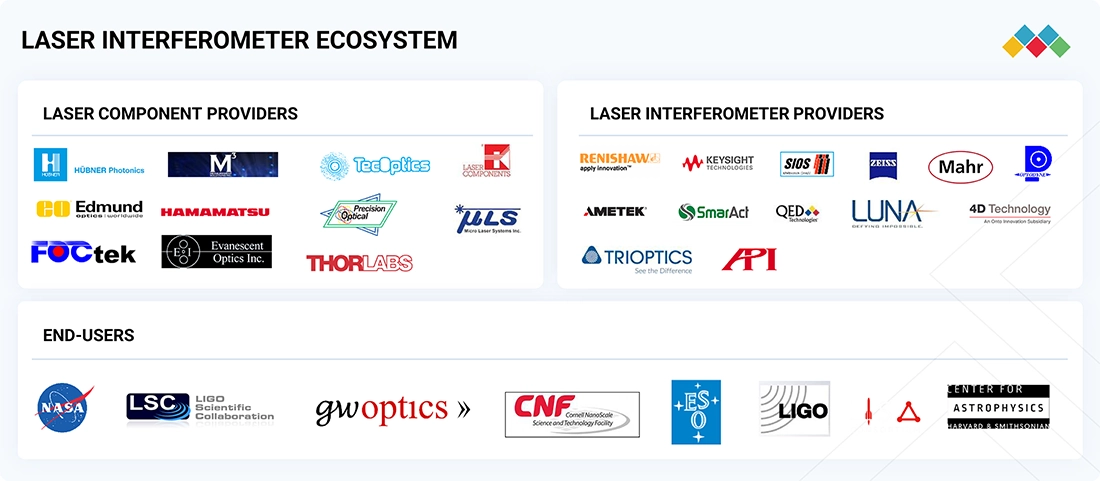
Laser Interferometer Market: COMMERCIAL USE CASES ACROSS INDUSTRIES
| COMPANY | USE CASE DESCRIPTION | BENEFITS |
|---|---|---|
 |
Laser interferometers for machine tool calibration and industrial metrology applications | Improved manufacturing precision| Reduced production errors| Extended machine tool life |
 |
Interferometry solutions for electronics, semiconductor testing, and optical communication systems | High-accuracy measurements| Enhanced product reliability| Faster time-to-market |
 |
Laser interferometers for surface topology analysis in optics, automotive, and aerospace sectors | Superior component quality| Defect detection at nanometer scale| Compliance with stringent standards |
 |
Interferometric metrology for semiconductor wafer inspection and optical component testing | Sub-nanometer accuracy| Improved yield rates| Reduced defects|Enhanced performance consistency |
 |
Laser interferometry-based surface analysis systems for materials research and life sciences | Advanced surface characterization| Support for nanotechnology research| Reliable results in R&D |
Logos and trademarks shown above are the property of their respective owners. Their use here is for informational and illustrative purposes only.
Related Ecosystem
Electronics System And Components
- Sensors
- Temperature Sensors
- Pressure Sensors
- Actuators
- Image Sensors
- Lenovo
- Samsung
- Texas Instruments Incorporated
- HONEYWELL INTERNATIONAL INC.
- Teledyne Technologies Incorporated
Industrial Automation
- Sensors
- Image Sensors
- Manufacturing Execution System (MES)
- Actuators
- Flow Sensors
- Siemens ag
- ABB India Limited
- Emerson Electric Co.
- HONEYWELL INTERNATIONAL INC.
- SCHNEIDER ELECTRIC SE
Sensors And Control
- Sensors
- Temperature Sensors
- Image Sensors
- Pressure Sensors
- Flow Sensors
- BAUMER ELECTRIC AG
- HONEYWELL INTERNATIONAL INC.
- Stmicroelectronics
- Lenovo
- Texas Instruments Incorporated
Key Takeaways
- Canada's laser interferometer market is valued at $16.33 million in 2025 and will reach $21.5 million by 2030 at a 5.7% CAGR.
- Canada's semiconductor and electronics industries are primary demand drivers for precision measurement and quality control applications.
- Advanced manufacturing investments and R&D infrastructure in Canada support sustained market growth through the forecast period.
- Canada's strategic position in North American supply chains enhances adoption of laser interferometry across automotive, aerospace, and industrial sectors.
Laser Interferometer Market Report Scope
| Report Metric | Details |
|---|---|
| Base Year | 2025 |
| Fastest Growing Segment | INDUSTRIAL (Vertical 2021-2024) |
| Forecast Period | 2025-2030 |
| Growth Rate | CAGR of 6.7% from 2025 to 2030 |
| Largest Segment | HETERODYNE (Technique) |
| Market Size Base Year (Billions) | ~USD 0.34 (2025) |
| Revenue Forecast (Billions) | ~USD 0.47 (2030) |
| Segments Covered | Type, Technique, Application, Vertical 2021-2024, Vertical |
Canada Laser Interferometer Market Report Segmentation
5 segment dimensions are covered across the global market.
By Type
- Fabry-Perot Interferometers
- Fizeau Interferometers
- Mach-Zehnder Interferometers
- Michelson Interferometers
- Sagnac Interferometers
- Twyman-Green Interferometers
By Technique
- Heterodyne
- Homodyne
By Application
- Applied Science
- Biomedical
- Engineering
- Semiconductor Detection
- Surface Topology
By Vertical 2021-2024
- Aerospace & Defense
- Automotive
- Electronics & Semiconductor
- Healthcare
- Industrial
- Telecommunications
By Vertical
- Aerospace & Defense
- Automotive
- Electronics & Semiconductor
- Healthcare
- Industrial
- Telecommunications
CANADA: LASER INTERFEROMETER MARKET, BY VERTICAL, 2025–2030
| Segment | 2025 | 2026 | 2027 | 2028 | 2029 | 2030 | CAGR (%) |
|---|---|---|---|---|---|---|---|
| AEROSPACE & DEFENSE | 4.65 | 4.83 | 5.05 | 5.29 | 5.56 | 5.84 | 4.7 |
| AUTOMOTIVE | 3.32 | 3.51 | 3.74 | 3.98 | 4.26 | 4.55 | 6.5 |
| ELECTRONICS & SEMICONDUCTOR | 2.44 | 2.56 | 2.7 | 2.86 | 3.03 | 3.21 | 5.7 |
| HEALTHCARE | 1.52 | 1.57 | 1.63 | 1.7 | 1.78 | 1.85 | 4 |
| INDUSTRIAL | 2.34 | 2.53 | 2.75 | 3 | 3.28 | 3.58 | 8.9 |
| TELECOMMUNICATIONS | 2.06 | 2.14 | 2.21 | 2.29 | 2.36 | 2.46 | 3.6 |
| TOTAL | 16.33 | 17.15 | 18.09 | 19.13 | 20.26 | 21.5 | 5.7 |
Target Audience
- Semiconductor Manufacturers : Canadian semiconductor producers need detailed market data to assess laser interferometer adoption rates, competitive offerings, and technology investments required for precision fabrication processes.
- Equipment Suppliers & Distributors : Suppliers targeting Canada require localized market insights to identify growth opportunities, understand customer segments, and develop region-specific sales and marketing strategies.
- Industrial & Manufacturing Companies : Canadian manufacturers in aerospace, automotive, and electronics sectors need market intelligence to evaluate precision measurement technology investments and benchmark against industry standards.
- Technology Investors & Consultants : Investment firms and business consultants require Canada-specific market data to assess growth potential, identify acquisition targets, and guide clients on market entry strategies.
- Government & Policy Makers : Canadian government agencies and industrial development organizations need market insights to inform technology policy, manufacturing incentives, and support programs for precision engineering sectors.
Reasons to Buy this Report
- Localized Market Intelligence : Gain Canada-specific insights into market size, growth trajectories, and regional dynamics that differ from global trends, enabling targeted business strategies for the Canadian market.
- Sector-Specific Demand Analysis : Understand how Canada's semiconductor, aerospace, and automotive sectors are driving laser interferometer adoption, with detailed insights into end-user requirements and purchasing patterns.
- Competitive Positioning : Identify market gaps and opportunities unique to Canada's industrial landscape, helping suppliers and manufacturers optimize product offerings and distribution strategies for regional success.
- Investment & Expansion Planning : Make informed decisions about market entry, facility expansion, or partnership development in Canada with reliable forecasts and growth projections through 2030.
- Technology Adoption Trends : Track Canada-specific adoption rates of precision measurement technologies, including Industry 4.0 integration and manufacturing modernization initiatives affecting market demand.
Frequently asked questions
What is the current size of Canada's laser interferometer market?
Canada's laser interferometer market is estimated at $16.33 million in 2025 and is expected to grow to $21.5 million by 2030.
What is the projected growth rate for Canada's laser interferometer market?
Canada's laser interferometer market is projected to grow at a compound annual growth rate (CAGR) of 5.7% from 2025 to 2030.
Which industries in Canada are driving laser interferometer demand?
Canada's semiconductor, electronics, automotive, aerospace, and industrial manufacturing sectors are the primary drivers of laser interferometer adoption for precision measurement and quality assurance.
What factors are supporting market growth in Canada?
Canada's market growth is supported by increased investments in advanced manufacturing, R&D infrastructure, demand for miniaturized components, stricter quality standards, and integration into semiconductor fabrication facilities.
How does Canada's market compare to the global laser interferometer market?
Canada's 5.7% CAGR is slightly lower than the global 6.7% CAGR, reflecting regional market maturity and steady but measured adoption across Canadian industries.
RESEARCH METHODOLOGY
The research process for this study included systematic gathering, recording, and analysis of data about customers and companies operating in the laser interferometer market. This process involved the extensive use of secondary sources, directories, and databases (Factiva and Oanda) to identify and collect valuable information for the comprehensive, technical, market-oriented, and commercial study of the Laser interferometer market.
In-depth interviews were conducted with primary respondents, including experts from core and related industries, as well as preferred manufacturers, to gather and verify critical qualitative and quantitative information and assess growth prospects. Key players in the laser interferometer market were identified through secondary research, and their market rankings were determined through primary and secondary research. This research involved studying the annual reports of top players and conducting interviews with key industry experts, including CEOs, directors, and marketing executives.
Secondary Research
Various sources were used in the secondary research process to identify and collect information crucial for this study. These include company annual reports, press releases, investor presentations, white papers, technology journals, certified publications, articles by recognized authors, directories, and databases. Secondary research was primarily used to gather key information about the industry’s value chain, the total pool of market players, market classification according to industry trends at the most detailed level, regional markets, and key developments from both market and technology-oriented perspectives.
Primary Research
Primary research was also conducted to identify the segmentation types, key players, competitive landscape, and key market dynamics, such as drivers, restraints, opportunities, challenges, and industry trends, along with key strategies adopted by players operating in the laser interferometer market. Extensive qualitative and quantitative analyses were performed on the complete market engineering process to list key information and insights throughout the report.
Extensive primary research has been conducted after acquiring knowledge about the laser interferometer market scenarios through secondary research. Several primary interviews have been conducted with experts from the demand and supply side across four major geographic regions: North America, Europe, Asia Pacific, and RoW. Approximately 60% and 40% of the primary interviews were conducted from the supply and demand sides. These primary data have been collected through questionnaires, emails, and telephonic interviews.
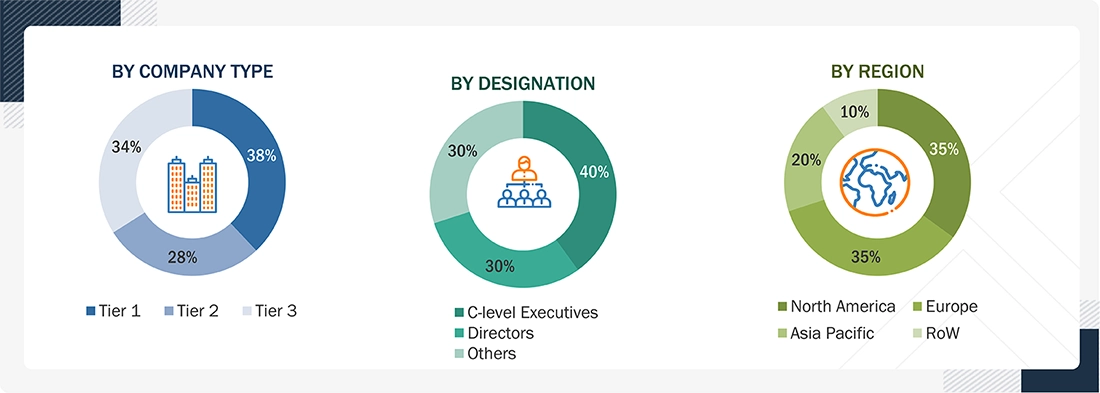
Note: The three tiers of the companies have been defined based on their total/segmental revenue as of 2024: Tier 1 = >USD 1 billion, Tier 2 = USD 1 billion–USD 500 million, and Tier 3 = USD 500 million. ‘Others’ include sales, marketing, and product managers.
To know about the assumptions considered for the study, download the pdf brochure
Market Size Estimation
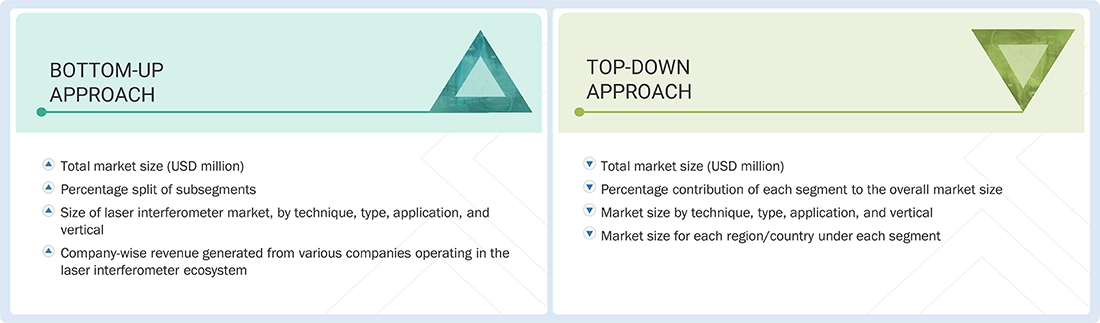
In the comprehensive market engineering process, the top-down and bottom-up approaches, along with several data triangulation methods, were implemented to estimate and validate the size of the laser interferometer market and various other dependent submarkets. Key players in the market were identified through secondary research, and their market share in the respective regions was determined through primary and secondary research. This entire research methodology included the study of annual and financial reports of the top players and interviews with experts (CEOs, VPs, directors, and marketing executives) for key insights (quantitative and qualitative).
All percentage shares, splits, and breakdowns were determined using secondary sources and verified through primary sources. All the possible parameters that affect the markets covered in this research study were accounted for, viewed in detail, verified through primary research, and analyzed to obtain the final quantitative and qualitative data. This data was consolidated and supplemented with detailed inputs and analysis from MarketsandMarkets and presented in this report.
Laser Interferometer Market: Top-Down and Bottom-Up Approach
Data Triangulation
After determining the overall market size through the market size estimation process, as explained above, the total market has been divided into several segments and subsegments. To complete the overall market engineering process and obtain precise statistics for all segments and subsegments, market breakdown and data triangulation procedures have been employed, as applicable. The data have been triangulated by studying various factors and trends from the demand and supply sides. Along with this, the market has been validated using top-down and bottom-up approaches.
Market Definition
Precision measuring instruments reduce measurement-related errors or machining errors in calibration and manufacturing processes. A laser interferometer is one such precision measuring instrument that delivers precise measurements of real-life objects. In most laser interferometers, a laser from a single source is split into two beams that travel in different optical paths, which are then combined to produce interference. Laser interferometers are usually used in ultraprecision machining and manufacturing, ultraprecision positioning control, and many non-contact optical sensing technologies. Laser interferometers are extensively used in research projects and manufacturing plants for the measurement of small displacements, refractive index changes, and surface irregularities.
Key Stakeholders
- Laser material and component providers
- Laser interferometer providers, integrators, and installers
- Electronic hardware equipment manufacturers
- Optical measurement system manufacturers
- Laser interferometer software and solution providers
- Consulting companies
- Laser interferometer-related associations, organizations, forums, and alliances
- Government and corporate bodies
- Research institutes and organizations
- Venture capitalists, private equity firms, and startup companies
- Distributors and traders
- Original equipment manufacturers (OEMs)
- End users
Report Objectives
- To define, describe, and forecast the laser interferometer market, in terms of value, segmented by technique, type, application, and vertical.
- To describe and forecast the market, in terms of value, for various segments with respect to four main regions—North America, Europe, Asia Pacific, and Rest of the World (RoW)
- To forecast the market for different types of laser interferometers in terms of volume
- To provide detailed information regarding the major factors, such as drivers, restraints, opportunities, and challenges, influencing the growth of the laser interferometer market
- To strategically analyze micromarkets1 with respect to individual growth trends, prospects, and contributions to the total market
- To analyze opportunities for stakeholders by identifying high-growth segments of the laser interferometer market
- To benchmark players within the market using the proprietary Company Evaluation Matrix framework, which analyzes market players on various parameters within the broad categories of market rank and product offering
- To strategically profile the key players and comprehensively analyze their market shares and core competencies2, and provide a detailed competitive landscape for market leaders
- To analyze competitive developments, such as partnerships, collaborations, agreements, and joint ventures; mergers and acquisitions; expansions; and product launches and developments, in the laser interferometer market
Customization Options
With the given market data, MarketsandMarkets offers customizations according to the company’s specific needs. The following customization options are available for the report:
Get the Full Laser Interferometer Market Report
Full forecast, segment splits, and company analysis for all Laser Interferometer Market.
- Mexico Laser Interferometer Market
- US Laser Interferometer Market
- UK Laser Interferometer Market
- Germany Laser Interferometer Market
- France Laser Interferometer Market
- Italy Laser Interferometer Market
- China Laser Interferometer Market
- Japan Laser Interferometer Market
- India Laser Interferometer Market
- South Korea Laser Interferometer Market
- Rest Of Europe Laser Interferometer Market
- Rest Of Asia Pacific Laser Interferometer Market
Need a Tailored Report?
Customize this report to your needs
Get 10% FREE Customization
Customize This Report
