
Europe Lateral Flow Assay Components Market (2025-2030)

The Europe Lateral Flow Assay Components Market was valued at $108.63 Million in 2025 and projected to reach to $135.27 Million by 2030, representing a compound annual growth rate of 4.5%. Europe's lateral flow assay components market is positioned for sustained growth through 2030, supported by robust healthcare spending, regulatory compliance frameworks, and widespread adoption of point-of-care testing solutions.


| Market Size in | USD 26.32 MN |
| Market Forecast in | |
| CAGR | |
| Forecast Period | |
| Units Considered | Value (USD MN) |
Europe Lateral Flow Assay Components Market Trends and Insights
- This steady growth reflects Europe's strong healthcare infrastructure, regulatory frameworks, and increasing demand for point-of-care diagnostic solutions across the region.
- Europe continues to lead in adoption of rapid diagnostic technologies, driven by both clinical and consumer health applications. The European market benefits from established manufacturing capabilities, stringent quality standards, and significant investment in healthcare innovation.
- Between 2025 and 2030, Europe is expected to maintain its position as a key hub for lateral flow assay component development and distribution.
- Growth in Europe is supported by rising prevalence of infectious diseases, expansion of home-based testing, and regulatory support for rapid diagnostic deployment across member states..
Key Market Statistics
- CAGR (2025-2030) 4.5% CAGR
- Market Size, 2025 ~USD 108.63 Million
- Forecast, 2030 ~USD 135.27 Million
- Geography Europe
Europe Lateral Flow Assay Components Market Overview
Market Leadership Position :
Europe commands a significant share of the global lateral flow assay components market, valued at USD 108.63 million in 2025, driven by advanced healthcare infrastructure and stringent regulatory standards across EU member states.
Steady Growth Trajectory :
The European market is projected to expand from USD 108.63 million (2025) to USD 135.27 million (2030) at a CAGR of 4.5%, outpacing the global growth rate of 4.4% and reflecting strong regional demand.
Germany Dominance :
Germany leads European adoption with a market size of USD 33.11 million, followed by France (USD 23.74 million) and the UK (USD 11.79 million), establishing the region as a hub for diagnostic innovation.
Point-of-Care Diagnostic Expansion :
Increasing demand for rapid, accessible diagnostic solutions across European healthcare systems is accelerating adoption of lateral flow assay components in clinical and home-use applications.
Europe Lateral Flow Assay Components Market Dynamics
- The region's emphasis on early disease detection and preventive healthcare drives consistent demand across clinical laboratories, hospitals, and home diagnostic settings.
- Germany, France, and the UK remain key growth engines, while emerging markets within Rest of Europe present additional expansion opportunities.
- Technological advancements in assay sensitivity and specificity, coupled with increasing prevalence of infectious diseases and chronic conditions, will further propel market expansion.
- European manufacturers benefit from established supply chains and quality standards that enhance competitive positioning globally..
Market Ecosystem
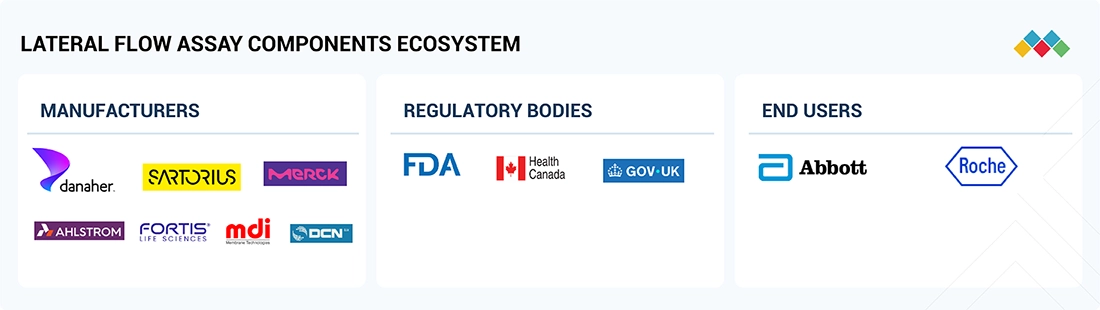
Lateral Flow Assay Components Market: COMMERCIAL USE CASES ACROSS INDUSTRIES
| COMPANY | USE CASE DESCRIPTION | BENEFITS |
|---|---|---|
 |
Provides a broad portfolio of LFA components including membranes, and pads for diagnostic applications. | Ensures high-quality, consistent assay performance; scalable production; reliable support for R&D and manufacturing workflows. |
 |
Offers Unisart CN membranes designed for lateral flow devices with customizable properties for diverse diagnostic needs. | Accelerates time-to-market; provides reproducible, defect-free membranes; supports flexible assay design and high-quality results. |
 |
Manufactures absorbent, conjugate, and sample pads, including plasma separation pads for lateral flow devices. | Improves fluid handling and assay reliability; customizable for specific applications; reduces production time and variability. |
 |
Supplies Hi-Flow Plus nitrocellulose membranes and SureWick pads for lateral flow assays, emphasizing clinical and industrial diagnostic use. | Delivers superior consistency and reliability; maintains high performance across batches; widely used in clinical diagnostics. |
 |
Provides membranes and absorbent pads suitable for dipstick and device formats in lateral flow assays. | Offers high-quality membranes and pads for efficient fluid flow; supports various LFA formats; enhances assay sensitivity and reproducibility. |
Logos and trademarks shown above are the property of their respective owners. Their use here is for informational and illustrative purposes only.
Related Ecosystem
In Vitro Diagnostics
- Polymerase Chain Reaction (PCR)
- Enzyme-Linked Immunosorbent Assay (ELISA)
- Dna Microarrays
- Assay Kits
- Microarrays
- ROCHE HOLDINGS AG
- Thermo Fisher Scientific Inc.
- Danaher Corporation
- Abbott Laboratories
- Biomerieux s.a.
Medical Devices
- Polymerase Chain Reaction (PCR)
- Magnetic Resonance Imaging (MRI)
- Disposable Autoinjectors
- Pulse Oximeters
- Blood Pressure Monitors
- Medtronic plc
- Abbott Laboratories
- Stryker Corporation
- Becton, Dickinson and Company
- JOHNSON & JOHNSON
Key Takeaways
- Europe's lateral flow assay components market is valued at USD 108.63 million in 2025 and will reach USD 135.27 million by 2030.
- Europe maintains a 4.5% CAGR, reflecting steady demand for point-of-care diagnostics across the region.
- Europe's strong regulatory environment and manufacturing infrastructure support sustained market growth through 2030.
- Europe is experiencing increased adoption of home-based and rapid diagnostic testing, driving component demand.
Lateral Flow Assay Components Market Report Scope
| Report Metric | Details |
|---|---|
| Base Year | 2025 |
| Fastest Growing Segment | DRUG DEVELOPMENT & QUALITY TESTING (Application) |
| Forecast Period | 2025-2030 |
| Growth Rate | CAGR of 4.4% from 2025 to 2030 |
| Largest Segment | CLINICAL TESTING (Application) |
| Market Size Base Year (Billions) | ~USD 0.39 (2025) |
| Revenue Forecast (Billions) | ~USD 0.49 (2030) |
| Segments Covered | Product, Membrane Type, Pad Type, Technique, Application, Type, End User |
Europe Lateral Flow Assay Components Market Report Segmentation
7 segment dimensions are covered across the global market.
By Product
- Membranes
- Other Components
- Pads
By Membrane Type
- Nitrocellulose Membranes
- Other Membranes
By Pad Type
- Absorbent Pads
- Conjugate Pads
- Sample Pads
By Technique
- Competitive Assays
- Multiplex Detection Assays
- Sandwich Assays
By Application
- Clinical Testing
- Drug Development & Quality Testing
- Food Safety & Environmental Testing
- Veterinary Diagnostics
By Type
- Cardiac Marker Testing
- Cholesterol Testing/Lipid Profiling
- Drug-Of-Abuse Testing
- Infectious Disease Testing
- Other Clinical Testing Applications
- Pregnancy & Fertility Testing
By End User
- Medical Device Contract Manufacturing Companies
- Medical Device Manufacturing Companies
REST OF EUROPE: LATERAL FLOW ASSAY COMPONENTS MARKET, BY END USER, 2023–2030
| Segment | 2023 | 2024 | 2025 | 2026 | 2027 | 2028 | 2029 | 2030 | CAGR (%) |
|---|---|---|---|---|---|---|---|---|---|
| MEDICAL DEVICE CONTRACT MANUFACTURING COMPANIES | 8.35 | 8.73 | 9.14 | 9.6 | 10.1 | 10.65 | 11.25 | 11.91 | 5.4 |
| MEDICAL DEVICE MANUFACTURING COMPANIES | 16.83 | 17.33 | 17.88 | 18.48 | 19.16 | 19.9 | 20.7 | 21.58 | 3.8 |
| TOTAL | 25.18 | 26.06 | 27.02 | 28.08 | 29.26 | 30.54 | 31.95 | 33.48 | 4.4 |
EUROPE: LATERAL FLOW ASSAY COMPONENTS MARKET, BY END USER, 2023–2030
| Segment | 2023 | 2024 | 2025 | 2026 | 2027 | 2028 | 2029 | 2030 | CAGR (%) |
|---|---|---|---|---|---|---|---|---|---|
| MEDICAL DEVICE CONTRACT MANUFACTURING COMPANIES | 33.92 | 35.49 | 37.22 | 39.1 | 41.19 | 43.48 | 45.98 | 48.72 | 5.5 |
| MEDICAL DEVICE MANUFACTURING COMPANIES | 67.09 | 69.16 | 71.41 | 73.88 | 76.66 | 79.67 | 82.96 | 86.55 | 3.9 |
| TOTAL | 101.01 | 104.65 | 108.63 | 112.98 | 117.84 | 123.15 | 128.95 | 135.27 | 4.5 |
Target Audience
- Diagnostic Device Manufacturers : European and international manufacturers need regional market data to optimize product portfolios, identify distribution partnerships, and align manufacturing capacity with growing demand for lateral flow components.
- Healthcare System Planners : Hospital administrators, clinical laboratory directors, and healthcare procurement teams require market insights to evaluate supplier options, budget allocation, and adoption of point-of-care testing solutions.
- Investment & Private Equity Firms : Investors targeting the European healthcare diagnostics sector need comprehensive market analysis to identify acquisition targets, assess growth potential, and evaluate competitive positioning of portfolio companies.
- Regulatory & Quality Assurance Teams : Compliance officers and quality managers need regional regulatory landscape analysis to navigate CE marking requirements, IVDR compliance, and quality standards specific to European markets.
- Market Research & Strategy Consultants : Business consultants and strategy firms require detailed European market data to support client advisory services, competitive benchmarking, and market entry strategy development across the region.
Countries within Europe - compare and drill down
| Country | 2025 size (native) |
|---|---|
| Germany | USD 33.11 Million |
| France | USD 23.74 Million |
| UK | USD 11.79 Million |
| Italy | USD 8.17 Million |
| Spain | USD 5.22 Million |
| Rest Of Europe | USD 18.84 Million |
Country market size visualization
Reasons to Buy this Report
- Regional Market Segmentation : Gain detailed insights into Europe's lateral flow assay market with country-level breakdowns for Germany, France, UK, Italy, Spain, and Rest of Europe, enabling targeted market entry strategies.
- Competitive Landscape Intelligence : Understand the competitive dynamics specific to European manufacturers and suppliers, including regulatory compliance advantages and market positioning strategies that differentiate regional players.
- Growth Opportunity Identification : Identify high-growth segments and emerging applications within Europe's healthcare system, from clinical diagnostics to home-use testing, with actionable market expansion recommendations.
- Regulatory & Compliance Insights : Access comprehensive analysis of European regulatory frameworks (CE marking, IVDR compliance) that impact product development, market entry, and competitive positioning across the region.
- Strategic Investment Guidance : Leverage accurate market forecasts and trend analysis to guide investment decisions, partnership opportunities, and resource allocation within Europe's high-potential diagnostic market.
Frequently asked questions
What is the current size of Europe's lateral flow assay components market?
Europe's lateral flow assay components market is valued at USD 108.63 million in 2025.
What is the projected market size for Europe by 2030?
Europe's lateral flow assay components market is projected to reach USD 135.27 million by 2030.
What is the CAGR for Europe's lateral flow assay components market?
Europe's lateral flow assay components market is expected to grow at a CAGR of 4.5% from 2025 to 2030.
What factors are driving growth in Europe's lateral flow assay components market?
Growth in Europe is driven by strong healthcare infrastructure, regulatory support, rising infectious disease prevalence, expansion of home-based testing, and increased adoption of point-of-care diagnostics.
Why is Europe a significant market for lateral flow assay components?
Europe is significant due to its established manufacturing capabilities, stringent quality standards, advanced healthcare systems, and substantial investment in diagnostic innovation across member states.
RESEARCH METHODOLOGY
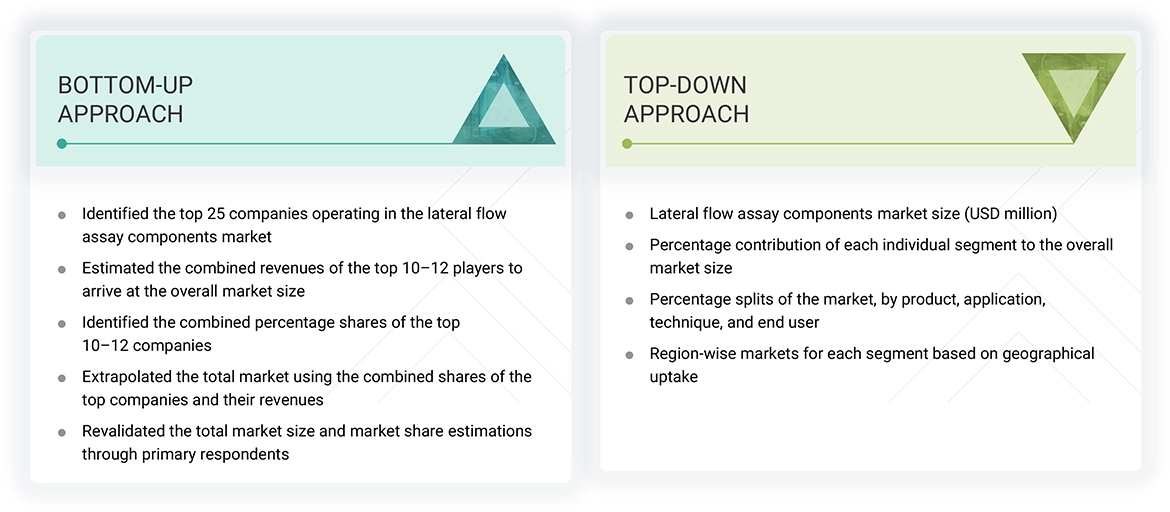
The study focused on key activities to estimate the current market size for the lateral flow assay (LFA) components market. Extensive secondary research was conducted to gather information on the industry. The next step involved validating these findings, assumptions, and size estimates with industry experts across the value chain through primary research. Various methods, such as top-down and bottom-up approaches, were used to calculate the total market size. Subsequently, market segmentation and data triangulation were employed to determine the sizes of segments and subsegments within the lateral flow assay components market.
The four steps involved in estimating the market size are:
Secondary Research
The secondary research process involves extensively using secondary sources such as directories, databases (including Bloomberg Businessweek, Factiva, and D&B Hoovers), white papers, annual reports, investor presentations, SEC filings from companies, and publications from government agencies like the National Institutes of Health (NIH), US FDA, US Census Bureau, World Health Organization (WHO), Global Burden of Disease Study, and Centers for Medicare and Medicaid Services (CMS). These sources are utilized to gather information for the global lateral flow assay components market study. They also help gather key details about the main players, market classification, and segmentation based on industry trends, down to the most detailed level, as well as significant developments related to market and technology perspectives. Additionally, a database of leading industry players was created using secondary data research.
Primary Research
In the primary research process, various sources from both the supply and demand sides were interviewed to gather qualitative and quantitative information for this report. Primary sources from the supply side include industry experts such as CEOs, vice presidents, marketing and sales directors, technology and innovation directors, and other key executives from various companies and organizations operating in the LFAs market and the lateral flow assay components market. Primary sources from the demand side include medical device manufacturing companies and medical device contract manufacturer companies.
The following is a breakdown of the primary respondents:
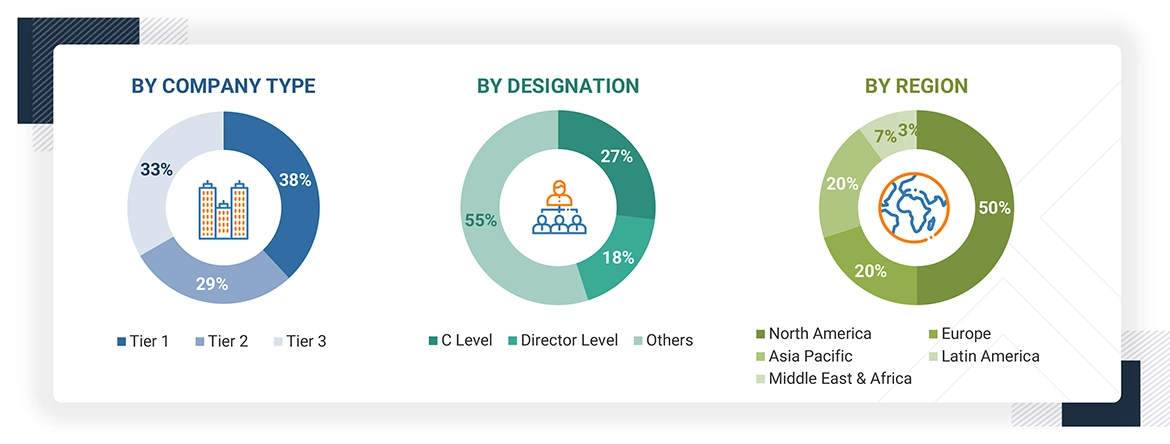
Note 1: Other designations include sales managers, marketing managers, and product managers.
Note 2: Companies are classified into tiers based on their total revenues. As of 2024, Tier 1 = >USD 100 million, Tier 2 = USD 10 million to USD 100 million, and Tier 3 = < USD 10 million.
To know about the assumptions considered for the study, download the pdf brochure
Market Size Estimation
For the global market value, annual revenues were estimated based on revenue mapping of major product manufacturers and OEMs active in the worldwide lateral flow assay components market. All key service providers were identified at the global and/or regional, or country level. Revenue mapping for the respective business segments and sub-segments was conducted for the major players. The global lateral flow assay components market was split into various segments and sub-segments based on:
- List of major players operating in the products market at the regional and/or country level
- Product mapping of LFA components providers at the regional and/or country level
- Mapping of annual revenue generated by listed major players from LFA components (or the nearest reported business unit/product category)
- Extrapolation of the revenue mapping of the listed major players to derive the global market value of the respective segments/subsegments
- Summation of the market value of all segments/subsegments to arrive at the global lateral flow assay components market
The above-mentioned data was consolidated and added with detailed inputs and analysis from MarketsandMarkets and presented in this report.
The research methodology used to estimate the market size includes the following:
Data Triangulation
After determining the overall market size using the method described above, the total market was divided into several segments. Data triangulation and market breakdown methods were used wherever applicable to complete the market segmentation process and obtain precise data for all segments and subsegments. The data was triangulated by analyzing various factors and trends from both demand and supply sides.
Market Definition
LFA components typically include membranes (such as nitrocellulose, polyvinylidene difluoride, nylon, or polyether sulfone membranes with immobilized antibodies) and pads (such as sample, conjugate, and absorbent pads) that are fixed to an inert backing material to create the assay. These components can be used for various applications, including clinical testing, food and beverage testing, and drug-of-abuse detection testing, among others.
Stakeholders
- Manufacturers and distributors of LFA components
- Trade associations and industry bodies
- Medical device contract manufacturing companies
- Research and Consulting Firms
- Venture Capitalists and Investors
- Government Organizations
Report Objectives
- To define, describe, segment, and forecast the lateral flow assay components market by product, application, technique, end user, and region
- To provide detailed information regarding the major factors influencing market growth (such as drivers, restraints, opportunities, and challenges)
- To analyze the micromarkets with respect to individual growth trends, prospects, and contributions to the overall lateral flow assay components market
- To analyze market opportunities for stakeholders and provide details of the competitive landscape for key players
- To forecast the size of the market segments with respect to five regions: North America, Europe, the Asia Pacific, Latin America, and the Middle East & Africa.
- To profile the key players and comprehensively analyze their product portfolios, market positions, and core competencies
- To benchmark players within the market using the proprietary Company Evaluation Matrix framework, which analyzes market players on various parameters within the broad categories of business and product excellence
- To study the impact of AI/Gen AI on the market, along with the macroeconomic outlook for each region
Get the Full Lateral Flow Assay Components Market Report
Full forecast, segment splits, and company analysis for all Lateral Flow Assay Components Market.
- Rest Of Latin America Lateral Flow Assay Components Market
- Canada Lateral Flow Assay Components Market
- US Lateral Flow Assay Components Market
- Germany Lateral Flow Assay Components Market
- France Lateral Flow Assay Components Market
- UK Lateral Flow Assay Components Market
- Italy Lateral Flow Assay Components Market
- Spain Lateral Flow Assay Components Market
- China Lateral Flow Assay Components Market
- Japan Lateral Flow Assay Components Market
- India Lateral Flow Assay Components Market
- Australia Lateral Flow Assay Components Market
- Brazil Lateral Flow Assay Components Market
- Mexico Lateral Flow Assay Components Market
- Rest Of Europe Lateral Flow Assay Components Market
- Rest Of Asia Pacific Lateral Flow Assay Components Market
Need a Tailored Report?
Customize this report to your needs
Get 10% FREE Customization
Customize This Report
