
Spain LiDAR Market (2025-2030)

The Spain LiDAR Market was valued at $19.3 Million in 2025 and projected to reach to $55.8 Million by 2030, representing a compound annual growth rate of 23.6%. Spain's LiDAR market is poised for accelerated growth through 2030, driven by strategic investments in autonomous mobility and digital infrastructure modernization.


| Market Size in | USD 26.32 MN |
| Market Forecast in | |
| CAGR | |
| Forecast Period | |
| Units Considered | Value (USD MN) |
Spain LiDAR Market Trends and Insights
- Spain is emerging as a key player in the European LiDAR ecosystem, driven by increasing adoption in autonomous vehicles, industrial automation, and smart city infrastructure projects.
- The Spanish market benefits from strong automotive manufacturing capabilities and growing investment in advanced sensor technologies across the Iberian Peninsula. During the 2025–2030 forecast period, Spain's LiDAR market will be shaped by accelerating demand from automotive OEMs, logistics operators, and government digitalization initiatives.
- Spain's strategic position within the EU regulatory framework and its established semiconductor supply chain create favorable conditions for LiDAR component integration and system deployment.
- Regional players and multinational technology firms are expanding operations in Spain to capitalize on the country's growing sensor and autonomous systems market..
Key Market Statistics
- CAGR (2025-2030) 23.6% CAGR
- Market Size, 2025 ~USD 19.3 Million
- Forecast, 2030 ~USD 55.8 Million
- Country Spain
Spain LiDAR Market Overview
Market Valuation Growth :
Spain's LiDAR market is valued at $19.3 million in 2025 and is projected to reach $55.8 million by 2030, demonstrating a robust 23.6% CAGR, significantly outpacing broader European growth trends.
Autonomous Vehicle Adoption :
Spanish automotive manufacturers and tech companies are increasingly integrating LiDAR technology into autonomous vehicle development, positioning Spain as a regional innovation hub for self-driving car solutions.
Smart City Infrastructure :
Major Spanish cities are investing in LiDAR-enabled smart city projects for traffic management, urban planning, and infrastructure monitoring, driving substantial market demand across municipal and regional governments.
Industrial Automation Expansion :
Spanish manufacturing and logistics sectors are adopting LiDAR for robotics, warehouse automation, and quality control applications, creating new revenue streams for technology providers and system integrators.
Spain LiDAR Market Dynamics
- The country's strong automotive heritage combined with increasing government support for smart city initiatives creates favorable conditions for market expansion.
- Spanish enterprises are leveraging LiDAR technology to enhance operational efficiency and competitive positioning in European markets. The convergence of regulatory support for autonomous vehicles, rising industrial automation adoption, and smart city development initiatives will sustain Spain's 23.6% CAGR.
- Key growth opportunities exist in urban mobility solutions, industrial robotics, and environmental monitoring applications.
- Strategic partnerships between Spanish tech companies and international players will further accelerate market penetration and innovation across the region..
Market Ecosystem
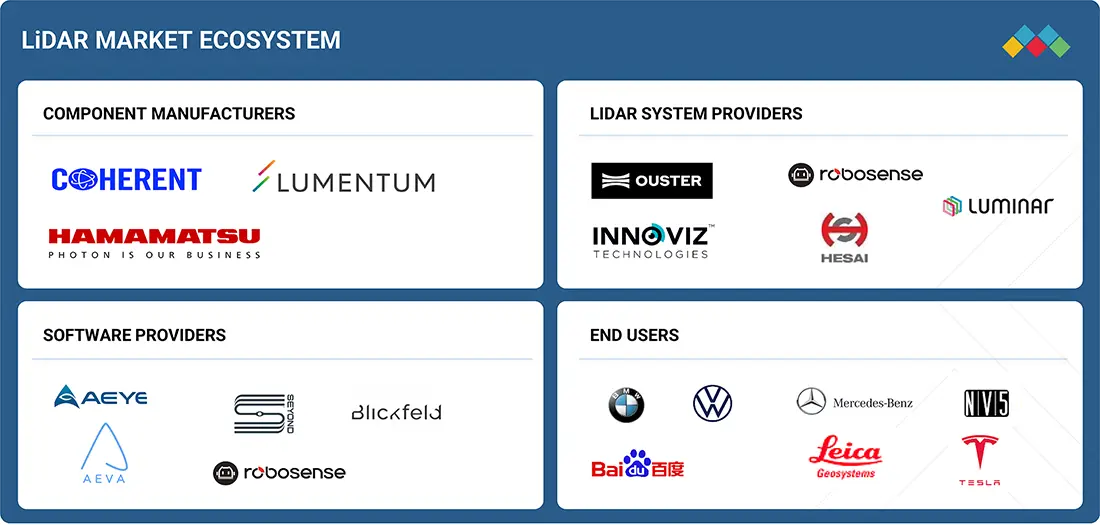
LiDAR Market: COMMERCIAL USE CASES ACROSS INDUSTRIES
| COMPANY | USE CASE DESCRIPTION | BENEFITS |
|---|---|---|
 |
LiDAR sensors for autonomous vehicles to enable safe navigation and object detection | Enhanced accuracy in obstacle detection, improved safety, reliable performance in diverse environments |
 |
Long-range LiDAR systems for ADAS and self-driving applications | 250m+ detection range, high-resolution mapping, better night and adverse weather visibility |
Logos and trademarks shown above are the property of their respective owners. Their use here is for informational and illustrative purposes only.
Related Ecosystem
Electronics System And Components
- Sensors
- Temperature Sensors
- Pressure Sensors
- Actuators
- Image Sensors
- Lenovo
- Samsung
- Texas Instruments Incorporated
- HONEYWELL INTERNATIONAL INC.
- Teledyne Technologies Incorporated
Key Takeaways
- Spain's LiDAR market is valued at $19.3 million in 2025 and will nearly triple to $55.8 million by 2030.
- Spain's 23.6% CAGR reflects strong regional demand for autonomous vehicle and industrial automation applications.
- Spain benefits from EU regulatory alignment and established automotive manufacturing infrastructure supporting LiDAR adoption.
- Growth in Spain is driven by smart city projects, logistics automation, and government investment in advanced sensor technologies.
LiDAR Market Report Scope
| Report Metric | Details |
|---|---|
| Base Year | 2025 |
| Fastest Growing Segment | SOLID STATE (Type) |
| Forecast Period | 2025–2030 |
| Growth Rate | CAGR of 31.3% from 2025 to 2030 |
| Largest Segment | MECHANICAL (Type) |
| Market Size Base Year (Billions) | ~USD 3.28 (2025) |
| Revenue Forecast (Billions) | ~USD 12.79 (2030) |
| Segments Covered | Installation, Range, Aircraft Type, Type, Service, Application |
Spain LiDAR Market Report Segmentation
6 segment dimensions are covered across the global market.
By Installation
- Airborne
- Bathymetric
- Ground-Based
- Mobile
- Static
- Topographic
By Range
- Long
- Long ( Above 500 M)
- Long (Above 500 M)
- Medium
- Medium (200–500 M)
- Short
- Short (0–200 M)
By Aircraft Type
- Manned Aircraft
- Uav
By Type
- Agriculture
- Coastline Management
- Flood Modeling
- Forest Management
- Heavy Commercial Vehicle Hcv)
- Light Commercial Vehicle (Lcv)
- Mechanical
- Mining
- Oil & Gas
- Other Corridor Mapping Types
- Other Urban Planning Types
- Passenger Car
- Pollution Modelling
- Railways
- Roadways
- Solid State
- Transportation Planning
- Wind Farm
By Service
- Aerial Surveying
- Asset Management
- Geographic Information System (Gis) Services
- Ground-Based Surveying
- Other Services
By Application
- ADAS & Driverless Cars
- Cartography
- Corridor Mapping
- Engineering
- Environment
- Exploration
- Meteorology
- Other Applications
- Urban Planning
Target Audience
- Automotive OEMs & Suppliers : Spanish and international automotive manufacturers need market data to assess LiDAR integration opportunities in autonomous vehicle programs and competitive positioning within Spain's growing mobility sector.
- Technology & Robotics Companies : Industrial automation and robotics firms require Spain-specific insights to identify expansion opportunities in manufacturing, logistics, and warehouse automation applications driving LiDAR adoption.
- Smart City Solution Providers : Urban infrastructure and smart city technology vendors need detailed market analysis to understand municipal demand patterns, funding mechanisms, and project pipelines across Spanish cities and regions.
- Investment & Private Equity Firms : Investors evaluating opportunities in Spain's semiconductor and electronics sector require comprehensive market forecasts and growth drivers to assess portfolio companies and acquisition targets.
- Government & Municipal Authorities : Spanish regional and local government bodies need market intelligence to inform smart city procurement strategies, infrastructure planning, and technology adoption roadmaps aligned with digital transformation goals.
Key Companies in the Spain LiDAR Market
| Company | HQ | Ownership | Strongest segments |
|---|---|---|---|
| JABIL | United States | Public Company | Regulated Industries (medical, healthcare, automotive, packaging),Intelligent Infrastructure (5G, wireless, cloud, networking, storage, industrial, semi-cap),Connected Living and Digital Commerce (connected devices, mobility, digital print, retail, smart building), |
| FUGRO | Netherlands | Public Company | Marine site characterization,Marine asset integrity & positioning,Land site characterization, |
| LENOVO | China | Public Company | Small form factor PCs and signage controllers,Thin clients and dedicated media players,Tablets and smart devices for kiosks/PoS displays, |
| ROBOSENSE | China | Public Company | Automotive LiDAR for ADAS/AV,Robotics and Cleaning LiDAR,Industrial, Logistics, and Public Services LiDAR, |
| HESAI GROUP | China | Public Company | Automotive ADAS LiDAR (passenger and commercial vehicles),Autonomous mobility fleets (robotaxis, autonomous trucks, shuttles),Robotics and restricted-area applications, |
| LUMINAR TECHNOLOGIES, INC. | United States | Private Company | Autonomy Solutions – Automotive OEM lidar + perception software,Autonomy Solutions – Robo-taxi and adjacent industries,Advanced Technologies and Services – ASICs and pixel-based sensors, |
| OUSTER, INC. | United States | Public Company | OS series mechanical/hybrid lidar (OSDome, OS0, OS1, OS2),Velodyne surround-view lidar (VLP-16 family, VLP-32, VLS-128),DF series solid-state ADAS and autonomous driving lidar, |
| SICK AG | Germany | Private Company | Detection and distance sensors,Safety sensors and systems,LiDAR, radar, and outdoor automation, |
| LEICA GEOSYSTEMS AG | Switzerland | Private Company | Surveying instruments (total stations, levels, theodolites, MultiStation),GNSS/GPS and positioning systems,Reality capture and laser scanning (terrestrial, airborne, SPL100, JetStream), |
| TRIMBLE INC. | United States | Public Company | Construction lifecycle software (BIM, VDC, project management),Machine control and field systems,Positioning services (VRSNow, RTX, xFill), |
| FARO | United States | Private Company | Portable CMMs and 3D Metrology Hardware,Laser Scanners and Reality Capture for AEC,Public Safety and Forensics Solutions, |
JABIL
Jabil is a U.S.-based manufacturing services company founded in 1966 that employs 135,000 people globally. Operating as a public company, Jabil provides electronics manufacturing, supply chain solutions, and engineering services to major technology and industrial clients.
FUGRO
Fugro is a Dutch public company established in 1962 with 9,062 employees specializing in geotechnical, survey, and geospatial data services. The company provides engineering and consulting solutions for infrastructure, energy, and environmental projects worldwide.
LENOVO
Lenovo is a Chinese technology company founded in 1984 and operates as a public company. The company is a global leader in personal computers, servers, storage systems, and other computing devices.
ROBOSENSE
RoboSense is a Chinese autonomous driving perception company founded in 2014 with 1,800 employees. The company specializes in LiDAR sensors and perception software for autonomous vehicles and intelligent transportation systems.
HESAI GROUP
Hesai Group is a Chinese LiDAR manufacturer founded in 2014 with 1,118 employees. The company develops and produces 3D LiDAR sensors for autonomous vehicles, robotics, and other applications.
LUMINAR TECHNOLOGIES, INC.
Luminar Technologies is a U.S.-based private company founded in 2012 with 254 employees focused on developing LiDAR technology for autonomous vehicles. The company designs and manufactures advanced sensing solutions for the autonomous driving industry.
OUSTER, INC.
Ouster is a U.S. public company founded in 2015 with 320 employees that manufactures digital LiDAR sensors and software. The company provides 3D sensing solutions for autonomous vehicles, robotics, and industrial applications.
SICK AG
SICK AG is a German private company established in 1946 with 11,804 employees specializing in sensor technology and industrial automation solutions. The company develops and manufactures sensors, safety systems, and software for factory automation and logistics.
LEICA GEOSYSTEMS AG
Leica Geosystems AG is a Swiss private company founded in 1997 with 3,500 employees providing surveying, measurement, and geospatial solutions. The company offers hardware and software products for construction, engineering, and mapping applications.
TRIMBLE INC.
Trimble Inc. is a U.S. public company founded in 1978 with 11,500 employees providing positioning, navigation, and geospatial technology solutions. The company serves industries including construction, agriculture, transportation, and surveying.
FARO
FARO is a U.S. private company founded in 1981 with 1,181 employees manufacturing 3D measurement and imaging technology. The company produces laser scanners, coordinate measuring machines, and software for construction, manufacturing, and forensics.
Reasons to Buy this Report
- Localized Market Intelligence : Gain Spain-specific insights into market dynamics, competitive landscape, and growth drivers that differ from broader European trends, enabling targeted business strategy development.
- Investment Decision Support : Access detailed forecasts and valuation data for Spain's LiDAR market to inform capital allocation decisions, partnership opportunities, and market entry strategies in this high-growth segment.
- Competitive Positioning : Understand Spanish market adoption patterns, customer preferences, and emerging applications to benchmark your offerings against local competitors and identify differentiation opportunities.
- Regulatory & Policy Landscape : Discover Spain-specific regulatory frameworks, government incentives, and policy drivers supporting LiDAR adoption in autonomous vehicles and smart city projects affecting market growth.
- Sector-Specific Opportunities : Identify high-potential applications across Spanish automotive, industrial automation, and municipal sectors with quantified demand forecasts to prioritize resource allocation and product development.
Frequently asked questions
What is the current size of Spain's LiDAR market?
Spain's LiDAR market was valued at $19.3 million in 2025 and is projected to grow to $55.8 million by 2030.
What is the growth rate of Spain's LiDAR market?
Spain's LiDAR market is growing at a compound annual growth rate (CAGR) of 23.6% from 2025 to 2030.
Which industries are driving LiDAR adoption in Spain?
Spain's LiDAR growth is primarily driven by autonomous vehicles, industrial automation, logistics, and smart city infrastructure projects.
How does Spain's LiDAR market compare to Europe?
Spain represents a significant regional market within Europe, with strong automotive manufacturing and government support accelerating LiDAR technology adoption.
What factors support LiDAR market expansion in Spain?
Spain's LiDAR market is supported by EU regulatory frameworks, established semiconductor supply chains, automotive OEM presence, and government digitalization initiatives.
RESEARCH METHODOLOGY
The study involved four major activities in estimating the size of the LiDAR market. Exhaustive secondary research was done to collect information on the market, peer market, and parent market. The next step was to validate these findings, assumptions, and sizing with industry experts across value chains through primary research. The bottom-up approach was employed to estimate the overall market size. After that, market breakdown and data triangulation were used to estimate the market size of segments and subsegments.
Secondary Research
In the secondary research process, various sources were used to identify and collect information important for this study. These include annual reports, press releases & investor presentations of companies, white papers, technology journals, and certified publications, articles by recognized authors, directories, and databases.
Secondary research was mainly used to obtain key information about the supply chain of the industry, the total pool of market players, classification of the market according to industry trends to the bottom-most level, regional markets, and key developments from the market and technology-oriented perspectives.
Primary research was also conducted to identify the segmentation types, key players, competitive landscape, and key market dynamics such as drivers, restraints, opportunities, challenges, and industry trends, along with key strategies adopted by players operating in the LiDAR market. Extensive qualitative and quantitative analyses were performed on the complete market engineering process to list key information and insights throughout the report.
Primary Research
Extensive primary research has been conducted after acquiring knowledge about the LiDAR market scenario through secondary research. Several primary interviews have been conducted with experts from both the demand (end users) and supply (LiDAR solution providers) sides across four major geographic regions: North America, Europe, Asia Pacific, and RoW. Approximately 80% and 20% of the primary interviews have been conducted from the supply and demand sides, respectively. These primary data have been collected through questionnaires, emails, and telephone interviews.
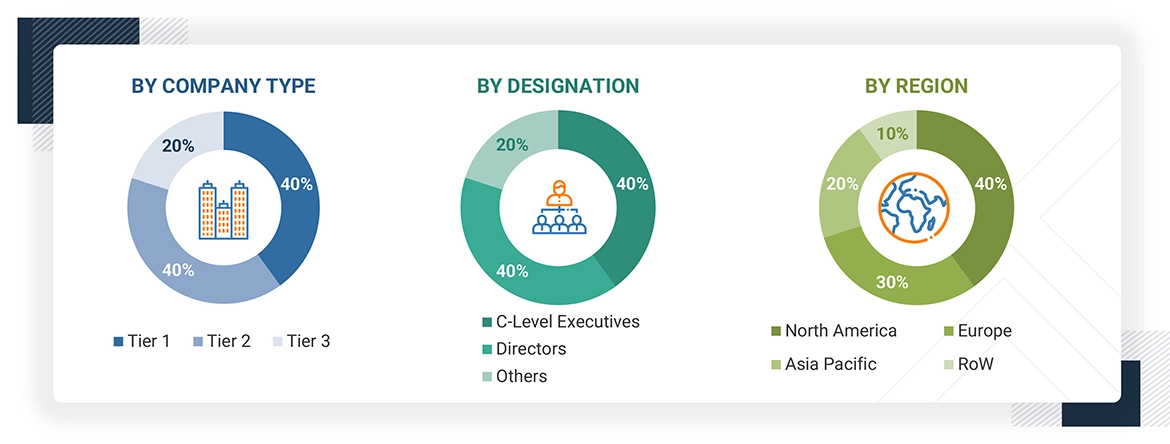
Note: The 3 tiers of the companies have been defined based on their total/segmental revenue as of 2024; Tier 1 = >USD 1 billion, Tier 2 = USD 1 billion–USD 500 million, and Tier 3 = USD 500 million. Others includes sales, marketing, and product managers.
To know about the assumptions considered for the study, download the pdf brochure
Market Size Estimation
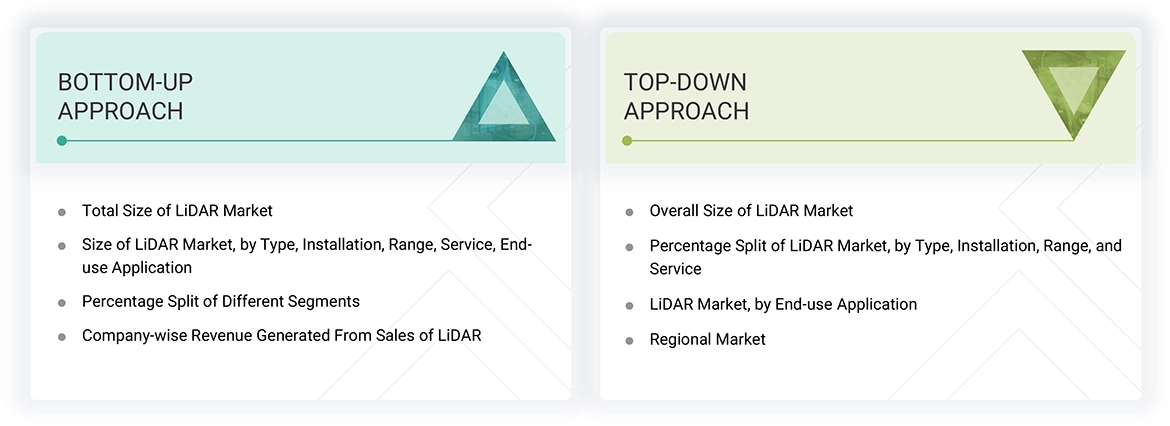
In the complete market engineering process, both the top-down and bottom-up approaches were implemented, along with several data triangulation methods, to estimate and validate the size of the LiDAR market and various other dependent submarkets. Key players in the market were identified through secondary research, and their market share in the respective regions was determined through primary and secondary research. This entire research methodology included the study of annual and financial reports of the top players, as well as interviews with experts (such as CEOs, VPs, directors, and marketing executives) for key insights (quantitative and qualitative).
All percentage shares, splits, and breakdowns were determined using secondary sources and verified through primary sources. All the possible parameters that affect the markets covered in this research study were accounted for, viewed in detail, verified through primary research, and analyzed to obtain the final quantitative and qualitative data. This data was consolidated and supplemented with detailed inputs and analysis from MarketsandMarkets and presented in this report.
LiDAR Market : Top-Down and Bottom-Up Approach
Data Triangulation
After arriving at the overall market size from the market size estimation process as explained above, the total market has been split into several segments and subsegments. To complete the overall market engineering process and arrive at the exact statistics for all segments and subsegments, market breakdown and data triangulation procedures have been employed, wherever applicable. The data has been triangulated by studying various factors and trends from both demand and supply sides. Along with this, the market has been validated using top-down and bottom-up approaches.
Market Definition
LiDAR, or light detection and ranging, works on the time of flight principle. The system uses light waves or a light source as a pulsed laser to measure the distance between objects. Measuring distances helps create 3D maps of terrains or earth surfaces that are not visible to the human eye or cannot be created through photogrammetry. The light waves are combined with other data recorded by the system (airborne or ground-based) to generate precise 3D information about the shape and characteristics of the targeted object.
Key Stakeholders
- Senior Management
- End User
- Finance/Procurement Department
- R&D Department
Report Objectives
- To describe, segment, and forecast the overall size of the LiDAR market by type, installation, range, service, end-use application, and region, in terms of value
- To describe and forecast the market size for various segments with regard to four main regions—North America, Europe, Asia Pacific, and the Rest of the World (RoW), in terms of value
- To provide detailed information regarding major factors, such as drivers, restraints, opportunities, and challenges influencing the market growth
- To analyze the supply chain, trends/disruptions impacting customer business, market/ecosystem map, pricing analysis, and regulatory landscape pertaining to the LiDAR market
- To analyze opportunities in the market for stakeholders by identifying the high-growth segments of the market
- To briefly describe the value chain of light detection and ranging (LiDAR) solutions
- To strategically analyze micromarkets1 with respect to individual growth trends, prospects, and contributions to the overall market
- To profile key players and comprehensively analyze their market position in terms of their ranking and core competencies, along with the detailed competitive landscape of the market
- To analyze competitive developments, such as product launches and developments, partnerships, agreements, expansions, acquisitions, contracts, alliances, and research & development (R&D)undertaken in the LiDAR market
- To benchmark market players using the proprietary ‘Company Evaluation Matrix,’ which analyzes market players on various parameters within the broad categories of business strategy excellence and strength of product portfolio
- To analyze the probable impact of the recession on the market
Get the Full LiDAR Market Report
Full forecast, segment splits, and company analysis for all LiDAR Market.
- US LiDAR Market
- Canada LiDAR Market
- Mexico LiDAR Market
- UK LiDAR Market
- Germany LiDAR Market
- France LiDAR Market
- Italy LiDAR Market
- Poland LiDAR Market
- China LiDAR Market
- Japan LiDAR Market
- South Korea LiDAR Market
- India LiDAR Market
- Australia LiDAR Market
- Indonesia LiDAR Market
- Malaysia LiDAR Market
- Thailand LiDAR Market
- Vietnam LiDAR Market
Need a Tailored Report?
Customize this report to your needs
Get 10% FREE Customization
Customize This Report
