
Canada Lipid Nanoparticles Market (2024-2029)

The Canada Lipid Nanoparticles Market was valued at $14.46 Million in 2024 and projected to reach to $17.34 Million by 2029, representing a compound annual growth rate of CAGR 3.7%. Canada's lipid nanoparticles market is positioned for steady growth, supported by the country's robust biopharmaceutical ecosystem and increasing focus on precision medicine.


| Market Size in | USD 26.32 MN |
| Market Forecast in | |
| CAGR | |
| Forecast Period | |
| Units Considered | Value (USD MN) |
Canada Lipid Nanoparticles Market Trends and Insights
- This steady growth reflects Canada's advancing biopharmaceutical infrastructure and increasing investment in mRNA-based therapeutics and vaccine development.
- Canada's regulatory environment and research capabilities position the country as a key player in lipid nanoparticle innovation within North America. The Canadian market benefits from strong government support for life sciences research and a robust network of academic institutions and biotech companies focused on drug delivery technologies.
- Canada's participation in global clinical trials and partnerships with international pharmaceutical firms accelerates adoption of lipid nanoparticle platforms.
- Between 2024 and 2029, Canada is expected to see heightened demand driven by expanding applications in oncology, infectious disease, and personalized medicine. Canada's lipid nanoparticles sector is characterized by collaborative innovation and strategic investments in manufacturing capabilities.
- The country's proximity to the U.S.
- market and established supply chain networks enhance Canada's competitive positioning in the broader North American lipid nanoparticles landscape..
Key Market Statistics
- CAGR (2024-2029) CAGR 3.7%
- Market Size, 2024 ~USD 14.46 Million
- Forecast, 2029 ~USD 17.34 Million
- Country Canada
Canada Lipid Nanoparticles Market Overview
Market Valuation :
Canada's lipid nanoparticles market is valued at $14.46 million in 2024, with projected growth to $17.34 million by 2029, representing a steady CAGR of 3.7%.
mRNA Therapeutics Investment :
Canada is experiencing increased investment in mRNA-based therapeutics and vaccine development, driven by post-pandemic momentum and government support for biopharmaceutical innovation.
Regulatory Advantages :
Canada's progressive regulatory environment through Health Canada and established approval pathways provide competitive advantages for LNP-based drug development and commercialization.
Research Infrastructure :
Strong academic institutions and research capabilities across Canadian universities and biotech hubs support LNP technology advancement and clinical trial infrastructure.
Canada Lipid Nanoparticles Market Dynamics
- The 3.7% CAGR reflects moderate but consistent expansion driven by ongoing mRNA vaccine and therapeutic development initiatives.
- Government funding programs and partnerships between academic institutions and private biotech companies are accelerating LNP research and commercialization efforts. Looking ahead, Canada's market growth will be fueled by expanding clinical pipelines, regulatory approvals for LNP-based products, and increased manufacturing capacity.
- The country's strategic position in North America, combined with its skilled workforce and innovation incentives, positions it as a key hub for LNP technology development and production within the region..
Market Ecosystem
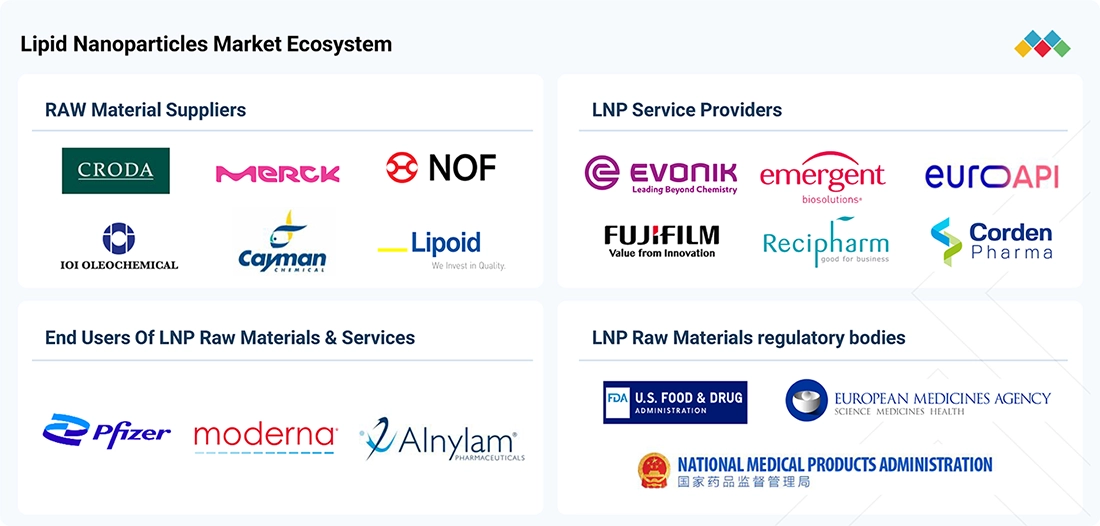
LIPID NANOPARTICLES MARKET: COMMERCIAL USE CASES ACROSS INDUSTRIES
| COMPANY | USE CASE DESCRIPTION | BENEFITS |
|---|---|---|
 |
Developed and licensed clinically validated LNP delivery technology for nucleic acid therapeutics, including mRNA vaccine applications. Its LNP platform is used in Pfizer-BioNTech's COMIRNATY and has also contributed to LNP technology used in ONPATTRO. | Demonstrated the ability of LNP technology to protect nucleic acid payloads, enable intracellular delivery, support large-scale clinical use, and provide a validated platform for expansion into vaccines, RNA therapeutics, and gene-editing applications. |
Logos and trademarks shown above are the property of their respective owners. Their use here is for informational and illustrative purposes only.
Related Ecosystem
Biotechnology
- Reagents
- Polymerase Chain Reaction (PCR)
- Stem Cells
- Assay Kits
- Flow Cytometers
- Thermo Fisher Scientific Inc.
- Merck KGaA
- Danaher Corporation
- Agilent Technologies, Inc.
- Bio-Rad Laboratories, Inc.
Key Takeaways
- Canada's lipid nanoparticles market is valued at $14.46 million in 2024 and will reach $17.34 million by 2029 at a 3.7% CAGR.
- Canada's strong biopharmaceutical infrastructure and government support for life sciences research drive steady market expansion.
- Increasing applications in mRNA therapeutics, oncology, and personalized medicine are key growth drivers in Canada.
- Canada's regulatory framework and proximity to the U.S. market position it as a strategic hub for lipid nanoparticle innovation in North America.
Lipid Nanoparticles Market Report Scope
| Report Metric | Details |
|---|---|
| Base Year | 2024 |
| Fastest Growing Segment | FORMULATION DEVELOPMENT SERVICES (Service Type) |
| Forecast Period | 2024-2029 |
| Growth Rate | CAGR of 5.2% from 2024 to 2029 |
| Largest Segment | MRNA (Molecule Type) |
| Market Size Base Year (Billions) | ~USD 0.27 (2024) |
| Revenue Forecast (Billions) | ~USD 0.35 (2029) |
| Segments Covered | Product, Lnp Type, Molecule Type, Application, Type, End User, Service Type |
Canada Lipid Nanoparticles Market Report Segmentation
7 segment dimensions are covered across the global market.
By Product
- Ionizable Lipids
- Kits & Reagents
- Neutral Lipids
- Other Formulation Materials
- Other Products
- Pegylated Lipids
- Phospholipids
By Lnp Type
- Nanostructured Lipid Carriers (Nlcs)
- Other Lnp Types
- Solid Lipid Nanoparticles (Slns)
By Molecule Type
- Mrna
- Other Molecule Types
- Other Molecules
- Sirna
By Application
- Clinical
- Commercial
By Type
- Cancer
- Covid-19
- Other Clinical Applications
- Polyneuropathy
By End User
- Academic & Research Institutes
- Cdmos
- Contract Development Manufacturing Organizations (Cdmos)
- Pharmaceutical & Biotechnology Companies
By Service Type
- Formulation Development Services
- Manufacturing Services
- Other Services
CANADA: LNP RAW MATERIALS MARKET, BY END USER, 2022–2029
| Segment | 2022 | 2023 | 2024 | 2025 | 2026 | 2027 | 2028 | 2029 | CAGR (%) |
|---|---|---|---|---|---|---|---|---|---|
| ACADEMIC & RESEARCH INSTITUTES | 4.09 | 3.15 | 3.17 | 3.2 | 3.25 | 3.31 | 3.38 | 3.45 | 1.7 |
| CDMOS | 6.52 | 5.08 | 5.18 | 5.31 | 5.47 | 5.65 | 5.85 | 6.06 | 3.2 |
| PHARMACEUTICAL & BIOTECHNOLOGY COMPANIES | 7.41 | 5.89 | 6.11 | 6.38 | 6.69 | 7.03 | 7.41 | 7.82 | 5.1 |
| TOTAL | 18.02 | 14.12 | 14.46 | 14.9 | 15.4 | 15.99 | 16.64 | 17.34 | 3.7 |
Target Audience
- Biopharmaceutical Companies : Canadian and international biotech firms developing LNP-based therapeutics need market intelligence to guide R&D investment, regulatory strategy, and commercialization planning in Canada.
- Investment & Venture Capital Firms : VC and private equity investors targeting Canadian biotech require detailed market data to evaluate investment opportunities, portfolio company valuations, and exit potential in the LNP sector.
- Contract Manufacturing Organizations : CMOs and CDMO providers need Canadian market insights to identify growth opportunities, capacity planning requirements, and client demand trends for LNP manufacturing services.
- Government & Policy Makers : Canadian health agencies and policy bodies require market analysis to inform funding decisions, regulatory frameworks, and strategic initiatives supporting LNP innovation and commercialization.
- Academic & Research Institutions : Canadian universities and research centers need market data to align research programs with commercial opportunities, secure funding, and identify industry collaboration prospects in LNP technology.
Reasons to Buy this Report
- Market-Specific Sizing & Forecasts : Access precise valuation data for Canada's LNP market with detailed 5-year projections, enabling accurate budget allocation and investment planning specific to the Canadian market.
- Regulatory & Approval Landscape : Understand Health Canada's regulatory pathways, approval timelines, and compliance requirements unique to LNP-based therapeutics and vaccines in the Canadian market.
- Competitive & Investment Analysis : Identify key Canadian biotech players, research institutions, and funding sources driving LNP innovation, plus competitive positioning strategies for market entry and expansion.
- Clinical Pipeline Intelligence : Track active LNP-based clinical trials and development programs in Canada, including therapeutic areas, trial phases, and commercialization timelines for strategic planning.
- Manufacturing & Supply Chain Insights : Evaluate Canada's LNP production capacity, contract manufacturing opportunities, and supply chain infrastructure to optimize sourcing and operational efficiency.
Frequently asked questions
What is the current size of Canada's lipid nanoparticles market?
Canada's lipid nanoparticles market is valued at $14.46 million in 2024 and is expected to grow to $17.34 million by 2029.
What is the projected growth rate for Canada's lipid nanoparticles market?
Canada's lipid nanoparticles market is projected to grow at a compound annual growth rate of 3.7% from 2024 to 2029.
What are the main drivers of growth in Canada's lipid nanoparticles market?
Key growth drivers in Canada include increasing investment in mRNA therapeutics, expanding applications in oncology and personalized medicine, strong government support for life sciences research, and partnerships with international pharmaceutical firms.
How does Canada's lipid nanoparticles market compare to the global market?
While Canada's market grows at 3.7% CAGR, the global lipid nanoparticles market expands at 5.2% CAGR, reflecting Canada's more conservative but stable growth trajectory within the North American region.
What role does Canada play in the North American lipid nanoparticles market?
Canada serves as a strategic innovation hub in North America, leveraging its regulatory environment, academic research capabilities, and proximity to the U.S. market to advance lipid nanoparticle development and manufacturing.
RESEARCH METHODOLOGY
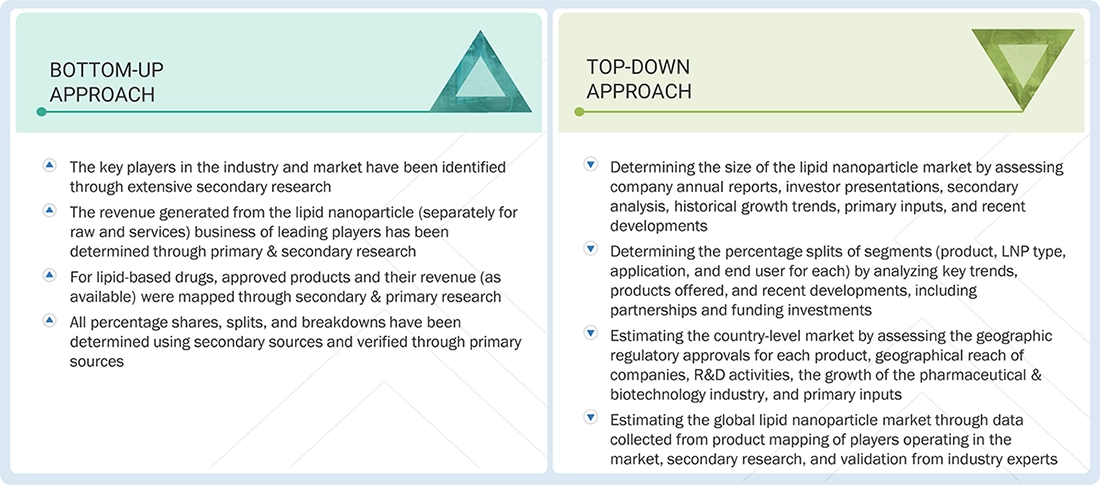
This study involved four major activities to estimate the current size of the lipid nanoparticles market. Exhaustive secondary research was conducted to gather information on the market, its peer markets, and its parent market. These findings, assumptions, and sizing were then validated with industry experts across the value chain through primary research. Both top-down and bottom-up approaches were employed to estimate the total market size. Following this, data triangulation was used to estimate the market size of segments and subsegments.
Secondary Research
Secondary research was primarily used to identify and gather information for the extensive, technical, market-oriented, and commercial study. Secondary sources for this study included publications from government agencies, such as the National Center for Biotechnology Information (NCBI), National Institutes of Health (NIH), World Health Organization (WHO), Food and Drug Administration (FDA), European Medicines Agency (EMA), Pharmaceutical Research and Manufacturers of America (PhRMA), Global Cancer Observatory (GLOBOCAN), Centers for Disease Control and Prevention (CDC), and the European Federation of Biotechnology. Secondary sources also included corporate and regulatory filings (such as annual reports, SEC filings, investor presentations, and financial statements); business magazines and research journals; press releases; and trade, business, and professional associations. These sources were used to obtain key information on major players, global product revenues, market classification, segmentation by industry trends and regional/country-level markets, market developments, and technology perspectives. Secondary data were collected and analyzed to determine the overall size of the global protein expression market, and the findings were validated through primary research.
Primary Research
In-depth interviews were conducted with primary respondents, including key industry participants, subject-matter experts (SMEs), C-level executives of key market players, and industry consultants, among others, to obtain and verify critical qualitative and quantitative information and to assess market prospects. Primary sources from both the supply and demand sides of the market were interviewed to gather qualitative and quantitative data. The following is a breakdown of the primary respondents:
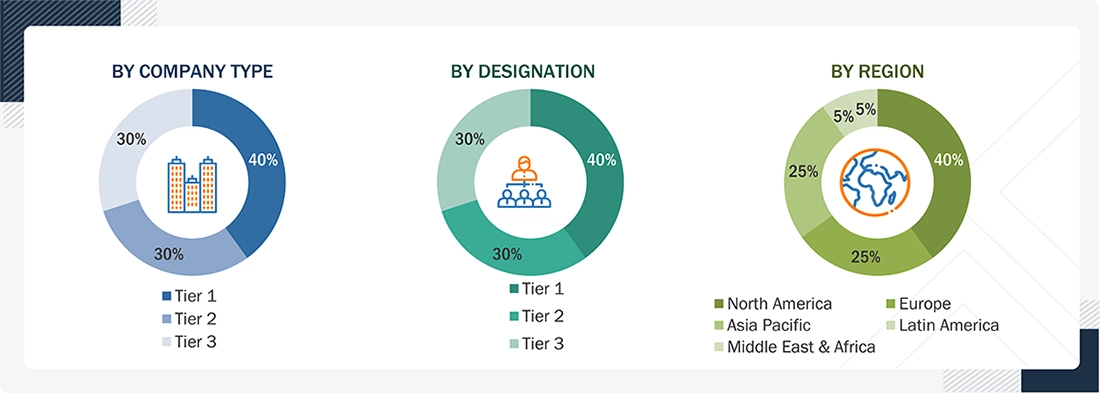
To know about the assumptions considered for the study, download the pdf brochure
Market Size Estimation
The size of the global LNP market was estimated using multiple approaches. A detailed market estimation approach was used to estimate and validate the market value and other dependent submarkets. These methods were also used extensively to estimate the size of various subsegments in the market. The research methodology used to estimate the market size includes the following:
Lipid Nanoparticles Market: Top-Down and Bottom-Up Approach
Data Triangulation
After estimating the overall market size through the market size estimation process, the total market was divided into several segments. To complete the overall market engineering process and arrive at the exact statistics for all segments, the data triangulation procedure was employed; it involved analyzing various factors and trends from both the demand and supply sides.
Market Definition
Lipid nanoparticles (LNPs) are among the most clinically advanced drug delivery systems. They safely and effectively deliver nucleic acids. LNPs serve as vehicles that transport pharmaceutical substances into targeted cells, where the substances are absorbed and released. LNPs have been in high demand owing to their applications in COVID-19 mRNA vaccines, where they coat fragile mRNA strands for cellular uptake and processing. LNPs have several applications, including gene editing, rapid vaccine development, immuno-oncology, and the treatment of rare genetic diseases and undruggable targets, which are often hindered by inefficient nucleic acid delivery.
Key Stakeholders
- Academic Research Institutes
- Raw Materials Manufacturers & Distributors of Liquid Nanoparticles
- Contract Research Organizations (CROs)
- Lipid Nanoparticles Development & Manufacturing Service Providers
- Market Research and Consulting Firms
- Pharmaceutical & Biotechnology Companies
- Regulatory Agencies
- Venture Capitalists
- Government Organizations
- Private Research Firms
- Contract Development and Manufacturing Organizations (CDMOs)
Report Objectives
- To define, describe, and forecast the lipid nanoparticles market by product, type of LNP product, molecule, application, raw material end user, service, service end user, and region
- To provide detailed information regarding the major factors influencing the market growth (such as drivers, restraints, opportunities, and challenges)
- To analyze micromarkets with respect to individual growth trends, prospects, and contributions to the overall lipid nanoparticles market
- To analyze opportunities for stakeholders and provide details of the competitive landscape for market leaders
- To forecast the size of the market segments with respect to six regions: North America (US and Canada), Europe (Germany, France, the UK, Italy, Spain, and the Rest of Europe), Asia Pacific (China, Japan, India, South Korea, Australia, and the Rest of Asia Pacific), Latin America (Brazil, Mexico, Argentina, and the Rest of Latin America), the Middle East [GCC (Saudi Arabia, United Arab Emirates, and the Rest of GCC) and the Rest of Middle East], and Africa
- To profile the key players and analyze their market shares and core competencies
- To track and analyze competitive developments, such as product launches, partnerships, agreements, collaborations, and expansions
- To benchmark players within the market using the proprietary “Company Evaluation Matrix” framework, which analyzes market players on various parameters within the broad categories of business and product excellence strategy
Available customizations:
With the given market data, MarketsandMarkets offers customizations as per the company’s specific needs. The following customization options are available for the report:
Geographic Analysis
- Further breakdown of the Rest of Europe LNP market, by country
- Further breakdown of the Rest of Asia Pacific LNP market, by country
Company Information
- Detailed analysis and profiling of additional market players (up to five)
Segment Analysis
- Cross-segment analysis
Get the Full Lipid Nanoparticles Market Report
Full forecast, segment splits, and company analysis for all Lipid Nanoparticles Market.
- Spain Lipid Nanoparticles Market
- China Lipid Nanoparticles Market
- Japan Lipid Nanoparticles Market
- India Lipid Nanoparticles Market
- South Korea Lipid Nanoparticles Market
- Australia Lipid Nanoparticles Market
- Brazil Lipid Nanoparticles Market
- Mexico Lipid Nanoparticles Market
- Rest Of Europe Lipid Nanoparticles Market
- Rest Of Asia Pacific Lipid Nanoparticles Market
- Rest Of Latin America Lipid Nanoparticles Market
- US Lipid Nanoparticles Market
- Germany Lipid Nanoparticles Market
- UK Lipid Nanoparticles Market
- France Lipid Nanoparticles Market
- Italy Lipid Nanoparticles Market
Need a Tailored Report?
Customize this report to your needs
Get 10% FREE Customization
Customize This Report
