
Rest Of Asia Liquid Handling System Market (2025-2030)

The Rest Of Asia Liquid Handling System Market was valued at $60.3 Million in 2025 and projected to reach to $78.7 Million by 2030, representing a compound annual growth rate of 5.5%. Rest Of Asia's liquid handling system market demonstrates solid growth potential as healthcare infrastructure modernization accelerates across the region.


| Market Size in | USD 26.32 MN |
| Market Forecast in | |
| CAGR | |
| Forecast Period | |
| Units Considered | Value (USD MN) |
Rest Of Asia Liquid Handling System Market Trends and Insights
- In 2025, Rest Of Asia's liquid handling system market is estimated at $60.3 million, reflecting steady adoption across diagnostic laboratories, pharmaceutical research facilities, and clinical settings.
- The region is poised for moderate but consistent growth, with the market forecast to expand to $78.7 million by 2030, driven by increasing healthcare infrastructure investments and rising demand for automation in laboratory workflows. The 5.5% compound annual growth rate (CAGR) in Rest Of Asia reflects the region's gradual shift toward modernized laboratory practices and precision medicine initiatives.
- Rest Of Asia's growth trajectory is supported by expanding pharmaceutical and biotechnology sectors, coupled with government initiatives to enhance healthcare capabilities.
- Between 2025 and 2030, Rest Of Asia will experience incremental market expansion as healthcare facilities increasingly recognize the efficiency and accuracy benefits of automated liquid handling solutions. Rest Of Asia's market dynamics are characterized by price sensitivity and a preference for cost-effective solutions tailored to regional laboratory standards.
- Rest Of Asia continues to present opportunities for vendors offering scalable, reliable liquid handling systems that address the specific needs of emerging healthcare markets..
Key Market Statistics
- CAGR (2025-2030) 5.5% CAGR
- Market Size, 2025 ~USD 60.3 Million
- Forecast, 2030 ~USD 78.7 Million
- Country Rest Of Asia
Rest Of Asia Liquid Handling System Market Overview
Market Size & Growth Trajectory :
Rest Of Asia's liquid handling system market is valued at $60.3 million in 2025, with a projected CAGR of 5.5% through 2030, reaching $78.7 million. This steady growth reflects increasing healthcare infrastructure investments across emerging economies in the region.
Key Application Sectors :
Diagnostic laboratories, pharmaceutical research facilities, and clinical settings are driving adoption of liquid handling systems in Rest Of Asia. These sectors are expanding rapidly due to rising disease prevalence and increased R&D spending in the region.
Emerging Market Dynamics :
Rest Of Asia represents a significant emerging market with moderate but consistent growth potential. The region benefits from improving healthcare accessibility, growing pharmaceutical manufacturing, and increasing laboratory automation adoption among developing nations.
Growth Drivers :
Key factors propelling the Rest Of Asia market include rising healthcare expenditure, expansion of diagnostic capabilities, increasing pharmaceutical research activities, and gradual shift toward automated laboratory processes in emerging healthcare systems.
Rest Of Asia Liquid Handling System Market Dynamics
- The 5.5% CAGR reflects steady demand from diagnostic laboratories and pharmaceutical facilities investing in automation to improve efficiency and accuracy.
- Emerging economies in the region are prioritizing healthcare advancement, creating sustained opportunities for liquid handling system adoption. The market outlook through 2030 is characterized by moderate but reliable expansion, driven by increasing laboratory automation, rising pharmaceutical research investments, and improving healthcare accessibility.
- While growth rates remain below the global 8% CAGR, Rest Of Asia's market presents attractive opportunities for vendors targeting emerging healthcare markets with cost-effective, scalable solutions tailored to regional needs and infrastructure capabilities..
Market Ecosystem
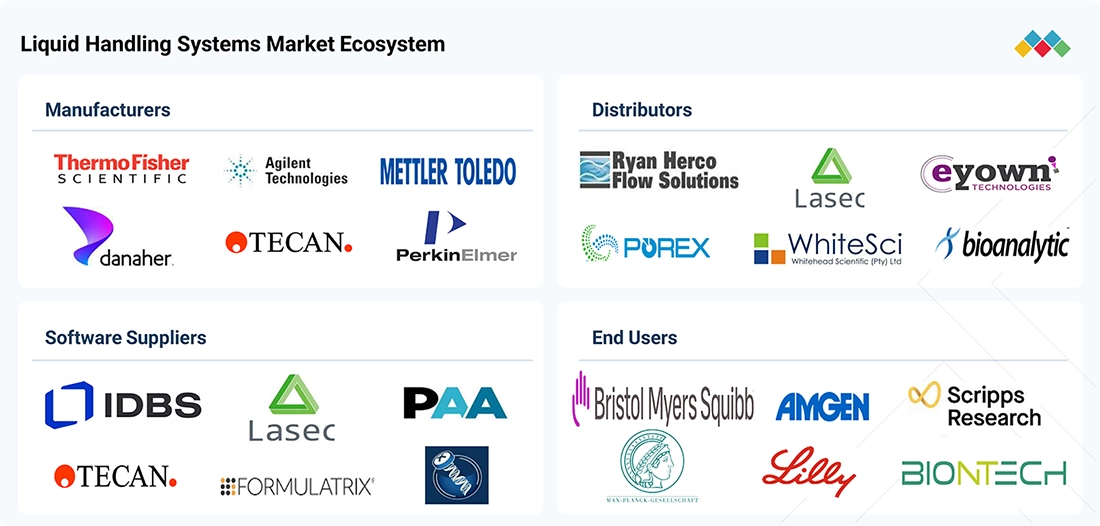
LIQUID HANDLING SYSTEM MARKET: COMMERCIAL USE CASES ACROSS INDUSTRIES
| COMPANY | USE CASE DESCRIPTION | BENEFITS |
|---|---|---|
 |
Thermo Fisher excels in integrating automated liquid handling with high-content imaging, enabling seamless dispense-to-image workflows for advanced cell-based assays. | Delivers up to ~90% time savings and higher throughput by automating cell-based workflows, combining precise liquid handling with integrated high-content imaging for faster, consistent results and reduced manual effort. |
 |
Danaher’s core strength in the liquid handling systems market lies in high-throughput genomic, proteomic, and cellular workflow automation, enabling efficient NGS library prep, advanced sample processing, and large-volume dispensing for large-scale research and screening applications. | Provides adaptable automation across miniaturized acoustic dispensing for reagent savings and reliable tip-based systems, enabling labs to scale throughput and workflows seamlessly as their demands increase. |
 |
Encore Multispan system, combining multispan pipetting and robotics to automate high-throughput sample prep, compound management, and screening workflows. | Delivers higher throughput and productivity through dual pipetting banks and extended-reach robotic arms, enabling seamless automation of both upstream and downstream workflow steps. |
 |
High-throughput, modular Fluent Automation Workstations, which seamlessly integrate advanced pipetting, detection, and handling capabilities across plates, tubes, and tips for scalable and versatile lab workflows. | Delivers highly modular and configurable automation, with multi-arm systems that adapt to diverse labware, combine multiple pipetting technologies, and integrate detection tools enabling tailored, scalable workflows for varied research needs. |
Logos and trademarks shown above are the property of their respective owners. Their use here is for informational and illustrative purposes only.
Related Ecosystem
Analytical And Scientific Instrumentation
- Environmental Testing
- Gas Chromatography
- Polymerase Chain Reaction (PCR)
- Automated Liquid Handling Systems
- Flow Cytometry
- Thermo Fisher Scientific Inc.
- Danaher Corporation
- Agilent Technologies, Inc.
- Merck KGaA
- Shimadzu Corporation
Key Takeaways
- Rest Of Asia's liquid handling system market is valued at $60.3 million in 2025 and is projected to grow to $78.7 million by 2030 at a 5.5% CAGR.
- Rest Of Asia demonstrates steady adoption of liquid handling automation driven by expanding pharmaceutical, biotechnology, and diagnostic laboratory sectors.
- Rest Of Asia exhibits price sensitivity, creating demand for cost-effective, scalable solutions tailored to regional laboratory standards and workflows.
- Rest Of Asia's growth is supported by government healthcare infrastructure investments and increasing recognition of automation benefits in laboratory efficiency and accuracy.
Liquid Handling System Market Report Scope
| Report Metric | Details |
|---|---|
| Base Year | 2025 |
| Fastest Growing Segment | PIPETTES (Product) |
| Forecast Period | 2025–2030 |
| Growth Rate | CAGR of 8% from 2025 to 2030 |
| Largest Segment | AUTOMATED SYSTEMS (Type) |
| Market Size Base Year (Billions) | ~USD 5.04 (2025) |
| Revenue Forecast (Billions) | ~USD 7.4 (2030) |
| Segments Covered | Type, Product, Application, End User |
Rest Of Asia Liquid Handling System Market Report Segmentation
4 segment dimensions are covered across the global market.
By Type
- Adme Screening
- Automated Systems
- Compound Weighing & Dissolution
- Disposable Tips
- Dna/Rna Purification
- Electronic Pipettes
- Electronic Systems
- Elisa
- Fully Automated Systems
- Gene Expression Analysis
- Genotyping
- Hts
- Maintenance, Installation, And Calibration Services
- Maintenance, Installation, And Calibration Services
- Manual Pipettes
- Manual Systems
- Microplate Reagent Dispensers
- Microplate Washers
- Next-Generation Sequencing (Ngs)
- Next-Generation Sequencing (Ngs)
- Other Clinical Diagnostic Application
- Other Clinical Diagnostics Applications
- Other Consumables
- Other Drug Discovery Applications
- Other Environmental Testing
- Other Genomics Applications
- Polymerase Chain Reaction (Pcr)
- Polymerase Chain Reactions
- Reagent Containers
- Sample Preparation
- Samples Preparation
- Semi-Automated Pipettes
- Semi-Automated Systems
- Semi-Automated Pipettes
- Semi-Automated Systems
- Training And Education Services
- Training And Education Services
- Tubes & Plates
- Tubes And Plates
- Wastewater Analysis
- Water Analysis
By Product
- Accessories
- Burettes
- Consumables
- Liquid Handling Workstations
- Other Products
- Pipettes
- Software & Services
By Application
- Cell & Gene Therapy
- Clinical Diagnostics
- Drug Discovery
- Environmental Testing
- Food Testing
- Forensic Testing
- Genomics
- Other Applications
- Proteomics
By End User
- Biotechnology & Pharmaceutical Companies
- Environmental Testing Laboratories
- Food & Beverages Industry
- Food & Beverages Industry
- Forensic Laboratories
- Hospitals & Diagnostic Laboratories
- Hospitals & Diagnostics Laboratories
- Other End Users
- Research & Academic Institutes
Target Audience
- Medical Device Manufacturers : Manufacturers need Rest Of Asia-specific market data to develop region-appropriate liquid handling solutions, understand adoption barriers, and identify growth opportunities in emerging healthcare markets with distinct infrastructure requirements.
- Healthcare System Operators : Hospital networks and diagnostic laboratory chains require market intelligence to benchmark automation investments, evaluate equipment ROI, and plan capital expenditures for liquid handling system upgrades across Rest Of Asia facilities.
- Pharmaceutical & Biotech Companies : R&D organizations need insights into Rest Of Asia's research infrastructure capabilities and automation trends to optimize laboratory operations, plan facility expansions, and identify regional partnership opportunities for drug development.
- Healthcare Investors & Consultants : Investment firms and management consultants require Rest Of Asia market data to evaluate healthcare technology opportunities, assess portfolio companies' regional positioning, and identify emerging market entry strategies in Asia.
- Laboratory Equipment Distributors : Regional distributors and resellers need market-specific insights to forecast demand, optimize inventory, identify key customer segments, and develop targeted sales strategies for liquid handling systems across Rest Of Asia territories.
Key Companies in the Rest Of Asia Liquid Handling System Market
| Company | HQ | Ownership | Strongest segments |
|---|---|---|---|
| THERMO FISHER SCIENTIFIC INC. | United States | Public Company | Pipettes (manual and electronic),Consumables (tips, reservoirs, plates),Automated liquid handling systems, |
| DANAHER CORPORATION | United States | Public Company | Automated liquid handling systems,Electronic and manual pipettes,Consumables (tips, plates, reagents-linked), |
| PERKINELMER | United States | Public Company | Automated liquid handling systems,Electronic pipettes and semi-automated tools,Manual pipettes, |
| METTLER-TOLEDO INTERNATIONAL INC. | Switzerland | Public Company | Pipettes,Consumables,Accessories, |
| AGILENT TECHNOLOGIES, INC. | United States | Public Company | Automated liquid handling systems and sample preparation platforms,Consumables (tips, plates, sample prep, lab supplies),Accessories and plate management hardware, |
| QIAGEN | Netherlands | Public Company | Automated liquid handling systems (integrated with sample prep/PCR/NGS),Consumables for liquid handling workflows (kits, reagents, plastics),Manual and electronic pipettes and accessories, |
| CORNING INCORPORATED | United States | Public Company | Consumables (tips, plates, reservoirs, vessels),Pipettes and liquid handling instruments,Accessories (racks, controllers, storage, adapters), |
| SARTORIUS AG | United States | Public Company | Pipettes (manual and electronic),Consumables (tips and related),Accessories (dispensers, stands, calibration tools), |
| LONZA | Switzerland | Public Company | Pipettes,Consumables,Accessories, |
| EPPENDORF SE | Germany | Private Company | Pipettes (manual and electronic),Consumables (tips, tubes, plates),Automated pipetting systems, |
| BROOKS AUTOMATION INC. | United States | Public Company | Automated liquid handling–adjacent systems (automated stores, cryogenic, controlled thaw),Sample tubes, consumables, and instruments,Sample repository and management services, |
THERMO FISHER SCIENTIFIC INC.
Thermo Fisher Scientific Inc. is a leading American public company founded in 1956 with 125,000 employees, providing life sciences research tools, diagnostics, and laboratory equipment globally.
DANAHER CORPORATION
Danaher Corporation is an American multinational public company founded in 1969 with 59,000 employees, operating across diverse industrial and life sciences sectors.
PERKINELMER
PerkinElmer is an American public company founded in 1937 with 11,000 employees, specializing in diagnostics, life sciences research, and environmental testing solutions.
METTLER-TOLEDO INTERNATIONAL INC.
Mettler-Toledo International Inc. is a Swiss public company founded in 1991 with 16,600 employees, manufacturing precision instruments and weighing solutions for laboratory and industrial applications.
AGILENT TECHNOLOGIES, INC.
Agilent Technologies, Inc. is an American public company founded in 1999 with 18,000 employees, providing analytical instruments, software, and services for life sciences and diagnostics.
QIAGEN
QIAGEN is a Dutch public company founded in 1984 with 5,500 employees, specializing in molecular diagnostics, sample preparation, and life sciences research technologies.
CORNING INCORPORATED
Corning Incorporated is an American public company founded in 1851 with 67,200 employees, manufacturing specialty glass, ceramics, and optical materials for diverse industries.
SARTORIUS AG
Sartorius AG is a public company founded in 1870 with 14,242 employees, providing laboratory and bioprocess equipment, filtration systems, and weighing solutions.
LONZA
Lonza is a Swiss public company founded in 1897 with 20,000 employees, offering contract manufacturing, cell therapy, and specialty ingredients for pharmaceuticals and biotechnology.
EPPENDORF SE
Eppendorf SE is a German private company founded in 1945 with 4,358 employees, manufacturing laboratory equipment including centrifuges, pipettes, and bioreactors.
BROOKS AUTOMATION INC.
Brooks Automation Inc. is an American public company founded in 1978 with 2,900 employees, providing automation solutions and software for life sciences and semiconductor industries.
Reasons to Buy this Report
- Regional Market Sizing & Forecasts : Obtain precise market valuation for Rest Of Asia ($60.3M in 2025) with detailed 5-year forecasts through 2030. Make informed investment and expansion decisions based on region-specific growth projections and CAGR analysis.
- Emerging Market Opportunity Assessment : Identify high-potential opportunities in Rest Of Asia's developing healthcare sector. Understand adoption patterns across diagnostic labs, pharmaceutical facilities, and clinical settings to prioritize market entry and resource allocation strategies.
- Competitive Positioning Intelligence : Benchmark your organization against regional market dynamics and growth trajectories. Develop targeted strategies for Rest Of Asia by understanding sector-specific demand drivers and competitive landscape within emerging healthcare markets.
- Sector-Specific Insights : Gain detailed understanding of liquid handling system adoption across diagnostic laboratories, pharmaceutical research, and clinical settings in Rest Of Asia. Tailor product offerings and marketing strategies to region-specific healthcare infrastructure needs.
- Strategic Planning & Risk Mitigation : Support long-term business planning with comprehensive Rest Of Asia market data. Identify growth catalysts, market barriers, and regional healthcare trends to minimize investment risks and maximize ROI in emerging Asian markets.
Frequently asked questions
What is the current market size of liquid handling systems in Rest Of Asia?
Rest Of Asia's liquid handling system market is estimated at $60.3 million in 2025, with verified data indicating steady market presence across diagnostic and pharmaceutical laboratories.
What is the projected market size for Rest Of Asia by 2030?
Rest Of Asia's liquid handling system market is forecast to reach $78.7 million by 2030, representing a 5.5% compound annual growth rate over the forecast period.
What factors are driving growth in Rest Of Asia's liquid handling system market?
Rest Of Asia's market growth is driven by expanding pharmaceutical and biotechnology sectors, government healthcare infrastructure investments, and increasing adoption of laboratory automation for improved efficiency and accuracy.
What are the key characteristics of Rest Of Asia's liquid handling system market?
Rest Of Asia's market is characterized by price sensitivity, preference for cost-effective solutions, and demand for systems tailored to regional laboratory standards and workflows.
How does Rest Of Asia's growth rate compare to global trends?
Rest Of Asia's 5.5% CAGR is below the global average of 8%, reflecting the region's emerging market status and gradual adoption of liquid handling automation technologies.
RESEARCH METHODOLOGY
The study involved four major activities to estimate the current size of the liquid handling systems market. We conducted extensive secondary research to gather information on the market, peer markets, and parent markets. The findings, assumptions, and market estimates were subsequently validated through primary research with industry experts across the value chain. Both top-down and bottom-up approaches were employed to estimate the overall market size. The report then segmented the market and triangulated data to estimate the size of key segments and subsegments across product types, applications, end users, and regions.
Secondary Research
The secondary research process involved the extensive use of industry databases, company websites, annual reports, investor presentations, SEC filings, white papers, financial reports, trade publications, and commercial databases such as Bloomberg Businessweek, Factiva, and D&B Hoovers. Secondary research gathered comprehensive technical, market-oriented, and commercial information on liquid handling systems, including their applications across pharmaceutical and biotechnology companies, hospitals, diagnostic laboratories, academic and research institutes, and other end users. It was also used to identify key market players, establish detailed market classification and segmentation, assess industry and technology trends, and identify key market developments and growth opportunities. Secondary research also helped develop a database of key industry participants and stakeholders.
Primary Research
During the primary research process, we interviewed supply- and demand-side stakeholders to obtain qualitative and quantitative insights for the study. Supply-side respondents included industry experts such as CEOs, vice presidents, marketing and sales directors, product managers, technology and innovation directors, and other senior executives from leading liquid handling system manufacturers and solution providers. Demand-side respondents included professionals from pharmaceutical and biotechnology companies, hospitals, diagnostic laboratories, academic and research institutions, CROs, and other laboratory end users. Primary research validated market segmentation and estimates, identified and assessed key market participants, and provided insights into technology adoption, application trends, purchasing criteria, competitive dynamics, and key market drivers and challenges influencing the liquid handling systems market.
A breakdown of the primary respondents is provided below:
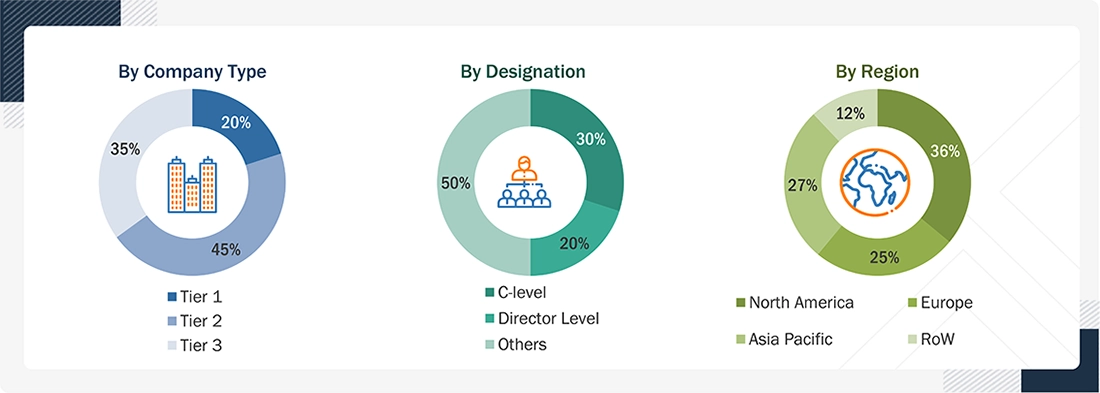
*Others include sales managers, marketing managers, business development managers, product managers, distributors, and suppliers.
Note: Companies are classified into tiers based on their total revenue. Tier 1 = >USD 400 million, Tier 2 = USD 200 million, and Tier 3 = <USD 100 million.
To know about the assumptions considered for the study, download the pdf brochure
Market Size Estimation
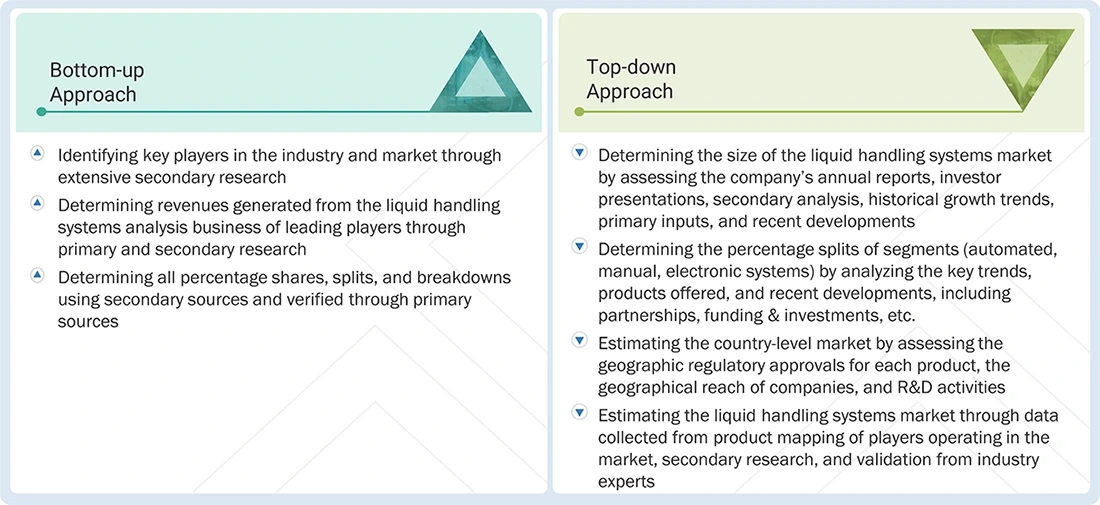
In this report, the liquid handling systems market size was determined using the revenue share analysis of leading players. For this purpose, we identified key market players and determined their revenues from the market business through insights gathered during the primary and secondary research phases. Secondary research included reviewing the annual and financial reports of the top market players. In contrast, primary research included extensive interviews with key opinion leaders, such as CEOs, directors, and key marketing executives at hospital procurement and biobanking divisions.
Segmental revenues were calculated by mapping the revenues of major solution/product providers to estimate the global liquid handling systems market value. This process involved the following steps:
- Generating a list of major global players operating in the liquid handling systems market.
- Mapping annual revenues generated by major global players from the liquid handling systems storage consumables segment (or nearest reported business unit/product category).
- Revenue mapping of major players to cover a major share of the global market, as of 2025.
- Extrapolating the global value of the liquid handling systems market, with specific attention to the healthcare end-user segment.
Liquid Handling System Market : Top-Down and Bottom-Up Approach
Data Triangulation
After arriving at the overall market size from the market size estimation process explained above, the global liquid handling systems market was split into segments and subsegments. We used data triangulation and market-breakdown procedures to complete the overall market engineering process and arrive at exact statistics for all segments and subsegments, including the hospitals and diagnostic laboratories end-user category. The data was triangulated by studying various factors and trends from both the demand and supply sides. Additionally, the liquid handling systems market was validated using top-down and bottom-up approaches.
Market Definition
The liquid handling systems market comprises manual, semi-automated, and automated instruments and solutions designed to accurately aspirate, dispense, transfer, and handle liquid samples and reagents in laboratory environments. These systems are widely used across pharmaceutical and biotechnology research, clinical diagnostics, life sciences, chemical analysis, and drug discovery to improve precision, reproducibility, and workflow efficiency. Liquid handling systems support a broad range of downstream applications, including next-generation sequencing (NGS), polymerase chain reaction (PCR), mass spectrometry, cell analysis, flow cytometry, genomics, epigenetics, and proteomics.
Key Stakeholders
- Manufacturers of liquid handling products
- Liquid handling product distributors
- Venture capitalists and investors
- Genomics and proteomics associations
- Drug discovery and development research centers
- Hospitals and diagnostic laboratories
- Research & consulting firms
- Contract manufacturers of liquid handling systems and consumables
- Research institutes and contract research organizations (CROs)
- Government associations
Report Objectives
- To define, describe, and forecast the size of the liquid handling systems market based on type, product, application, end user, and region
- To provide detailed information regarding the major factors influencing the growth potential of the global liquid handling systems market (drivers, restraints, opportunities, challenges, and trends) from a healthcare industry perspective
- To analyze the micromarkets with respect to individual growth trends, prospects, and contributions to the global liquid handling systems market, with emphasis on hospitals and diagnostic laboratories
- To analyze key growth opportunities in the global liquid handling systems market for key stakeholders and provide details of the competitive landscape for market leaders
- To forecast the size of market segments and/or subsegments with respect to five major regions: North America (US and Canada), Europe (Germany, France, the UK, Italy, Spain, and the Rest of Europe), Asia Pacific (Japan, China, India, Australia, South Korea, and the Rest of Asia Pacific), Latin America (Brazil, Mexico, and the Rest of Latin America), and the Middle East & Africa
- To profile the key players in the liquid handling systems market and comprehensively analyze their market shares and core competencies
- To track and analyze the competitive developments undertaken in the global liquid handling systems market, such as product launches, agreements, expansions, and mergers & acquisitions
Available customizations:
Based on the market data provided, customizations are offered to meet the company's specific needs. The following customization options are available for the present global liquid handling systems market report:
Product Analysis
- Product matrix, which gives a detailed comparison of the product portfolios of the top five companies.
- Detailed analysis and profiling of additional market players (up to five).
Geographic Analysis
- Further breakdown of the Rest of Europe liquid handling systems market into Russia, Belgium, the Netherlands, Switzerland, Austria, Finland, Sweden, Poland, and Portugal, among others.
- Further breakdown of the Rest of Asia Pacific liquid handling systems market into Singapore, Taiwan, New Zealand, the Philippines, Malaysia, and other APAC countries.
- Further breakdown of the Latin American liquid handling systems market into Colombia, Chile, Argentina, and Peru, among others.
Get the Full Liquid Handling System Market Report
Full forecast, segment splits, and company analysis for all Liquid Handling System Market.
- Spain Liquid Handling System Market
- China Liquid Handling System Market
- Japan Liquid Handling System Market
- India Liquid Handling System Market
- South Korea Liquid Handling System Market
- Australia Liquid Handling System Market
- Brazil Liquid Handling System Market
- Mexico Liquid Handling System Market
- Rest Of Europe Liquid Handling System Market
- Rest Of Latin America Liquid Handling System Market
- GCC Liquid Handling System Market
- Canada Liquid Handling System Market
- US Liquid Handling System Market
- Germany Liquid Handling System Market
- UK Liquid Handling System Market
- France Liquid Handling System Market
- Italy Liquid Handling System Market
Need a Tailored Report?
Customize this report to your needs
Get 10% FREE Customization
Customize This Report
