
Europe Lithium-ion Battery Dispersant Market (2024-2029)

The Europe Lithium-ion Battery Dispersant Market was valued at $274.1 Million in 2024 and projected to reach to $497.9 Million by 2029, representing a compound annual growth rate of 12.7%. Europe's lithium-ion battery dispersant market is positioned for sustained expansion, driven by the continent's aggressive shift toward electrification and renewable energy adoption.


| Market Size in | USD 26.32 MN |
| Market Forecast in | |
| CAGR | |
| Forecast Period | |
| Units Considered | Value (USD MN) |
Europe Lithium-ion Battery Dispersant Market Trends and Insights
- This 12.7% compound annual growth rate reflects Europe's strategic position as a leading hub for battery manufacturing and electric vehicle production.
- Europe's commitment to decarbonization and stringent environmental regulations are driving demand for high-performance dispersants that enhance battery efficiency and longevity. The European market benefits from a mature automotive sector transitioning toward electrification, coupled with substantial investments in battery cell manufacturing facilities across the region.
- Europe's focus on sustainable battery production and circular economy principles is accelerating the adoption of advanced dispersant technologies.
- Between 2024 and 2029, Europe is expected to capture significant market share as OEMs and battery manufacturers prioritize quality and performance in their supply chains..
Key Market Statistics
- CAGR (2024-2029) 12.7% CAGR
- Market Size, 2024 ~USD 274.1 Million
- Forecast, 2029 ~USD 497.9 Million
- Geography Europe
Europe Lithium-ion Battery Dispersant Market Overview
Market Valuation & Growth :
Europe's lithium-ion battery dispersant market reached $274.1 million in 2024, with a robust 12.7% CAGR projected through 2029, reaching $497.9 million. This growth trajectory underscores Europe's critical role in the global battery supply chain.
Manufacturing Hub Status :
Europe has established itself as a leading battery manufacturing and electric vehicle production center, driving sustained demand for high-quality dispersants. Germany alone accounts for $181.4 million of the regional market, reflecting its dominance in automotive and battery technology.
Regulatory & Sustainability Drivers :
Stringent EU environmental regulations and Europe's decarbonization commitments are accelerating adoption of advanced dispersant technologies. These policies create competitive advantages for manufacturers meeting strict performance and sustainability standards.
Strategic Regional Composition :
Germany ($181.4M) and France ($99.7M) lead the market, while Rest of Europe contributes $216.8 million. This diversified geographic distribution reflects strong battery ecosystem development across multiple European nations.
Europe Lithium-ion Battery Dispersant Market Dynamics
- The region's established manufacturing infrastructure, combined with stringent environmental regulations, creates a favorable environment for dispersant innovation and market penetration.
- Germany's leadership in automotive battery production and France's growing EV sector will continue anchoring regional growth. Looking ahead to 2029, Europe's market is expected to nearly double from current levels, supported by increasing battery production capacity, rising EV adoption rates, and continued investment in battery technology advancement.
- The region's commitment to achieving climate neutrality by 2050 ensures sustained regulatory support for battery manufacturing, positioning dispersant suppliers with long-term growth opportunities..
Market Ecosystem
Related Ecosystem
Speciality Chemicals
- Corrosion Inhibitors
- Polyetheretherketone (PEEK)
- Acrylonitrile Butadiene Styrene (ABS)
- Epoxy Resin
- Polycarbonate
- Basf se
- DOW CHEMICAL COMPANY
- Evonik industries ag
- Clariant ag.
- Solvay sa
Battery And Wireless Charging
- Nickel-Cadmium Battery
- Battery Electric Vehicle (BEV)
- Energy Harvesting
- Hybrid Electric Vehicle (HEV)
- Smart Cards
- Panasonic Holdings Corporation
- MOMENTIVE PERFORMANCE MATERIALS INC.
- Lg corp
- FDK Corporation
- Samsung
Key Takeaways
- Europe's lithium-ion battery dispersant market is valued at $274.1 million in 2024 and will reach $497.9 million by 2029, representing an 81.6% total growth over five years.
- Europe's 12.7% CAGR is driven by aggressive EV adoption targets and battery manufacturing expansion across Germany, Poland, and Scandinavia.
- Europe's regulatory framework and sustainability mandates are creating premium demand for high-quality dispersants that improve battery performance and environmental compliance.
- Europe's market consolidation among battery manufacturers is intensifying competition and driving innovation in dispersant formulations tailored to regional specifications.
Lithium-ion Battery Dispersant Market Report Scope
| Report Metric | Details |
|---|---|
| Base Year | 2024 |
| Fastest Growing Segment | NAPHTHALENE SULFONATES (Dispersant Type) |
| Forecast Period | 2024-2029 |
| Growth Rate | CAGR of 13.2% from 2024 to 2029 |
| Largest Segment | BLOCK COPOLYMERS (Dispersant Type) |
| Market Size Base Year (Billions) | ~USD 0.91 (2024) |
| Revenue Forecast (Billions) | ~USD 1.7 (2029) |
| Segments Covered | Dispersant Type, End Use |
Europe Lithium-ion Battery Dispersant Market Report Segmentation
2 segment dimensions are covered across the global market.
By Dispersant Type
- Block Copolymers
- Lignosulfonates
- Naphthalene Sulfonates
- Other Dispersant Types
By End Use
- Automotive
- Consumer Electronics
- Electric Vehicles
- Industrial
- Military
- Non-Automotive
- Other End Uses
Target Audience
- Battery Manufacturers : European battery producers require detailed dispersant market intelligence to optimize supply chain sourcing, negotiate supplier contracts, and ensure consistent product quality across manufacturing operations.
- Dispersant Suppliers & Producers : Chemical manufacturers need regional market sizing, growth forecasts, and country-specific data to identify expansion opportunities, allocate resources, and develop targeted sales strategies across Europe.
- EV & Automotive OEMs : Electric vehicle manufacturers depend on dispersant market insights to understand battery component availability, pricing trends, and supply chain resilience across European production facilities.
- Investment & Private Equity Firms : Investors evaluating opportunities in Europe's battery ecosystem require market validation, growth projections, and regional performance data to assess portfolio companies and identify acquisition targets.
- Government & Policy Bodies : European regulatory agencies and industrial development organizations use market research to inform policy decisions, incentive programs, and strategic initiatives supporting the region's battery manufacturing competitiveness.
Countries within Europe - compare and drill down
| Country | 2025 size (native) |
|---|---|
| Germany | USD 181.4 Million |
| France | USD 99.7 Million |
| Rest Of Europe | USD 216.8 Million |
Country market size visualization
Reasons to Buy this Report
- Regional Market Segmentation : Gain detailed insights into Europe's $274.1M market with country-level breakdowns for Germany, France, and Rest of Europe, enabling precise market targeting and localized strategy development.
- Growth Trajectory Clarity : Understand the 12.7% CAGR growth path through 2029, with forecasted expansion to $497.9M. Identify timing for market entry, capacity expansion, and investment decisions across European territories.
- Regulatory & Compliance Intelligence : Access analysis of Europe's stringent environmental regulations and decarbonization mandates that drive dispersant demand, helping suppliers align products with regional compliance requirements.
- Competitive Positioning : Benchmark your dispersant offerings against regional leaders in Germany and France, understanding market dynamics in Europe's dominant battery manufacturing hubs and identifying partnership opportunities.
- Strategic Investment Guidance : Make informed decisions on R&D investment, facility location, and market expansion priorities based on comprehensive European market data and growth projections through 2029.
Frequently asked questions
What is the current size of Europe's lithium-ion battery dispersant market?
Europe's lithium-ion battery dispersant market was valued at $274.1 million in 2024 and is expected to grow to $497.9 million by 2029.
What is the projected growth rate for Europe's dispersant market?
Europe's lithium-ion battery dispersant market is projected to grow at a compound annual growth rate (CAGR) of 12.7% from 2024 to 2029.
Which countries in Europe are driving dispersant market growth?
Europe's market growth is primarily driven by Germany, Poland, Sweden, and other nations with significant battery manufacturing investments and strong EV adoption policies.
Why is Europe's dispersant market growing faster than other regions?
Europe's market is accelerated by stringent environmental regulations, aggressive EV targets, substantial battery manufacturing capacity expansion, and a focus on sustainable production practices.
What role do regulations play in Europe's dispersant market?
Europe's regulatory framework, including battery manufacturing standards and environmental compliance requirements, drives demand for premium dispersants that meet strict performance and sustainability criteria.
RESEARCH METHODOLOGY
The study involved four major activities in estimating the current size of the lithium-ion battery dispersant market—exhaustive secondary research collected information on the market, peer markets, and parent markets. The next step was to validate these findings, assumptions, and sizing with the industry experts across the lithium-ion battery dispersant value chain through primary research. Both top-down and bottom-up approaches were employed to estimate the complete market size. After that, market breakdown and data triangulation were used to estimate the market size of segments and subsegments.
Secondary Research
Secondary sources for this study include annual reports, press releases, and investor presentations of companies; white papers; certified publications; and articles by recognized authors; gold- and silver-standard websites; lithium-ion battery dispersant manufacturing companies, regulatory bodies, trade directories, and databases. The secondary research was mainly used to obtain critical information about the industry’s supply chain, the pool of key players, market classification, and segmentation according to industry trends to the bottom-most level and regional markets. It has also been used to obtain information about key developments from a market-oriented perspective.
Primary Research
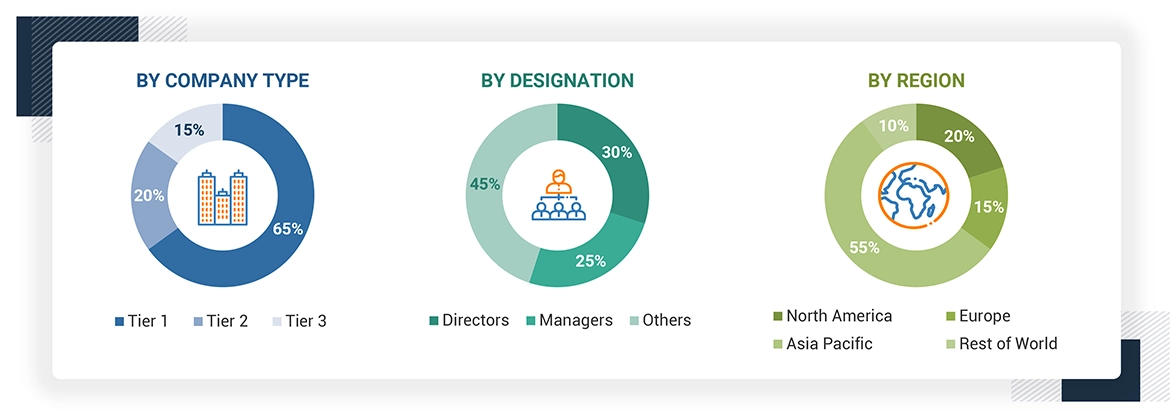
The lithium-ion battery dispersant market comprises several stakeholders, such as raw material manufacturers and suppliers, manufacturers, traders, distributors, suppliers, contract manufacturing organizations, institutions, and regulatory organizations in the supply chain. As part of the primary research process, various primary sources from both the supply and demand sides were interviewed to obtain qualitative and quantitative information for this report on the lithium-ion battery dispersant market. Primary sources from the supply side included industry experts such as Chief Executive Officers (CEOs), vice presidents, marketing directors, and related key executives from various companies and organizations operating in the lithium-ion battery dispersant market. Primary sources from the demand side included directors, marketing heads, and purchase managers from multiple end-use industries.
Breakdown of the Primary Interviews
To know about the assumptions considered for the study, download the pdf brochure
Market Size Estimation
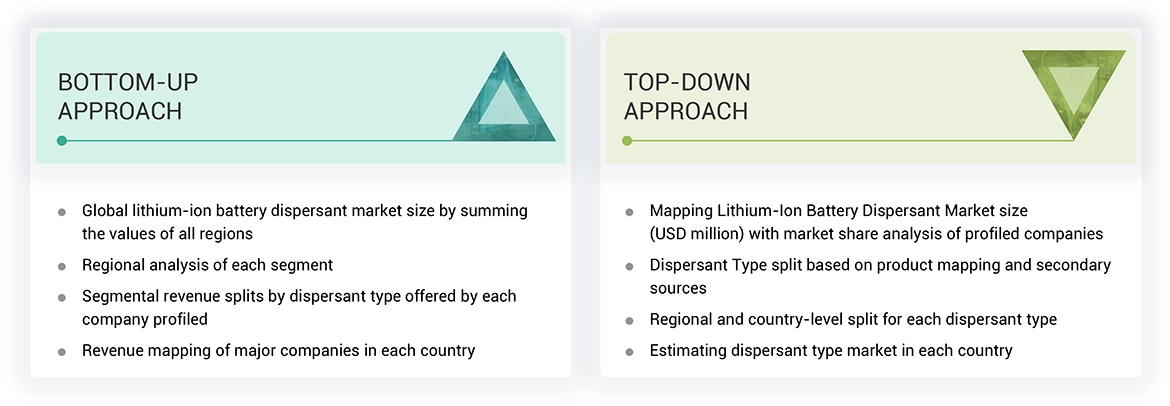
The top-down and bottom-up approaches have been used to estimate and validate the total size of the lithium-ion battery dispersant market. These approaches have also been used extensively to estimate the size of various dependent market subsegments. The research methodology used to estimate the market size included the following:
- The following segments provide details about the overall market size estimation process employed in this study
- The key players in the market were identified through secondary research.
- The market shares in the respective regions were identified through primary and secondary research.
- The value chain and market size of the lithium-ion battery dispersant market, in terms of value, were determined through primary and secondary research.
- All percentage shares, splits, and breakdowns were determined using secondary sources and verified through primary sources.
- All possible parameters that affect the market covered in this research study were accounted for, viewed in extensive detail, verified through primary research, and analyzed to obtain the final quantitative and qualitative data.
- The research included studying the annual and financial reports of the top market players and interviewing industry experts, such as CEOs, VPs, directors, sales managers, and marketing executives, for key insights, both quantitative and qualitative.
Data Triangulation
After arriving at the overall market size, using the market size estimation processes explained above, the market was split into several segments and subsegments. Data triangulation and market breakdown procedures were employed to complete the overall market engineering process and arrive at the exact statistics of each market segment and subsegment. The data was triangulated by studying various factors and trends from both the demand and supply sides. In addition to this, the market size was validated using both top-down and bottom-up approaches.
Market Definition
Lithium-ion battery dispersant is an additive used in various stages of battery manufacturing processes to get optimum viscosity of electrode slurry and to have a homogeneous distribution of conductive carbon in electrodes. A more uniform distribution of the active material will generally positively affect battery performance. There are various types of lithium-ion battery dispersants: block copolymers, naphthalene sulfonates, lignosulfonates, and others (polyimide-based dispersants, carboxymethyl cellulose, and polyacrylic acids). Some of the key stakeholders and manufacturers are Ashland, LG Chem, Huntsman International LLC, Evonik Industries AG, and Kao Corporation.
Report Objectives
- To define, describe, and forecast the lithium-ion battery dispersant market size based on dispersant type, end-use, formulation type, and region.
- To provide detailed information regarding the major factors (drivers, restraints, opportunities, and challenges) influencing market growth.
- To forecast the size of the various segments of the lithium-ion battery dispersant market based on four regions—North America, Asia Pacific, Europe, and Rest of World—along with key countries in each region.
- To analyze the opportunities in the market for stakeholders and present a competitive landscape for the market leaders.
- To analyze recent developments, such as expansions, agreements, new product developments, partnerships, acquisitions, and collaboration in the lithium-ion battery dispersant market.
- To strategically profile the key players in the market and comprehensively analyze their core competencies.
Get the Full Lithium-ion Battery Dispersant Market Report
Full forecast, segment splits, and company analysis for all Lithium-ion Battery Dispersant Market.
- US Lithium-ion Battery Dispersant Market
- Canada Lithium-ion Battery Dispersant Market
- Mexico Lithium-ion Battery Dispersant Market
- Germany Lithium-ion Battery Dispersant Market
- France Lithium-ion Battery Dispersant Market
- China Lithium-ion Battery Dispersant Market
- Japan Lithium-ion Battery Dispersant Market
- South Korea Lithium-ion Battery Dispersant Market
- Rest Of Europe Lithium-ion Battery Dispersant Market
- Rest Of Asia Pacific Lithium-ion Battery Dispersant Market
Need a Tailored Report?
Customize this report to your needs
Get 10% FREE Customization
Customize This Report
