
Rest Of Europe Live Cell Imaging Market (2025-2030)

The Rest Of Europe Live Cell Imaging Market was valued at $4.6 Million in 2025 and projected to reach to $5.8 Million by 2030, representing a compound annual growth rate of 4.8%. Rest Of Europe's live cell imaging market is positioned for steady growth as research institutions and pharmaceutical companies increasingly recognize the value of real-time cellular monitoring in drug development and disease research.


| Market Size in | USD 26.32 MN |
| Market Forecast in | |
| CAGR | |
| Forecast Period | |
| Units Considered | Value (USD MN) |
Rest Of Europe Live Cell Imaging Market Trends and Insights
- Rest Of GCC Countries represents a developing segment within the broader GCC region, with steady adoption of advanced imaging technologies in research and clinical applications.
- The market growth in Rest Of GCC Countries is driven by increasing investments in life sciences infrastructure and rising demand for real-time cellular analysis across pharmaceutical and biotechnology sectors. Rest Of GCC Countries is experiencing gradual market maturation as healthcare institutions and research facilities upgrade their laboratory capabilities.
- Between 2025 and 2030, Rest Of GCC Countries will benefit from improved access to live cell imaging systems and growing awareness of their applications in drug discovery and disease monitoring.
- The moderate growth trajectory of Rest Of GCC Countries reflects the region's emerging status in the global live cell imaging landscape, with opportunities for expansion as regional research initiatives expand..
Key Market Statistics
- CAGR (2025-2030) 4.8% CAGR
- Market Size, 2025 ~USD 4.6 Million
- Forecast, 2030 ~USD 5.8 Million
- Country Rest Of Europe
Rest Of Europe Live Cell Imaging Market Overview
Market Size & Growth :
Rest Of Europe's live cell imaging market is valued at USD 4.6 million in 2025, with projected growth to USD 5.8 million by 2030, representing a steady CAGR of 4.8% over the forecast period.
Regional Adoption Trends :
Rest Of Europe demonstrates moderate adoption of live cell imaging technologies in academic research institutions and smaller clinical laboratories, driven by increasing funding for life sciences research and growing awareness of advanced imaging capabilities.
Market Drivers :
Growth is fueled by rising investments in pharmaceutical R&D, expanding biotechnology sectors in emerging European markets, and increasing demand for real-time cellular analysis in drug discovery and development processes.
Competitive Landscape :
The Rest Of Europe segment features a mix of regional distributors and smaller specialized vendors, with limited presence of major global players, creating opportunities for niche market entrants and localized solutions.
Rest Of Europe Live Cell Imaging Market Dynamics
- The region's growing biotechnology sector and rising government support for life sciences research are expected to drive adoption of advanced imaging technologies over the next five years.
- However, budget constraints in smaller research facilities and limited access to cutting-edge equipment may moderate growth compared to more developed European markets..
Market Ecosystem
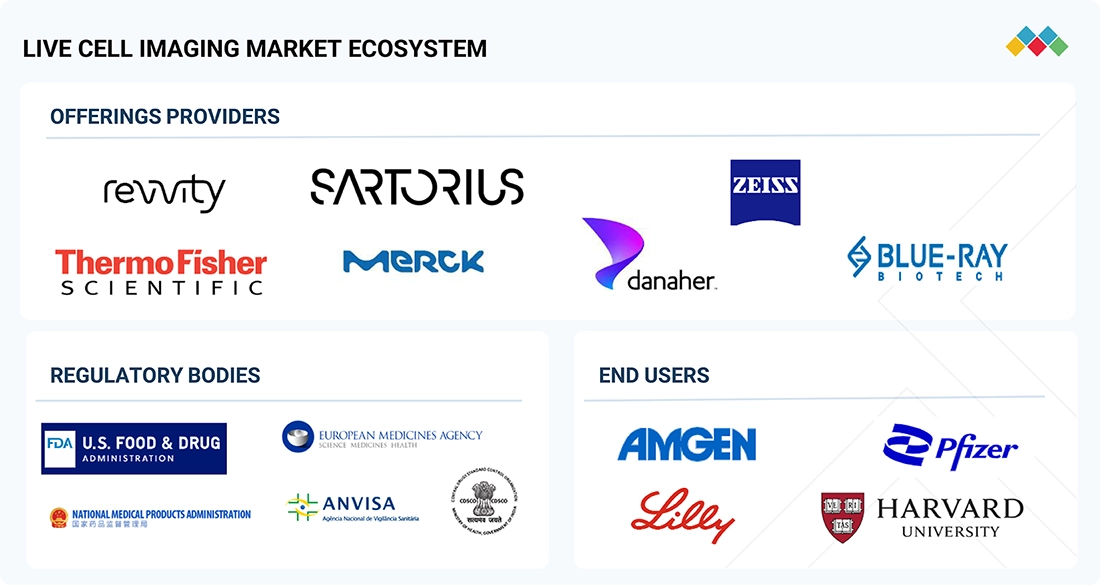
LIVE CELL IMAGING MARKET: GROWTH, SIZE, SHARE, AND TRENDS: COMMERCIAL USE CASES ACROSS INDUSTRIES
| COMPANY | USE CASE DESCRIPTION | BENEFITS |
|---|---|---|
 |
Institute of Developmental & Regenerative Medicine uses the microscopy facilities offered by Carl Zeiss | Rapid and gentle state-of-the-art live-cell imaging system | Useful in experiments demanding high temporal resolution or imaging of sensitive processes |
Logos and trademarks shown above are the property of their respective owners. Their use here is for informational and illustrative purposes only.
Related Ecosystem
Biotechnology
- Reagents
- Polymerase Chain Reaction (PCR)
- Stem Cells
- Assay Kits
- Flow Cytometers
- Thermo Fisher Scientific Inc.
- Merck KGaA
- Danaher Corporation
- Agilent Technologies, Inc.
- Bio-Rad Laboratories, Inc.
Key Takeaways
- Rest Of GCC Countries live cell imaging market valued at USD 4.6 million in 2025, growing to USD 5.8 million by 2030
- Rest Of GCC Countries exhibits a 4.8% CAGR, reflecting steady but moderate market expansion over the forecast period
- Rest Of GCC Countries is driven by increasing life sciences infrastructure investments and pharmaceutical research demand
- Rest Of GCC Countries represents an emerging market segment with significant growth potential as regional research capabilities develop
Live Cell Imaging Market Report Scope
| Report Metric | Details |
|---|---|
| Base Year | 2025 |
| Fastest Growing Segment | HIGH-CONTENT SCREENING (HCS) (Technology) |
| Forecast Period | 2025–2030 |
| Growth Rate | CAGR of 8.68% from 2025 to 2030 |
| Largest Segment | TIME-LAPSE MICROSCOPY (Technology) |
| Market Size Base Year (Billions) | ~USD 3.13 (2025) |
| Revenue Forecast (Billions) | ~USD 4.75 (2030) |
| Segments Covered | Offering, Type, Technology, Application, End User |
Rest Of Europe Live Cell Imaging Market Report Segmentation
5 segment dimensions are covered across the global market.
By Offering
- Consumables
- Instruments
- Services
- Software
By Type
- Accessories
- Assay Kits
- Cell Analyzers
- Cell Imaging Systems
- Media
- Microscopes
- Other Consumables
- Reagents
By Technology
- Fluorescence Recovery After Photobleaching (Frap)
- Fluorescence Resonance Energy Transfer (Fret)
- High-Content Screening (Hcs)
- Other Technologies
- Time-Lapse Microscopy
By Application
- Cell Biology Research
- Developmental Biology
- Drug Discovery
- Stem Cell Research
By End User
- Academic & Research Institutes
- Contract Research Organizations
- Pharmaceutical & Biopharmaceutical Companies
Target Audience
- Medical Device Manufacturers : Manufacturers need Rest Of Europe-specific market data to assess regional demand for live cell imaging systems, identify distribution partnerships, and develop localized product strategies for this growing but price-sensitive market.
- Pharmaceutical & Biotech Companies : R&D teams in Rest Of Europe require market insights to benchmark imaging technology adoption, justify equipment investments, and understand competitive advantages of implementing advanced live cell imaging in drug discovery pipelines.
- Research Institutions & Universities : Academic research centers need regional market intelligence to secure funding for imaging infrastructure, evaluate technology options, and understand adoption trends among peer institutions across Rest Of Europe.
- Healthcare Investors & Consultants : Investment firms and management consultants require Rest Of Europe-specific forecasts and growth drivers to evaluate market opportunities, identify acquisition targets, and advise clients on regional expansion strategies.
- Distributors & Service Providers : Regional distributors and imaging service providers need localized market data to identify customer segments, assess market potential, and develop service offerings aligned with Rest Of Europe's specific research and clinical needs.
Key Companies in the Rest Of Europe Live Cell Imaging Market
| Company | HQ | Ownership | Strongest segments |
|---|---|---|---|
| ABCAM PLC | United Kingdom | Private Company | Primary and secondary antibodies,Conjugated antibodies and conjugation kits,Singleplex immunoassays, |
| MAXCYTE, INC | United States | Public Company | ExPERT GTx and VLx (therapeutic-scale platforms),ExPERT STx and ATx (R&D and mid-scale platforms),Consumables and PAs, |
| GENERAL ELECTRIC | United States | Public Company | Commercial Engines OEM,Commercial MRO and Spares,Defense Engines and Services, |
| TENET HEALTHCARE CORPORATION | United States | Public Company | Hospital Operations and Services – Acute and Specialty Care,Ambulatory Care – ASCs and Surgical Hospitals,Outpatient and Ancillary Services (imaging, urgent care, labs, telemedicine), |
| DANAHER | United States | Public Company | Biotechnology (bioprocessing and related solutions),Life Sciences tools and reagents,Diagnostics (clinical instruments, consumables, software, services), |
| THERMO FISHER SCIENTIFIC INC. | United States | Public Company | Life Sciences Solutions,Analytical Instruments,Specialty Diagnostics, |
| REVVITY | United States | Public Company | Diagnostics (prenatal, neonatal, infectious disease, immunodiagnostics),Life science reagents, assays, and consumables,Instruments and imaging systems, |
| SARTORIUS AG | Germany | Public Company | Bioprocess solutions (bioreactors, cell culture, filtration, chromatography),Lab products and services (lab filtration, water, weighing, pipettes, microbiological testing),Analytical and cell analysis solutions (BLI, cytometry, live-cell imaging, SPR, PAT, software), |
| NIKON CORPORATION | Japan | Public Company | Imaging Business (digital cameras & cinema),Precision Equipment (FPD exposure),Healthcare Business (life science solutions), |
| AGILENT TECHNOLOGIES, INC. | United States | Public Company | Life Sciences and Diagnostics Markets,Agilent CrossLab,Applied Markets, |
| NANOENTEK | South Korea | Public Company | FREND fluorescence immunoassay analyzers and consumables,BUDDI and rapid diagnostic test items,ADAM cell counters (rWBC, stem cell, fluorescence, brightfield, somatic), |
| BRUKER | United States | Public Company | BSI BioSpin (NMR/EPR and preclinical imaging),BSI CALID (mass spectrometry, molecular diagnostics, applied solutions),BSI Nano (X-ray, AFM, nanoanalysis, metrology), |
| BD | United States | Public Company | Medical Essentials (syringes, needles, vascular access, sharps, basic disposables),Connected Care (infusion pumps, IV medication safety, dispensing, pharmacy automation, informatics),Life Sciences (specimen collection, microbiology, TB, molecular, flow cytometry, reagents), |
| MERCK KGAA | Germany | Public Company | Life Science (reagents, consumables, bioprocessing, CDMO services),Healthcare (oncology, neurology, fertility, rare diseases, cardiometabolic),Electronics (semiconductor materials, display and OLED, specialty gases and equipment), |
| BIO-RAD LABORATORIES, INC. | United States | Public Company | Clinical Diagnostics systems, kits, and quality controls,Life Science instruments and consumables,Software and informatics solutions, |
| SYSMEX CORPORATION | Japan | Public Company | Hematology analyzers and reagents (XN-Series, XN-V, ProCyte Dx),Coagulation analyzers and reagents,Blood gas, electrolyte, and urinalysis systems, |
ABCAM PLC
Abcam PLC is a United Kingdom-based private company founded in 1998 that employs 1,760 people. The company operates in the life sciences sector.
MAXCYTE, INC
MaxCyte, Inc. is a United States-based public company founded in 1998 with 91 employees. The company operates in the cell engineering and life sciences technology sector.
GENERAL ELECTRIC
General Electric is a United States-based public company founded in 1892 with 57,000 employees. The company operates across multiple industrial and technology sectors.
TENET HEALTHCARE CORPORATION
Tenet Healthcare Corporation is a United States-based public company founded in 1967 with 88,500 employees. The company operates as a healthcare services provider.
DANAHER
Danaher is a United States-based public company founded in 1969 with 59,000 employees. The company operates across diversified industrial and life sciences sectors.
THERMO FISHER SCIENTIFIC INC.
Thermo Fisher Scientific Inc. is a United States-based public company founded in 1956 with 125,000 employees. The company operates as a global leader in life sciences and laboratory services.
REVVITY
Revvity is a United States-based public company founded in 1937 with 11,000 employees. The company operates in the life sciences and diagnostics sector.
SARTORIUS AG
Sartorius AG is a Germany-based public company founded in 1870 with 14,242 employees. The company operates in the life sciences and laboratory equipment sector.
NIKON CORPORATION
Nikon Corporation is a Japan-based public company founded in 1917 with 19,928 employees. The company operates in imaging, optics, and precision equipment sectors.
AGILENT TECHNOLOGIES, INC.
Agilent Technologies, Inc. is a United States-based public company founded in 1999 with 18,000 employees. The company operates in life sciences, diagnostics, and analytical instruments.
NANOENTEK
Nanoentek is a South Korea-based public company founded in 1987 with 97 employees. The company operates in the life sciences and diagnostics technology sector.
BRUKER
Bruker is a United States-based public company founded in 1960 with 11,085 employees. The company operates in scientific instruments and analytical equipment.
BD
BD is a United States-based public company founded in 1897 with 72,000 employees. The company operates as a global medical technology and diagnostics provider.
MERCK KGAA
Merck KGaA is a Germany-based public company founded in 1668 with 59,077 employees. The company operates in pharmaceuticals, life sciences, and specialty chemicals.
BIO-RAD LABORATORIES, INC.
Bio-Rad Laboratories, Inc. is a United States-based public company founded in 1952 with 7,450 employees. The company operates in life sciences research and clinical diagnostics.
SYSMEX CORPORATION
Sysmex Corporation is a Japan-based public company founded in 1968 with 10,861 employees. The company operates in clinical diagnostics and laboratory equipment.
Reasons to Buy this Report
- Regional Market Sizing : Obtain precise market valuation for Rest Of Europe (USD 4.6M in 2025), enabling accurate budget allocation and investment decisions specific to this developing segment within the broader European market.
- Growth Trajectory Analysis : Understand the 4.8% CAGR forecast through 2030, allowing stakeholders to identify expansion opportunities and plan long-term strategies tailored to Rest Of Europe's moderate but consistent growth pattern.
- Competitive Intelligence : Gain insights into the regional competitive landscape, including vendor distribution, market gaps, and opportunities for new entrants in Rest Of Europe's less saturated imaging technology market.
- Localized Adoption Drivers : Identify region-specific factors influencing live cell imaging adoption, including research funding patterns, institutional capabilities, and regulatory environment unique to Rest Of Europe countries.
- Strategic Market Entry : Develop targeted go-to-market strategies for Rest Of Europe by understanding local demand patterns, customer segments, and barriers to adoption specific to this emerging regional market.
Frequently asked questions
What is the current market size of live cell imaging in Rest Of GCC Countries?
Rest Of GCC Countries live cell imaging market is estimated at USD 4.6 million in 2025.
What is the projected market size for Rest Of GCC Countries by 2030?
Rest Of GCC Countries live cell imaging market is forecast to reach USD 5.8 million by 2030.
What is the CAGR for the live cell imaging market in Rest Of GCC Countries?
Rest Of GCC Countries live cell imaging market is expected to grow at a CAGR of 4.8% from 2025 to 2030.
What factors are driving growth in Rest Of GCC Countries live cell imaging market?
Rest Of GCC Countries market growth is driven by increased life sciences infrastructure investments, rising pharmaceutical research demand, and growing adoption of advanced imaging technologies in research facilities.
How does Rest Of GCC Countries compare to the broader GCC region?
Rest Of GCC Countries represents an emerging segment within the GCC region with steady adoption rates and moderate growth, reflecting the region's developing status in the global live cell imaging landscape.
RESEARCH METHODOLOGY
This research study involved the extensive use of secondary sources, directories, and databases to identify and collect valuable information to analyze the global live cell imaging market. In-depth interviews were conducted with various primary respondents, including key industry participants, subject-matter experts (SMEs), C-level executives of key market players, and industry consultants, to obtain and verify critical qualitative and quantitative information and assess the growth prospects of the market. The global market size estimated through secondary research was then triangulated with inputs from primary research to arrive at the final market size.
Secondary Research
The secondary sources referred to for this research study include publications from government sources, such as the American Society for Cell Biology (ASCB), Cancer Research UK (CRUK), International Society for Stem Cell Research (ISSCR), European Molecular Biology Organization (EMBO), Clinical and Contract Research Association (CCRA), Association of International Contract Research Organizations (AICROS), Clinical and Contract Research Association (CCRA), American Association of Pharmaceutical Scientists (AAPS), Eurostat, Food and Drug Administration (FDA), Pharmaceutical Research and Manufacturers of America (PhRMA), PubMed, Government Associations. Secondary sources also include corporate and regulatory filings, such as annual reports, SEC filings, investor presentations, and financial statements; business magazines & research journals; press releases; and trade, business, and professional associations. Secondary data was collected and analyzed to arrive at the overall size of the global live cell imaging market, which was validated through primary research.
Primary Research
Extensive primary research was conducted after acquiring basic knowledge about the global live cell imaging market scenario through secondary research. Several primary interviews were conducted with market experts from the demand side, such as pharmaceutical and biotechnology companies, and experts from the supply side, such as C-level and D-level executives and managers. These interviews were conducted across major regions, namely, North America, Europe, the Asia Pacific, and the Rest of the World (including Latin America, the Middle East, and Africa). This primary data was collected through questionnaires, e-mails, online surveys, personal interviews, and telephonic interviews.
In the complete market engineering process, the top-down and bottom-up approaches were extensively used, along with several data triangulation methods, to perform the market estimation and market forecasting for the overall market segments and subsegments listed in this report. Extensive qualitative and quantitative analysis was performed on the complete market engineering process to list the key information/insights throughout the report.
The following is a breakdown of the primary respondents:
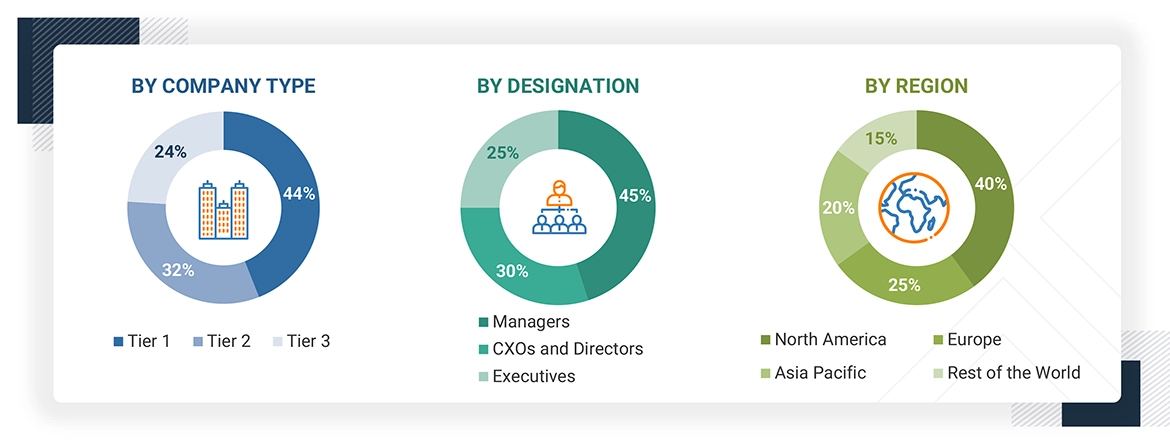
To know about the assumptions considered for the study, download the pdf brochure
Market Size Estimation
The global size of the live cell imaging market was estimated and validated through multiple approaches, such as the top-down and bottom-up approaches. These methods were also used extensively to estimate the size of various subsegments in the markets.
Bottom-up Approach
- The key players in the live cell imaging market were identified through extensive primary and secondary research.
- The revenues generated from the live cell imaging businesses of leading players in product & service offerings were determined separately through primary and secondary research.
- All percentage shares, splits, and breakdowns for respective market segments were determined using secondary sources and verified through primary sources.
Top-down Approach
- After arriving at the overall market size from the market size estimation process, the total market was split into several segments and subsegments.
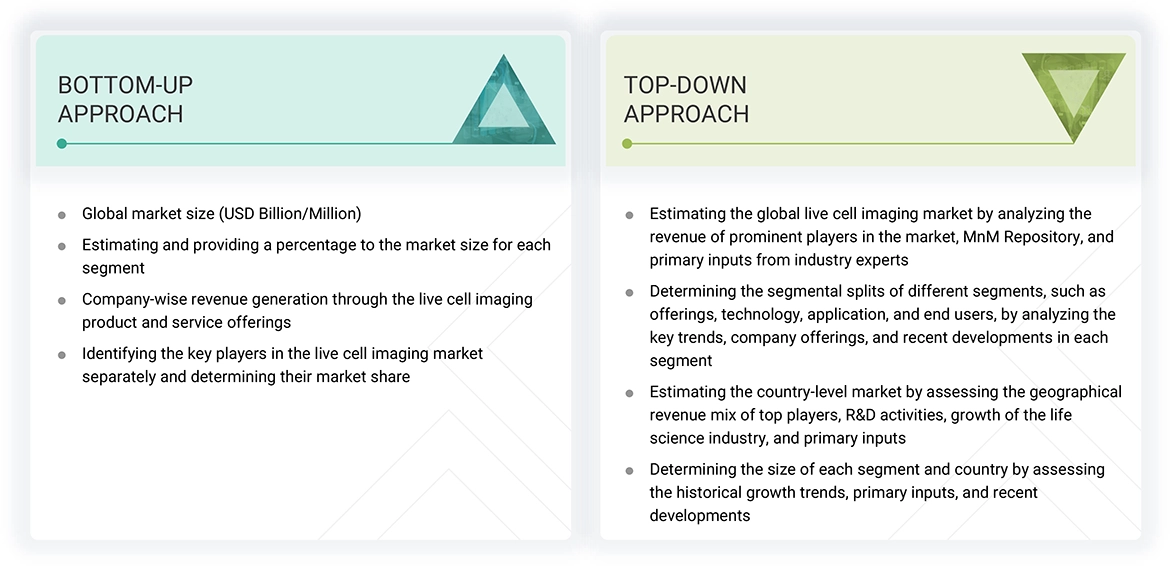
Data Triangulation
After arriving at the market size from the market size estimation process explained above, the total market was divided into several segments and subsegments. To complete the overall market engineering process and arrive at the exact statistics for all segments and subsegments, data triangulation and market breakdown procedures were employed, wherever applicable.
Market Definition
Live cell imaging allows scientists to observe living cells in real time using advanced fluorescence-based methods like FRET, FRAP, and HCS. These techniques help study important biological processes such as protein interactions, ion movement, and cell transport with minimal disruption to the cell. The live cell imaging market includes instruments (like microscopes, imaging systems, and analyzers), consumables (such as reagents, assay kits, buffers, and accessories), software, and services. Key technologies in this market include time-lapse microscopy, FRET, FRAP, and high-content screening. Live-cell imaging is mainly used in areas such as cell biology research, stem cell studies, developmental biology, and drug discovery. The main users of these technologies are pharmaceutical and biotechnology companies, academic and research institutions, and contract research organizations.
Stakeholders
- Manufacturers of live cell imaging equipment and consumables
- Suppliers and distributors of live cell imaging technologies
- Research institutes and academic centers
- Pharmaceutical & biotechnology companies
- Contract research organizations (CROs)
- Business research and consulting service providers
- Venture capitalists
- Regulatory bodies
- Government bodies/municipal corporations
Report Objectives
- To define, describe, and forecast the live cell imaging market based on offering, technology, application, end user, and region
- To provide detailed information regarding the major factors influencing the market growth (drivers, restraints, opportunities, and challenges)
- To analyze micromarkets with respect to individual growth trends, prospects, and contributions to the overall live cell imaging market
- To analyze the opportunities for stakeholders and provide details of the competitive landscape for market leaders
- To forecast the market size of the segments in six regions: North America, Europe, the Asia Pacific, Latin America, Middle East and Africa
- To profile the key players and analyze their market shares and core competencies
- To track and analyze competitive developments, such as acquisitions, product launches, expansions, agreements, partnerships, and collaborations
- To benchmark players within the market using the proprietary “Company Evaluation Matrix” framework, which analyzes market players on various parameters within the broad categories of business and product excellence strategies
- To study trends & disruptions impacting business; apply pricing analysis, supply/value chain analysis, ecosystem analysis, technology analysis, patent analysis, and trade analysis; and identify key conferences & events in 2025–2026, key stakeholders & buying criteria, and the investment & funding scenario
- To study the impact of AI/Gen AI on the market under study, along with the macroeconomic analysis for each region
Get the Full Live Cell Imaging Market Report
Full forecast, segment splits, and company analysis for all Live Cell Imaging Market.
- Canada Live Cell Imaging Market
- US Live Cell Imaging Market
- Germany Live Cell Imaging Market
- UK Live Cell Imaging Market
- France Live Cell Imaging Market
- Italy Live Cell Imaging Market
- Spain Live Cell Imaging Market
- China Live Cell Imaging Market
- Japan Live Cell Imaging Market
- India Live Cell Imaging Market
- South Korea Live Cell Imaging Market
- Australia Live Cell Imaging Market
- Brazil Live Cell Imaging Market
- Mexico Live Cell Imaging Market
- Saudi Arabia Live Cell Imaging Market
- UAE Live Cell Imaging Market
Need a Tailored Report?
Customize this report to your needs
Get 10% FREE Customization
Customize This Report
