
US Loudspeaker Market (2025-2030)

The US Loudspeaker Market was valued at $3826 Million in 2025 and projected to reach to $4469.8 Million by 2030, representing a compound annual growth rate of 3.2%. The US loudspeaker market is poised for steady growth through 2030, driven by increasing consumer preference for wireless and smart-enabled audio solutions.


| Market Size in | USD 26.32 MN |
| Market Forecast in | |
| CAGR | |
| Forecast Period | |
| Units Considered | Value (USD MN) |
US Loudspeaker Market Trends and Insights
- The US market benefits from strong consumer demand across portable, automotive, and professional audio segments, driven by increasing adoption of wireless technologies and smart home integration.
- The US loudspeaker industry is characterized by mature distribution channels and established brand presence, supporting steady expansion through the forecast period. Growth in the US loudspeaker market is supported by rising consumer spending on premium audio experiences and the proliferation of connected devices.
- The US market reflects moderate but consistent demand as consumers upgrade to higher-fidelity systems and integrate audio solutions into smart home ecosystems.
- Between 2025 and 2030, the US loudspeaker market will experience incremental gains driven by innovation in wireless connectivity, voice-activated features, and compact form factors tailored to US consumer preferences..
Key Market Statistics
- CAGR (2025-2030) 3.2% CAGR
- Market Size, 2025 ~USD 3826 Million
- Forecast, 2030 ~USD 4469.8 Million
- Country US
US Loudspeaker Market Overview
Market Valuation :
The US loudspeaker market is valued at $3,826.0 million in 2025 and is projected to reach $4,469.8 million by 2030, reflecting steady growth in consumer and commercial audio segments.
Growth Trajectory :
The US market is expanding at a CAGR of 3.2% through 2030, outpacing global growth rates in certain segments due to strong consumer purchasing power and technological adoption in smart home ecosystems.
Key Demand Drivers :
Wireless technology adoption, smart home integration, and the rise of portable audio devices are fueling demand across consumer, automotive, and professional audio segments in the US market.
Competitive Landscape :
The US loudspeaker market is characterized by intense competition from established brands and emerging players, with differentiation driven by innovation in connectivity, sound quality, and IoT integration.
US Loudspeaker Market Dynamics
- The proliferation of smart home devices, coupled with rising demand for premium audio experiences in automotive and professional settings, will sustain market expansion.
- Consumer electronics manufacturers are investing heavily in voice-activated and AI-integrated loudspeakers, creating new revenue opportunities.
- Additionally, the growing trend of home entertainment upgrades post-pandemic continues to support market momentum.
- However, market saturation in certain segments and price competition may moderate growth rates compared to emerging markets globally..
Market Ecosystem
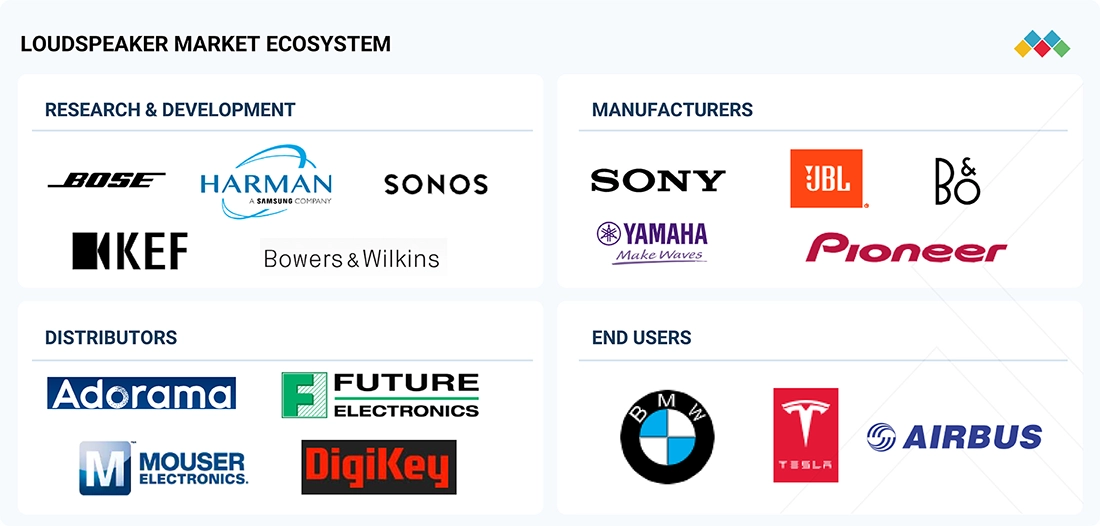
Loudspeaker Market Trends: COMMERCIAL USE CASES ACROSS INDUSTRIES
| COMPANY | USE CASE DESCRIPTION | BENEFITS |
|---|---|---|
 |
Wireless speakers integrated into the SmartThings ecosystem for smart home audio control via voice and app interfaces | Centralized automation, hands-free operation, and seamless device interoperability |
 |
Utilization of adaptive audio technology in Bose speakers to automatically adjust sound based on room acoustics | Personalized, high-quality sound optimized for various environments |
 |
Use of LDAC-enabled Bluetooth speakers for high-resolution wireless audio streaming | Superior sound quality delivered wirelessly, appealing to audiophiles |
 |
Use of multi-room audio systems for synchronized playback and individual control of wireless speakers across multiple rooms | Flexible and scalable whole-home audio experiences |
 |
Utilization of the MusicCast platform to connect loudspeakers and other audio devices into a unified home entertainment network | Centralized control with support for high-resolution, multi-device audio playback |
Logos and trademarks shown above are the property of their respective owners. Their use here is for informational and illustrative purposes only.
Related Ecosystem
Electrical System And Components
- Natural Language Processing (NLP)
- Sensors
- Machine Learning
- Temperature Sensors
- Actuators
- ABB India Limited
- Siemens ag
- SCHNEIDER ELECTRIC SE
- Eaton Corporation plc
- General Electric Company
Key Takeaways
- The US loudspeaker market is estimated at $3,826.0 million in 2025 and will reach $4,469.8 million by 2030.
- The US market is growing at a 3.2% CAGR, reflecting steady but moderate expansion driven by consumer audio upgrades.
- The US loudspeaker sector is supported by mature retail infrastructure and strong brand loyalty among consumers.
- Smart home integration and wireless connectivity are key growth drivers for the US loudspeaker market through 2030.
Loudspeaker Market Report Scope
| Report Metric | Details |
|---|---|
| Base Year | 2025 |
| Fastest Growing Segment | PORTABLE SPEAKERS (Product Type) |
| Forecast Period | 2025–2030 |
| Growth Rate | CAGR of 4.5% from 2025 to 2030 |
| Largest Segment | WIRELESS (Connectivity) |
| Market Size Base Year (Billions) | ~USD 16.44 (2025) |
| Revenue Forecast (Billions) | ~USD 20.49 (2030) |
| Segments Covered | Product Type, Connectivity, Functionality, Vertical |
US Loudspeaker Market Report Segmentation
4 segment dimensions are covered across the global market.
By Product Type
- Home Audio Systems
- Outdoor Speakers
- Portable Speakers
- Public Announcement Systems
- Soundbars
- Subwoofers
By Connectivity
- Wired
- Wireless
By Functionality
- Smart Speakers
- Traditional Speakers
By Vertical
- Commercial
- Entertainment
- Institutional
- Professional
- Residential
Target Audience
- Consumer Electronics Manufacturers : Need US-specific market data to develop product portfolios, optimize pricing strategies, and identify opportunities in wireless and smart speaker segments for competitive positioning.
- Automotive OEMs & Suppliers : Require detailed insights on automotive audio segment growth in the US to inform in-vehicle audio system development, supplier partnerships, and technology integration decisions.
- Professional Audio Equipment Providers : Seek market intelligence on professional loudspeaker demand trends in the US to guide product innovation, channel strategy, and commercial audio system offerings.
- Investment & Private Equity Firms : Need comprehensive US market analysis and growth forecasts to evaluate investment opportunities, assess portfolio company performance, and identify acquisition targets in the audio sector.
- Retail & Distribution Partners : Require market sizing and segment analysis for the US to optimize inventory management, negotiate supplier terms, and develop effective merchandising strategies for loudspeaker products.
Key Companies in the US Loudspeaker Market
| Company | HQ | Ownership | Strongest segments |
|---|---|---|---|
| SAMSUNG | Korea, South | Public Company | Soundbar,Home Theatre,Portable Speaker, |
| SONY GROUP CORPORATION | Japan | Public Company | Portable Speaker,Soundbar,Home Theatre, |
| PANASONIC CORPORATION | Japan | Public Company | Portable Speaker,Soundbar,Home Theatre, |
| YAMAHA CORPORATION | Japan | Public Company | Portable Speaker,Soundbar,Home Theatre, |
| LG ELECTRONICS | South Korea | Public Company | Soundbar,Home Theatre,Portable Speaker, |
| AMAZON.COM, INC. | United States | Public Company | Portable Speaker,Soundbar,Home Theatre, |
| ALPHABET INC. | United States | Public Company | Portable Speaker,Soundbar,Home Theatre, |
| VIZIO HOLDING CORP., INC. | United States | Private Company | Soundbar,Home Theatre,Portable Speaker, |
| MASIMO | United States | Private Company | Portable Speaker,Soundbar,Home Theatre, |
| PIONEER CORPORATION | United States | Private Company | Portable Speaker,Soundbar,Home Theatre, |
| SONOS, INC. | United States | Public Company | Portable Speaker,Soundbar,Home Theatre, |
| BANG & OLUFSEN | Denmark | Public Company | Portable Speaker,Soundbar,Home Theatre, |
SAMSUNG
Samsung is a South Korean multinational conglomerate founded in 1969 and publicly traded, with over 128,000 employees. The company operates across electronics, semiconductors, telecommunications, and consumer appliances.
SONY GROUP CORPORATION
Sony Group Corporation is a Japanese multinational entertainment and technology conglomerate founded in 1946 and publicly listed, employing approximately 94,900 people. The company operates in electronics, gaming, music, film, and financial services.
PANASONIC CORPORATION
Panasonic Corporation is a Japanese multinational electronics manufacturer founded in 1918 and publicly traded, with over 183,000 employees. The company produces consumer electronics, home appliances, industrial equipment, and battery systems.
YAMAHA CORPORATION
Yamaha Corporation is a Japanese multinational manufacturer founded in 1887 and publicly listed, employing approximately 17,900 people. The company produces musical instruments, audio equipment, motorcycles, and marine engines.
LG ELECTRONICS
LG Electronics is a South Korean multinational electronics company founded in 1958 and publicly traded, with over 34,000 employees. The company manufactures consumer electronics, home appliances, displays, and mobile devices.
AMAZON.COM, INC.
Amazon.com, Inc. is an American multinational technology and e-commerce company founded in 1994 and publicly listed, with over 1.5 million employees. The company operates in retail, cloud computing, digital streaming, and artificial intelligence.
ALPHABET INC.
Alphabet Inc. is an American multinational technology holding company founded in 1998 and publicly traded, employing approximately 194,700 people. The company operates through subsidiaries including Google, which dominates search, advertising, and cloud services.
VIZIO HOLDING CORP., INC.
Vizio Holding Corp., Inc. is a private American consumer electronics manufacturer founded in 2002, employing approximately 900 people. The company specializes in televisions and smart home entertainment devices.
MASIMO
Masimo is a private American medical technology company founded in 1989, employing approximately 2,200 people. The company develops and manufactures non-invasive monitoring technologies and sensors for healthcare applications.
PIONEER CORPORATION
Pioneer Corporation is a private American audio and electronics company founded in 1997, employing approximately 2,200 people. The company manufactures car audio systems, home audio equipment, and DJ technology.
SONOS, INC.
Sonos, Inc. is an American publicly traded audio equipment company founded in 2002, employing approximately 1,400 people. The company specializes in wireless speakers and multi-room audio systems for home entertainment.
BANG & OLUFSEN
Bang & Olufsen is a Danish luxury audio and electronics manufacturer founded in 1925 and publicly listed, employing approximately 1,100 people. The company produces high-end televisions, speakers, and audio equipment.
Reasons to Buy this Report
- Accurate US Market Sizing : Obtain precise valuation data for the US loudspeaker market with verified figures for 2025 ($3,826M) and 2030 forecasts ($4,469.8M), enabling accurate business planning and investment decisions.
- Segment-Specific Insights : Gain detailed analysis of portable, automotive, and professional audio segments specific to the US market, identifying high-growth opportunities and emerging consumer preferences.
- Competitive Intelligence : Understand the competitive dynamics, market consolidation trends, and key player strategies within the US loudspeaker industry to benchmark performance and identify market gaps.
- Technology Adoption Trends : Access insights on wireless technology penetration, smart home integration adoption, and IoT connectivity trends driving demand in the US market through 2030.
- Strategic Growth Planning : Leverage 5-year forecast data and CAGR analysis to develop targeted go-to-market strategies, product development roadmaps, and expansion plans for the US loudspeaker market.
Frequently asked questions
What is the current size of the US loudspeaker market?
The US loudspeaker market is valued at $3,826.0 million in 2025.
What is the projected size of the US loudspeaker market by 2030?
The US loudspeaker market is projected to reach $4,469.8 million by 2030.
What is the growth rate of the US loudspeaker market?
The US loudspeaker market is growing at a compound annual growth rate (CAGR) of 3.2% from 2025 to 2030.
What are the main drivers of growth in the US loudspeaker market?
Key growth drivers in the US loudspeaker market include smart home adoption, wireless technology advancement, premium audio demand, and integration with connected devices.
How does the US loudspeaker market compare to global trends?
The US loudspeaker market grows at 3.2% CAGR, slightly below the global average of 4.5%, reflecting a more mature and saturated market with steady but moderate expansion.
RESEARCH METHODOLOGY
The study used four major activities to estimate the market size of loudspeakers. Exhaustive secondary research was conducted to gather information on the market and its peer and parent markets. The next step was to validate these findings, assumptions, and sizing with industry experts across the value chain through primary research. Both top-down and bottom-up approaches were employed to estimate the total market size. Finally, market breakdown and data triangulation methods were utilized to estimate the market size for different segments and subsegments.
Secondary Research
The research methodology used to estimate and forecast the size of the loudspeaker market began with the acquisition of data related to the revenues of key vendors in the market through secondary research. Various secondary sources have been referred to in the secondary research process to identify and collect information for this study. Secondary sources include annual reports, press releases, and investor presentations of companies; white papers, journals, certified publications, and articles by recognized authors; websites; directories; and databases. Secondary research has mainly been used to obtain key information about the value chain of the loudspeaker market, key players, market classification, and segmentation according to the industry trends to the bottom-most level, geographic markets, and key developments from both market and technology-oriented perspectives. Secondary data has been collected and analyzed to determine the overall market size, further validated through primary research. Moreover, the study involved extensive use of secondary sources, directories, and databases, such as Hoovers, Bloomberg Businessweek, Factiva, and OneSource, to identify and collect valuable information for a technical, market-oriented, and commercial study of the loudspeaker market. Vendor offerings have been taken into consideration to determine market segmentation.
Primary Research
In the primary research, various primary sources from both the supply and demand sides have been interviewed to obtain the qualitative and quantitative information relevant to this report. Primary sources from the supply side include the key industry participants, subject-matter experts (SMEs), and C-level executives and consultants from various key companies and organizations in the loudspeaker ecosystem. After the complete market engineering (including calculations for the market statistics, the market breakdown, the market size estimations, the market forecasting, and the data triangulation), extensive primary research has been conducted to verify and validate the critical market numbers obtained. Extensive qualitative and quantitative analyses have been performed during the market engineering process to list key information/insights throughout the report. Extensive primary research has been conducted after understanding the loudspeaker market scenario through secondary research. Several primary interviews have been conducted with market experts from the demand- and supply-side players across key regions: North America, Europe, Asia Pacific, and the Rest of the World (Middle East, Africa, and South America). Various primary sources from the supply and demand sides of the market have been interviewed to obtain qualitative andquantitative information.
Primary data has been collected through questionnaires, emails, and telephone interviews. In the canvassing of primaries, various departments within organizations, such as sales, operations, and administration, were covered to provide a holistic viewpoint in our report. After interacting with industry experts, brief sessions were conducted with highly experienced independent consultants to reinforce the findings from our primaries. This and the in-house subject matter experts’ opinions have led us to the findings described in the remainder of this report.
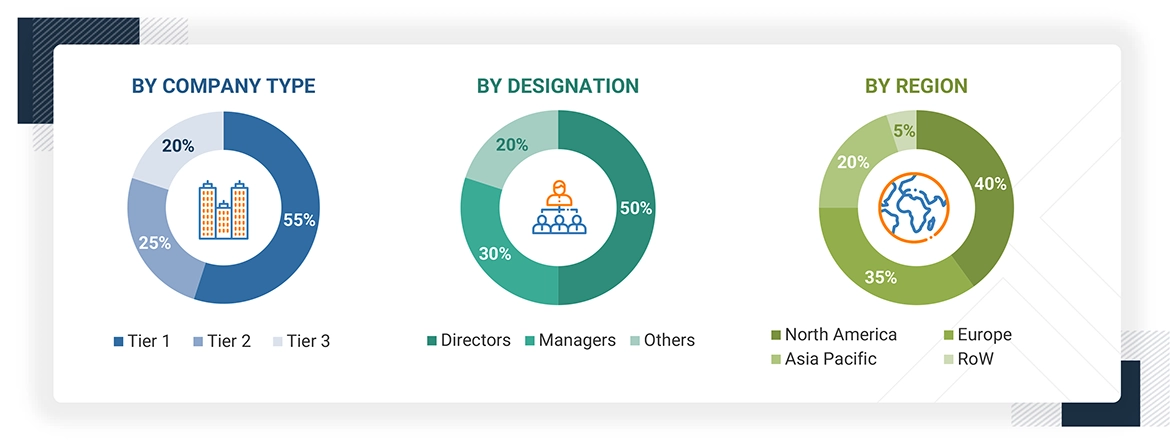
Note: The three tiers of the companies are defined based on their total revenue in 2024: Tier 1 - revenue greater than or equal to USD 1 billion; Tier 2 - revenue between USD 100 million and USD 1 billion; and Tier 3 revenue less than or equal to USD 100 million. Other designations include sales managers, marketing managers, and product managers.
To know about the assumptions considered for the study, download the pdf brochure
Market Size Estimation
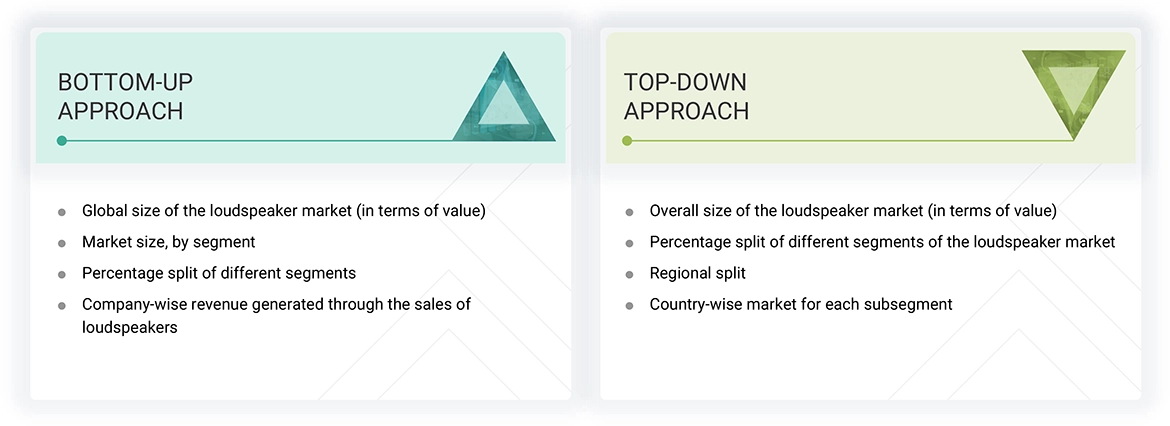
Both top-down and bottom-up approaches were utilized to estimate and validate the size of the loudspeaker market and its submarkets. Secondary research was conducted to identify the key players in the market, and primary and secondary research was used to determine their market share in specific regions. The entire process involved studying top players' annual and financial reports and conducting extensive interviews with industry leaders such as CEOs, VPs, directors, and marketing executives. Secondary sources were used to determine all percentage shares and breakdowns, which were verified through primary sources. All parameters that could impact the markets covered in this research study were accounted for, analyzed in detail, verified through primary research, and consolidated to obtain the final quantitative and qualitative data.
Loudspeaker Market : Top-Down and Bottom-Up Approach
Data Triangulation
Once the overall size of the loudspeaker market was determined using the methods described above, it was divided into multiple segments and subsegments. Market engineering was performed for each segment and subsegment using market breakdown and data triangulation methods, as applicable, to obtain accurate statistics. To triangulate the data, various factors and trends from the demand and supply sides were studied. The market was validated using both top-down and bottom-up approaches.
Market Definition
A loudspeaker is a device that converts electrical audio signals into sound, allowing users to hear music, speech, or other audio. It is commonly used across consumer electronics, automotive systems, public address systems, and home entertainment setups. Loudspeakers come in various designs and sizes, including portable Bluetooth speakers, soundbars, and high-end audio systems tailored to different applications and environments. Manufacturers focus on sound quality, power output, and connectivity features to cater to personal and professional audio needs.
Key Stakeholders
- Loudspeaker material and component providers
- Loudspeaker providers, integrators, and installers
- Electronic hardware equipment manufacturers
- Loudspeaker software and solution providers
- Consulting companies
- Loudspeaker-related associations, organizations, forums, and alliances
- Government and corporate bodies
- Research institutes and organizations
- Venture capitalists, private equity firms, and startup companies
- Distributors and traders
- Original equipment manufacturers (OEMs)
- End users
Report Objectives
- To define, describe, and forecast the loudspeaker market, in terms of value, segmented by product type, connectivity, functionality, and vertical
- To describe and forecast the market, in terms of value, for various segments with respect to four main regions—North America, Europe, Asia Pacific, and Rest of the World (RoW)
- To provide detailed information regarding the major factors, such as drivers, restraints, opportunities, and challenges, influencing the growth of the loudspeaker market
- To strategically analyze micromarkets with respect to individual growth trends, prospects, and contributions to the total market
- To analyze opportunities for stakeholders by identifying high-growth segments of the loudspeaker market
- To benchmark players within the market using the proprietary Company Evaluation Matrix framework, which analyzes market players on various parameters within the broad categories of market rank and product offering
- To strategically profile the key players, comprehensively analyze their market shares and core competencies, and provide a detailed competitive landscape for market leaders
- To analyze competitive developments, such as partnerships, collaborations, agreements, joint ventures, mergers and acquisitions, expansions, and product launches and developments in the loudspeaker market
- To analyze the impact of the macroeconomic factors impacting the loudspeaker market
Available customizations:
With the given market data, MarketsandMarkets offers customizations according to the specific requirements of companies. The following customization options are available for the report:
- Detailed analysis and profiling of additional market players (up to 5)
- Additional country-level analysis of the loudspeaker market
Product Analysis
- Product matrix, which provides a detailed comparison of the product portfolio of each company in the loudspeaker market.
Get the Full Loudspeaker Market Report
Full forecast, segment splits, and company analysis for all Loudspeaker Market.
- Canada Loudspeaker Market
- Mexico Loudspeaker Market
- France Loudspeaker Market
- Germany Loudspeaker Market
- Italy Loudspeaker Market
- Rest Of Europe Loudspeaker Market
- UK Loudspeaker Market
- China Loudspeaker Market
- India Loudspeaker Market
- Japan Loudspeaker Market
- Rest Of Asia Pacific Loudspeaker Market
- South Korea Loudspeaker Market
Need a Tailored Report?
Customize this report to your needs
Get 10% FREE Customization
Customize This Report
