
GCC Countries Low GWP Refrigerants Market (2026-2031)

The GCC Countries Low GWP Refrigerants Market was valued at $283 Million in 2026 and projected to reach to $470 Million by 2031, representing a compound annual growth rate of 10.7%. The GCC Countries low GWP refrigerants market is positioned for sustained growth through 2031, supported by intensifying environmental regulations, rising industrial cooling requirements, and corporate sustainability initiatives.


| Market Size in | USD 26.32 MN |
| Market Forecast in | |
| CAGR | |
| Forecast Period | |
| Units Considered | Value (USD MN) |
GCC Countries Low GWP Refrigerants Market Trends and Insights
- GCC Countries are witnessing accelerated adoption of low global warming potential refrigerants driven by stringent environmental regulations, rising cooling demand in the region's hot climate, and corporate sustainability commitments.
- The market growth in GCC Countries reflects both regulatory compliance pressures and increasing investment in energy-efficient cooling infrastructure across commercial, industrial, and residential sectors. GCC Countries' refrigerant market is characterized by a shift away from high-GWP alternatives toward compliant, low-impact solutions.
- Between 2026 and 2031, GCC Countries will see intensified competition among manufacturers and distributors, with major players expanding regional operations to capture growing demand.
- The 10.7% compound annual growth rate in GCC Countries outpaces the global average, underscoring the region's strategic importance and the urgency of transitioning to environmentally responsible refrigeration technologies..
Key Market Statistics
- CAGR (2026-2031) 10.7% CAGR
- Market Size, 2026 ~USD 283 Million
- Forecast, 2031 ~USD 470 Million
- Country GCC Countries
GCC Countries Low GWP Refrigerants Market Overview
Strong Regional Growth :
GCC Countries' low GWP refrigerants market is expanding at 10.7% CAGR, outpacing the global rate of 9.8%, driven by regional climate demands and regulatory pressures.
Significant Market Expansion :
Market valuation is projected to grow from USD 283.0 million in 2026 to USD 470.0 million by 2031, representing a 66% increase over the five-year forecast period.
Climate-Driven Demand :
Extreme heat conditions across GCC nations create persistent cooling demand, accelerating the transition from high-GWP to environmentally compliant low-GWP refrigerant solutions.
Regulatory Compliance Push :
Stringent environmental regulations and international climate commitments are compelling GCC industries to adopt low-GWP refrigerants, reshaping procurement strategies across HVAC and cooling sectors.
GCC Countries Low GWP Refrigerants Market Dynamics
- The region's extreme climate conditions necessitate reliable cooling infrastructure, creating consistent demand for advanced refrigerant solutions that comply with global environmental standards. Key growth drivers include increased adoption in commercial HVAC systems, refrigeration in food and pharmaceutical sectors, and automotive air conditioning applications.
- GCC nations' economic diversification efforts and investments in sustainable infrastructure further accelerate market penetration.
- Strategic partnerships between regional distributors and global refrigerant manufacturers are expected to enhance product availability and technical support, solidifying the region's transition toward low-GWP alternatives..
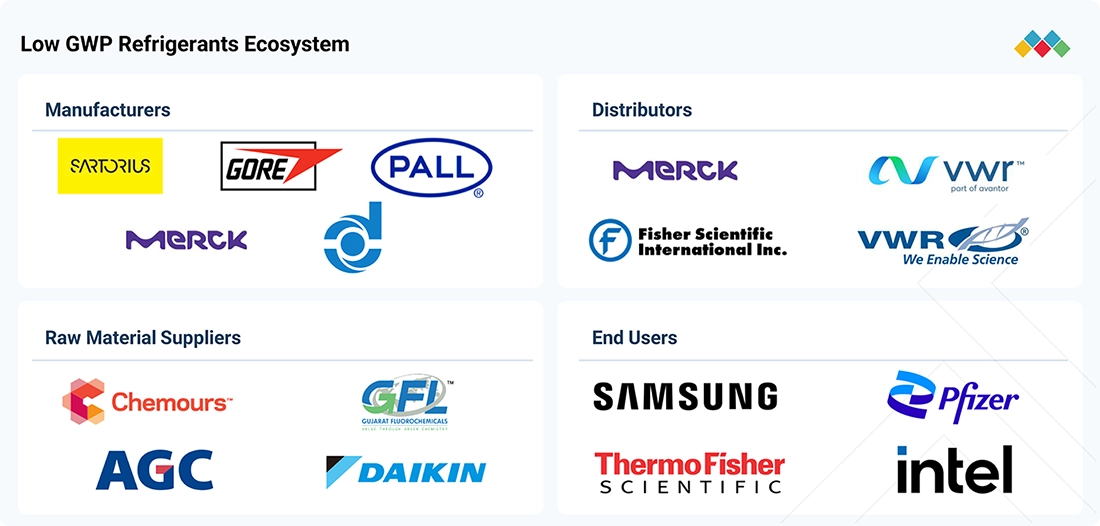
Market Ecosystem
LOW GWP REFRIGERANTS MARKET: COMMERCIAL USE CASES ACROSS INDUSTRIES
| COMPANY | USE CASE DESCRIPTION | BENEFITS |
|---|---|---|
 |
Provides low-GWP HFO and HFO-blend refrigerants for industrial refrigeration, cold storage, food retail, heat pumps, and air-conditioning applications. | Low global warming potential | High energy efficiency | Reliable cooling performance |
 |
Provides Opteon™ low-GWP refrigerants for commercial refrigeration, air conditioning, heat pumps, mobile air conditioning, and chiller applications. | Reduced environmental impact | High energy efficiency | Reliable system performance |
 |
Uses low-GWP refrigerants such as R-32 across stationary air-conditioning and heat pump systems. | Lower GWP | High cooling efficiency | Reduced refrigerant charge |
 |
Provides Forane® lower-GWP refrigerants for air conditioning, commercial and industrial refrigeration, chillers, heat pumps, and cold storage applications. | Lower global warming potential | Effective cooling performance | System compatibility |
 |
Develops and supplies lower-GWP refrigerants for automotive air conditioning, heat pumps, cold-chain refrigeration, and commercial refrigeration applications. | Reduced environmental impact | Energy-efficient cooling | Broad application suitability |
Logos and trademarks shown above are the property of their respective owners. Their use here is for informational and illustrative purposes only.
Related Ecosystem
Speciality Chemicals
- Corrosion Inhibitors
- Polyetheretherketone (PEEK)
- Acrylonitrile Butadiene Styrene (ABS)
- Epoxy Resin
- Polycarbonate
- Basf se
- DOW CHEMICAL COMPANY
- Evonik industries ag
- Clariant ag.
- Solvay sa
Key Takeaways
- GCC Countries' low GWP refrigerants market is valued at USD 283.0 million in 2026, expanding to USD 470.0 million by 2031 at a 10.7% CAGR.
- GCC Countries' growth rate exceeds the global average, driven by climate demands, regulatory mandates, and sustainability initiatives across the region.
- GCC Countries' market expansion is supported by rising commercial and industrial cooling infrastructure investments and energy efficiency requirements.
- GCC Countries will attract increased competition and regional expansion from major refrigerant manufacturers through 2031.
Low GWP Refrigerants Market Report Scope
| Report Metric | Details |
|---|---|
| Base Year | 2026 |
| Fastest Growing Segment | HYDROCARBONS (Type) |
| Forecast Period | 2026-2030 |
| Growth Rate | CAGR of 9.8% from 2026 to 2030 |
| Largest Segment | FLUOROCARBONS (Type) |
| Market Size Base Year (Billions) | ~USD 8.18 (2026) |
| Revenue Forecast (Billions) | ~USD 11.89 (2030) |
| Segments Covered | Type, Application |
GCC Countries Low GWP Refrigerants Market Report Segmentation
2 segment dimensions are covered across the global market.
By Type
- Fluorocarbons
- Hydrocarbons
- Inorganics
By Application
- Commercial Refrigeration
- Domestic Refrigeration
- Industrial Refrigeration
- Mobile Air Conditioning
- Other Applications
- Stationary Air Conditioning
Target Audience
- Refrigerant Manufacturers : Develop region-specific product portfolios and distribution strategies aligned with GCC market growth projections and regulatory requirements.
- HVAC & Cooling Equipment Suppliers : Understand GCC demand patterns and compliance standards to design compatible systems and capture market share in this high-growth regional segment.
- Industrial & Commercial Operators : Make informed procurement decisions for refrigerant upgrades and system replacements based on GCC-specific market trends and regulatory timelines.
- Investment & Private Equity Firms : Evaluate investment opportunities in GCC refrigerant distribution, manufacturing, and service sectors with detailed market sizing and growth forecasts.
- Environmental & Regulatory Consultants : Support clients navigating GCC compliance requirements with comprehensive market data on low-GWP adoption rates and regulatory implementation timelines.
Reasons to Buy this Report
- Regional Market Sizing : Obtain precise market valuations and forecasts specific to GCC Countries, enabling accurate budget allocation and investment decisions for regional expansion strategies.
- Competitive Landscape Intelligence : Understand market dynamics, key players, and competitive positioning within GCC nations to identify partnership opportunities and market entry strategies.
- Regulatory Compliance Insights : Access detailed analysis of GCC-specific environmental regulations and compliance requirements driving low-GWP refrigerant adoption across industries.
- Demand Forecasting : Leverage segment-level projections for HVAC, refrigeration, and automotive sectors in GCC to optimize product development and supply chain planning.
- Strategic Growth Opportunities : Identify high-potential applications and emerging sectors within GCC Countries where low-GWP refrigerant solutions are gaining traction for accelerated market penetration.
Frequently asked questions
What is the market size of low GWP refrigerants in GCC Countries in 2026?
The low GWP refrigerants market in GCC Countries is valued at USD 283.0 million in 2026.
What is the projected market size for GCC Countries by 2031?
GCC Countries' low GWP refrigerants market is forecast to reach USD 470.0 million by 2031.
What is the CAGR for low GWP refrigerants in GCC Countries?
GCC Countries' market is expected to grow at a compound annual growth rate of 10.7% from 2026 to 2031.
Why is GCC Countries' growth rate higher than the global average?
GCC Countries' elevated growth reflects extreme climate conditions requiring intensive cooling, strict environmental regulations, and regional sustainability commitments driving rapid adoption of low-GWP alternatives.
What sectors are driving demand in GCC Countries?
Commercial, industrial, and residential cooling sectors in GCC Countries are primary growth drivers, supported by infrastructure expansion and energy efficiency mandates.
RESEARCH METHODOLOGY
The study involved four major activities to estimate the current size of the global low GWP refrigerants market. Exhaustive secondary research was carried out to collect information on the market, the peer product market, and the parent product group market. The next step was to validate these findings, assumptions, and sizes with the industry experts across the value chain of low GWP refrigerants through primary research. The top-down and bottom-up approaches were employed to estimate the overall size of the low GWP refrigerants market. After that, market breakdown and data triangulation procedures were used to determine the size of different segments and sub-segments of the market.
Secondary Research
The market for companies offering low GWP refrigerants is arrived at by secondary data available through paid and unpaid sources, analyzing the product portfolios of the major companies in the ecosystem, and rating the companies by their performance and quality. Various secondary sources, such as Business Standard, Bloomberg, World Bank, and Factiva, were referred to identify and collect information for this study on the low GWP refrigerants market. In the secondary research process, various secondary sources were referred to identify and collect information related to the study. Secondary sources included annual reports, press releases, and investor presentations of door vendors, forums, certified publications, and whitepapers. The secondary research was used to obtain critical information on the industry’s value chain, the total pool of key players, market classification, and segmentation from the market and technology-oriented perspectives.
Primary Research
In the primary research process, various primary sources from both the supply and demand sides were interviewed to obtain qualitative and quantitative information for this report. The primary sources from the supply side included industry experts, such as Chief Executive Officers (CEOs), Vice Presidents (VPs), marketing directors, technology and innovation directors, and related key executives from several key companies and organizations operating in the Low GWP refrigerants market. After the complete market engineering (calculations for market statistics, market breakdown, market size estimations, market forecasting, and data triangulation), extensive primary research was conducted to gather information and verify and validate the critical numbers arrived at. Primary research was also conducted to identify the segmentation types, industry trends, competitive landscape of Low GWP refrigerants offered by various market players, and key market dynamics, such as drivers, restraints, opportunities, challenges, industry trends, and key player strategies. In the complete market engineering process, the top-down and bottom-up approaches and several data triangulation methods were extensively used to perform the market estimation and market forecasting for the overall market segments and subsegments listed in this report. Extensive qualitative and quantitative analysis was performed on the complete market engineering process to list the key information/insights throughout the report.
Following is the breakdown of primary respondents:
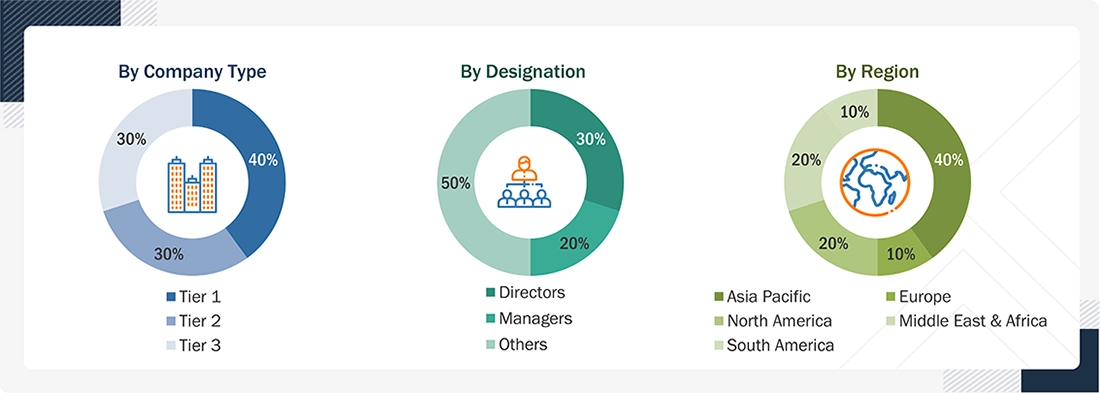
Notes: Other designations include sales, marketing, and product managers.
Tier 1: >USD 1 Billion; Tier 2: USD 500 million–1 Billion; and Tier 3: <USD 500 million.
To know about the assumptions considered for the study, download the pdf brochure
Market Size Estimation
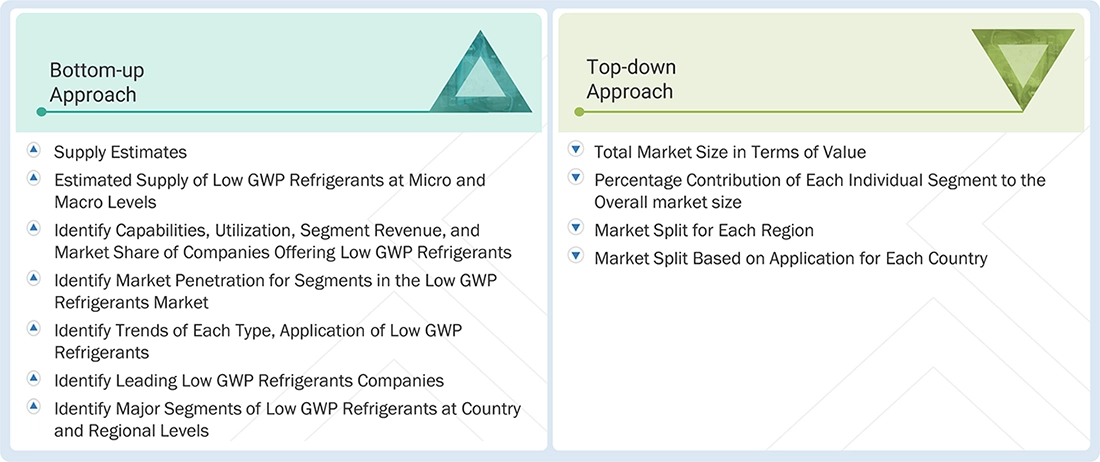
The top-down and bottom-up approaches were used to estimate and validate the size of the global low GWP refrigerants market. These approaches were also used extensively to estimate the size of various dependent market segments. The research methodology used to estimate the market size included the following:
Low GWP Refrigerants Market: Top-Down and Bottom-Up Approach
Data Triangulation
After arriving at the overall market size using the market size estimation processes, the market was split into several segments and subsegments. The data triangulation and market breakup procedures were employed, wherever applicable, to complete the overall market engineering process and arrive at the exact statistics of each market segment and subsegment. The data was triangulated by studying various factors and trends from both the demand and supply sides.
Market Definition
The Low GWP Refrigerants market represents advanced cooling technology designed to supply efficient cooling services while minimizing the adverse effects on the environment largely across various segments like industrial, commercial, residential, automotive, and others. Apart from the very low global warming potential of the low GWP refrigerants, they still provide high effectiveness for their chilling ability, energy usage, and overall operational dependability. The main reasons for turning away from high-GWP refrigerants and embracing new refrigerants are the green advantages together with the tight regulatory system. There are several categories of low GWP refrigerants among them are inorganic refrigerants, fluorocarbons, and hydrocarbons, every category having a set of specific characteristics to suit different application scenarios. The producers are working hand in hand with the industry and customers to come up with refrigerant options that use less of a system's energy, provide a cooling capacity that meets modern standards, ensure the safety of the user, and have the kind of environmental credentials that the consumers would be very interested in. The use of Low GWP refrigerants is extensive in industrial freezing, commercial refrigeration units, home cooling units, fixed air-conditioning units, car or vehicle air-conditioning units, and other forms of cooling. Due to their environmentally friendly behavior, energy efficient design principles, and Truth is they integrate perfectly with state-of-the-art refrigeration equipment, they are gaining momentum in different sectors.
Key Stakeholders
- Low GWP refrigerants manufacturers
- Refrigerant raw material and chemical suppliers
- Refrigeration and air conditioning equipment manufacturers
- Refrigeration system manufacturers and technology providers
- Distributors and refrigerant equipment suppliers
- End-use industries and industrial customers
- Regulatory bodies, industry associations, and standards organizations
- R&D institutions
Report Objectives
- To define, describe, and forecast the size of the global low GWP refrigerants market, based on type, application, and region in terms of value.
- To provide detailed information on the significant drivers, restraints, opportunities, and challenges influencing the market
- To strategically analyze micro markets concerning individual growth trends, prospects, and their contribution to the market
- To assess the growth opportunities in the market for stakeholders and provide details on the competitive landscape for market leaders
- To forecast the market size of segments and subsegments for North America, Europe, Asia Pacific, South America, and the Middle East & Africa
- To strategically profile key players and comprehensively analyze their market shares and core competencies
- To analyze competitive developments such as product launches, acquisitions, expansions, partnerships, and agreements in the low GWP refrigerants market
- To provide the impact of AI/Gen AI on the market
Available customizations:
With the given market data, MarketsandMarkets offers customizations according to client-specific needs.
The following customization options are available for Low GWP refrigerants market report:
Product Analysis
-
A product matrix that gives a detailed comparison of the product portfolio of each company
Regional Analysis
-
A further breakdown of the Low GWP refrigerants market for additional countries
Company Information
-
Detailed analysis and profiling of additional market players (up to five)
Get the Full Low GWP Refrigerants Market Report
Full forecast, segment splits, and company analysis for all Low GWP Refrigerants Market.
- US Low GWP Refrigerants Market
- Canada Low GWP Refrigerants Market
- Mexico Low GWP Refrigerants Market
- France Low GWP Refrigerants Market
- Germany Low GWP Refrigerants Market
- UK Low GWP Refrigerants Market
- China Low GWP Refrigerants Market
- India Low GWP Refrigerants Market
- Japan Low GWP Refrigerants Market
- South Korea Low GWP Refrigerants Market
- South Africa Low GWP Refrigerants Market
- Brazil Low GWP Refrigerants Market
- Argentina Low GWP Refrigerants Market
- Rest Of Europe Low GWP Refrigerants Market
- Rest Of Asia Pacific Low GWP Refrigerants Market
- -Rest Of GCC Low GWP Refrigerants Market
- Rest Of South America Low GWP Refrigerants Market
Need a Tailored Report?
Customize this report to your needs
Get 10% FREE Customization
Customize This Report
