
Australia Management System Certification Market (2025-2030)

The Australia Management System Certification Market was valued at $1079.6 Million in 2025 and projected to reach to $1262.5 Million by 2030, representing a compound annual growth rate of 3.18%. Australia's Management System Certification Market is poised for sustained growth through 2030, driven by increasing regulatory requirements and the semiconductor industry's expansion.


| Market Size in | USD 26.32 MN |
| Market Forecast in | |
| CAGR | |
| Forecast Period | |
| Units Considered | Value (USD MN) |
Australia Management System Certification Market Trends and Insights
- This steady growth reflects Australia's commitment to quality assurance and regulatory compliance within the semiconductor and electronics sector.
- Australia's market demonstrates resilience driven by increasing demand for ISO certifications and industry-specific standards across manufacturing and technology enterprises. The Australian market benefits from strong regulatory frameworks and a mature industrial base that prioritizes operational excellence and risk management.
- Australia's semiconductor and electronics companies are increasingly adopting management system certifications to enhance competitiveness and meet international supply chain requirements.
- Between 2025 and 2030, Australia is expected to see sustained investment in certification infrastructure, driven by digital transformation initiatives and heightened focus on sustainability standards across the region..
Key Market Statistics
- CAGR (2025-2030) 3.18% CAGR
- Market Size, 2025 ~USD 1079.6 Million
- Forecast, 2030 ~USD 1262.5 Million
- Country Australia
Australia Management System Certification Market Overview
Market Valuation :
Australia's Management System Certification Market is valued at USD 1,079.6 million in 2025, demonstrating significant investment in quality assurance and compliance infrastructure across the semiconductor and electronics sector.
Steady Growth Trajectory :
The market is projected to reach USD 1,262.5 million by 2030, representing a CAGR of 3.18%, indicating consistent demand for certification services among Australian manufacturers and technology companies.
Regulatory Compliance Focus :
Australia's commitment to stringent quality standards and regulatory compliance drives adoption of management system certifications, particularly ISO standards, across semiconductor and electronics manufacturing facilities.
Market Resilience :
The Australian market demonstrates resilience and stability, supported by strong government initiatives, industry partnerships, and the nation's position as a key player in the Asia-Pacific electronics supply chain.
Australia Management System Certification Market Dynamics
- The 3.18% CAGR reflects steady demand from manufacturers seeking to enhance operational efficiency and meet international quality standards.
- Key growth drivers include digital transformation initiatives, supply chain resilience efforts, and heightened focus on environmental and safety certifications.
- The market will benefit from Australia's strategic positioning in the Asia-Pacific region and growing collaboration with global electronics manufacturers.
- Investment in advanced manufacturing capabilities and Industry 4.0 adoption will further accelerate certification demand across the sector..
Market Ecosystem
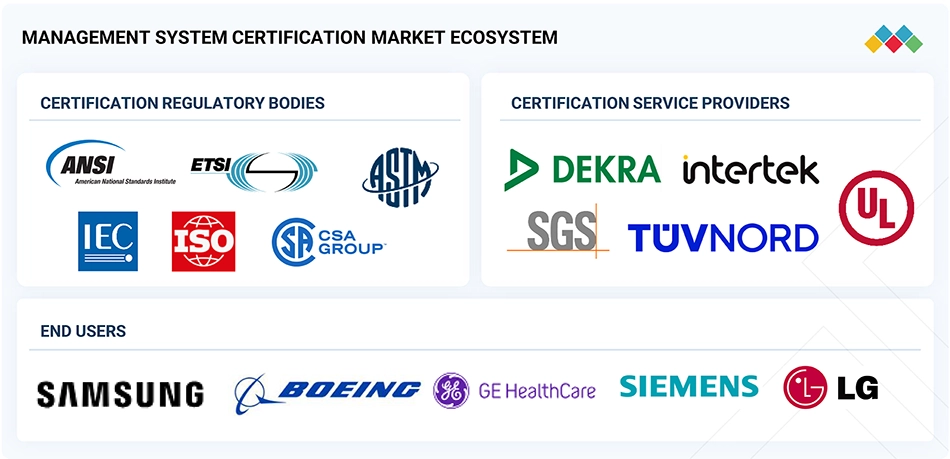
Management System Certification Market: COMMERCIAL USE CASES ACROSS INDUSTRIES
| COMPANY | USE CASE DESCRIPTION | BENEFITS |
|---|---|---|
 |
Implements ISO 9001 (Quality Management) and ISO 14001 (Environmental Management) certifications across industrial and energy facilities to ensure consistent process quality and sustainability compliance. | Enhances operational efficiency, reduces environmental impact, and ensures global compliance with ISO standards. |
 |
Maintains ISO/IEC 27001 (Information Security Management) and ISO/IEC 22301 (Business Continuity Management) certifications for global data centers under the IT & Telecommunications vertical. | Protects sensitive data, ensures operational resilience, and meets international cybersecurity compliance. |
 |
Applies ISO 13485 and ISO 45001 (Occupational Health & Safety) certifications across its Medical & Life Sciences operations for manufacturing and workforce protection. | Ensures patient safety, regulatory alignment, and improved workplace health standards. |
 |
Implements ISO 9001 and ISO 14001 certifications under Transportation & Logistics, focusing on global supply chain efficiency and sustainability initiatives. | Improves service reliability, reduces carbon footprint, and ensures compliance with environmental and quality benchmarks. |
 |
Adopts ISO 26000 (Social Responsibility) and ISO 50001 (Energy Management) certifications under Finance and Sustainable Governance verticals. | Demonstrates ESG commitment, enhances energy efficiency, and strengthens brand reputation for sustainable operations. |
Logos and trademarks shown above are the property of their respective owners. Their use here is for informational and illustrative purposes only.
Related Ecosystem
Testing Inspection And Certification
- Eddy Current Testing (ECT)
- Safety Testing
- Signal Generators
- Acoustic Emission Testing (AET)
- Automated Test Equipment
- Sgs s.a.
- Intertek Group plc
- Bureau veritas s.a.
- TUV RHEINLAND AG
- EUROFINS SCIENTIFIC SE
Key Takeaways
- Australia's Management System Certification Market is valued at USD 1,079.6 million in 2025 with a projected value of USD 1,262.5 million by 2030.
- Australia is experiencing a 3.18% CAGR, reflecting steady but moderate growth compared to global expansion rates in the certification sector.
- Australia's semiconductor and electronics companies are increasingly prioritizing ISO and industry-specific certifications to strengthen supply chain resilience and international competitiveness.
- Australia's regulatory environment and mature industrial base support sustained demand for management system certifications through 2030.
Management System Certification Market Report Scope
| Report Metric | Details |
|---|---|
| Base Year | 2025 |
| Fastest Growing Segment | FSSC 22000 (Food Safety Certification Type) |
| Forecast Period | 2025–2030 |
| Growth Rate | CAGR of 4.4% from 2025 to 2030 |
| Largest Segment | PRODUCT CERTIFICATION (Certification Type) |
| Market Size Base Year (Billions) | ~USD 41.31 (2025) |
| Revenue Forecast (Billions) | ~USD 51.24 (2030) |
| Segments Covered | Certification Type, Management System Certification Service Type, Application, Information Securtiy Certification Type, Information Security Certification Type, It & Telecom Certification Type, Food Safety Certification Type, Other Application Type, Social Responsibility Certification Type, Sustainable Finance Certification Type, Sustainable Procurement Certification Type, Governance Certification Type, Dei & Workforce Certification Type, Type, Energy Management Certification Type, Vertical |
Australia Management System Certification Market Report Segmentation
16 segment dimensions are covered across the global market.
By Certification Type
- Management System Certification
- Product Certification
By Management System Certification Service Type
- Certification & Verification
- Training & Business Assurance
By Application
- Data Center
- Environmental Management
- Food Safety
- Information Security
- It & Telecom
- Occupational Health And Safety
- Other Applications
- Quality Management
- Quality Management System
By Information Securtiy Certification Type
- Csa Star Certification
- Iso/Iec 15408
- Iso/Iec 20000-1
- Iso/Iec 27001
- Iso/Sae 21434
- Other Information Security Certifications
- Soc
By Information Security Certification Type
- Csa Star Certification
- Iso/Iec 15408
- Iso/Iec 20000-1
- Iso/Iec 27001
- Iso/Sae 21434
- Other Information Security Certifications
- Soc
By It & Telecom Certification Type
- Gcf
- Iso/Iec 22301
- Istqb
- Other It & Telecom Certifications
- Ptcrb
By Food Safety Certification Type
- Brcgs
- Fssc 22000
- Haccp
- Ifs
- Iso 22000
- Other Food Safety Certifications
- Sqf
By Other Application Type
- Dei & Workforce
- Energy Management
- Governance
- Social Responsibility
- Sustainable Finance
- Sustainable Procurement
By Social Responsibility Certification Type
- B Corp Certification
- Fair Trade Certification
- Other Social Responsibility Certificates
- Sa 8000 Certification
By Sustainable Finance Certification Type
- Climate Bonds Certification
- Gresb Certification
- Other Sustainable Finance Certificates
By Sustainable Procurement Certification Type
- Fsc
- Other Sustainable Procurement Certificates
- Pefc
- Rainforest Alliance Certification
By Governance Certification Type
- Iso 37001
- Iso 37301
- Other Governance Certificates
By Dei & Workforce Certification Type
- Cde
- Cdp
- Iso 30415
- Other Dei & Workforce Certifications
By Type
- Cde
- Cdp
- Iso 30415
- Other Dei & Workforce Certifications
By Energy Management Certification Type
- Breeam
- Energy Star Certification
- Iso 50001
- Iso 50003
- Leed
- Other Energy Management Certifications
By Vertical
- Agriculture & Food
- Construction & Infrastructure
- Consumer Goods & Retail
- Energy & Utilities
- Finance
- Industrial & Manufacturing
- It & Telecommunication
- It & Telecommunications
- Marine
- Medical & Life Sciences
- Other Verticals
- Transportation & Logistics
AUSTRALIA: MANAGEMENT SYSTEM CERTIFICATION MARKET, BY VERTICAL, 2025–2030
| Segment | 2025 | 2026 | 2027 | 2028 | 2029 | 2030 | CAGR (%) |
|---|---|---|---|---|---|---|---|
| AGRICULTURE & FOOD | 98.5 | 101 | 103.6 | 106.3 | 109.3 | 112.5 | 2.68 |
| CONSTRUCTION & INFRASTRUCTURE | 102.6 | 105.3 | 108.3 | 111.4 | 114.8 | 118.4 | 2.91 |
| CONSUMER GOODS & RETAIL | 170.7 | 175.1 | 179.8 | 184.7 | 189.9 | 195.4 | 2.74 |
| ENERGY & UTILITIES | 29.1 | 30.2 | 31.3 | 32.4 | 33.7 | 35 | 3.73 |
| FINANCE | 70.6 | 74.1 | 77.8 | 81.8 | 86.1 | 90.8 | 5.17 |
| INDUSTRIAL & MANUFACTURING | 99.3 | 103.2 | 107.3 | 111.7 | 116.4 | 121.5 | 4.11 |
| IT & TELECOMMUNICATIONS | 1.1 | 1.2 | 1.3 | 1.4 | 1.5 | 1.6 | 6.61 |
| MARINE | 88 | 91 | 94.2 | 97.6 | 101.3 | 105.2 | 3.63 |
| MEDICAL & LIFE SCIENCES | 93.9 | 97.4 | 101 | 104.9 | 109.1 | 113.5 | 3.86 |
| OTHER VERTICALS | 280.8 | 287.1 | 293.7 | 300.8 | 308.3 | 316.4 | 2.42 |
| TRANSPORTATION & LOGISTICS | 44.9 | 46.2 | 47.6 | 49.1 | 50.7 | 52.4 | 3.12 |
| TOTAL | 1079.6 | 1111.7 | 1145.9 | 1182.3 | 1221.1 | 1262.5 | 3.18 |
Target Audience
- Certification Service Providers : Organizations offering ISO and management system certifications need Australia-specific market data to identify growth opportunities, assess competitive positioning, and develop localized service offerings.
- Semiconductor & Electronics Manufacturers : Australian manufacturers require insights into certification trends, compliance requirements, and market benchmarks to optimize quality management systems and maintain competitive advantage.
- Business Development & Strategy Teams : Corporate strategists and business development professionals need market forecasts and growth projections to guide expansion plans, partnerships, and investment decisions in Australia.
- Regulatory & Compliance Officers : Compliance professionals and quality assurance managers need Australia-specific regulatory landscape data to ensure adherence to local standards and industry best practices.
- Investment & Consulting Firms : Private equity, venture capital, and management consulting firms require detailed market analysis to evaluate investment opportunities and advise clients on market entry strategies in Australia.
Key Companies in the Australia Management System Certification Market
| Company | HQ | Ownership | Strongest segments |
|---|---|---|---|
| SGS SA | Switzerland | Public Company | Quality Management,Environmental Management,Occupational Health and Safety, |
| BUREAU VERITAS | France | Public Company | Quality Management (ISO 9001 and related),Environmental Management (ISO 14001 and related),Occupational Health and Safety (ISO 45001 and related), |
| INTERTEK GROUP PLC | United Kingdom | Public Company | Quality Management (e.g., ISO 9001 and sector variants),Environmental Management & Sustainability (e.g., ISO 14001 and related),Occupational Health and Safety Management, |
| DEKRA | Germany | Private Company | Quality Management (e.g., ISO 9001 and sector-specific),Environmental Management (e.g., ISO 14001 and related),Occupational Health and Safety (e.g., ISO 45001), |
| UL LLC | United States | Public Company | Quality Management Certification (ISO 9001 and related),Environmental Management Certification (ISO 14001 and related),Occupational Health and Safety Certification (ISO 45001 and related), |
| APPLUS+ | Spain | Private Company | Quality Management (e.g., ISO 9001 and sector-specific),Environmental Management (e.g., ISO 14001 and sustainability schemes),Occupational Health and Safety Management, |
| EUROFINS SCIENTIFIC | Luxembourg | Public Company | Quality Management Certification,Environmental Management Certification,Occupational Health and Safety Certification, |
| ALS | France | Public Company | Quality Management (ISO 9001–linked rail solutions),Environmental Management (ISO 14001–linked green traction and electrification),Occupational Health and Safety (ISO 45001–linked maintenance and projects), |
SGS SA
SGS SA is a Swiss multinational public company founded in 1878, operating with approximately 83,000 employees and providing inspection, verification, testing, and certification services.
BUREAU VERITAS
Bureau Veritas is a French public company established in 1828 with approximately 80,449 employees, specializing in testing, inspection, and certification services across multiple industries.
INTERTEK GROUP PLC
Intertek Group PLC is a British public company founded in 1885 with approximately 45,425 employees, providing quality and safety solutions including testing, inspection, and certification services.
DEKRA
DEKRA is a German private company founded in 1925 with approximately 47,803 employees, specializing in vehicle inspection, testing, certification, and safety services.
UL LLC
UL LLC is a United States-based public company founded in 1990 with approximately 44,101 employees, offering product safety testing, certification, and compliance services.
APPLUS+
APPLUS+ is a Spanish private company founded in 1996 with approximately 27,218 employees, providing testing, inspection, and certification services across multiple sectors.
EUROFINS SCIENTIFIC
Eurofins Scientific is a Luxembourg-based public company founded in 1987 with approximately 65,694 employees, specializing in laboratory testing and analytical services for various industries.
ALS
ALS is a French public company established in 1928 with approximately 87,832 employees, providing testing, inspection, and certification services globally.
Reasons to Buy this Report
- Market-Specific Insights : Gain detailed understanding of Australia's unique certification landscape, regulatory environment, and industry-specific requirements that differ from global market trends.
- Competitive Intelligence : Identify key certification providers, market leaders, and competitive dynamics specific to Australia's semiconductor and electronics sector to inform strategic positioning.
- Growth Opportunity Assessment : Evaluate the 3.18% CAGR growth potential and USD 183 million market expansion opportunity through 2030 to prioritize investment and expansion strategies in Australia.
- Regulatory Compliance Strategy : Understand Australia-specific compliance requirements, standards adoption rates, and regulatory drivers to develop effective market entry and operational strategies.
- Stakeholder Decision Support : Provide board-level executives, business development teams, and compliance officers with data-driven insights for strategic planning and resource allocation in the Australian market.
Frequently asked questions
What is the current size of Australia's Management System Certification Market?
Australia's Management System Certification Market is valued at USD 1,079.6 million in 2025, representing a significant segment within the Asia Pacific region's broader certification ecosystem.
What is the projected market size for Australia by 2030?
Australia's Management System Certification Market is forecast to reach USD 1,262.5 million by 2030, reflecting a 3.18% compound annual growth rate over the five-year period.
What is driving growth in Australia's Management System Certification Market?
Growth in Australia is driven by increasing regulatory compliance requirements, digital transformation initiatives, supply chain resilience demands, and heightened focus on sustainability standards within the semiconductor and electronics sector.
How does Australia's certification market growth compare to global trends?
Australia's 3.18% CAGR is slightly lower than the global average of 4.4%, indicating that while Australia maintains steady growth, the market is maturing relative to faster-expanding regions.
Which certifications are most relevant to Australia's semiconductor and electronics industry?
Australia's semiconductor and electronics companies prioritize ISO 9001 (quality management), ISO 14001 (environmental management), ISO 45001 (occupational health and safety), and industry-specific certifications aligned with international supply chain standards.
RESEARCH METHODOLOGY
The study involved four major activities in estimating the current size of the management system certification market. Exhaustive secondary research has been done to collect information on the market, peer market, and parent market. The next step has been to validate these findings and assumptions and size them with industry experts across the supply chain through primary research. Both top-down and bottom-up approaches have been employed to estimate the complete market size. After that, market breakdown and data triangulation methods have been used to estimate the market size of segments and subsegments. Secondary and primary sources have been used to identify and collect information for an extensive technical and commercial study of the management system certification market.
Secondary Research
Various secondary sources have been referred to in the secondary research process to identify and collect information important for this study. The secondary sources include annual reports, press releases, and investor presentations of companies; white papers; journals and certified publications; and articles from recognized authors, websites, directories, and databases. Secondary research has been conducted to obtain key information about the industry’s supply chain, the market’s value chain, the total pool of key players, market segmentation according to the industry trends (to the bottom-most level), regional markets, and key developments from market- and technology-oriented perspectives. The secondary data has been collected and analyzed to determine the overall market size, further validated by primary research.
Primary Research
Extensive primary research was conducted after gaining knowledge about the current scenario of the management system certification market through secondary research. Several primary interviews were conducted with experts from the demand and supply sides across four major regions—North America, Europe, Asia Pacific, and RoW. This primary data was collected through questionnaires, emails, and telephonic interviews.
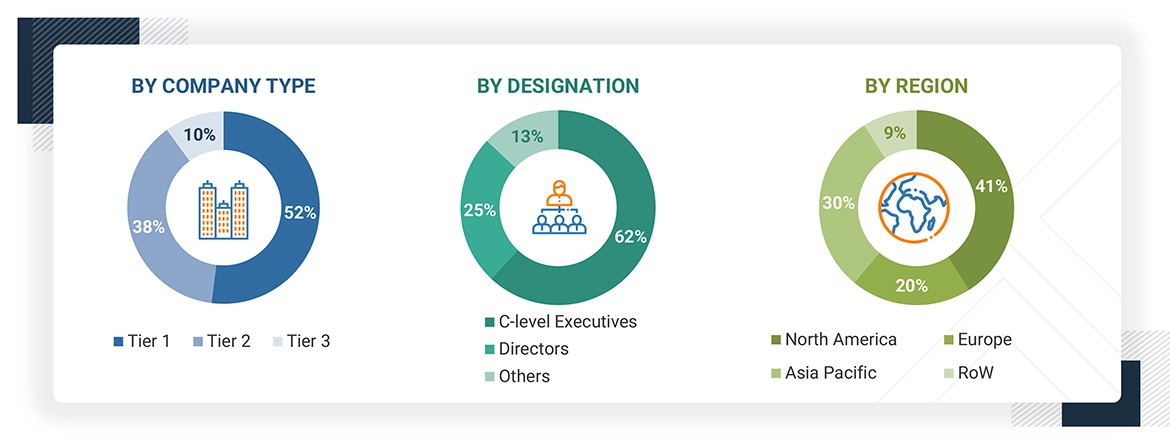
Note: RoW mainly comprises the Middle East, Africa, and South America.
Other designations include product managers, sales managers, and marketing managers.
Three tiers of companies have been defined based on their total revenue as of 2024; tier 3: revenue lesser than USD 500 million; tier 2: revenue between USD 500 million and 1 billion; and tier 1: revenue more than USD 1 billion.
To know about the assumptions considered for the study, download the pdf brochure
Market Size Estimation
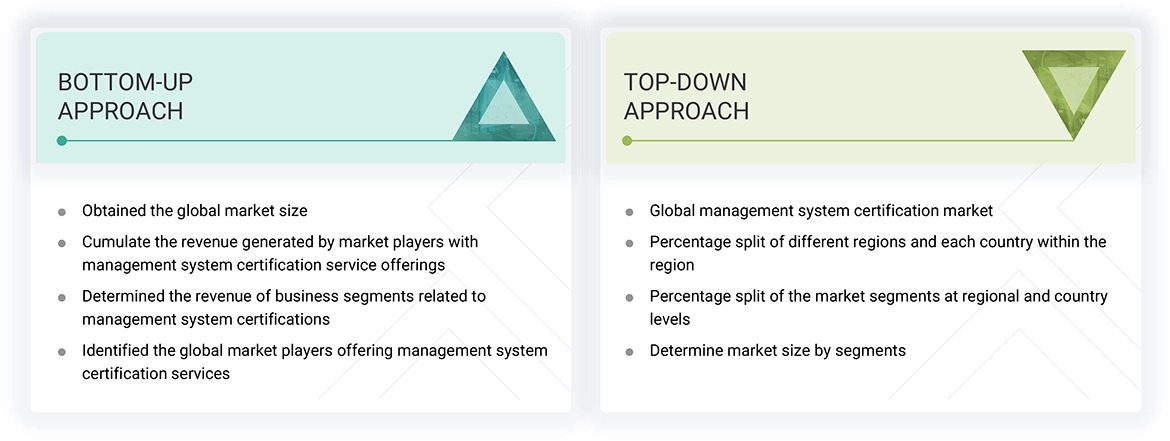
The bottom-up procedure has been employed to arrive at the overall size of the management system certification market.
- Identified major companies that provide management system certification services. This included analyzing company portfolios, service offerings, and presence across various regions.
- Their segment-specific revenues, particularly those related to certification services, were determined.
- These individual revenue figures were compiled to determine the total revenue generated across the identified companies within the sector.
- Using this consolidated data, the global market size for management system certification was obtained.
The top-down approach has been used to estimate and validate the total size of the management system certification market.
- Estimated the total market size for management system certification, outlining the overall scope and growth potential of the market
- Analyzed the regional market distribution, with further estimation of individual country shares within each region to identify localized trends and differences
- Estimated the percentage split of the market segment based on certification type, service type, and vertical at regional and country levels
- Estimated the percentage split of the market segment based on application at regional levels
- Determine the global market size by certification type, service type, vertical, and application; and further, break down application segment into sub-applications to understand specific contributions and trends
Management System Certification Market : Top-Down and Bottom-Up Approach
Data Triangulation
After arriving at the overall market size—using the market size estimation processes as explained above—the market has been split into several segments and subsegments. Data triangulation and market breakdown procedures have been employed to complete the entire market engineering process and arrive at the exact statistics of each market segment and subsegment. The data has been triangulated by studying various factors and trends from the demand and supply sides in the management system certification market.
Market Definition
The management system certification encompasses a range of services provided by accredited bodies to assess and certify that an organization’s management systems comply with recognized international, national, or sector-specific standards. These certifications, covering standards, such as ISO 9001 (Quality Management Systems), ISO 14001 (Environmental Management Systems), ISO 45001 (Occupational Health and Safety Management Systems), ISO 27001 (Information Security Management), and ISO 50001 (Energy Management Systems), validate an organization’s commitment to operational excellence, regulatory compliance, risk management, sustainability, and continual improvement. Certification services include auditing, gap assessments, consulting, training, and recertification processes, often supported by digital platforms and remote auditing technologies.
Key Stakeholders
- Raw material and testing equipment suppliers
- Research organizations
- Original equipment manufacturers (OEMs)
- Technology standards organizations, forums, alliances, and associations
- Technology investors
- Analysts and strategic business planners
- Government bodies, venture capitalists, and private equity firms
- End users
Report Objectives
- To define, describe, and forecast the size of the management system certification market by certification type, management system certification service type, application, and vertical in terms of value
- To describe and forecast the market size for various segments concerning four key regions, namely North America, Europe, Asia Pacific, and RoW, in terms of value
- To provide detailed information regarding the key factors, such as drivers, restraints, opportunities, and challenges, influencing the growth of the market
- To understand and analyze the impact of evolving technologies on the overall value chain of the market and upcoming trends in the ecosystem
- To offer macroeconomic outlooks with respect to main regions, namely North America, Europe, Asia Pacific, and RoW
- To give a detailed overview of the management system certification market industry trends, technology trends, use cases, regulatory landscape, and Porter’s five forces
- To strategically analyze micromarkets for individual growth trends, prospects, and contributions to the total market
- To provide ecosystem analysis, trends/disruptions impacting customer business, technology analysis, pricing analysis, key stakeholders & buying criteria, case study analysis, patent analysis, key conferences & events, Gen AI/ AI impact, Trump Tariff impact, and regulations related to the management system certification market
- To analyze the opportunities in the market for stakeholders by identifying high-growth segments and detailing the competitive landscape for market players
- To strategically profile key players and comprehensively analyze their market rankings, core competencies, company valuation and financial metrics, and product/brand comparison, along with detailing the competitive landscape for the market leaders
- To analyze the competitive developments, such as acquisitions, service launches, expansions, agreements, partnerships, accreditations, and collaborations, carried out by market players
- To benchmark players within the market using the proprietary competitive leadership mapping framework, which analyzes market players on various parameters within the broad categories of business strategy excellence and strength of service portfolio
Available Customizations
With the given market data, MarketsandMarkets offers customizations according to the company‘s specific needs. The following customization options are available for the report.
Company Information
- Detailed analysis and profiling of additional market players (up to five)
Get the Full Management System Certification Market Report
Full forecast, segment splits, and company analysis for all Management System Certification Market.
- US Management System Certification Market
- Canada Management System Certification Market
- Mexico Management System Certification Market
- Germany Management System Certification Market
- UK Management System Certification Market
- France Management System Certification Market
- Italy Management System Certification Market
- Spain Management System Certification Market
- Poland Management System Certification Market
- Switzerland Management System Certification Market
- Romania Management System Certification Market
- China Management System Certification Market
- Japan Management System Certification Market
- India Management System Certification Market
- South Korea Management System Certification Market
- Singapore Management System Certification Market
- Brazil Management System Certification Market
- Saudi Arabia Management System Certification Market
- UAE Management System Certification Market
- Qatar Management System Certification Market
- Kuwait Management System Certification Market
- Oman Management System Certification Market
- Bahrain Management System Certification Market
- South Africa Management System Certification Market
- Nordic Countries Management System Certification Market
- Rest Of Europe Management System Certification Market
- Rest Of Middle East Management System Certification Market
- Rest Of Asia Pacific Management System Certification Market
- Southeast Asia Management System Certification Market
- Rest Of South America Management System Certification Market
Need a Tailored Report?
Customize this report to your needs
Get 10% FREE Customization
Customize This Report
