
Rest Of Europe Manufacturing Execution System Market (2025-2030)

The Rest Of Europe Manufacturing Execution System Market was valued at $542.1 Million in 2025 and projected to reach to $724.2 Million by 2030, representing a compound annual growth rate of 6.0%. Rest Of Europe's Manufacturing Execution System market demonstrates consistent growth potential as semiconductor and electronics manufacturers increasingly recognize the value of digital production management.


| Market Size in | USD 26.32 MN |
| Market Forecast in | |
| CAGR | |
| Forecast Period | |
| Units Considered | Value (USD MN) |
Rest Of Europe Manufacturing Execution System Market Trends and Insights
- This moderate but steady expansion reflects Rest Of Europe's increasing adoption of digital manufacturing technologies across semiconductor and electronics production facilities.
- Rest Of Europe's growth trajectory is driven by regulatory compliance requirements, Industry 4.0 initiatives, and the region's commitment to operational efficiency in competitive global markets. The Rest Of Europe MES market benefits from a mature industrial base and strong investment in automation infrastructure.
- Rest Of Europe's semiconductor and electronics manufacturers are progressively integrating MES solutions to enhance real-time production visibility, reduce downtime, and optimize resource allocation.
- Rest Of Europe's market expansion is supported by the presence of established technology vendors and growing demand for data-driven manufacturing processes across mid-sized and large-scale production operations..
Key Market Statistics
- CAGR (2025-2030) 6.0% CAGR
- Market Size, 2025 ~USD 542.1 Million
- Forecast, 2030 ~USD 724.2 Million
- Country Rest Of Europe
Rest Of Europe Manufacturing Execution System Market Overview
Steady Regional Growth :
Rest Of Europe's MES market is expanding at a 6.0% CAGR from $542.1 million in 2025 to $724.2 million by 2030, driven by increasing digitalization in semiconductor and electronics manufacturing.
Digital Transformation Adoption :
European manufacturers are progressively implementing MES solutions to enhance production efficiency, reduce downtime, and meet stringent quality standards across semiconductor fabrication and electronics assembly operations.
Moderate Growth vs. Global Trends :
While Rest Of Europe grows at 6.0% CAGR, the global MES market expands at 10.1%, indicating regional maturity but sustained demand for manufacturing optimization technologies in established industrial hubs.
Industry-Specific Focus :
The semiconductor and electronics sector in Rest Of Europe is the primary driver, with manufacturers seeking MES solutions to maintain competitiveness and comply with European manufacturing and data protection regulations.
Rest Of Europe Manufacturing Execution System Market Dynamics
- The region's established industrial infrastructure and regulatory environment create a stable foundation for MES adoption, though growth rates remain moderate compared to global expansion.
- Investment in Industry 4.0 initiatives and supply chain resilience continues to drive demand for integrated manufacturing solutions. Looking ahead to 2030, Rest Of Europe's MES market will benefit from ongoing digital transformation initiatives, rising labor costs encouraging automation, and the need for real-time production visibility.
- However, regional growth will be tempered by market maturity and competition from global vendors.
- Organizations prioritizing operational excellence and regulatory compliance will drive sustained market expansion throughout the forecast period..
Market Ecosystem
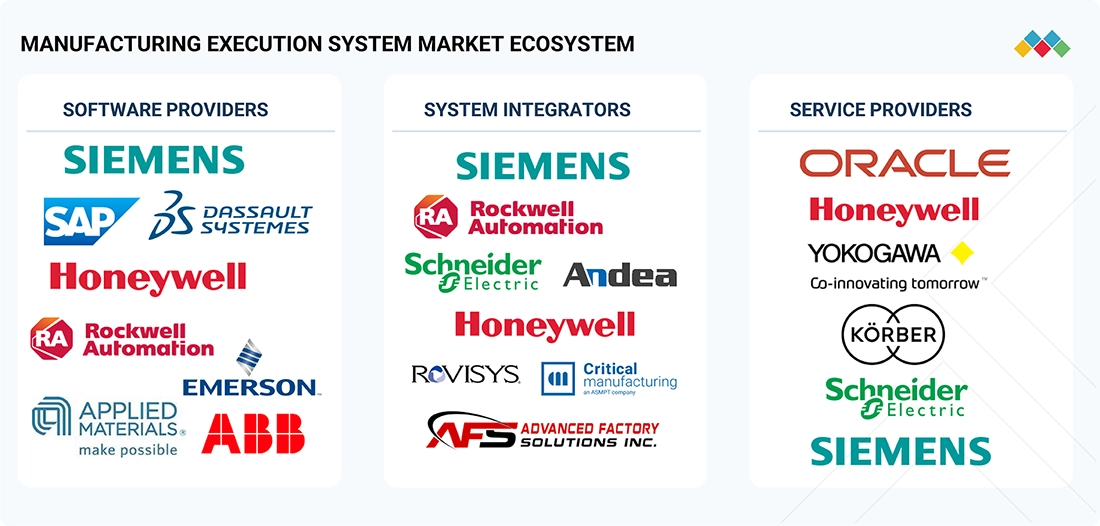
Manufacturing Execution System Market Trends: COMMERCIAL USE CASES ACROSS INDUSTRIES
| COMPANY | USE CASE DESCRIPTION | BENEFITS |
|---|---|---|
 |
Real-time shopfloor MES for integrated production monitoring, digital workflows, and resource management | Complete production control, streamlined compliance, improved operational agility, and lower downtime |
 |
DELMIA MES for live quality control, batch traceability, and plant-wide process optimization | Enhanced plant productivity, cost savings, reduced scrap, and improved regulatory compliance |
 |
SAP MES integration with ERP; digitized work instructions, equipment monitoring, and full product traceability | Improved product quality, higher equipment uptime, reduced inventory costs, and real-time process visibility |
 |
FactoryTalk MES: Real-time production management, workflow tracking, and operation intelligence | Boosted supply chain efficiency, regulatory compliance, greater traceability, reduced waste, and fast scale-up |
 |
MES for process industries with deep DCS integration, modular batch digitization, and automated decision support | Real-time production insights, accelerated innovation, easier compliance/traceability, and scalable deployment |
Logos and trademarks shown above are the property of their respective owners. Their use here is for informational and illustrative purposes only.
Related Ecosystem
Digital Oilfield
Software And Services
Industrial Automation
Key Takeaways
- Rest Of Europe's MES market will expand from $542.1M (2025) to $724.2M (2030) at a 6.0% CAGR, reflecting steady regional adoption.
- Rest Of Europe's semiconductor and electronics manufacturers are prioritizing MES implementation to meet Industry 4.0 standards and regulatory requirements.
- Rest Of Europe's mature industrial infrastructure and established vendor ecosystem support consistent market growth through 2030.
- Rest Of Europe's MES adoption is driven by demand for real-time production visibility, downtime reduction, and resource optimization across manufacturing operations.
Manufacturing Execution System Market Report Scope
| Report Metric | Details |
|---|---|
| Base Year | 2025 |
| Fastest Growing Segment | SERVICES (Offering) |
| Forecast Period | 2025–2030 |
| Growth Rate | CAGR of 10.1% from 2025 to 2030 |
| Largest Segment | SERVICES (Offering) |
| Market Size Base Year (Billions) | ~USD 15.93 (2025) |
| Revenue Forecast (Billions) | ~USD 25.78 (2030) |
| Segments Covered | Offering, Industry, Deployment Mode |
Rest Of Europe Manufacturing Execution System Market Report Segmentation
3 segment dimensions are covered across the global market.
By Offering
- Services
- Software
By Industry
- Aerospace
- Automotive
- Chemicals
- Electronics & Semiconductor
- Food & Beverages
- Medical Devices
- Metals & Mining
- Oil & Gas
- Other Industries
- Pharmaceuticals & Life Sciences
By Deployment Mode
- Cloud
- Hybrid
- On-Premises
Target Audience
- MES Software Vendors : Vendors need Rest Of Europe-specific market data to refine product positioning, identify growth opportunities, and develop localized sales strategies for the semiconductor and electronics manufacturing sector.
- Manufacturing Enterprises : European semiconductor and electronics manufacturers require market insights to benchmark their MES investments, evaluate vendor options, and align digital transformation roadmaps with regional market trends.
- System Integrators & Consultants : Implementation partners need Rest Of Europe market intelligence to advise clients on MES adoption timelines, competitive offerings, and best practices specific to regional manufacturing environments.
- Investment & Private Equity Firms : Investors evaluating MES companies or manufacturing technology portfolios require Rest Of Europe market forecasts and growth dynamics to assess regional expansion potential and valuation metrics.
- Industry Analysts & Researchers : Analysts covering European manufacturing technology markets need granular Rest Of Europe MES data to support market reports, competitive analysis, and strategic recommendations for stakeholders.
Key Companies in the Rest Of Europe Manufacturing Execution System Market
| Company | HQ | Ownership | Strongest segments |
|---|---|---|---|
| ZENSAR TECHNOLOGIES LTD | India | Public Company | On-premises MES-related services,Cloud MES enablement and integration,Hybrid MES and edge integration, |
| DASSAULT SYSTèMES | France | Public Company | On-premises MES (DELMIA-centric),Cloud MES via 3DEXPERIENCE / OUTSCALE,Hybrid MES (edge/on-prem plus cloud analytics), |
| SAP SE | Germany | Public Company | Production Management,Quality Management,Material and Inventory Management, |
| ABB | Switzerland | Public Company | On-premises MES,Cloud MES,Hybrid MES, |
| APPLIED MATERIALS | United States | Public Company | On-premises MES,Cloud MES,Hybrid MES, |
| EMERSON ELECTRIC CO. | United States | Public Company | On-premises MES,Cloud MES,Hybrid MES, |
| GE VERNOVA | United States | Public Company | Production Management,Quality Management,Material and Inventory Management, |
| ORACLE | United States | Public Company | Cloud MES (Fusion SCM & NetSuite manufacturing modules),Hybrid MES deployments,On-premises MES and legacy manufacturing modules, |
| SCHNEIDER ELECTRIC | Canada | Public Company | Production Management,Quality Management,Material and Inventory Management, |
| KöRBER AG | Germany | Private Company | Production Management,Quality Management,Material and Inventory Management, |
| APTEAN | United States | Private Company | On-premises MES and shop-floor execution,Cloud MES and shop-floor execution,Hybrid MES architectures, |
| EPICOR SOFTWARE CORPORATION | United States | Private Company | On-premises MES,Cloud MES,Hybrid MES, |
ZENSAR TECHNOLOGIES LTD
Zensar Technologies Ltd is an Indian public company founded in 1963 with 10,066 employees, providing IT services and digital solutions.
DASSAULT SYSTèMES
Dassault Systèmes is a French public company founded in 1981 with 25,724 employees, specializing in 3D design, simulation, and digital lifecycle management software.
SAP SE
SAP SE is a German public company founded in 1972 with 111,038 employees, a global leader in enterprise resource planning (ERP) and business management software.
ABB
ABB is a Swiss public company founded in 1883 with 112,700 employees, a leading provider of robotics, power, and automation technologies.
APPLIED MATERIALS
Applied Materials is a United States public company founded in 1967 with 36,500 employees, specializing in semiconductor equipment and materials engineering.
EMERSON ELECTRIC CO.
Emerson Electric Co. is a United States public company founded in 1890 with 71,000 employees, providing process management and automation solutions.
GE VERNOVA
GE Vernova is a United States public company founded in 2023 with 78,000 employees, focused on energy transition and industrial technology solutions.
ORACLE
Oracle is a United States public company founded in 1977 with 141,000 employees, a global leader in database software, cloud computing, and enterprise solutions.
SCHNEIDER ELECTRIC
Schneider Electric is a Canadian public company founded in 1836 with 158,122 employees, specializing in energy management and industrial automation.
KöRBER AG
Körber AG is a German private company founded in 1946 with 10,665 employees, providing software and automation solutions for supply chain and manufacturing.
APTEAN
Aptean is a United States private company founded in 2012 with 1,400 employees, offering enterprise resource planning and supply chain management software.
EPICOR SOFTWARE CORPORATION
Epicor Software Corporation is a United States private company founded in 1972 with 4,600 employees, providing enterprise resource planning and business management software solutions.
Reasons to Buy this Report
- Regional Market Sizing : Obtain precise market valuation for Rest Of Europe ($542.1M in 2025) with detailed forecasts through 2030, enabling accurate budget allocation and investment planning specific to this geographic segment.
- Competitive Landscape Intelligence : Understand regional MES vendor positioning, market share dynamics, and competitive strategies tailored to Rest Of Europe's semiconductor and electronics manufacturing ecosystem.
- Growth Opportunity Identification : Identify high-potential subsegments and customer verticals within Rest Of Europe's 6% CAGR expansion, targeting sectors with accelerating MES adoption and digital transformation initiatives.
- Regulatory & Compliance Insights : Access region-specific regulatory requirements, data protection standards, and compliance drivers influencing MES implementation decisions across Rest Of Europe's manufacturing facilities.
- Strategic Market Entry Planning : Leverage detailed Rest Of Europe market analysis to develop targeted go-to-market strategies, partnership opportunities, and customer acquisition approaches for MES solutions in this mature regional market.
Frequently asked questions
What is the estimated market size of MES in Rest Of Europe for 2025?
Rest Of Europe's Manufacturing Execution System market is estimated at $542.1 million in 2025.
What is the projected market size for Rest Of Europe's MES market by 2030?
Rest Of Europe's MES market is projected to reach $724.2 million by 2030.
What is the CAGR for Rest Of Europe's MES market from 2025 to 2030?
Rest Of Europe's MES market is expected to grow at a compound annual growth rate of 6.0% during the forecast period.
Which industries drive MES adoption in Rest Of Europe?
Rest Of Europe's semiconductor and electronics industries are the primary drivers of MES market growth, supported by regulatory compliance and Industry 4.0 initiatives.
What factors support MES market expansion in Rest Of Europe?
Rest Of Europe's MES market is supported by mature industrial infrastructure, established technology vendors, demand for operational efficiency, and regulatory compliance requirements.
RESEARCH METHODOLOGY
The study involved four major activities in estimating the current size of the manufacturing execution systems market. Exhaustive secondary research has been done to collect information on the market, peer market, and parent market. To validate these findings, assumptions, and sizing with industry experts across the value chain through primary research has been the next step. Both top-down and bottom-up approaches have been employed to estimate the complete market size. After that, market breakdown and data triangulation methods have been used to estimate the market size of segments and subsegments. Two sources of information—secondary and primary—have been used to identify and collect information for an extensive technical and commercial study of the manufacturing execution systems market.
Secondary Research
Various secondary sources have been referred to in the secondary research process to identify and collect information important for this study. The secondary sources include annual reports, press releases, and investor presentations of companies; white papers; journals and certified publications; and articles from recognized authors, websites, directories, and databases. Secondary research has been conducted to obtain key information about the industry’s supply chain, the market’s value chain, the total pool of key players, market segmentation according to the industry trends (to the bottom-most level), regional markets, and key developments from market- and technology-oriented perspectives. The secondary data has been collected and analyzed to determine the overall market size, further validated by primary research.
Primary Research
Extensive primary research was conducted after gaining knowledge about the current scenario of the manufacturing execution systems market through secondary research. Several primary interviews were conducted with experts from the demand and supply sides across four major regions—North America, Europe, Asia Pacific and RoW. This primary data was collected through questionnaires, emails, and telephonic interviews.
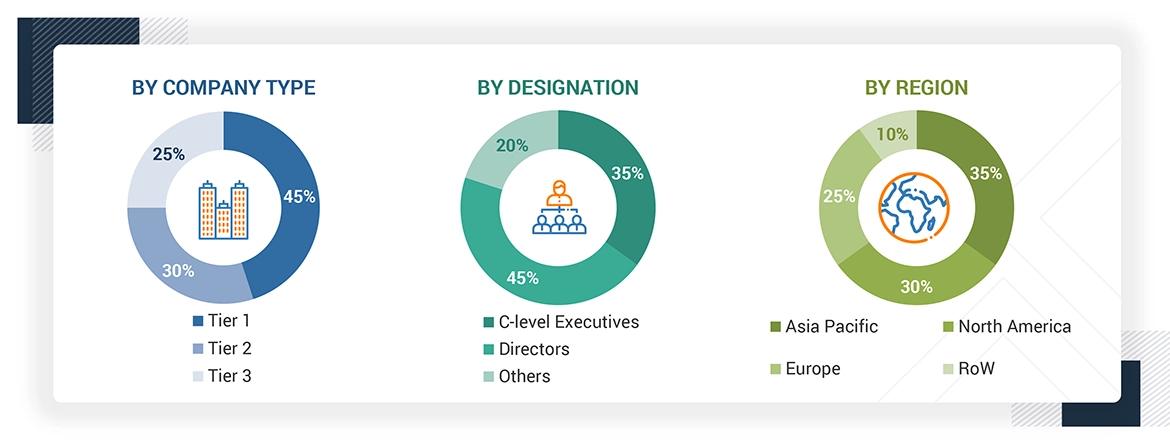
Note: RoW mainly comprises the Middle East, Africa, and South America.
Other designations include product managers, sales managers, and marketing managers.
Three tiers of companies have been defined based on their total revenue as of 2024; tier 3: revenue lesser than USD 500 million; tier 2: revenue between USD 500 million and 1 billion; and tier 1: revenue more than USD 1 billion.
To know about the assumptions considered for the study, download the pdf brochure
Market Size Estimation
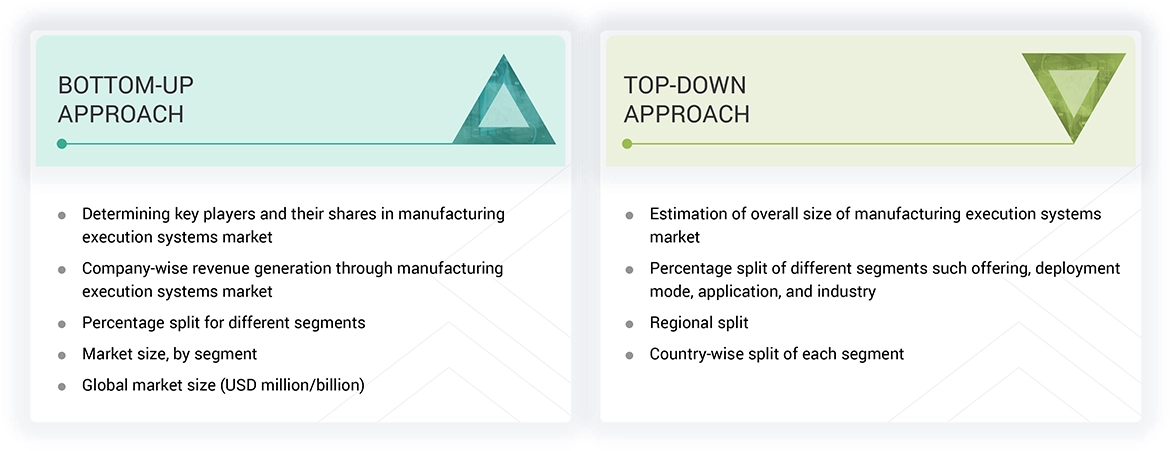
Both top-down and bottom-up approaches have been used to estimate and validate the total size of the manufacturing execution systems market. These methods have also been used extensively to estimate the size of various subsegments in the market. The following research methodology has been used to estimate the market size:
- Major players in the industry and markets have been identified through extensive secondary research.
- The industry’s value chain and market size (in terms of value) have been determined through primary and secondary research processes.
- All percentage shares, splits, and breakdowns have been determined using secondary sources and verified through primary sources.
Manufacturing Execution System Market : Top-Down and Bottom-Up Approach
Data Triangulation
After arriving at the overall size of the manufacturing execution systems market from the market size estimation process explained above, the total market has been split into several segments and subsegments. Data triangulation and market breakdown procedures have been employed, wherever applicable, to complete the overall market engineering process and arrive at the exact statistics for all segments and subsegments of the market. The data has been triangulated by studying various factors and trends from both the demand and supply sides. Along with this, the market size has been validated using both top-down and bottom-up approaches..
Market Definition
The Manufacturing Execution Systems (MES) market refers to software designed to maximize real-time factory production management by integrating operational technology (OT) with information technology (IT). Unlike enterprise resource planning (ERP) systems, MES offers granular visibility, control, and coordination of the manufacturing process at the shop floor level. These systems maximize production efficiency through optimized monitoring, quality assurance, workflow automation, and compliance with regulatory requirements.
Propelled by Industry 4.0, smart manufacturing, and real-time analytics needs, MES solutions assist manufacturers in minimizing downtime, enhancing agility, and maximizing the use of resources. Industries such as automotive, electronics, pharmaceuticals, aerospace, and food & beverage depends on MES for smooth production, supply chain synchronization, and improved decision-making.
Key Stakeholders
- Associations and regulatory authorities (especially responsible for developing standards related to plant maintenance)
- Government bodies, venture capitalists, and private equity firms
- Automation consultants
- Automation system integrators
- ERP developers
- MES distributors and providers
- Process and discrete industries
- Research organizations and consulting companies
- Technology providers
- Technology investors, standards organizations, forums, alliances, and associations
Report Objectives
- To describe, segment, and forecast the overall manufacturing execution systems market, by deployment mode, offering, application, and industry, in terms of value.
- To describe and forecast the market for four key regions: North America, Europe, Asia Pacific, and Rest of the World (RoW), along with their respective countries, in terms of value.
- To describe the applications and leveraging entities of manufacturing execution systems and software.
- To provide an overview of the recent trends in the market.
- To provide detailed information regarding the drivers, restraints, opportunities, and challenges influencing the growth of the market.
- To analyze the supply chain, trends/disruptions impacting customers’ business, market/ecosystem map, pricing analysis, and regulatory landscape pertaining to manufacturing execution systems market.
- To strategically analyze micromarkets with respect to individual growth trends, prospects, and contributions to the overall market size.
- To analyze opportunities in the market for stakeholders and provide a competitive landscape of the market.
- To strategically profile the key players and comprehensively analyze their market positions in terms of their ranking and core competencies, along with detailing the competitive landscape for market leaders,
- To analyze competitive developments, such as product launches, acquisitions, collaborations, agreements, and partnerships, in the manufacturing execution systems market.
- To provide ecosystem analysis, case study analysis, patent analysis, technology analysis, value chain analysis, trends/disruptions impacting customer business, the impact of AI/Gen AI, key conferences and events, pricing analysis, Porter’s five forces analysis, and regulations pertaining to the market under study.
- To provide a macroeconomic outlook based on all the regions in the region chapter.
Available Customizations
With the given market data, MarketsandMarkets offers customizations according to the company’s specific needs. The following customization options are available for the report:
Company Information:
- Detailed analysis and profiling of additional market players (up to 5)
Get the Full Manufacturing Execution System Market Report
Full forecast, segment splits, and company analysis for all Manufacturing Execution System Market.
- US Manufacturing Execution System Market
- Canada Manufacturing Execution System Market
- Mexico Manufacturing Execution System Market
- UK Manufacturing Execution System Market
- Germany Manufacturing Execution System Market
- France Manufacturing Execution System Market
- Italy Manufacturing Execution System Market
- Spain Manufacturing Execution System Market
- Netherlands Manufacturing Execution System Market
- Switzerland Manufacturing Execution System Market
- China Manufacturing Execution System Market
- Japan Manufacturing Execution System Market
- India Manufacturing Execution System Market
- South Korea Manufacturing Execution System Market
- Singapore Manufacturing Execution System Market
- Malaysia Manufacturing Execution System Market
- Indonesia Manufacturing Execution System Market
- Nordics Manufacturing Execution System Market
- Rest Of Asia Pacific Manufacturing Execution System Market
- Bahrain Manufacturing Execution System Market
- Kuwait Manufacturing Execution System Market
- Oman Manufacturing Execution System Market
- Qatar Manufacturing Execution System Market
- Rest Of Middle East Manufacturing Execution System Market
- Saudi Arabia Manufacturing Execution System Market
- UAE Manufacturing Execution System Market
- Argentina Manufacturing Execution System Market
- North America Manufacturing Execution System Market
- Europe Manufacturing Execution System Market
- Asia Pacific Manufacturing Execution System Market
- Rest of World Manufacturing Execution System Market
- Middle East Manufacturing Execution System Market
- South America Manufacturing Execution System Market
Need a Tailored Report?
Customize this report to your needs
Get 10% FREE Customization
Customize This Report
