
UAE MEA Variable Frequency Drive Market (2025-2030)

The UAE MEA Variable Frequency Drive Market was valued at $164 Million in 2025 and projected to reach to $222.7 Million by 2030, representing a compound annual growth rate of 6.3%. The UAE Variable Frequency Drive market is poised for robust growth, driven by the nation's Vision 2030 sustainability agenda and aggressive energy efficiency targets.


| Market Size in | USD 26.32 MN |
| Market Forecast in | |
| CAGR | |
| Forecast Period | |
| Units Considered | Value (USD MN) |
UAE MEA Variable Frequency Drive Market Trends and Insights
- The UAE's rapid industrialization, coupled with aggressive energy efficiency mandates and smart city initiatives, positions the nation as a key growth hub within the MEA region.
- The UAE's commitment to reducing carbon emissions and optimizing operational costs across manufacturing, oil & gas, and water treatment sectors is driving widespread VFD adoption. In 2025, the UAE market reflects strong demand from both established industrial players and emerging sectors seeking to modernize infrastructure.
- By 2030, the UAE is expected to consolidate its position as a regional leader in VFD deployment, supported by government incentives, renewable energy integration, and digital transformation programs.
- The UAE's strategic location, advanced regulatory framework, and investment in Industry 4.0 technologies create a favorable environment for sustained market expansion throughout the forecast period..
Key Market Statistics
- CAGR (2025-2030) 6.3% CAGR
- Market Size, 2025 ~USD 164 Million
- Forecast, 2030 ~USD 222.7 Million
- Country UAE
UAE MEA Variable Frequency Drive Market Overview
Market Size & Growth :
The UAE VFD market is valued at USD 164.0 million in 2025, with a projected CAGR of 6.3% through 2030, reaching USD 222.7 million. This outpaces the global growth rate of 5.6%, reflecting UAE's accelerated industrial modernization.
Energy Efficiency Mandates :
UAE's stringent energy efficiency regulations and sustainability targets are driving widespread VFD adoption across industrial, commercial, and municipal sectors. Government incentives for energy conservation are accelerating market penetration.
Smart City & Infrastructure :
Major smart city projects in Dubai and Abu Dhabi are creating substantial demand for advanced VFD systems in HVAC, water treatment, and building automation. These initiatives position UAE as a regional technology leader.
Industrial Diversification :
UAE's economic diversification beyond oil and gas is spurring investments in manufacturing, desalination, and renewable energy sectors—all key VFD application areas driving market expansion.
UAE MEA Variable Frequency Drive Market Dynamics
- Industrial facilities, water desalination plants, and smart building infrastructure are increasingly adopting VFDs to optimize operational efficiency and reduce carbon footprints.
- Government support through regulatory frameworks and green building certifications is accelerating market adoption across both public and private sectors. Looking ahead, the integration of IoT and AI-enabled VFD systems will unlock new opportunities in predictive maintenance and real-time energy management.
- The UAE's position as a regional hub for technology innovation, combined with rising electricity costs and water scarcity concerns, will sustain double-digit growth in premium VFD solutions.
- Strategic partnerships between local distributors and global manufacturers will further strengthen market penetration in industrial and commercial segments..
Market Ecosystem
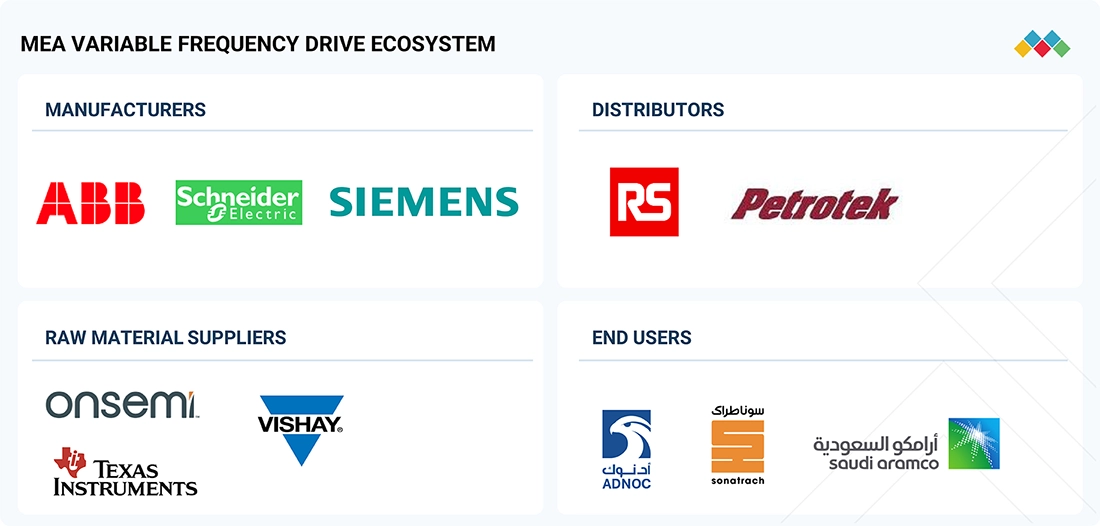
MEA Variable Frequency Drive Market: COMMERCIAL USE CASES ACROSS INDUSTRIES
| COMPANY | USE CASE DESCRIPTION | BENEFITS |
|---|---|---|
 |
Deploys VFDs in LPG plants and upstream facilities to optimize centrifugal pump speeds for fluid transfer and processing across Algerian refineries and gas fields | Enhanced process control and equipment reliability |
 |
Implements VFDs in power generation and downstream refineries for compressor and fan control in crude processing and desalination tie-ins, supporting high-demand operations under Vision 2030's Jafurah Gas expansions | Improved energy efficiency with precise torque/speed regulation |
 |
Integrates VFDs in onshore water injection and production wells for variable-speed pump control, optimizing flow rates in mature fields like Bu Hasa | Increased grid resilience and lower utility costs via renewable integration |
Logos and trademarks shown above are the property of their respective owners. Their use here is for informational and illustrative purposes only.
Related Ecosystem
Key Takeaways
- The UAE VFD market is valued at USD 164.0 million in 2025 and will reach USD 222.7 million by 2030, growing at 6.3% CAGR.
- The UAE's energy efficiency regulations and smart city initiatives are primary catalysts for VFD market expansion.
- The UAE's oil & gas, manufacturing, and water treatment sectors are the largest consumers of variable frequency drive technology.
- The UAE's government support for renewable energy integration and Industry 4.0 adoption will sustain market growth through 2030.
MEA Variable Frequency Drive Market Report Scope
| Report Metric | Details |
|---|---|
| Base Year | 2025 |
| Fastest Growing Segment | MICRO POWER DRIVE (Power Rating) |
| Forecast Period | 2025–2030 |
| Growth Rate | CAGR of 5.6% from 2025 to 2030 |
| Largest Segment | AC DRIVE (Type) |
| Market Size Base Year (Billions) | ~USD 0.98 (2025) |
| Revenue Forecast (Billions) | ~USD 1.29 (2030) |
| Segments Covered | Type, Gcc, Voltage, Power Rating, Application, End User |
UAE MEA Variable Frequency Drive Market Report Segmentation
6 segment dimensions are covered across the global market.
By Type
- Ac Drive
- Dc Drive
- Servo Drive
By Gcc
- Rest Of GCC
- Saudi Arabia
- UAE
By Voltage
- Low Voltage
- Medium Voltage
By Power Rating
- High Power Drive
- Low Power Drive
- Medium Power Drive
- Micro Power Drive
By Application
- Compressors
- Conveyors
- Fans & Blowers
- Other Applications
- Pumps
By End User
- Automotive
- Chemicals & Petrochemicals
- Construction/Infrastructure
- Food & Beverage
- Mining & Metal
- Oil & Gas
- Other End Users
- Power
- Water & Wastewater Treatment
UAE: VARIABLE FREQUENCY DRIVE MARKET, BY END USER, 2025–2030
| Segment | 2025 | 2026 | 2027 | 2028 | 2029 | 2030 | CAGR (%) |
|---|---|---|---|---|---|---|---|
| AUTOMOTIVE | 12.3 | 13.11 | 13.99 | 14.92 | 15.92 | 17 | 6.68 |
| CHEMICALS & PETROCHEMICALS | 19.95 | 21.23 | 22.59 | 24.05 | 25.62 | 27.29 | 6.47 |
| CONSTRUCTION/INFRASTRUCTURE | 11.39 | 12.03 | 12.71 | 13.43 | 14.2 | 15.01 | 5.67 |
| FOOD & BEVERAGE | 12.52 | 13.18 | 13.89 | 14.64 | 15.44 | 16.29 | 5.41 |
| MINING & METAL | 19.39 | 20.61 | 21.92 | 23.32 | 24.81 | 26.41 | 6.38 |
| OIL & GAS | 32.1 | 34.28 | 36.62 | 39.15 | 41.85 | 44.7 | 6.85 |
| OTHER END USERS | 12.48 | 12.98 | 13.52 | 14.07 | 14.66 | 15.28 | 4.13 |
| POWER | 34.43 | 36.9 | 39.54 | 42.38 | 45.43 | 48.69 | 7.18 |
| WATER & WASTEWATER TREATMENT | 9.41 | 9.88 | 10.39 | 10.92 | 11.48 | 12.08 | 5.13 |
| TOTAL | 163.96 | 174.21 | 185.16 | 196.88 | 209.41 | 222.75 | 6.32 |
Target Audience
- Industrial Equipment Manufacturers : Manufacturers need UAE market data to design VFD-compatible products, optimize supply chains, and identify partnership opportunities with local integrators and distributors serving the region's growing industrial base.
- Energy & Utilities Companies : Utilities and energy providers require insights on VFD adoption trends to plan grid modernization, optimize operational efficiency, and align with UAE's renewable energy and sustainability commitments.
- System Integrators & Distributors : Local and regional integrators need competitive intelligence on market sizing, customer segments, and growth drivers to refine sales strategies, expand service offerings, and capture market share in UAE.
- Real Estate & Smart Building Developers : Developers and facility managers require data on VFD adoption in smart buildings and HVAC systems to meet UAE's green building standards and optimize energy costs in commercial and residential projects.
- Government & Policy Advisors : Government agencies and policy makers need market insights to evaluate the effectiveness of energy efficiency mandates, forecast economic impact, and design incentive programs supporting UAE's sustainability goals.
Key Companies in the UAE MEA Variable Frequency Drive Market
| Company | HQ | Ownership | Strongest segments |
|---|---|---|---|
| SUMITOMO HEAVY INDUSTRIES, LTD. | Japan | Public Company | Mechatronics (gearmotors, gearboxes, drives, motion systems, cryocoolers),Industrial Machinery (plastics machinery, film forming, semiconductor and medical equipment, presses),Logistics & Construction (hydraulic excavators, cranes, road machinery, logistics systems, automated parking), |
SUMITOMO HEAVY INDUSTRIES, LTD.
Sumitomo Heavy Industries, Ltd. is a Japanese industrial conglomerate founded in 1888 with approximately 25,123 employees, operating as a public company across diverse industrial sectors.
Reasons to Buy this Report
- Localized Market Intelligence : Gain UAE-specific insights on market size, growth trajectories, and competitive dynamics. Understand local regulatory drivers and government incentives shaping VFD adoption across industrial and commercial sectors.
- Strategic Investment Planning : Identify high-growth segments and emerging opportunities within UAE's diversifying economy. Make data-driven decisions on market entry, expansion, and resource allocation in the region's fastest-growing sectors.
- Competitive Benchmarking : Analyze UAE-specific competitive landscape, key players, and market share distribution. Understand pricing strategies, distribution channels, and customer preferences unique to the Emirati market.
- Regulatory & Policy Insights : Stay informed on UAE's energy efficiency mandates, sustainability targets, and smart city initiatives. Align product development and marketing strategies with local compliance requirements and government priorities.
- Growth Forecasting : Access detailed 5-year projections (2025-2030) with segment-level breakdowns. Plan capacity, supply chain, and go-to-market strategies based on UAE's 6.3% CAGR and emerging application areas.
Frequently asked questions
What is the current size of the UAE Variable Frequency Drive market?
The UAE Variable Frequency Drive market is estimated at USD 164.0 million in 2025.
What is the projected size of the UAE VFD market by 2030?
The UAE VFD market is projected to reach USD 222.7 million by 2030.
What is the growth rate of the UAE Variable Frequency Drive market?
The UAE Variable Frequency Drive market is expected to grow at a compound annual growth rate of 6.3% from 2025 to 2030.
Which industries drive demand for VFDs in the UAE?
The UAE's oil & gas, manufacturing, water treatment, and smart city infrastructure sectors are the primary drivers of VFD demand.
What factors support VFD market growth in the UAE?
The UAE's energy efficiency mandates, renewable energy integration goals, smart city initiatives, and Industry 4.0 investments support sustained VFD market growth.
RESEARCH METHODOLOGY
This research study involves the use of extensive secondary sources, directories, and databases, such as Hoovers, Bloomberg L.P., Factiva, and ICIS, to identify and collect information useful for this technical, market-oriented, and commercial study of the MEA variable frequency drive market. Primary sources are mainly industry experts from core and related industries, preferred suppliers, manufacturers, distributors, service providers, and organizations related to all segments of the value chain of this industry. In-depth interviews were conducted with various primary respondents, including key industry participants, subject matter experts, C-level executives of key market players, and industry consultants, among other experts, to obtain and verify critical qualitative and quantitative information as well as assess the growth prospects of the market.
Secondary Research
Secondary sources include annual reports, press releases, and investor presentations of companies; directories and databases, which include D&B, Bloomberg, and Factiva; white papers and articles from recognized authors; and publications and databases from associations, such as the International Energy Agency (IEA), the US Energy Information Administration (EIA), the International Renewable Energy Agency (IRENA), and the National Electrical Manufacturers Association (NEMA). Secondary research has been used to obtain important information about the key players, market classification & segmentation according to industry trends, and key developments related to the market. A database of the key industry leaders has also been prepared using secondary research.
Primary Research
In the primary research process, various sources from both the supply and demand sides have been interviewed to obtain and verify qualitative and quantitative information for this report and analyze prospects. Primary sources from the supply side include industry experts such as CEOs, vice presidents, marketing directors, technology and innovation directors, and related executives from various leading companies and organizations operating in the variable frequency drive market. Primary sources from the demand side include experts and key executives.
After the complete market engineering process (which includes calculations of market statistics, market breakdown, market size estimations, market forecasts, and data triangulation), extensive primary research has been conducted to gather information and verify and validate the critical numbers arrived at. Primary research has also been conducted to identify the segmentation, applications, Porter’s Five Forces, key players, competitive landscape, and key market dynamics such as drivers, opportunities, challenges, industry trends, and strategies adopted by key players.
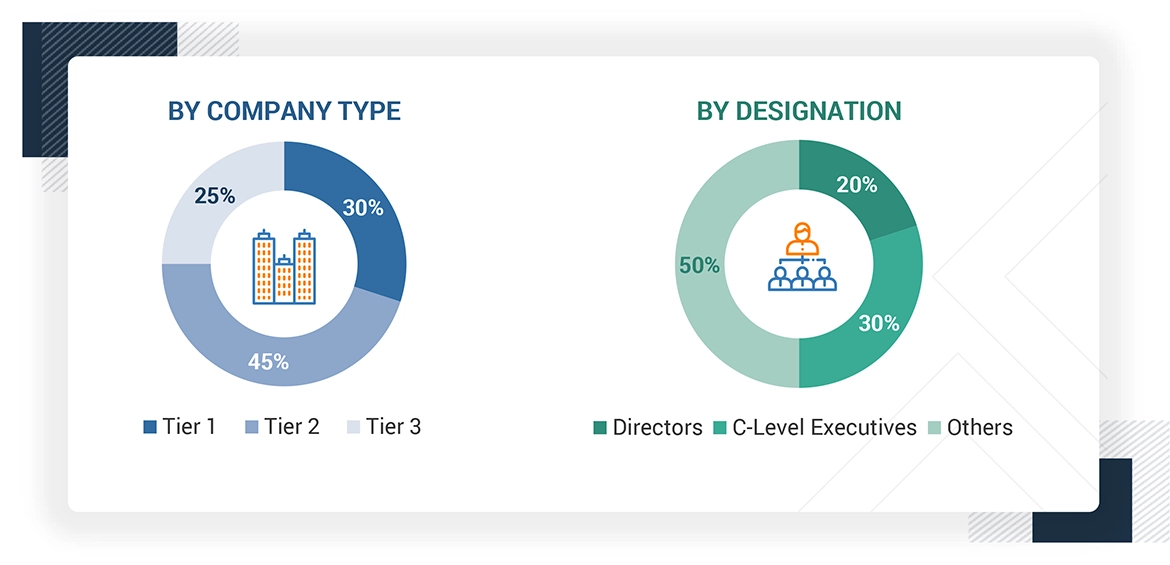
Note 1: Others include sales managers, marketing managers, and product managers.
Note 2: Tier 1 companies’ revenues are more than USD 10 billion; tier 2 companies’ revenues range between USD 1 and 10 billion; and tier 3 companies’ revenues range between USD 500 million and USD 1 billion.
Source: Industry Experts
To know about the assumptions considered for the study, download the pdf brochure
Market Size Estimation
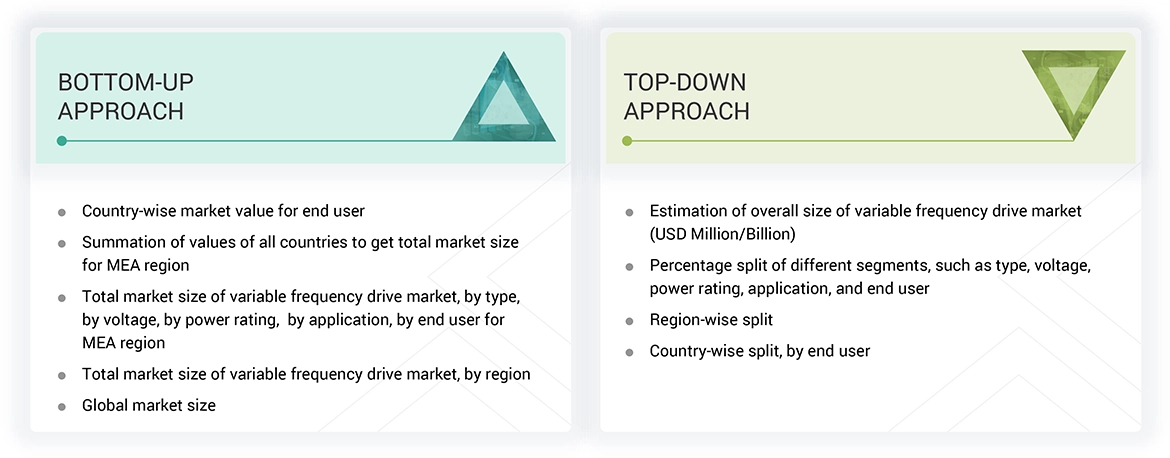
In the complete market engineering process, both the top-down and bottom-up approaches have been extensively used along with several data triangulation methods to estimate and forecast the overall market segments listed in this report.
The key players in the market have been identified through secondary research, and their market share in respective regions has been determined through primary and secondary research. This entire procedure includes the study of annual and financial reports of the key market players and extensive interviews for insights from industry leaders such as CEOs, vice presidents, directors, and marketing executives. All percentage shares, splits, and breakdowns have been determined using secondary sources and verified through primary sources.
MEA Variable Frequency Drive Market : Top-Down and Bottom-Up Approach
Data Triangulation
After arriving at the overall market size from the estimation process explained above, the total market has been split into several segments and sub-segments. Data triangulation and market breakdown procedures have been used wherever applicable to complete the overall market engineering process and to arrive at the exact statistics for all segments and sub-segments. The data has been triangulated by studying various factors and trends from both the demand and supply sides. The market has been validated using both the top-down and bottom-up approaches. Then, it was verified through primary interviews. Hence, for every data segment, there are three sources: the top-down approach, the bottom-up approach, and expert interviews. When the values arrived at from the three points matched, the data was assumed to be correct.
Market Definition
A variable frequency drive (VFD) is an electronic motor control device that drives an electric motor by changing the voltage and frequency supplied to the electric motor circuit. VFD works by converting fixed frequency and fixed voltage sine wave power to a variable frequency or variable output voltage, which is used to control the speed of a motor. It is also referred to as variable speed drive, adjustable speed drive, adjustable frequency drive, AC drive, micro drive, and inverter. The primary advantages of the use of VFD include reduced energy consumption and energy cost, controlled performance, extended equipment life, and low maintenance cost. It is mainly used for variable torque applications in various industries, such as oil & gas, water & wastewater treatment, power, paper & pulp, textiles, and mining. The market for variable frequency drives is defined as the sum of revenues generated by companies through the sale of variable frequency drives.
Stakeholders
- Government organizations and regulatory agencies
- VFD manufacturing companies
- Automotive, aerospace, marine, and industrial equipment manufacturers
- Research and development institutes
- Environmental and sustainability organizations
- Trade associations and industry forums related to VFD technologies
- Original equipment manufacturers (OEMs)
- Component and parts suppliers for VFD
- Consulting companies in the energy, automotive, and manufacturing sectors
- Transportation and logistics companies
- Maintenance and repair service providers
Report Objectives
- To describe and forecast the MEA variable frequency drive market in terms of value based on type, voltage, power rating, application, end user, and region
- To describe and forecast the MEA variable frequency drive market in terms of volume based on region and power rating
- To provide detailed information about the key factors, such as drivers, restraints, opportunities, and challenges influencing the growth of the MEA variable frequency drive market
- To strategically analyze the subsegments with respect to individual growth trends, prospects, and contributions of each segment to the overall market size
- To forecast the market size for the Middle East & Africa with key countries
- To strategically analyze micromarkets1 with respect to individual growth trends, prospects, and contributions to the total market
- To study the complete supply chain and allied industry segments and perform a supply chain analysis of the variable frequency drive market landscape
- To study market trends, patent analysis, trade analysis, tariff and regulatory landscape, Porter’s five forces analysis, ecosystem mapping, technology analysis, investment and funding scenario, key stakeholders & buying criteria, and case studies pertaining to the MEA variable frequency drive market
- To analyze the opportunities for various stakeholders by identifying the high-growth segments of the variable frequency drivemarket
- To profile the key players and comprehensively analyze their market positions in terms of ranking and core competencies, along with detailing the competitive landscape for the market leaders
- To analyze competitive developments, such as contracts, collaborations, expansions, product launches, investments, and acquisitions, in the MEA variable frequency drivemarket
Available Customizations
MarketsandMarkets offers customizations according to the specific needs of the companies with the given market data.
The following customization options are available for the report:
Product Analysis
- Product matrix, which gives a detailed comparison of the product portfolio of each company
Geographic Analysis as per Feasibility
- Further breakdown of the VFD market, by country
Company Information
- Detailed analysis and profiling of additional market players (up to five)
Get the Full MEA Variable Frequency Drive Market Report
Full forecast, segment splits, and company analysis for all MEA Variable Frequency Drive Market.
Need a Tailored Report?
Customize this report to your needs
Get 10% FREE Customization
Customize This Report
