
Asia Pacific Medical Equipment Cooling Market (2026-2031)

The Asia Pacific Medical Equipment Cooling Market was valued at $149.93 Million in 2026 and projected to reach to $203.75 Million by 2031, representing a compound annual growth rate of 6.3%. The Asia Pacific medical equipment cooling market is positioned for sustained growth through 2031, driven by expanding healthcare infrastructure and technological advancement across the region.


| Market Size in | USD 26.32 MN |
| Market Forecast in | |
| CAGR | |
| Forecast Period | |
| Units Considered | Value (USD MN) |
Asia Pacific Medical Equipment Cooling Market Trends and Insights
- Asia Pacific's market expansion is driven by increasing healthcare infrastructure investments, rising demand for advanced diagnostic equipment, and growing adoption of temperature-sensitive medical devices across the region.
- The 6.3% compound annual growth rate in Asia Pacific reflects strong regional demand for reliable cooling solutions in hospitals, diagnostic centers, and research facilities. Asia Pacific's medical equipment cooling sector benefits from rapid urbanization, expanding middle-class populations, and government initiatives to modernize healthcare systems.
- Key markets within Asia Pacific are investing heavily in medical technology infrastructure, creating sustained demand for efficient cooling systems that protect sensitive equipment and ensure optimal operational performance.
- Between 2026 and 2031, Asia Pacific is expected to capture significant market share as healthcare providers prioritize equipment longevity and performance reliability..
Key Market Statistics
- CAGR (2026-2031) 6.3% CAGR
- Market Size, 2026 ~USD 149.93 Million
- Forecast, 2031 ~USD 203.75 Million
- Geography Asia Pacific
Asia Pacific Medical Equipment Cooling Market Overview
Rapid Market Expansion :
Asia Pacific's medical equipment cooling market is projected to grow from USD 149.93 million in 2026 to USD 203.75 million by 2031, representing a 6.3% CAGR—outpacing the global average of 5.4%.
Healthcare Infrastructure Investment :
Increasing government and private sector investments in healthcare infrastructure across Asia Pacific are driving demand for advanced cooling solutions in hospitals, diagnostic centers, and research facilities.
Temperature-Sensitive Device Adoption :
Growing adoption of temperature-sensitive medical equipment including MRI machines, CT scanners, and laboratory analyzers is accelerating the need for reliable cooling systems throughout the region.
Emerging Market Opportunities :
Rising healthcare spending in developing Asia Pacific economies, coupled with increasing prevalence of chronic diseases, is creating significant growth opportunities for medical equipment cooling solutions.
Asia Pacific Medical Equipment Cooling Market Dynamics
- Countries like China and India are investing heavily in modern medical facilities, while developed markets such as Japan and Australia are upgrading existing equipment with advanced cooling technologies.
- The region's growing middle class and increasing healthcare awareness are fueling demand for diagnostic and therapeutic equipment that requires sophisticated temperature management. Key growth drivers include rising healthcare expenditure, regulatory compliance requirements for medical device operation, and the proliferation of specialized medical facilities.
- As Asia Pacific continues to strengthen its healthcare ecosystem and adopt international medical standards, the demand for reliable, efficient cooling solutions will remain robust.
- Market players are increasingly focusing on localized solutions and partnerships to capture emerging opportunities in this dynamic region..
Market Ecosystem
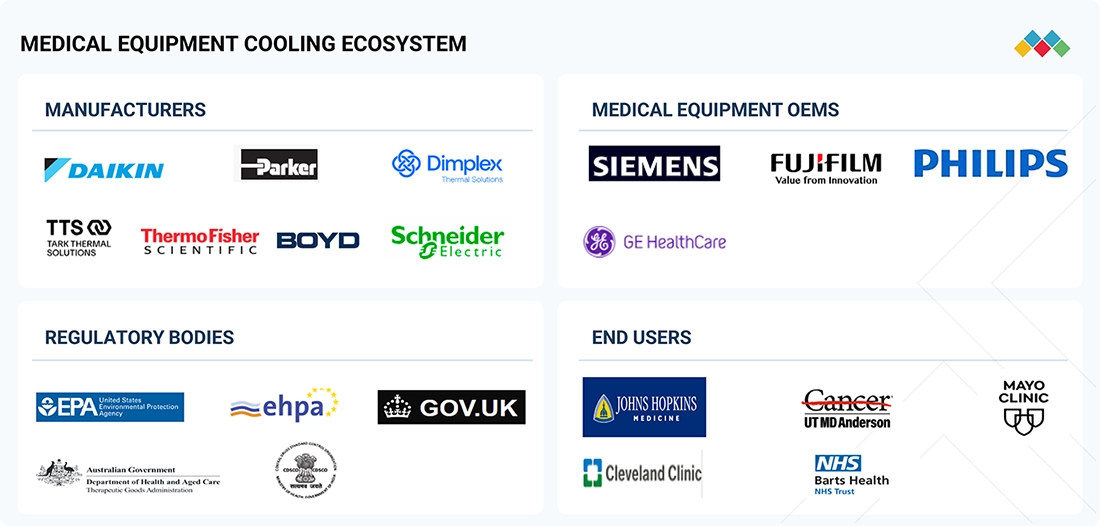
MEDICAL EQUIPMENT COOLING MARKET: COMMERCIAL USE CASES ACROSS INDUSTRIES
| COMPANY | USE CASE DESCRIPTION | BENEFITS |
|---|---|---|
 |
Parker Hannifin develops precision process chillers, liquid cooling systems, refrigeration technologies, pumps, valves, and heat exchangers used in medical imaging equipment, laboratory diagnostic instruments, and life science applications. The company's customized thermal management solutions are integrated into OEM medical equipment requiring precise temperature regulation. | Highly stable temperature control | Improved diagnostic accuracy and equipment performance | Reduced downtime | Enhanced operational efficiency | Continuous operation of critical medical equipment while lowering maintenance costs and improving energy efficiency |
 |
Daikin supplies medical chillers, inverter compressor-based cooling systems, and environmentally sustainable refrigeration solutions for diagnostic imaging systems, laboratory equipment, and healthcare facilities. The company's precision cooling technologies are utilized in MRI scanners, CT systems, PET scanners, and analytical laboratory instruments requiring continuous temperature control. | High energy efficiency | Quiet operation | Reliable thermal performance while utilizing environmentally friendly refrigerants | Minimized power consumption | Reduced operational costs | Improved equipment stability | Support in achieving sustainability and regulatory compliance objectives |
 |
Laird Thermal Systems specializes in thermoelectric cooling modules, liquid cooling systems, recirculating chillers, and customized thermal management solutions for medical diagnostics, laboratory analyzers, medical lasers, and imaging equipment. The company's precision cooling technologies support temperature-sensitive medical devices requiring highly accurate thermal control. | Precise temperature regulation | Optimal performance of sensitive medical instruments | Diagnostic reliability | Reduced equipment size | Improved system efficiency | Extended component lifespan | Support in developing high-performance medical devices |
 |
Thermo Fisher Scientific integrates precision cooling technologies into its laboratory analyzers, molecular diagnostic instruments, life science equipment, and analytical systems to maintain stable operating conditions during complex laboratory workflows. The company utilizes advanced thermal management systems to support research laboratories, pharmaceutical manufacturing, and clinical diagnostics. | Improved analytical accuracy | Stable instrument temperatures | Reduced thermal fluctuations | Minimized equipment downtime | Enhanced laboratory productivity | Extended instrument life | Consistent test results | Continuous operation in high-throughput diagnostic and research environments |
 |
Boyd Corporation provides advanced liquid cooling systems, cold plates, heat exchangers, thermal interface materials, and customized thermal management solutions for high-performance medical equipment, including MRI systems, CT scanners, PET scanners, medical lasers, LINACs, and analytical & laboratory instruments. The company collaborates with leading medical device OEMs to design application-specific cooling solutions that effectively dissipate heat generated by high-power electronic components and imaging systems while supporting compact equipment architectures. | Superior heat dissipation, enabling medical equipment to operate continuously without performance degradation or overheating | Improved equipment reliability | Extended component lifespan | Reduced maintenance requirements | Enhanced diagnostic accuracy by maintaining stable operating temperatures | Optimize device design | Reduced system footprint | Improved overall energy efficiency | Support for the development of next-generation medical imaging and laboratory equipment |
Logos and trademarks shown above are the property of their respective owners. Their use here is for informational and illustrative purposes only.
Related Ecosystem
Key Takeaways
- Asia Pacific medical equipment cooling market valued at USD 149.93 million in 2026, growing at 6.3% CAGR through 2031
- Asia Pacific's growth outpaces global average, driven by healthcare infrastructure modernization and equipment adoption
- Asia Pacific demand concentrated in diagnostic imaging, surgical suites, and laboratory equipment cooling applications
- Asia Pacific market expansion supported by regulatory compliance requirements and increasing focus on equipment reliability
Medical Equipment Cooling Market Report Scope
| Report Metric | Details |
|---|---|
| Base Year | 2026 |
| Fastest Growing Segment | MODULAR SYSTEMS (Configuration) |
| Forecast Period | 2026-2031 |
| Growth Rate | CAGR of 5.4% from 2026 to 2031 |
| Largest Segment | MEDICAL DEVICES (Application) |
| Market Size Base Year (Billions) | ~USD 0.63 (2026) |
| Revenue Forecast (Billions) | ~USD 0.82 (2031) |
| Segments Covered | Type, Compressor, Configuration, Application, End User |
Asia Pacific Medical Equipment Cooling Market Report Segmentation
5 segment dimensions are covered across the global market.
By Type
- Air-Based Cooling
- Air-To-Air Configuration
- Compressor-Based Recirculating Configuration
- Ct
- Direct-To-Air Configuration
- Linacs
- Liquid-Air Heat Transfer Configuration
- Liquid-Based Cooling
- Liquid-Liquid Configuration
- Medical Imaging Systems
- Medical Lasers
- Mri
- Pet
By Compressor
- Centrifugal Compressors
- Reciprocating Compressors
- Screw Compressors
- Scroll Compressors
By Configuration
- Modular Systems
- Packaged Systems
- Split Systems
By Application
- Analytical & Laboratory Equipment
- Medical Devices
By End User
- Hospitals & Clinics
- Independent Diagnostic & Treatment Centers & Laboratories
- Oems
- Other End Users
Target Audience
- Medical Equipment Manufacturers : Need Asia Pacific market data to design cooling-integrated products, understand regional demand patterns, and identify growth opportunities in high-potential markets like China and India.
- Cooling System Suppliers & OEMs : Require detailed regional forecasts and country-level insights to optimize production capacity, establish distribution networks, and develop localized cooling solutions for Asia Pacific healthcare facilities.
- Healthcare Facility Operators : Seek market intelligence on cooling technology trends, cost-benefit analyses, and supplier options to make informed procurement decisions and upgrade medical equipment infrastructure.
- Investment & Private Equity Firms : Need comprehensive Asia Pacific market analysis to evaluate investment opportunities, assess portfolio company growth potential, and identify acquisition targets in the medical cooling sector.
- Healthcare Consultants & System Integrators : Require regional market insights and forecasts to advise clients on technology adoption, infrastructure planning, and vendor selection for medical equipment cooling solutions.
Countries within Asia Pacific - compare and drill down
| Country | 2025 size (native) |
|---|---|
| China | USD 31.41 Million |
| India | USD 20.73 Million |
| Japan | USD 27.9 Million |
| Australia | USD 16.87 Million |
| South Korea | USD 16.51 Million |
| Rest Of Asia Pacific | USD 22.64 Million |
Country market size visualization
Reasons to Buy this Report
- Regional Market Sizing & Forecasts : Obtain precise market valuations for Asia Pacific and individual country-level data through 2031, enabling accurate budgeting and resource allocation for regional expansion strategies.
- Growth Driver Analysis : Understand the specific factors propelling Asia Pacific's 6.3% CAGR, including healthcare infrastructure investments, regulatory changes, and technology adoption patterns unique to the region.
- Competitive Landscape Intelligence : Identify key players, market consolidation trends, and competitive positioning within Asia Pacific to inform partnership, acquisition, and go-to-market strategies.
- Country-Level Opportunity Assessment : Evaluate market potential across major Asia Pacific economies including China, India, Japan, and Australia to prioritize market entry and investment decisions.
- Strategic Planning & Risk Mitigation : Leverage comprehensive regional insights to develop informed business strategies, anticipate market challenges, and capitalize on emerging opportunities in Asia Pacific's growing medical cooling sector.
Frequently asked questions
What is the current size of the Asia Pacific medical equipment cooling market?
The Asia Pacific medical equipment cooling market is valued at USD 149.93 million in 2026 and is projected to reach USD 203.75 million by 2031.
What is the growth rate for medical equipment cooling in Asia Pacific?
Asia Pacific's medical equipment cooling market is growing at a compound annual growth rate (CAGR) of 6.3% from 2026 to 2031.
Which medical equipment types drive cooling demand in Asia Pacific?
Asia Pacific cooling demand is primarily driven by diagnostic imaging systems, surgical equipment, laboratory analyzers, and research instruments that require precise temperature control.
What factors are accelerating medical equipment cooling adoption in Asia Pacific?
Key drivers in Asia Pacific include healthcare infrastructure investments, rising diagnostic equipment adoption, regulatory compliance requirements, and growing awareness of equipment protection and longevity.
How does Asia Pacific's growth compare to the global medical equipment cooling market?
Asia Pacific's 6.3% CAGR exceeds the global average of 5.4%, indicating stronger regional demand and market expansion opportunities through 2031.
RESEARCH METHODOLOGY
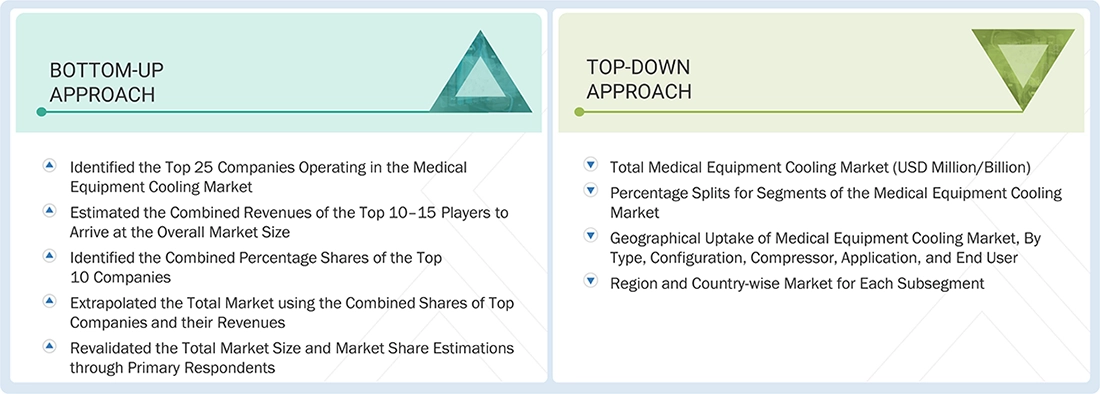
This study involved four major activities in estimating the current medical equipment cooling market size. First, extensive secondary research was conducted to gather information on the market, including related and parent markets. The next step was to validate these findings, assumptions, and sizing with industry experts across the value chain through primary research. Both top-down and bottom-up approaches were employed to estimate the complete market size. After that, market breakdown and data triangulation were used to estimate the market size of segments and subsegments.
Secondary Research
The secondary research process involved the widespread use of secondary sources, directories, databases (Bloomberg Businessweek, Factiva, and D&B Hoovers), white papers, annual reports, company house documents, investor presentations, and SEC filings of companies. Secondary research was used to identify and collect information useful for the extensive technical, market-oriented, and commercial study of the medical equipment cooling market. It was also used to obtain important information about the key players and market classification and segmentation according to industry trends to the bottom-most level, and key developments related to market and technology perspectives. A database of the key industry leaders was also prepared using secondary research.
Primary Research
In the primary research process, various sources from the supply and demand sides were interviewed to obtain qualitative and quantitative information for this report. The primary sources from the supply side include industry experts such as CEOs, vice presidents, marketing and sales directors, technology & innovation directors, and related key executives from various key companies and organizations operating in the medical equipment cooling market. The primary sources from the demand side included industry experts, purchase & sales managers, doctors, and personnel from research organizations. Primary research was conducted to validate the market segmentation, identify key players in the market, and gather insights on key industry trends and key market dynamics.
A breakdown of the primary respondents for the medical equipment cooling market is provided below:
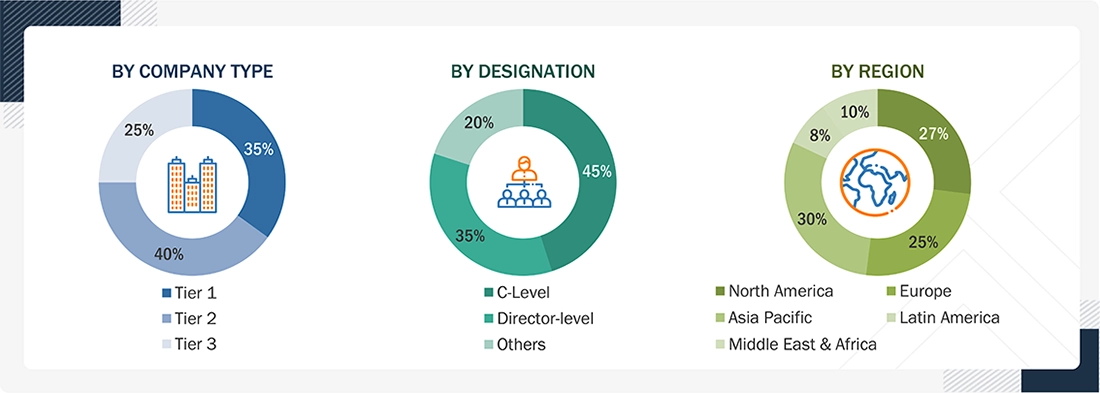
Note 1: C-level primaries include CEOs, CFOs, COOs, and VPs.
Note 2: Other designations include sales managers, marketing managers, business development managers, product managers, distributors, and suppliers.
Note 3: Companies are classified into tiers based on their total revenue. As of 2025, Tier 1 = >USD 10.00 billion, Tier 2 = USD 1.00 billion to USD 10.00 billion, and Tier 3 = <USD 1.00 billion.
To know about the assumptions considered for the study, download the pdf brochure
Market Size Estimation
For the global market value, annual revenues were calculated based on the revenue mapping of major product manufacturers and OEMs active in the global medical equipment cooling market. All the major product manufacturers were identified at the global and/or country/regional level. Revenue mapping for the respective business segments/sub-segments was done for the major players. Additionally, the global medical equipment cooling market was split into various segments and sub-segments based on:
- List of major players operating in the products market at the regional and/or country level
- Product mapping of various medical equipment cooling manufacturers at the regional and/or country level
- Mapping of annual revenue generated by listed major players from medical equipment cooling (or the nearest reported business unit/product category)
- Revenue mapping of major players to covered
- Extrapolation of the revenue mapping of the listed major players to derive the global market value of the respective segments/subsegments
- Summation of the market value of all segments/subsegments to arrive at the global medical equipment cooling market
The above-mentioned data was consolidated and added with detailed input and analysis from MarketsandMarkets and presented in this report.
Market Size Estimation (Bottom-Up Approach & Top-down Approach)
Data Triangulation
After arriving at the overall size of the global medical equipment cooling market through the above-mentioned methodology, this market was split into several segments and subsegments. The data triangulation and market breakdown procedures were employed, wherever applicable, to complete the overall market engineering process and arrive at the exact market value data for the key segments and subsegments. The extrapolated market data was triangulated by studying various macro indicators and regional trends from both the demand- and supply-side participants.
Market Definition
Medical equipment such as MRI, CT, and LINAC produces a large amount of heat while operating. A powerful cooling system is necessary to consistently cope with the thermal load in order to ensure the continuous and accurate working of equipment and avoid damage from overheating.
Key Stakeholders
- Medical Equipment Cooling Product Manufacturing Companies
- Distributors, Suppliers, and Commercial Service Providers
- Medical Equipment Manufacturing Companies
- Healthcare Service Providers
- Clinical Research Organizations (CROs)
- Medical Research Laboratories
- Cancer Research Organizations
- Academic Medical Centers and Universities
- Diagnostic Laboratories
- Hospitals and Clinics
- Academic Institutions
- Research Institutions
- Government Associations
- Market Research and Consulting Firms
- Venture Capitalists and Investors
Report Objectives
- To describe, analyze, and forecast the medical equipment cooling market, by type, configuration, compressor, application, and end user, in terms of value
- To describe and forecast the medical equipment cooling market for key regions—North America, Europe, Asia Pacific, Latin America, and the Middle East & Africa, in terms of value
- To provide detailed information regarding the drivers, restraints, opportunities, and challenges influencing the growth of the medical equipment cooling market
- To strategically analyze micromarkets with respect to individual growth trends, prospects, and contributions to the overall market
- To analyze market opportunities for stakeholders and provide details of the competitive landscape for market players
- To profile key players and comprehensively analyze their market shares and core competencies in the medical equipment cooling market
- To analyze competitive developments such as partnerships, collaborations, agreements, acquisitions, product launches, expansions, and R&D activities in the market
- To benchmark players within the market using the proprietary Company Evaluation Matrix framework, which analyzes market players on various parameters within the broad categories of business and product strategy
Available customizations:
With the given market data, MarketsandMarkets offers customizations as per your company’s specific needs. The following customization options are available for the report:
GEOGRAPHIC ANALYSIS
- Further breakdown of the Rest of Europe Medical equipment cooling market into Russia, Switzerland, Denmark, Austria, and others
- Further breakdown of the Rest of Asia Pacific Medical equipment cooling market into Taiwan and others
- Further breakdown of the Rest of Latin America Medical equipment cooling market into Argentina, Colombia, Chile, Ecuador, and others
- Further breakdown of the Southeast Asia Medical equipment cooling market into Malaysia, Singapore, New Zealand, and others
COMPETITIVE LANDSCAPE ASSESSMENT
- Market share analysis, by region (North America, Europe, Asia Pacific, Latin America, Middle East and Africa), which provides market shares of the top 3-5 key players in the medical equipment cooling market
- Competitive leadership mapping for established players in the US
Get the Full Medical Equipment Cooling Market Report
Full forecast, segment splits, and company analysis for all Medical Equipment Cooling Market.
- Canada Medical Equipment Cooling Market
- US Medical Equipment Cooling Market
- Germany Medical Equipment Cooling Market
- UK Medical Equipment Cooling Market
- France Medical Equipment Cooling Market
- Italy Medical Equipment Cooling Market
- Spain Medical Equipment Cooling Market
- Japan Medical Equipment Cooling Market
- China Medical Equipment Cooling Market
- India Medical Equipment Cooling Market
- Australia Medical Equipment Cooling Market
- South Korea Medical Equipment Cooling Market
- Brazil Medical Equipment Cooling Market
- Mexico Medical Equipment Cooling Market
- GCC Countries Medical Equipment Cooling Market
- Rest Of Europe Medical Equipment Cooling Market
- Rest Of Asia Pacific Medical Equipment Cooling Market
- Rest Of Latin America Medical Equipment Cooling Market
Need a Tailored Report?
Customize this report to your needs
Get 10% FREE Customization
Customize This Report
