
Australia Membrane Bioreactor Market (2025-2030)

The Australia Membrane Bioreactor Market was valued at $6113 Million in 2025 and projected to reach to $8938 Million by 2030, representing a compound annual growth rate of 7.9%. Australia's membrane bioreactor market is poised for sustained growth through 2030, driven by aging wastewater infrastructure requiring upgrades and tightening environmental regulations across states.


| Market Size in | USD 26.32 MN |
| Market Forecast in | |
| CAGR | |
| Forecast Period | |
| Units Considered | Value (USD MN) |
Australia Membrane Bioreactor Market Trends and Insights
- Australia's wastewater treatment infrastructure and stringent environmental regulations are driving adoption of advanced membrane bioreactor technologies across municipal and industrial sectors.
- The market in Australia reflects strong demand for sustainable water treatment solutions as the country prioritizes circular economy principles and resource efficiency. In 2025, Australia's membrane bioreactor market demonstrates robust growth momentum supported by increasing investments in water recycling and reuse initiatives.
- By 2030, Australia is expected to see significant market expansion driven by aging infrastructure upgrades, population growth in urban centers, and heightened focus on reducing environmental footprint.
- Australia's position within the Asia Pacific region positions it as a key market for membrane bioreactor innovation and deployment..
Key Market Statistics
- CAGR (2025-2030) 7.9% CAGR
- Market Size, 2025 ~USD 6113 Million
- Forecast, 2030 ~USD 8938 Million
- Country Australia
Australia Membrane Bioreactor Market Overview
Market Valuation :
Australia's membrane bioreactor market is valued at USD 6,113 million in 2025, with strong growth trajectory driven by infrastructure modernization and regulatory compliance requirements across the nation.
Regulatory Environment :
Stringent Australian environmental regulations and water quality standards are accelerating adoption of advanced membrane bioreactor technologies in both municipal wastewater treatment facilities and industrial applications.
Growth Momentum :
The Australian market is expanding at a CAGR of 7.9% from 2025 to 2030, outpacing global average growth and reflecting increased investment in sustainable water management infrastructure.
Sector Expansion :
Municipal and industrial sectors in Australia are increasingly deploying membrane bioreactor systems to meet water reuse objectives, environmental compliance, and operational efficiency targets.
Australia Membrane Bioreactor Market Dynamics
- Municipal water authorities and industrial operators are investing in advanced treatment technologies to achieve water recycling targets and reduce environmental impact.
- The market's 7.9% CAGR reflects growing awareness of membrane bioreactor benefits including compact footprint, superior effluent quality, and resource recovery capabilities.
- Increasing water scarcity concerns and government initiatives promoting circular economy principles further support market expansion across urban and regional centers..
Market Ecosystem
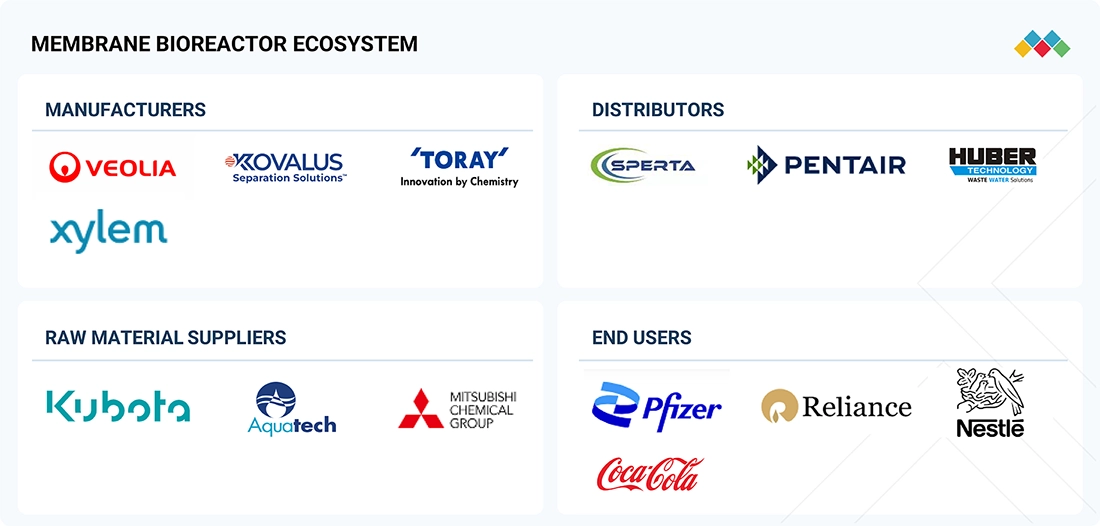
membrane-bioreactor-market: COMMERCIAL USE CASES ACROSS INDUSTRIES
| COMPANY | USE CASE DESCRIPTION | BENEFITS |
|---|---|---|
 |
Food & beverage washwater, CIP effluent; onsite treatment for reuse & compliance | High-quality reuse water, compact footprint, stable operation, strong demand for modular membrane bioreactor chemicals |
 |
Bottling plant rinse water; many small/medium sites needing consistent effluent quality | Ideal for decentralized, skid-based membrane bioreactor systems; recurring membrane cleaning chemicals and service demand |
 |
Pharma wastewater with organics & trace actives requiring reliable treatment | Drives demand for premium, high-performance membrane bioreactors, long-term service, and specialized cleaning chemicals |
 |
Refinery & petrochemical wastewater; high volume and variable loads | Boosts market for large, robust industrial membrane bioreactors; heavy-duty membranes, pretreatment integration, and O&M contracts |
Logos and trademarks shown above are the property of their respective owners. Their use here is for informational and illustrative purposes only.
Related Ecosystem
Membranes
- Reverse Osmosis
- Acetone
- Bioremediation
- Cartridge Filters
- Granular Activated Carbon
- Veolia
- Toray Industries, Inc.
- PALL CORPORATION
- DuPont de Nemours, Inc.
- Pentair plc
Water Purification
- Corrosion Inhibitors
- Cartridge Filters
- Fiberglass
- Reverse Osmosis
- Acetone
- Veolia
- SOLENIS
- Kemira oyj
- CALGON CARBON CORPORATION
- Basf se
Key Takeaways
- Australia's membrane bioreactor market is valued at USD 6,113 million in 2025 and will reach USD 8,938 million by 2030, representing a 7.9% CAGR.
- Australia's stringent environmental regulations and water scarcity concerns are primary drivers accelerating membrane bioreactor adoption across municipal and industrial applications.
- Australia's focus on water recycling and circular economy initiatives positions the country as a growth leader for advanced treatment technologies in the Asia Pacific region.
- Australia's aging wastewater infrastructure and urban population growth create sustained demand for membrane bioreactor solutions through 2030.
Membrane Bioreactor Market Report Scope
| Report Metric | Details |
|---|---|
| Base Year | 2025 |
| Fastest Growing Segment | EXTERNAL MBR (System Configuration) |
| Forecast Period | 2025–2030 |
| Growth Rate | CAGR of 8.5% from 2025 to 2030 |
| Largest Segment | SUBMERGED MBR (System Configuration) |
| Market Size Base Year (Billions) | ~USD 4.49 (2025) |
| Revenue Forecast (Billions) | ~USD 6.75 (2030) |
| Segments Covered | System Configuration, Membrane Type, Capacity, Application |
Australia Membrane Bioreactor Market Report Segmentation
4 segment dimensions are covered across the global market.
By System Configuration
- External Mbr
- Submerged Mbr
By Membrane Type
- Flat Sheet
- Hollow Fiber
- Multi-Tubular
By Capacity
- Large (> 5,000 M3/D)
- Medium (2,501 - 5,000 M3/D)
- Small (= 2,500 M3/D)
By Application
- Industrial Wastewater Treatment
- Municipal Wastewater Treatment
- –Food & Beverage
- –Oil & Gas
- –Other Industrial Wastewater Treatment Applications
- –Pharmaceuticals
- –Pulp & Paper
AUSTRALIA: MEMBRANE BIOREACTOR MARKET, BY APPLICATION, 2025–2030
| Segment | 2025 | 2026 | 2027 | 2028 | 2029 | 2030 | CAGR (%) |
|---|---|---|---|---|---|---|---|
| INDUSTRIAL WASTEWATER TREATMENT | 25.4 | 27.9 | 30.6 | 33.6 | 36.9 | 40.5 | 9.8 |
| MUNICIPAL WASTEWATER TREATMENT | 57.7 | 62.8 | 68.4 | 74.6 | 81.2 | 88.4 | 8.9 |
| TOTAL | 83.1 | 90.7 | 99 | 108.2 | 118 | 129 | 9.2 |
Target Audience
- Water Treatment Equipment Manufacturers : Manufacturers need Australia-specific market data to identify growth opportunities, assess demand for membrane bioreactor systems, and develop localized product strategies for municipal and industrial clients.
- Municipal Water Authorities : Water utility operators require market insights to evaluate technology investments, benchmark against peers, and justify capital expenditure for upgrading wastewater treatment infrastructure across Australian regions.
- Industrial Operators : Industrial facilities need to understand market trends and regulatory drivers to make informed decisions about implementing membrane bioreactor systems for wastewater treatment and water reuse compliance.
- Investment & Private Equity Firms : Investors seeking exposure to Australia's water treatment sector need comprehensive market data to evaluate investment opportunities, assess growth potential, and identify acquisition targets in the membrane bioreactor space.
- Environmental Consultants & Engineers : Consulting firms require Australia market intelligence to advise clients on technology selection, project feasibility, and cost-benefit analysis for membrane bioreactor implementations across various applications.
Key Companies in the Australia Membrane Bioreactor Market
| Company | HQ | Ownership | Strongest segments |
|---|---|---|---|
| GE | United States | Public Company | Commercial Engines OEM,Commercial Engines Services & MRO,Defense & Military Propulsion, |
| VALMET CORPORATION | Finland | Public Company | Biomaterial Solutions and Services – pulp and board lines,Biomaterial Solutions and Services – tissue, packaging, and rebuilds,Process Performance Solutions – automation systems and industrial internet, |
| GODREJ GROUP | India | Private Company | Home and commercial appliances,Locks, architectural hardware, and security products,Furniture and office solutions, |
| KEMIRA OYJ | Finland | Public Company | Water Solutions,Packaging & Hygiene Solutions,Fiber Essentials, |
| CALGON CARBON CORPORATION | United States | Private Company | Granular activated carbon (GAC),Powdered and pelletized activated carbon,Purification systems and related equipment, |
| VEOLIA | France | Public Company | Water (municipal and industrial, including Water Technologies),Waste (municipal, industrial, hazardous, recycling, waste-to-energy),Energy services and networks, |
| KUBOTA CORPORATION. | Japan | Public Company | Agricultural machinery (tractors, harvesters, rice equipment, implements),Construction machinery (mini excavators, loaders, compact track/skid steer),Engines and industrial machinery, |
| XYLEM | United States | Public Company | Water Infrastructure (pumps, treatment, dewatering, stormwater),Applied Water (residential, commercial, industrial pumps and controls),Measurement and Control Solutions (smart meters, sensors, analytics), |
| TORAY INDUSTRIES, INC. | Japan | Public Company | Fibers and Textiles (nylon, polyester, acrylics, non-wovens, apparel),Performance Chemicals (resins, films, fine chemicals, electronic materials),Carbon Fiber Composite Materials, |
| MITSUBISHI CHEMICAL CORPORATION | Japan | Public Company | Specialty Materials (battery, display, semiconductor, high-performance polymers),MMA & Derivatives / PMMA,Basic Materials & Polymers (commodity polymers, petrochemicals, elastomers), |
| DUPONT | United States | Public Company | Healthcare & Water Technologies,Construction Materials and Solutions,Engineered Components & Industrial Solutions, |
| ALFA LAVAL | Sweden | Public Company | Heat transfer (plate, air-cooled, tubular, scraped-surface),Separation (decanters, separators),Fluid handling (pumps, valves, fittings, tubing), |
| PENTAIR | United Kingdom | Public Company | Pool,Water Solutions,Flow, |
GE
GE is a publicly traded American industrial company founded in 1892 with 57,000 employees.
VALMET CORPORATION
Valmet Corporation is a publicly traded Finnish company founded in 1750 with 18,370 employees.
GODREJ GROUP
Godrej Group is a private Indian conglomerate founded in 1897 with 13,316 employees.
KEMIRA OYJ
Kemira Oyj is a publicly traded Finnish company founded in 1920 with 4,871 employees.
CALGON CARBON CORPORATION
Calgon Carbon Corporation is a private American company founded in 1942 with 1,268 employees.
VEOLIA
Veolia is a publicly traded French company founded in 1853 with 203,100 employees.
KUBOTA CORPORATION.
Kubota Corporation is a publicly traded Japanese manufacturer founded in 1890 with 52,503 employees.
XYLEM
Xylem is a publicly traded American company founded in 2011 with 22,000 employees.
TORAY INDUSTRIES, INC.
Toray Industries, Inc. is a publicly traded Japanese company founded in 1926 with 46,294 employees.
MITSUBISHI CHEMICAL CORPORATION
Mitsubishi Chemical Corporation is a publicly traded Japanese company founded in 1933 with 56,678 employees.
DUPONT
DuPont is a publicly traded American company founded in 2015 with 15,000 employees.
ALFA LAVAL
Alfa Laval is a publicly traded Swedish company founded in 1883 with 24,399 employees.
PENTAIR
Pentair is a publicly traded company based in the United Kingdom, founded in 1966 with 9,000 employees.
Reasons to Buy this Report
- Market Size & Growth Data : Access precise valuation metrics for Australia's membrane bioreactor market with 2025-2030 forecasts, enabling accurate investment planning and competitive positioning in this high-growth regional segment.
- Regulatory Insights : Understand Australia-specific environmental regulations and compliance drivers shaping membrane bioreactor adoption, critical for product development and market entry strategies tailored to local requirements.
- Sector-Specific Analysis : Gain detailed intelligence on municipal and industrial sector dynamics in Australia, identifying key growth opportunities and customer segments with highest adoption potential and revenue generation.
- Competitive Landscape : Benchmark your position against regional competitors with Australia-focused market data, understanding market concentration, key players, and differentiation opportunities in this emerging market.
- Strategic Planning : Leverage Australia market forecasts and growth drivers to develop targeted expansion strategies, resource allocation plans, and investment decisions for the 2025-2030 period with confidence.
Frequently asked questions
What is the current size of Australia's membrane bioreactor market?
Australia's membrane bioreactor market is valued at USD 6,113 million in 2025 and is expected to grow to USD 8,938 million by 2030.
What is the growth rate of Australia's membrane bioreactor market?
Australia's membrane bioreactor market is growing at a compound annual growth rate of 7.9% from 2025 to 2030.
What factors are driving growth in Australia's membrane bioreactor market?
Australia's market growth is driven by stringent environmental regulations, water scarcity concerns, infrastructure upgrades, and increasing investments in water recycling and reuse initiatives.
Which sectors are adopting membrane bioreactors in Australia?
In Australia, membrane bioreactors are being adopted across municipal wastewater treatment, industrial water treatment, and water recycling applications.
How does Australia's market compare to the broader Asia Pacific region?
Australia represents a significant market within Asia Pacific, driven by advanced infrastructure requirements, regulatory frameworks, and strong emphasis on sustainable water management practices.
RESEARCH METHODOLOGY
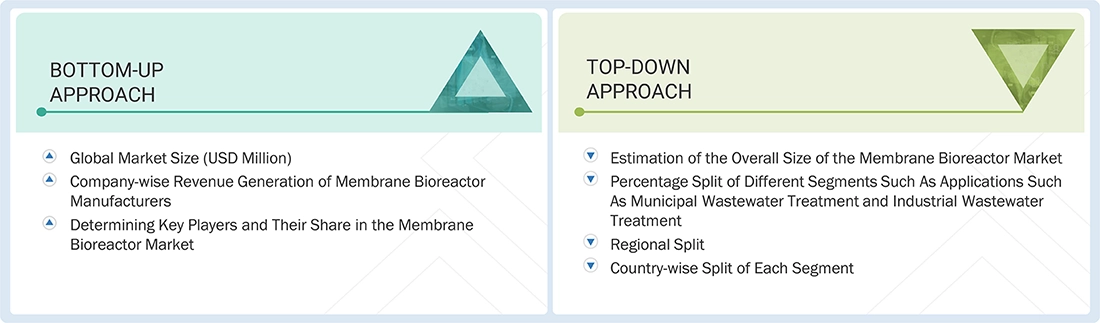
The study involves two major activities in estimating the current market size for the membrane bioreactor market. Exhaustive secondary research was done to collect information on the market, peer market, and parent market. The next step was to validate these findings, assumptions, and sizing with industry experts across the value chain through primary research. Both top-down and bottom-up approaches were employed to estimate the complete market size. Following this, market breakdown and data triangulation were used to determine the market size of each segment and its subsegments.
Secondary Research
Secondary sources referred to for this research study include financial statements of companies offering membrane bioreactor and information from various trade, business, and professional associations. Secondary research has been used to obtain critical information about the industry’s value chain, the total pool of key players, market classification, and segmentation according to industry trends to the bottom-most level and regional markets. Secondary data were collected and analyzed to determine the overall size of the membrane bioreactor market, which primary respondents subsequently validated.
Primary Research
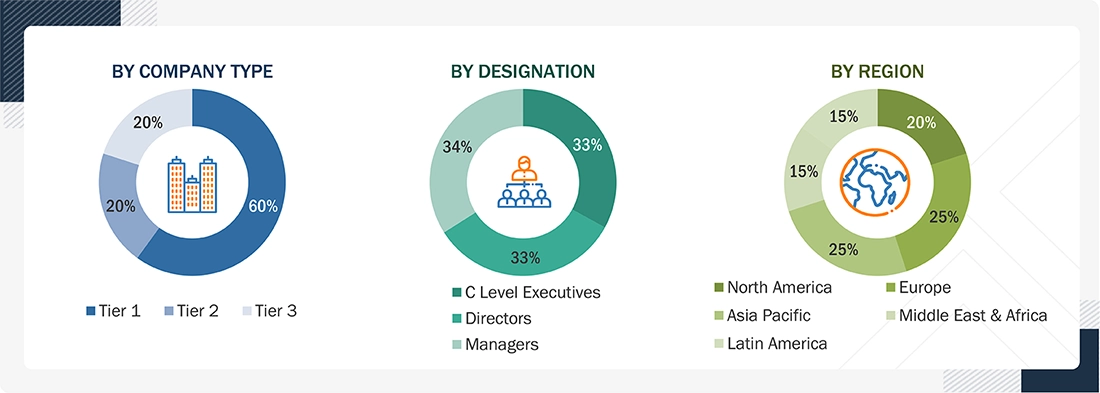
Extensive primary research was conducted following the collection of information regarding the membrane bioreactor market scenario through secondary research. Several primary interviews were conducted with market experts from both the demand and supply sides across major countries of North America, Europe, Asia Pacific, the Middle East & Africa, and South America. Primary data was collected through questionnaires, emails, and telephonic interviews. Primary sources from the supply side included various industry experts, such as Chief X Officers (CXOs), Vice Presidents (VPs), Directors from business development, marketing, product development/innovation teams, and related key executives from membrane bioreactor industry vendors; material providers; distributors; and key opinion leaders. Primary interviews were conducted to gather insights such as market statistics, data on revenue collected from the products and services, market breakdowns, market size estimations, market forecasting, and data triangulation. Primary research also helped in understanding the various trends related to membrane type, system configuration, capacity, application, and region. Stakeholders from the demand side, such as CIOs, CTOs, CSOs, and installation teams of the customer/end users who are seeking membrane bioreactor services, were interviewed to understand the buyer’s perspective on the suppliers, products, component providers, and their current usage of membrane bioreactor and future outlook of their business, which will affect the overall market.
To know about the assumptions considered for the study, download the pdf brochure
Market Size Estimation
The research methodology used to estimate the size of the membrane bioreactor market includes the following details. The market sizing was undertaken from the demand side. The market was upsized based on the demand for membrane bioreactors in different end-use industries at a regional level. Such procurements provide information on the demand aspects of the membrane bioreactor industry for each end-use industry. For each end use, all possible segments of the membrane bioreactor market were integrated and mapped.
Membrane Bioreactor Market : Top-Down and Bottom-Up Approach
Data Triangulation
After determining the overall size from the market size estimation process explained above, the total market was divided into several segments and subsegments. The data triangulation and market breakdown procedures explained below were implemented, wherever applicable, to complete the overall market engineering process and arrive at the exact statistics for various market segments and subsegments. The data was triangulated by studying various factors and trends from the demand and supply sides. Along with this, the market size was validated using both the top-down and bottom-up approaches.
Market Definition
A membrane bioreactor is an advanced wastewater treatment technology that combines biological processes with membrane filtration. It integrates a suspended growth bioreactor, where microorganisms decompose organic matter, with microfiltration or ultrafiltration membranes that separate solids from liquids. This setup efficiently removes suspended solids, bacteria, and other contaminants, producing high-quality effluent suitable for reuse. MBR systems are gaining popularity in municipal and industrial applications due to their compact design, smaller footprint compared to traditional methods, and ability to maintain higher biomass concentrations, enhancing treatment efficiency and performance.
Key Stakeholders
- Membrane Bioreactor Manufacturers
- Membrane Bioreactor Distributors and Suppliers
- End-use Industries
- Universities, Governments, and Research Organizations
- Associations and Industrial Bodies
- R&D Institutes
- Environmental Support Agencies
- Investment Banks and Private Equity Firms
- Research and Consulting Firms
Report Objectives
- To define, describe, and forecast the membrane bioreactor market size in terms of volume and value
- To provide detailed information regarding the key factors, such as drivers, restraints, opportunities, and challenges influencing market growth
- To analyze and forecast the market by membrane type, system configuration, capacity application, and region
- To forecast the market size concerning five main regions (along with country-level data): North America, Europe, Asia Pacific, Middle East & Africa, and South America, and analyze the significant region-specific trends
- To strategically analyze micromarkets with respect to individual growth trends, prospects, and contributions of the submarkets to the overall market
- To analyze the market opportunities and the competitive landscape for stakeholders and market leaders
- To assess recent market developments and competitive strategies, such as agreements, contracts, acquisitions, partnerships & collaborations, and new product developments/new product launches, to draw the competitive landscape
- To strategically profile the key market players and comprehensively analyze their core competencies
Customization Options
MarketsandMarkets offers the following customizations for this market report:
- Additional country-level analysis of the membrane bioreactor market
Product Analysis
- Product matrix, which provides a detailed comparison of the product portfolio of each company's market
Get the Full Membrane Bioreactor Market Report
Full forecast, segment splits, and company analysis for all Membrane Bioreactor Market.
- US Membrane Bioreactor Market
- Canada Membrane Bioreactor Market
- Mexico Membrane Bioreactor Market
- Germany Membrane Bioreactor Market
- UK Membrane Bioreactor Market
- France Membrane Bioreactor Market
- Italy Membrane Bioreactor Market
- Spain Membrane Bioreactor Market
- Russia Membrane Bioreactor Market
- Turkey Membrane Bioreactor Market
- China Membrane Bioreactor Market
- Japan Membrane Bioreactor Market
- India Membrane Bioreactor Market
- South Korea Membrane Bioreactor Market
- SAUDI ARABIA Membrane Bioreactor Market
- Egypt Membrane Bioreactor Market
- South Africa Membrane Bioreactor Market
- Brazil Membrane Bioreactor Market
- Argentina Membrane Bioreactor Market
- Rest Of Europe Membrane Bioreactor Market
- Rest Of Asia Pacific Membrane Bioreactor Market
- GCC Countries Membrane Bioreactor Market
- Rest Of Mea Membrane Bioreactor Market
- –Rest Of GCC Countries Membrane Bioreactor Market
Need a Tailored Report?
Customize this report to your needs
Get 10% FREE Customization
Customize This Report
