
Asia Pacific Mental Health Screening Market (2023-2028)

The Asia Pacific Mental Health Screening Market was valued at $172.8 Million in 2023 and projected to reach to $398.5 Million by 2028, representing a compound annual growth rate of 14.9%. The Asia Pacific mental health screening market is positioned for sustained growth through 2028, driven by demographic shifts, urbanization, and increasing prevalence of mental health disorders across the region.


| Market Size in | USD 26.32 MN |
| Market Forecast in | |
| CAGR | |
| Forecast Period | |
| Units Considered | Value (USD MN) |
Asia Pacific Mental Health Screening Market Trends and Insights
- Asia Pacific's market growth is driven by increasing awareness of mental health conditions, rising healthcare investments, and expanding digital health infrastructure across the region.
- The 14.9% compound annual growth rate in Asia Pacific significantly outpaces global trends, reflecting strong demand for early detection and preventive mental health solutions. Asia Pacific's mental health screening adoption is accelerated by growing prevalence of depression, anxiety, and stress-related disorders across diverse populations.
- Asia Pacific governments and healthcare systems are prioritizing mental health integration into primary care, supported by technological advancements in screening tools and telemedicine platforms.
- The forecast period through 2028 indicates Asia Pacific will continue to capture substantial market share as workplace wellness programs, school-based screening initiatives, and community mental health services expand throughout the region..
Key Market Statistics
- CAGR (2023-2028) 14.9% CAGR
- Market Size, 2023 ~USD 172.8 Million
- Forecast, 2028 ~USD 398.5 Million
- Geography Asia Pacific
Asia Pacific Mental Health Screening Market Overview
Rapid Market Expansion :
Asia Pacific's mental health screening market is valued at $172.8 million in 2023 and is projected to grow to $398.5 million by 2028, representing a robust 14.9% CAGR—outpacing the global average of 12.2%.
Digital Health Infrastructure Growth :
Expanding digital health infrastructure across Asia Pacific is enabling wider adoption of mental health screening tools, telemedicine platforms, and AI-driven diagnostic solutions in both urban and emerging markets.
Rising Mental Health Awareness :
Increasing awareness of mental health conditions, coupled with reduced stigma and government initiatives, is driving demand for screening services across China, Japan, India, and Southeast Asian nations.
Healthcare Investment Surge :
Rising healthcare investments and government funding for mental health programs in Asia Pacific countries are accelerating the adoption of standardized screening protocols and clinical assessment tools.
Asia Pacific Mental Health Screening Market Dynamics
- Key markets including China, Japan, and India are investing heavily in mental health infrastructure and digital solutions.
- Government initiatives and public health campaigns are normalizing mental health discussions, creating favorable conditions for screening adoption.
- The region's younger population and rising smartphone penetration further support the expansion of digital screening platforms and remote assessment capabilities. Market players are capitalizing on opportunities through partnerships with healthcare providers, integration of AI and machine learning technologies, and development of culturally adapted screening tools.
- Regulatory frameworks are gradually becoming more supportive, particularly in developed Asia Pacific economies.
- The convergence of increasing healthcare spending, technological advancement, and growing clinical recognition of mental health's importance positions Asia Pacific as one of the fastest-growing regions for mental health screening solutions globally..
Market Ecosystem
Related Ecosystem
Healthcare It
- Computed Tomography (CT)
- Machine Learning
- Magnetic Resonance Imaging (MRI)
- Natural Language Processing (NLP)
- Predictive Analytics
- CERNER CORPORATION
- PHILIPS HEALTHCARE
- Oracle Corporation
- GE HealthCare Technologies Inc.
- Siemens healthineers
Key Takeaways
- Asia Pacific mental health screening market valued at $172.8 million in 2023, expanding to $398.5 million by 2028 at 14.9% CAGR
- Asia Pacific's growth rate outpaces global average, driven by rising mental health awareness and healthcare infrastructure investment
- Digital health and telemedicine solutions are transforming mental health screening accessibility across Asia Pacific
- Asia Pacific workplace wellness and school-based screening programs are key growth catalysts through 2028
Mental Health Screening Market Report Scope
| Report Metric | Details |
|---|---|
| Base Year | 2023 |
| Fastest Growing Segment | COGNITIVE (Application) |
| Forecast Period | 2023-2028 |
| Growth Rate | CAGR of 12.2% from 2023 to 2028 |
| Largest Segment | ADULTS (AGE 19-64 YEARS) (Age Group) |
| Market Size Base Year (Billions) | ~USD 0.9 (2023) |
| Revenue Forecast (Billions) | ~USD 1.6 (2028) |
| Segments Covered | Application, Type, Screening Method, Technology, Age Group, Setting |
Asia Pacific Mental Health Screening Market Report Segmentation
6 segment dimensions are covered across the global market.
By Application
- Behavioral Disorders
- Cognitive
- Cognitive Disorders
- Physiological Disorders
- Psychiatric Disorders
By Type
- Aggression
- Alzheimer'S Disease
- Anxiety
- Attention Deficit Hyperactivity Disorder (Adhd)
- Beck Depression Inventory (Bdi)
- Bipolar Disorder
- Cognitive Impairment
- Dementia
- Depression
- Diagnostic Interview For Psychological Distress (Dipd)
- Dissociative Disorder
- Eating Disorder
- Generalized Anxiety Disorder-7 (Gad-7)
- Hamilton Anxiety Rating Scale (Ham-A)
- Hyperactivity
- Mini International Neuropsychiatric Interview (Mini)
- Obsessive Compulsive Disorder (Ocd)
- Other Behavioral Disorders
- Other Clinical Interviews
- Other Cognitive Disorders
- Other Physiological Disorders
- Other Psychiatric Disorders
- Other Self-Reported Questionnaires & Surveys
- Patient Health Questionnaire-12 (Phq-12)
- Post-Traumatic Stress Disorder (Ptsd)
- Post-Traumatic Stress Disorder (Ptsd)
- Psychotic Disorder
- Schizophrenia
- Self-Harm
- Sleep Disorders
- Social Withdrawal
- Structured Clinical Interview For Dsm (Scid)
- Structured Clinical Interviews For Dsm (Scid)
- Substance Abuse
- Yale-Brown Obsessive Compulsive Scale (Y-Bocs)
By Screening Method
- Biomarker Testing
- Clinical Interviews
- Observation-Based Assessments
- Self-Reported Questionnaires & Surveys
By Technology
- AI-Based Screening Tools
- Continuous Monitoring Wearable Devices
- Remote Mental Health Platforms
- Self-Screening Mhealth Apps
- Telehealth & Virtual Care Solutions
By Age Group
- Adults (Age 19-64 Years)
- Children & Adolescents (0-18 Years)
- Children & Adolescents (Age 0-18 Years)
- Seniors (Age 65 And Above)
By Setting
- Clinical Settings
- Educational Institutions
- Online Platforms
- Other Settings
- Workplace/Corporate Programs
Target Audience
- Healthcare Providers & Hospitals : Need market data to evaluate mental health screening service expansion opportunities and understand adoption trends across Asia Pacific healthcare systems.
- Medical Device & Diagnostic Companies : Require regional market insights to develop and commercialize screening tools, diagnostic platforms, and assessment solutions tailored to Asia Pacific markets.
- Digital Health & MedTech Startups : Seek market intelligence on growth opportunities, regulatory pathways, and competitive dynamics to launch or scale mental health screening applications across Asia Pacific.
- Investment & Private Equity Firms : Need comprehensive market analysis to identify high-growth investment opportunities and assess the viability of mental health screening ventures in Asia Pacific.
- Government & Healthcare Policy Makers : Require data-driven insights to inform mental health policy development, funding allocation, and healthcare infrastructure planning across Asia Pacific regions.
Countries within Asia Pacific - compare and drill down
| Country | 2025 size (native) |
|---|---|
| China | USD 50.72 Million |
| Japan | USD 56.79 Million |
| India | USD 37.84 Million |
| Rest Of Asia Pacific | USD 70.7 Million |
Country market size visualization
Reasons to Buy this Report
- Regional Growth Opportunity : Capture insights into the fastest-growing mental health screening market segment with 14.9% CAGR, significantly outpacing global growth and offering substantial revenue potential through 2028.
- Country-Level Market Intelligence : Access detailed market sizing and forecasts for key Asia Pacific economies including China, Japan, and India, enabling targeted market entry and expansion strategies.
- Digital Health Transformation Insights : Understand the digital health infrastructure evolution across Asia Pacific, including telemedicine adoption, AI-driven screening tools, and technology integration opportunities.
- Competitive Landscape Analysis : Identify market leaders, emerging players, and partnership opportunities specific to Asia Pacific's unique regulatory environment and healthcare delivery models.
- Strategic Investment Guidance : Make informed investment and expansion decisions with comprehensive data on market drivers, barriers, and growth catalysts specific to Asia Pacific mental health screening.
Frequently asked questions
What is the current size of the Asia Pacific mental health screening market?
The Asia Pacific mental health screening market was valued at $172.8 million in 2023 and is projected to grow to $398.5 million by 2028.
What is the expected growth rate for Asia Pacific mental health screening?
Asia Pacific's mental health screening market is expected to grow at a compound annual growth rate (CAGR) of 14.9% from 2023 to 2028.
What factors are driving growth in Asia Pacific mental health screening?
Key drivers include increasing mental health awareness, rising healthcare investments, expanding digital health infrastructure, workplace wellness programs, and school-based screening initiatives across Asia Pacific.
How does Asia Pacific's growth compare to global trends?
Asia Pacific's 14.9% CAGR significantly outpaces the global market CAGR of 12.2%, indicating stronger regional demand and adoption of mental health screening solutions.
What role does technology play in Asia Pacific mental health screening?
Telemedicine platforms, digital screening tools, and mobile health applications are expanding access to mental health screening services across Asia Pacific, particularly in underserved areas.
RESEARCH METHODOLOGY
This market research study involved the extensive use of secondary sources, directories, and databases to identify and collect information useful for this technical, market-oriented, and financial study of the Mental Health Screening market. In-depth interviews were conducted with various primary respondents, including key industry participants, subject-matter experts (SMEs), C-level executives of key market players, and industry consultants, among other experts, to obtain and verify critical qualitative and quantitative information and to assess market prospects. The size of the market was estimated through various secondary research approaches and triangulated with inputs from primary research to arrive at the final market size.
Secondary Research
The secondary research process involved the widespread use of secondary sources, directories, databases (such as Bloomberg Businessweek, Factiva, and D&B Hoovers), white papers, annual reports, company house documents, investor presentations, and SEC filings of companies. Some non-exclusive secondary sources include the World Health Organization (WHO), the Organisation for Economic Co-operation and Development (OECD), Agency for Healthcare Research and Quality (AHRQ), Primary Care Companion for CNS Disorders Journal, Centers for Medicare & Medicaid Services (CMS), Centers for Disease Control and Prevention (CDC), Expert Interviews, and MarketsandMarkets Analysis.
Secondary research was used to identify and collect information useful for the extensive, technical, market-oriented, and commercial study of the market. It was also used to obtain important information about the key players and market classification and segmentation according to industry trends to the bottom-most level and key developments related to market and technology perspectives. A database of the key industry leaders was also prepared using secondary research.
Primary Research
Extensive primary research was conducted after acquiring basic knowledge about the global market scenario through secondary research. Several primary interviews were conducted with market experts from both the demand side (Hospital personnel, department heads, hospital directors, corporate personnel) and supply side (such as C-level and D-level executives, technology experts, software developers, marketing and sales managers, among others) across five major regions—North America, Europe, the Asia Pacific, Latin America, Middle East, and Africa. This primary data was collected through questionnaires, e-mails, online surveys, personal interviews, and telephonic interviews.
Breakdown of Primary Interviews
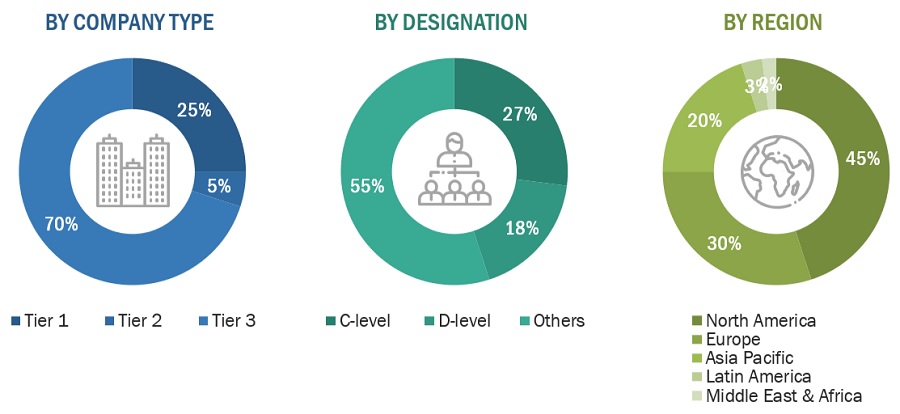
Note 1: Tiers are defined based on the total revenues of companies. As of 2022, Tier 1 = >USD 1 billion, Tier 2 = USD 500 million to USD 1 billion, and Tier 3 = <USD 500 million.
To know about the assumptions considered for the study, download the pdf brochure
Market Size Estimation
The total size of the mental health screening market was arrived at after data triangulation from various approaches, as mentioned below. After completing each approach, a weighted average of the three approaches was taken based on the level of assumptions used in each approach.
Approach 1: Mental Health Screening Market (Revenue Share Analysis)
- Revenues for individual companies were gathered from public sources and databases for each market segment.
- Revenues of private companies were gathered through paid databases such as Factiva and Hoovers.
- Shares of the mental health screening businesses of leading players were gathered from secondary sources to the extent available. In certain cases, shares have been ascertained after a detailed analysis of various parameters, including product portfolios, market positioning, and geographic reach.
- Individual shares or revenue estimates were validated through expert interviews.
- The market size was then extrapolated to obtain the global market. It was further validated through expert interviews.
Approach 2: Segmental Extrapolation
Separate research approaches were followed to estimate the revenue from mental health screening tools and continuous monitoring wearable devices used for mental health screening.
- Mental health screening tools (excluding continuous monitoring wearable devices):
- The total number of psychiatrists in the US was determined for 2022. The percentage of psychiatrists using mental health screening tools offered by vendors was identified through extensive secondary research and validated through insights from primary interviews.
- The average price of mental health screening tools for yearly subscriptions was considered to arrive at the US mental health screening market for clinical settings in 2022.
- Considering the share of clinical settings, revenues of the overall market in the US were determined for 2022.
- The US mental health screening market was extrapolated to arrive at the global market.
- The market for continuous monitoring wearable devices:
- The total prevalence of mental health disorders in the US was determined for 2022, and the share of people opting for assessments was identified through extensive secondary research and validated through insights from primary interviews.
- The share of people using continuous monitoring wearable devices for mental health screening was assumed based on secondary research and insights from primary interviews.
- The average price of continuous monitoring wearable devices was determined through secondary sources to arrive at the US market for continuous monitoring wearable devices.
- The US market for continuous monitoring wearable devices was extrapolated to arrive at the global market for continuous monitoring wearable devices.
- The sum of revenues from mental health screening tools and continuous monitoring wearable devices used for mental health screening provided the revenue of the global mental health screening market. The assumptions at each step were validated through primary interviews.
Approach 3: Primary Interviews
- As a part of the primary research process, individual respondents’ insights on the market size and growth were taken during the interview (regional and global, as applicable).
- All the responses were collated, and a weighted average was taken to derive a probabilistic estimate of the market size and growth rate.
Data Triangulation:
After arriving at the overall market size, from the market size estimation process explained above, the Mental Health Screening market was split into segments and subsegments. To complete the overall market engineering process and to arrive at the exact statistics for all segments and subsegments, data triangulation and market breakdown procedures were employed, wherever applicable. The data was triangulated by studying various factors and trends from both the demand and supply sides in the Mental Health Screening market.
Market Definition:
Mental health screening refers to the process of assessing an individual’s mental health status to identify potential signs or symptoms of mental health conditions. It is a preliminary step in recognizing and addressing mental health concerns early on. The goal of mental health screening is to identify individuals who may be at risk of or experiencing mental health issues so that appropriate interventions, support, or further assessments can be provided.
Screening tools may include questionnaires, surveys, or interviews that assess various aspects of an individual’s mental health, such as mood, behavior, thoughts, and emotions. These screenings are often administered by healthcare professionals, counselors, or mental health providers in different settings, including schools, workplaces, clinical settings, and others.
Key Stakeholders:
- Manufacturers of mental health screening solutions/products
- Suppliers and distributors of mental health screening solutions/products
- Third-party refurbishers/suppliers
- Clinical settings
- Educational institutions
- Group purchasing organizations (GPOs)
- Academic medical centers and universities
- Corporate entities
- Community centers
- Government institutes
- Market research & consulting firms
- Contract manufacturing organizations (CMOs)
- Venture capitalists & investors
Report Objectives
- To define, describe, and forecast the mental health screening market by application, screening method, technology, age group, setting, and region
- To provide detailed information regarding the major factors influencing the market growth (such as drivers, restraints, opportunities, and challenges)
- To strategically analyze micromarkets1 with respect to individual growth trends, prospects, and contributions to the overall mental health screening market
- To analyze the opportunities in the market for stakeholders and provide details of the competitive landscape for market leaders
- To profile the key players in the market and comprehensively analyze their market shares and core competencies
- To forecast the size of the market segments with respect to five main regions: North America, the Asia Pacific, Europe, Latin America, and the Middle East & Africa
- To track and analyze competitive developments, such as partnerships, acquisitions, and launches
- To benchmark players within the mental health screening market using the Competitive Evaluation Matrix, which analyzes market players on various parameters within the broad categories of business strategy, market share, and product offering
Available Customizations:
With the given market data, MarketsandMarkets offers customizations as per the company’s specific needs. The following customization options are available for the report:
Additional Company Profiling
- Detailed analysis and profiling of additional market players (up to 5)
Geographic Analysis
- Further breakdown of the Rest of Europe mental health screening market into Spain, Italy, Russia, and others
- Further breakdown of the Rest of Asia Pacific mental health screening market into Australia, South Korea, Singapore, and others
Get the Full Mental Health Screening Market Report
Full forecast, segment splits, and company analysis for all Mental Health Screening Market.
- US Mental Health Screening Market
- Canada Mental Health Screening Market
- UK Mental Health Screening Market
- Germany Mental Health Screening Market
- France Mental Health Screening Market
- China Mental Health Screening Market
- Japan Mental Health Screening Market
- India Mental Health Screening Market
- Brazil Mental Health Screening Market
- Mexico Mental Health Screening Market
- Rest Of Europe Mental Health Screening Market
- Rest Of Asia Pacific Mental Health Screening Market
- Rest Of Latin America Mental Health Screening Market
Need a Tailored Report?
Customize this report to your needs
Get 10% FREE Customization
Customize This Report
