
Europe Merging Unit Market (2025-2030)

The Europe Merging Unit Market was valued at $58.4 Million in 2025 and projected to reach to $76.1 Million by 2030, representing a compound annual growth rate of 5.4%. Europe's merging unit market is poised for sustained growth through 2030, driven by the region's ambitious energy transition goals and digital infrastructure modernization initiatives.


| Market Size in | USD 26.32 MN |
| Market Forecast in | |
| CAGR | |
| Forecast Period | |
| Units Considered | Value (USD MN) |
Europe Merging Unit Market Trends and Insights
- This 5.4% compound annual growth rate reflects Europe's commitment to modernizing energy infrastructure and adopting advanced power distribution technologies.
- Europe's regulatory framework and investment in grid modernization are key drivers supporting this expansion through the forecast period. The European merging unit sector benefits from stringent energy efficiency standards and the continent's transition toward renewable energy integration.
- Europe's aging electrical infrastructure requires upgraded equipment, positioning merging units as critical components in smart grid development.
- By 2030, Europe is expected to maintain its position as a significant market for merging units, driven by digital transformation initiatives and cross-border energy trading requirements..
Key Market Statistics
- CAGR (2025-2030) 5.4% CAGR
- Market Size, 2025 ~USD 58.4 Million
- Forecast, 2030 ~USD 76.1 Million
- Geography Europe
Europe Merging Unit Market Overview
Market Valuation & Growth :
Europe's merging unit market is valued at $58.4 million in 2025, with a projected expansion to $76.1 million by 2030, representing a steady 5.4% CAGR aligned with global growth rates.
Regulatory Framework Driving Adoption :
Europe's stringent energy regulations and commitment to grid modernization standards are accelerating the adoption of advanced merging unit technologies across the region's power distribution networks.
Infrastructure Modernization Investment :
Significant capital investments in smart grid infrastructure and digital substation technologies are positioning Europe as a leader in deploying next-generation power distribution solutions.
Key Market Contributors :
The UK, Germany, and France represent the largest European markets, collectively accounting for substantial market share, while Rest of Europe contributes $40.6 million to the regional total.
Europe Merging Unit Market Dynamics
- Utilities across the continent are increasingly investing in advanced substation technologies to enhance grid reliability, reduce operational costs, and integrate renewable energy sources more effectively.
- The regulatory environment, particularly EU directives on grid digitalization and cybersecurity, continues to create favorable conditions for merging unit deployment. Key European markets including the UK, Germany, and France are leading adoption rates, supported by government incentives and utility modernization programs.
- The forecasted growth to $76.1 million reflects ongoing investments in smart grid infrastructure, increased demand for real-time monitoring capabilities, and the need for enhanced grid resilience.
- As Europe accelerates its decarbonization agenda, merging units will play an increasingly critical role in enabling efficient power distribution and supporting the integration of distributed renewable energy resources..
Market Ecosystem
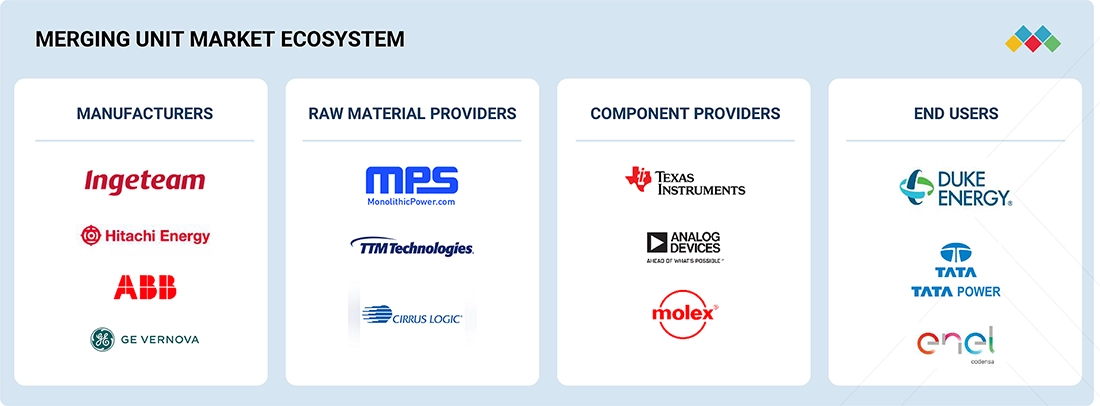
merging-unit-market: COMMERCIAL USE CASES ACROSS INDUSTRIES
| COMPANY | USE CASE DESCRIPTION | BENEFITS |
|---|---|---|
 |
Integrating renewable energy sources into grid with advanced substation automation technology | Facilitates precise measurement and control of power flow | Supports grid stability | Faster response times | Enhanced cybersecurity through standardized digital communication |
 |
Modernizing aging transmission and distribution infrastructure with digital substations and retrofits | Enables real-time digital signal conversion from legacy transformers | Better asset management | Reduced maintenance costs | Improved safety through reduced copper wiring |
 |
Deploying digital substations for enhanced grid automation and real-time data acquisition | Improved protection accuracy | Faster fault detection | Reduced wiring complexity | Seamless integration with IEC 61850 protocols | Enhanced operational efficiency and grid reliability |
Logos and trademarks shown above are the property of their respective owners. Their use here is for informational and illustrative purposes only.
Related Ecosystem
High Voltage Products And Systems
- Analytics Software
- Connected Healthcare
- Connected Logistics
- Geographical Information System (GIS)
- Network Bandwidth Management
- ABB India Limited
- Siemens ag
- SCHNEIDER ELECTRIC SE
- Eaton Corporation plc
- Mitsubishi Electric Corporation
Power Infrastructure
- Geographical Information System (GIS)
- Cogeneration
- Battery Electric Vehicle (BEV)
- Cellular Network
- Fuel Cell
- Siemens ag
- ABB India Limited
- SCHNEIDER ELECTRIC SE
- General Electric Company
- Eaton Corporation plc
Smart Grid
- Meter Data Management (MDM)
- Sensors
- Workforce Management
- Cellular Network
- Customer Analytics
- SCHNEIDER ELECTRIC SE
- Siemens ag
- ABB India Limited
- Eaton Corporation plc
- Hitachi Energy India Limited
Key Takeaways
- Europe's merging unit market grows from $58.4M (2025) to $76.1M (2030) at 5.4% CAGR
- Europe's grid modernization and renewable energy transition drive sustained demand for merging units
- Europe's regulatory standards and smart grid initiatives accelerate technology adoption across the region
- Europe's aging infrastructure creates replacement and upgrade opportunities through 2030
Merging Unit Market Report Scope
| Report Metric | Details |
|---|---|
| Base Year | 2025 |
| Fastest Growing Segment | RENEWABLE ENERGY (End User) |
| Forecast Period | 2025–2030 |
| Growth Rate | CAGR of 5.4% from 2025 to 2030 |
| Largest Segment | WITH RELAY OUTPUT (Configuration) |
| Market Size Base Year (Billions) | ~USD 0.37 (2025) |
| Revenue Forecast (Billions) | ~USD 0.48 (2030) |
| Segments Covered | Type, Voltage, Configuration, End User, Configuration 2025–2030 |
Europe Merging Unit Market Report Segmentation
5 segment dimensions are covered across the global market.
By Type
- Integrated
- Standalone
By Voltage
- High
- Low
- Medium
By Configuration
- With Relay Output
- Without Relay Output
By End User
- Commercial
- Data Centers
- Industrial
- Other End Users
- Renewable Energy
- Transportation
- Utilities
By Configuration 2025–2030
- With Relay Output
- Without Relay Output
EUROPE: MERGING UNIT MARKET, BY END USER, 2025–2030
| Segment | 2025 | 2026 | 2027 | 2028 | 2029 | 2030 | CAGR (%) |
|---|---|---|---|---|---|---|---|
| COMMERCIAL | 6.67 | 6.95 | 7.25 | 7.6 | 7.98 | 8.41 | 4.7 |
| DATA CENTERS | 5.88 | 6.17 | 6.49 | 6.85 | 7.25 | 7.69 | 5.5 |
| INDUSTRIAL | 18.19 | 18.98 | 19.87 | 20.86 | 21.97 | 23.2 | 5 |
| OTHER END USERS | 2.87 | 2.96 | 3.06 | 3.18 | 3.31 | 3.45 | 3.7 |
| RENEWABLE ENERGY | 9.99 | 10.54 | 11.15 | 11.83 | 12.59 | 13.43 | 6.1 |
| TRANSPORTATION | 3.73 | 3.87 | 4.03 | 4.2 | 4.4 | 4.62 | 4.4 |
| UTILITIES | 41.41 | 43.32 | 45.46 | 47.85 | 50.52 | 53.5 | 5.3 |
| TOTAL | 88.74 | 92.79 | 97.31 | 102.37 | 108.01 | 114.31 | 5.2 |
REST OF EUROPE: MERGING UNIT MARKET, BY END USER, 2025–2030
| Segment | 2025 | 2026 | 2027 | 2028 | 2029 | 2030 | CAGR (%) |
|---|---|---|---|---|---|---|---|
| COMMERCIAL | 2.3 | 2.42 | 2.55 | 2.69 | 2.85 | 3.02 | 5.6 |
| DATA CENTERS | 2 | 2.11 | 2.23 | 2.37 | 2.52 | 2.68 | 6 |
| INDUSTRIAL | 6.24 | 6.55 | 6.9 | 7.29 | 7.73 | 8.22 | 5.7 |
| OTHER END USERS | 1 | 1.04 | 1.09 | 1.14 | 1.2 | 1.26 | 4.8 |
| RENEWABLE ENERGY | 3.46 | 3.68 | 3.92 | 4.2 | 4.5 | 4.84 | 7 |
| TRANSPORTATION | 1.29 | 1.35 | 1.42 | 1.49 | 1.58 | 1.67 | 5.3 |
| UTILITIES | 14.2 | 14.95 | 15.79 | 16.72 | 17.77 | 18.94 | 5.9 |
| TOTAL | 30.48 | 32.1 | 33.89 | 35.9 | 38.14 | 40.64 | 5.9 |
Target Audience
- Utility Companies & Grid Operators : European utilities need detailed market insights to plan infrastructure modernization investments, evaluate merging unit technologies, and optimize grid performance across their networks.
- Equipment Manufacturers & Suppliers : Merging unit manufacturers require regional market data to identify growth opportunities, understand customer requirements, and develop products aligned with European regulatory standards.
- Investment & Financial Institutions : Investors and financial analysts use Europe-specific market forecasts to assess investment opportunities in energy infrastructure, evaluate portfolio companies, and guide capital allocation decisions.
- Consulting & Engineering Firms : Consultants advising on grid modernization projects need accurate market data and regional trends to develop feasibility studies, business cases, and technology recommendations for European clients.
- Government & Regulatory Bodies : European policymakers and regulatory agencies require market intelligence to inform energy policy, grid modernization initiatives, and technology adoption strategies supporting decarbonization goals.
Key Companies in the Europe Merging Unit Market
| Company | HQ | Ownership | Strongest segments |
|---|---|---|---|
| GE VERNOVA | United States | Public Company | Standalone merging units,Integrated merging units,Low-voltage applications, |
| ARTECHE | Spain | Public Company | Integrated merging units (with digital instrument transformers and relays),Standalone merging units (with relay configuration),Standalone merging units (without relay, process-bus interface only), |
| ABB | India | Public Company | Standalone merging units,Integrated merging units,Low voltage, |
| SIEMENS | Germany | Public Company | Standalone Merging Units,Integrated Merging Units,Low Voltage, |
| SCHNEIDER ELECTRIC | Canada | Public Company | Integrated Merging Units (in protection relays and switchgear),Standalone Merging Units,With Relay Configuration, |
| TOSHIBA CORPORATION | Japan | Private Company | Standalone Merging Units,Integrated Merging Units,Low Voltage, |
| EFACEC | Portugal | Private Company | Integrated merging units (with protection/control, within substation automation systems),Standalone merging units (without relay, device-level supply),Merging units with integrated relay functionality, |
GE VERNOVA
GE Vernova is a United States-based public company founded in 2023 that operates with 78,000 employees. The company focuses on energy infrastructure and renewable energy solutions.
ARTECHE
Arteche is a Spanish public company founded in 1946 with 2,966 employees. The company specializes in electrical equipment and power systems.
ABB
ABB is a global public company founded in India in 1883 with 111,900 employees. It operates in power and automation technologies across multiple sectors.
SIEMENS
Siemens is a German public company founded in 1847 with 310,312 employees. It is a multinational conglomerate specializing in industrial automation, digitalization, and energy solutions.
SCHNEIDER ELECTRIC
Schneider Electric is a Canadian public company founded in 1836 with 158,122 employees. It provides digital transformation and energy management solutions globally.
TOSHIBA CORPORATION
Toshiba Corporation is a Japanese private company founded in 1875 with 106,648 employees. It operates across multiple sectors including energy, infrastructure, and industrial systems.
EFACEC
Efacec is a Portuguese private company founded in 1905 with 1,927 employees. It specializes in electrical equipment and power systems technology.
Countries within Europe - compare and drill down
| Country | 2025 size (native) |
|---|---|
| UK | USD 24.3 Million |
| Germany | USD 21.8 Million |
| France | USD 15.2 Million |
| Italy | USD 12.4 Million |
| Rest Of Europe | USD 40.6 Million |
Country market size visualization
Reasons to Buy this Report
- Regional Market Sizing & Forecasts : Obtain precise market valuations for Europe's merging unit sector with country-level breakdowns for UK, Germany, France, Italy, and Rest of Europe, enabling targeted investment and expansion strategies.
- Regulatory & Policy Insights : Understand Europe's unique regulatory landscape and grid modernization mandates that are driving merging unit adoption, helping stakeholders align product development with compliance requirements.
- Competitive Landscape Analysis : Identify leading market players and competitive dynamics specific to Europe, including regional partnerships and technology preferences that influence purchasing decisions.
- Growth Opportunity Identification : Pinpoint high-growth segments and emerging opportunities within European markets, from smart grid initiatives to renewable energy integration projects requiring advanced merging unit solutions.
- Strategic Decision Support : Leverage Europe-specific market intelligence to support market entry strategies, partnership development, and resource allocation decisions across the region's diverse energy markets.
Frequently asked questions
What is the current size of Europe's merging unit market?
Europe's merging unit market is valued at $58.4 million in 2025 and is projected to grow to $76.1 million by 2030.
What is the growth rate for Europe's merging unit market?
Europe's merging unit market is expected to grow at a compound annual growth rate (CAGR) of 5.4% from 2025 to 2030.
What factors are driving growth in Europe's merging unit market?
Europe's market growth is driven by grid modernization initiatives, renewable energy integration, stringent regulatory standards, and the need to upgrade aging electrical infrastructure.
Which regions within Europe show the strongest merging unit demand?
Europe's Western and Central regions, with advanced grid infrastructure and significant renewable energy investments, typically demonstrate the strongest demand for merging units.
How does Europe's merging unit market compare to global trends?
Europe's 5.4% CAGR aligns with the global growth rate, reflecting Europe's proportional contribution to worldwide merging unit market expansion through 2030.
RESEARCH METHODOLOGY
The study involved major activities in estimating the current size of the merging unit market. Exhaustive secondary research was done to collect information on the peer and parent markets. The next step was to validate these findings, assumptions, and sizing with industry experts across the value chain through primary research. Both top-down and bottom-up approaches were employed to estimate the complete market size. Thereafter, market breakdown and data triangulation were used to estimate the market size of the segments and subsegments.
Secondary Research
This research study on the merging unit market involved the use of extensive secondary sources, directories, and databases, such as Hoovers, Bloomberg, Businessweek, Factiva, International Energy Agency, and BP Statistical Review of World Energy, to identify and collect information useful for a technical, market-oriented, and commercial study of the global merging unit market. The other secondary sources included annual reports, press releases, and investor presentations of companies, white papers, certified publications, articles by recognized authors, manufacturer associations, trade directories, and databases.
Primary Research
The merging unit market comprises a diverse ecosystem of stakeholders, including merging unit manufacturers, technology vendors, system integrators, and service providers, throughout the value chain. On the demand side, market growth is supported by increasing adoption of merging units in a range of applications spanning utility substations, renewable energy plants, heavy industrial sites, and commercial facilities, which is driven by the need for improved digitalization, interoperability, and operational efficiency. Modern grid modernization initiatives, efforts to integrate distributed renewables, and mandates for compliance with IEC 61850 standards fuel the demand for advanced merging unit solutions.
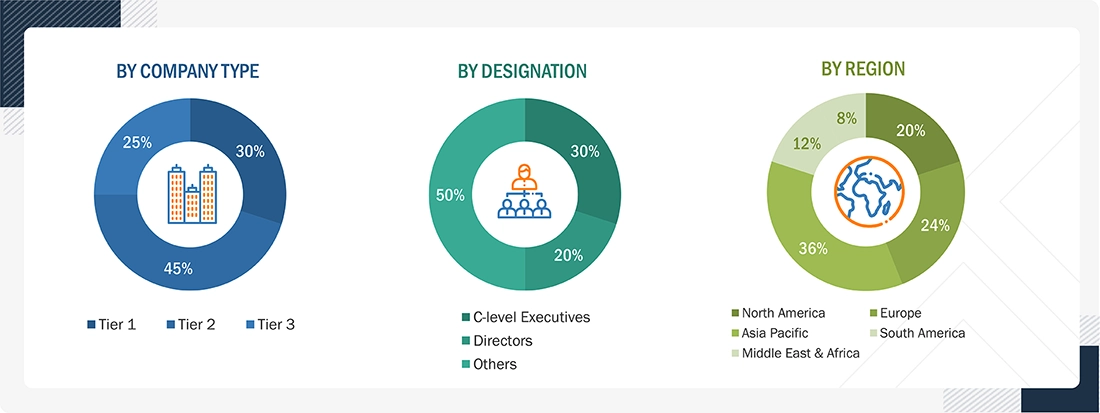
Note: “Others” include sales managers, engineers, and regional managers
The tiers of the companies are defined based on their total revenue as of 2024: Tier 1: >USD 1 billion, Tier 2: USD 500 million–1 billion, and Tier 3: USD 500 million
To know about the assumptions considered for the study, download the pdf brochure
Market Size Estimation
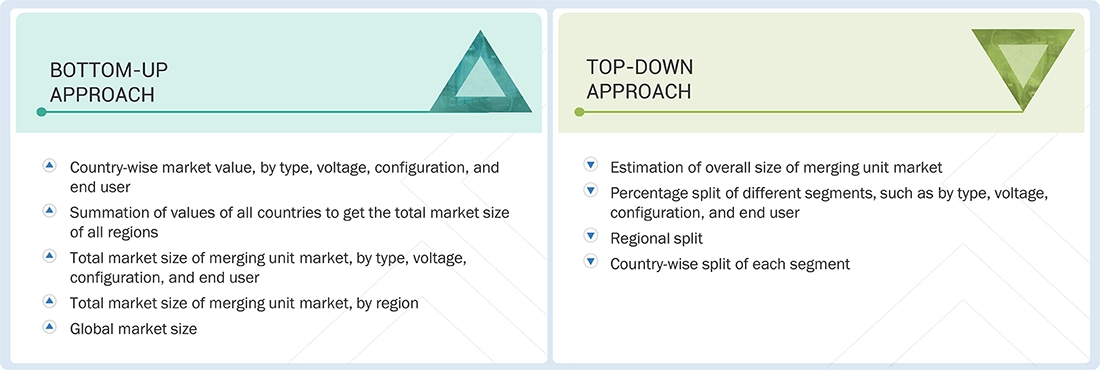
Both the top-down and bottom-up approaches were used to estimate and validate the size of the merging unit market and its dependent submarkets. Key players in the market were identified through secondary research, and their market share in the respective regions was obtained through primary and secondary research. The research methodology includes the study of the annual and financial reports of top market players and interviews with industry experts, such as chief executive officers, vice presidents, directors, sales managers, and marketing executives, for key quantitative and qualitative insights related to the merging unit market.
Merging Unit Market: Top-Down and Bottom-Up Approach
Data Triangulation
After arriving at the overall market size from the estimation process explained above, the total market has been split into several segments and subsegments. To complete the overall market engineering process and arrive at the exact statistics for all the segments and subsegments, the data triangulation and market breakdown processes have been employed, wherever applicable. The data has been triangulated by studying various factors and trends from the demand and supply sides. Along with this, the market has been validated using the top-down and bottom-up approaches.
Market Definition
A merging unit (MU) is a smart electronic unit applied in digital substations to transform analog signals of current transformers (CTs) and voltage transformers (VTs) to digital Sampled Values (SVs) in accordance with IEC 61850 standards. It measures and transmits these measurements to protection relays, control systems, and monitoring equipment using fiber-optic communication, which is digitized, time synchronized, and sent to the relays. A merging unit allows better precision, less installation complexity, and higher dependability of substations by substituting the traditional copper wiring with digital streams of data. It serves as a key interface between primary equipment and secondary systems, allowing the entirely automated, adaptable, and interoperable operations of a grid in a contemporary power network.
Key Stakeholders
- Government & research organizations
- Institutional investors
- Investors/Shareholders
- Environmental research institutes
- Manufacturers’ associations
- Merging unit manufacturers, dealers, and suppliers
- System integrators and EPC contractors
- Organizations, forums, alliances, and associations
- Renewable power generation and equipment manufacturing companies
- Public & private power generation, transmission & distribution companies (utilities)
- Industrial, commercial, and data center owners
- State and national regulatory authorities
- Venture capital firms
Report Objectives
- To describe and forecast the merging unit market, by type, voltage, configuration, and end user, in terms of value
- To describe and forecast the merging unit market for various segments with respect to five main regions: North America, Europe, Asia Pacific, South America, and the Middle East & Africa, in terms of value
- To describe and forecast the merging unit market, by region, in terms of volume
- To provide detailed information regarding drivers, restraints, opportunities, and challenges influencing the growth of the market
- To provide a detailed overview of the merging unit supply chain analysis, use case analysis, key stakeholders and buying criteria, patent analysis, trade analysis, tariff analysis, regulations, macroeconomic outlook, pricing analysis, Porter’s five forces analysis, impact of Gen AI/AI, and the 2024 US tariff impact
- To strategically analyze micromarkets with respect to individual growth trends, prospects, and contributions to the total market
- To analyze opportunities in the market for various stakeholders by identifying high-growth segments
- To strategically profile key players and comprehensively analyze their market position in terms of ranking and core competencies, along with detailing the market’s competitive landscape
- To analyze growth strategies, such as acquisitions, investments, expansions, and product launches, adopted by market players in the merging unit market
Available Customizations:
MarketsandMarkets offers customizations according to the specific needs of the companies with the given market data.
The following customization options are available for the report:
Product Analysis
- Product matrix, which gives a detailed comparison of the product portfolio of each company
Regional Analysis
- Detailed analysis and profiling of additional market players (up to five)
Company Information
- Further breakdown of the Merging Unit, by country
Get the Full Merging Unit Market Report
Full forecast, segment splits, and company analysis for all Merging Unit Market.
- US Merging Unit Market
- Canada Merging Unit Market
- Mexico Merging Unit Market
- UK Merging Unit Market
- Germany Merging Unit Market
- France Merging Unit Market
- Italy Merging Unit Market
- China Merging Unit Market
- Japan Merging Unit Market
- South Korea Merging Unit Market
- India Merging Unit Market
- Brazil Merging Unit Market
- Argentina Merging Unit Market
- Saudi Arabia Merging Unit Market
- UAE Merging Unit Market
- Rest Of Europe Merging Unit Market
- Rest Of Asia Pacific Merging Unit Market
- Rest Of South America Merging Unit Market
- Rest Of GCC Countries Merging Unit Market
Need a Tailored Report?
Customize this report to your needs
Get 10% FREE Customization
Customize This Report
