
Germany Microcars Market (2025-2030)

The Germany Microcars Market was valued at $3692 Million in 2025 and projected to reach to $4889 Million by 2030, representing a compound annual growth rate of 4.1%. Germany's microcars market is poised for steady growth through 2030, driven by urbanization pressures, environmental consciousness, and the need for cost-effective transportation solutions.


| Market Size in | USD 26.32 MN |
| Market Forecast in | |
| CAGR | |
| Forecast Period | |
| Units Considered | Value (USD MN) |
Germany Microcars Market Trends and Insights
- Germany's automotive sector continues to embrace compact vehicle solutions as urbanization and congestion drive demand for efficient, space-saving transportation options.
- In Germany, the microcar segment reflects broader European trends toward sustainability and cost-effective mobility, with manufacturers increasingly focusing on electric and hybrid variants to meet stringent emissions regulations. The German market benefits from strong consumer purchasing power and established infrastructure for alternative fuel vehicles, positioning Germany as a key hub for microcar innovation and adoption.
- Throughout the forecast period from 2025 to 2030, Germany is anticipated to maintain steady growth driven by rising fuel costs, environmental consciousness, and the expansion of smart city initiatives across major urban centers.
- Germany's regulatory environment and technological advancement in the automotive sector further support the expansion of the microcars market during this period..
Key Market Statistics
- CAGR (2025-2030) 4.1% CAGR
- Market Size, 2025 ~USD 3692 Million
- Forecast, 2030 ~USD 4889 Million
- Country Germany
Germany Microcars Market Overview
Urban Congestion Driving Adoption :
Germany's major metropolitan areas including Berlin, Munich, and Frankfurt are experiencing increased traffic congestion, making microcars an attractive solution for last-mile mobility and daily commuting in densely populated regions.
Strong Environmental Regulations :
Germany's stringent emissions standards and commitment to carbon neutrality are accelerating the shift toward electric and fuel-efficient microcars, with manufacturers investing heavily in EV microcar platforms.
Established Automotive Manufacturing Base :
Germany's world-class automotive infrastructure and engineering expertise position it as a key hub for microcar innovation, with both traditional OEMs and emerging startups developing next-generation compact vehicles.
Parking and Infrastructure Advantages :
Limited parking availability in German city centers and the development of dedicated micro-mobility infrastructure are creating favorable conditions for microcar market expansion and consumer acceptance.
Germany Microcars Market Dynamics
- The country's strong regulatory framework promoting electrification will accelerate the adoption of electric microcars, particularly among urban dwellers seeking affordable and sustainable mobility options.
- German manufacturers are increasingly integrating advanced connectivity and autonomous features into microcar platforms, enhancing their appeal to tech-savvy consumers.
- The market will benefit from expanding charging infrastructure and government incentives supporting electric vehicle adoption, positioning Germany as a leading European market for innovative microcar solutions..
Market Ecosystem
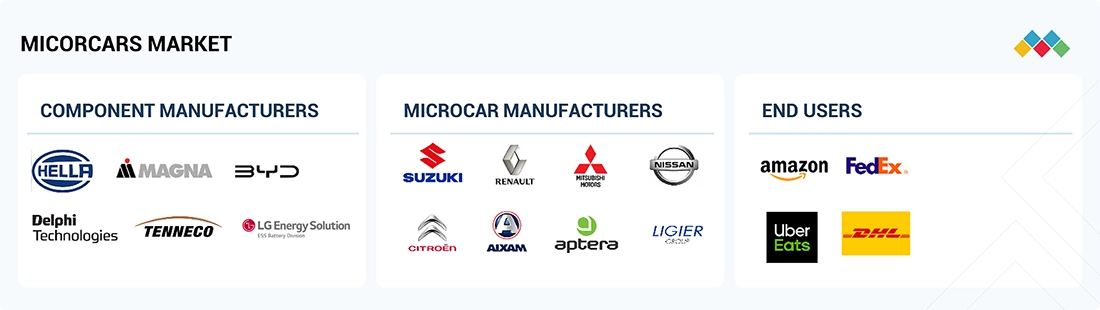
Microcars Market: COMMERCIAL USE CASES ACROSS INDUSTRIES
| COMPANY | USE CASE DESCRIPTION | BENEFITS |
|---|---|---|
 |
Honda has launched a new business unit called Fastport to build a zero-emission electric quadricycle (eQuad) for last-mile logistics. The eQuad is meant for urban deliveries, designed to fit in bike lanes and use swappable batteries and software-defined features, with a “Fleet-as-a-Service” model for customers. | It reduces emissions and congestion in dense urban zones, lowers costs over conventional delivery vans, allows operators to monitor and manage fleets via cloud dashboards, and adapts cargo/size options for varying regional needs. |
 |
INVERS microcars are being integrated into carsharing/shared mobility services to provide an intermediate mobility option between e-scooters and full cars. They examine design, operational, regulatory, and sharing suitability aspects of microcars in urban fleets. | Microcars enable shared mobility providers to deliver car-like comfort at reduced costs and footprint, with improved parking and space efficiency, lower energy use, and possibly fewer licensing restrictions. |
Logos and trademarks shown above are the property of their respective owners. Their use here is for informational and illustrative purposes only.
Related Ecosystem
Automotive Electronics And Electrical Equipment
- Battery Electric Vehicle (BEV)
- Light Commercial Vehicles (LCVs)
- Fuel Cell Electric Vehicle (FCEV)
- Sensors
- Hybrid Electric Vehicle (HEV)
- BOSCH LIMITED
- Continental ag
- DENSO Corporation
- Panasonic Holdings Corporation
- Texas Instruments Incorporated
Electric Hybrid Vehicles
- Battery Electric Vehicle (BEV)
- Fuel Cell Electric Vehicle (FCEV)
- Light Commercial Vehicles (LCVs)
- Hybrid Electric Vehicle (HEV)
- Agricultural Tractors
- Visteon Corporation
- BOSCH LIMITED
- Byd company ltd.
- Tesla, Inc.
- FORD MOTOR COMPANY
Key Takeaways
- Germany's microcars market is projected to grow from USD 3,692 million in 2025 to USD 4,889 million by 2030 at a 4.1% CAGR.
- Germany's strong regulatory focus on emissions reduction and sustainability is driving adoption of electric and hybrid microcars.
- Urban congestion and rising fuel costs in Germany are key factors accelerating demand for compact, efficient microcar solutions.
- Germany's advanced automotive infrastructure and consumer purchasing power position it as a leading European microcar market.
Microcars Market Report Scope
| Report Metric | Details |
|---|---|
| Base Year | 2025 |
| Fastest Growing Segment | COMMERCIAL (End-Use Application) |
| Forecast Period | 2025–2030 |
| Growth Rate | CAGR of 4.2% from 2025 to 2030 |
| Largest Segment | PERSONAL (End-Use Application) |
| Market Size Base Year (Billions) | ~USD 36.74 (2025) |
| Revenue Forecast (Billions) | ~USD 45.13 (2030) |
| Segments Covered | Classification, Propulsion, Category, End-Use Application, Power Output |
Germany Microcars Market Report Segmentation
5 segment dimensions are covered across the global market.
By Classification
- L6
- L7
By Propulsion
- Electric & Hybrid
- ICE
By Category
- A00 Vehicles
- Kei Cars
- Neighborhood Electric Vehicles
- Quadricycles
- Ultra Small Electric Vehicles
By End-Use Application
- Commercial
- Personal
By Power Output
- 26- 40 Kw
- 26-40 Kw
- 26–40 Kw
- 5-25 Kw
- 5–25 Kw
- <5 Kw
- > 40 Kw
- >40 Kw
Target Audience
- Automotive Manufacturers & OEMs : Require detailed Germany market data to develop localized microcar strategies, assess competitive positioning, and identify manufacturing and distribution opportunities in Europe's largest automotive market.
- Investment & Private Equity Firms : Need comprehensive market sizing and growth forecasts for Germany to evaluate investment opportunities in microcar startups, EV platforms, and automotive technology companies targeting this segment.
- Urban Mobility & Fleet Operators : Seek Germany-specific market intelligence to make informed decisions about microcar fleet integration, understand demand patterns, and optimize last-mile delivery and shared mobility solutions.
- Government & Policy Makers : Require market data and trend analysis to develop effective urban mobility policies, incentive programs, and infrastructure investments supporting sustainable microcar adoption across German cities.
- Market Research & Consulting Firms : Need granular Germany market data and forecasts to support client advisory services, competitive benchmarking, and strategic recommendations in the automotive and urban mobility sectors.
Key Companies in the Germany Microcars Market
| Company | HQ | Ownership | Strongest segments |
|---|---|---|---|
| SUZUKI MOTOR CORPORATION | Japan | ||
| HONDA MOTOR CO., LTD. | Japan | ||
| STELLANTIS N.V. | Netherlands | ||
| MITSUBISHI MOTORS CORPORATION | Japan | ||
| DAIHATSU MOTOR CO., LTD. | Japan | Private Company | Kei Cars,A00 Microcars,Neighborhood Electric Vehicles (NEVs), |
| BYD AUTO CO., LTD. | China | Private Company | A00 Micro EVs,Neighborhood Electric Vehicles,Quadricycles and Kei-like formats, |
| RENAULT GROUP | France | Public Company | A00 City Cars (ICE & EV),Quadricycles (L6e/L7e, incl. Mobilize-type),Neighborhood Electric Vehicles (NEVs), |
| ESTRIMA SPA | Italy | Public Company | Electric quadricycles (Birò, <5 and 5-25 kW urban vehicles),Neighborhood Electric Vehicles and corporate/community sharing fleets,Safety cabins for agricultural and industrial vehicles, |
| PMV ELECTRIC PVT. LTD. | India | Private Company | Neighborhood Electric Vehicles (urban personal use),Quadricycle-adjacent commercial and fleet applications,A00-like compact EVs (higher-spec variants), |
SUZUKI MOTOR CORPORATION
Suzuki Motor Corporation is a Japanese automotive manufacturer producing a diverse range of vehicles including cars, motorcycles, and all-terrain vehicles for global markets.
HONDA MOTOR CO., LTD.
Honda Motor Co., Ltd. is a Japanese multinational automotive and engine manufacturer known for producing automobiles, motorcycles, and power equipment.
STELLANTIS N.V.
Stellantis N.V. is a Netherlands-based multinational automotive manufacturing company formed through the merger of major global automakers.
MITSUBISHI MOTORS CORPORATION
Mitsubishi Motors Corporation is a Japanese automaker specializing in the design, manufacture, and sale of automobiles and automotive components.
DAIHATSU MOTOR CO., LTD.
Daihatsu Motor Co., Ltd. is a Japanese automotive manufacturer founded in 1907 with 43,197 employees, specializing in compact and mini vehicles.
BYD AUTO CO., LTD.
BYD Auto Co., Ltd. is a Chinese automotive manufacturer with 1,500 employees specializing in vehicle production.
RENAULT GROUP
Renault Group is a French multinational automotive manufacturer founded in 1898 with 100,541 employees, producing a comprehensive range of vehicles globally.
ESTRIMA SPA
Estrima SPA is an Italian automotive company with 98 employees engaged in vehicle manufacturing and production.
PMV ELECTRIC PVT. LTD.
PMV Electric PVT. Ltd. is an Indian automotive company founded in 2018 specializing in electric vehicle manufacturing.
Reasons to Buy this Report
- Market Size & Growth Validation : Access precise valuation data for Germany's microcar market (USD 3,692M in 2025) with verified 4.1% CAGR projections through 2030, enabling confident investment and expansion decisions.
- Competitive Landscape Intelligence : Understand Germany-specific competitive dynamics, manufacturer strategies, and market positioning to identify opportunities for market entry, partnerships, or product differentiation in this growing segment.
- Regulatory & Policy Insights : Gain detailed analysis of German emissions standards, EV incentives, and urban mobility policies shaping the microcar market, critical for compliance and strategic planning.
- Consumer Behavior & Demand Drivers : Discover Germany-specific consumer preferences, purchasing patterns, and motivations driving microcar adoption in urban centers, informing targeted marketing and product development strategies.
- Regional Growth Opportunities : Identify high-potential German cities and regions with strongest microcar demand, enabling focused market penetration and resource allocation for maximum ROI.
Frequently asked questions
What is the current size of Germany's microcars market?
Germany's microcars market is valued at USD 3,692 million in 2025 and is expected to reach USD 4,889 million by 2030.
What is the growth rate of the microcars market in Germany?
Germany's microcars market is growing at a compound annual growth rate (CAGR) of 4.1% from 2025 to 2030.
What factors are driving growth in Germany's microcars market?
Key drivers in Germany include urbanization, congestion in major cities, rising fuel costs, stringent emissions regulations, and increasing consumer preference for sustainable and cost-effective mobility solutions.
Are electric microcars gaining traction in Germany?
Yes, Germany's strong regulatory environment and advanced automotive infrastructure are accelerating the adoption of electric and hybrid microcars as manufacturers respond to emissions standards and consumer demand for sustainable options.
How does Germany's microcar market compare to other European markets?
Germany is a leading European microcar market due to its strong consumer purchasing power, established alternative fuel infrastructure, technological innovation, and stringent environmental regulations that favor compact, efficient vehicles.
RESEARCH METHODOLOGY
The study encompassed four primary tasks to determine the present and future scope of the microcars market. Initially, extensive secondary research was conducted to gather data on the market, its related sectors, and overarching industries. Subsequently, primary research involving industry experts across the supply chain corroborated and validated these findings and assumptions. The complete market size was estimated by using both top-down and bottom-up methodologies. Following this, a market breakdown and data triangulation approach were utilized to determine the size of specific segments and subsegments within the market.
Secondary Research
The secondary sources referred to were the company's annual reports/presentations, industry association publications, directories, technical handbooks, World Economic Outlook, technical articles, and databases, which were used to identify and collect information for an extensive study of the microcars market. The secondary sources used while estimating the market sizing are the Japan Automobile Manufacturers Association, China Association of Automobile Manufacturers, and corporate filings (such as annual reports, investor presentations, and financial statements). Secondary data was collected and analyzed to determine the overall market size, further validated through primary research. The primary sources—experts from related industries and OEMs—were interviewed to obtain and verify critical information and assess prospects and market estimations. Historical sales data was collected and analyzed, and the industry trend was considered to arrive at the forecast, which was further validated by primary research.
Primary Research
In the primary research process, various primary sources from both the supply and demand sides were interviewed to obtain qualitative and quantitative information on the market. The primary sources from the supply side included various industry experts, such as CXOs, vice presidents, directors from business development, marketing, product development/innovation teams, and related key executives from various key companies. Various system integrators, industry associations, independent consultants/industry veterans, and key opinion leaders were also interviewed.
Primary interviews were conducted to gather insights such as sizing estimates on the microcars market and forecast, future technology trends, and upcoming technologies in the microcars market. Data triangulation of all these points was done using the information gathered from secondary research and model mapping. Stakeholders from the demand and supply sides were interviewed to understand their views on the abovementioned points.
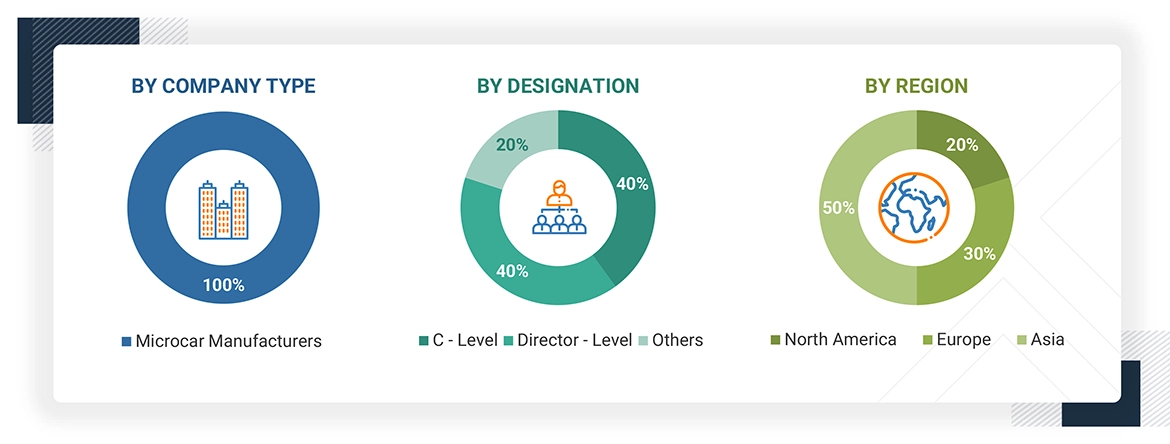
Note 1: Others include sales managers, marketing managers, and product managers.
Note 2: Tier 1 companies’ revenues are more than USD 10 billion; tier 2 companies’ revenues range between USD 1 and 10 billion; and tier 3 companies’ revenues range between USD 500 million and USD 1 billion.
Source: Industry Experts
To know about the assumptions considered for the study, download the pdf brochure
Market Size Estimation
As mentioned below, a detailed market estimation approach was followed to estimate and validate the value of the microcars market and other dependent submarkets.
- The bottom-up approach was used to estimate and validate the microcars market size. The microcars market size, by power output and by country, was derived by mapping the historical sales of different microcars at the country level. These data points were largely fetched from country-level associations, paid repositories, and OEM data excerpts. The sales forecast for microcar categories was based on factors such as country-wise macroeconomic indicators, emission regulations, automotive industry growth, GDP growth, growth in urbanization, growth in the share mobility business, and government initiatives. The market size, by value, was derived by multiplying the microcar-wise average selling price with the respective sales volumes of vehicles calculated in units. Each country’s/region’s total volume and value were then summed up to reveal the total volume of the global microcars market for each power output segment. The data was validated through primary interviews with industry experts.
- The market data gathered was consolidated, enhanced with detailed inputs, analyzed, and presented in this report.
Microcars Market : Top-Down and Bottom-Up Approach

Data Triangulation
All percentage shares, splits, and breakdowns were determined using secondary sources and verified by primary sources. All parameters that affect the markets covered in this research study were accounted for, viewed in extensive detail, and analyzed to obtain the final quantitative and qualitative data. This data was consolidated and enhanced with detailed inputs and analysis from MarketsandMarkets and presented in the report.
Market Definition
- Kei cars: According to the Japan Automobile Standards Internationalization Centre, Kei cars are also referred to as Japanese city cars, ultra mini cars, or Japanese microcars. They are the smallest highway-legal passenger cars with restricted dimensions and engine capacity.
- Ultra microelectric cars: Ultra microelectric cars are a class of enclosed vehicles that are smaller than conventional cars. Microelectric cars or new energy vehicles (NEVs), also known as micro EVs, are small electric vehicles that are designed for short-range travel in urban areas. Micro EVs can often be categorized as quadricycles or tricycles, depending on the number of wheels.
- A00 cars: A00 category cars in China refer to micro-sized passenger vehicles, primarily electric, with a wheelbase of 2.0–2.3 meters and seating for fewer than four passengers. These vehicles are designed for short-distance commuting.
- Neighborhood electric vehicles: According to the US Department of Energy, an NEV is defined as a four-wheeled electric vehicle that has a maximum speed greater than 20 miles per hour (mph) but not more than 25 mph.
- Quadricycles (India): The vehicle should be the size of a three-wheeler but with four tires and fully covered like a car. It has an engine like that of a three-wheeler. It must have a curb weight of < 475 kg and pass safety and crash-test norms and clear emissions tests based on the powertrain.
- Quadricycles (Europe): The European microcars are known as quadricycles and are categorized into L6 and L7 categories. L6 is a light quadricycle, and L7 is a heavy quadricycle. The L6 category cars have four wheels, two seats, and a power output of 6kW. The L7 category cars have four wheels, a maximum of four seats, and a power output of 15kW.
Stakeholders
- Microcar manufacturers
- Tier 1 companies (Component suppliers)
- Battery, motor, and other electric component suppliers
- Rental service providers
- Raw material suppliers for microcar component/system manufacturers
- Consulting companies
- On highway-vehicle safety regulatory bodies
- Government and research institutions
- On-highway associations
Report Objectives
-
To define, describe, and forecast the size of the microcars market in terms of value (USD million) and volume (units) based on
- By category (Kei cars and ultra micro electric vehicles, quadricycles, neighborhood electric vehicles, and A00 vehicles)
- Kei cars and ultra micro electric vehicles by propulsion (ICE and electric/hybrid)
- Quadricycles by propulsion (ICE and electric/hybrid)
- By end-use application (Personal and commercial)
- By power output (Below 5 kW, 5-15 kW, and above 15 kW)
- By Region (Asia, Europe, and North America)
- To understand the market dynamics (drivers, restraints, opportunities, and challenges) of the market
- To analyze the market share of leading players operating in the market and their evaluation matrix
- To strategically analyze the key player strategies and company revenue analysis
-
To study the following with respect to the market
- Trends/Disruptions impacting the microcars market
- Market ecosystem
- Technology analysis
- Supply chain analysis
- Patent analysis
- Regulatory landscape
- Case study analysis
- Key stakeholders and buying criteria
- Key conferences and events
- Pricing analysis by key players and by key regions
- Macroeconomic outlook
- Company valuation and financial metrics
- Brand and product comparison
- OEM analysis
- Market share analysis
- To strategically profile key players and comprehensively analyze their respective market share and core competencies
- To analyze recent developments, including product launches and deals, among others, undertaken by key players in the market
- To understand the dynamics of key players and evaluate the company evaluation matrix
- To analyze the opportunities offered by various market segments to its stakeholders
To provide a brief understanding of the core business segments in the microcars market in the recommendations chapter and how key stakeholders in the business will benefit from the available opportunities
Available Customizations
Microcars Market, by Seating Capacity
- 2-seater
- 4-seater
Note: Each seating capacity will be further analyzed for countries considered under the study scope of the report.
Microcars Market, By Drive Type
- 2WD
- AWD
Note: Each drive type will be further analyzed for countries considered under the study scope of the report.
Get the Full Microcars Market Report
Full forecast, segment splits, and company analysis for all Microcars Market.
Need a Tailored Report?
Customize this report to your needs
Get 10% FREE Customization
Customize This Report
