
Europe Microsampling Devices Market (2024-2029)

The Europe Microsampling Devices Market was valued at $12.91 Million in 2024 and projected to reach to $19.41 Million by 2029, representing a compound annual growth rate of 8.5%. Europe's microsampling devices market is positioned for sustained growth, expanding from $12.91 million in 2024 to $19.41 million by 2029 at an 8.5% CAGR, outpacing the global growth rate of 7.6%.


| Market Size in | USD 26.32 MN |
| Market Forecast in | |
| CAGR | |
| Forecast Period | |
| Units Considered | Value (USD MN) |
Europe Microsampling Devices Market Trends and Insights
- This expansion reflects Europe's strong healthcare infrastructure, regulatory support for minimally invasive diagnostics, and increasing adoption of point-of-care testing solutions across the region.
- Europe's emphasis on patient-centric care and advanced laboratory capabilities is driving demand for microsampling technologies that reduce sample volumes while maintaining diagnostic accuracy. The European market benefits from stringent quality standards, established reimbursement frameworks, and a growing focus on personalized medicine.
- Europe's pharmaceutical and clinical research sectors are increasingly integrating microsampling devices into their workflows, supported by regulatory bodies that recognize the clinical and operational advantages of these technologies.
- The 8.5% compound annual growth rate through 2029 underscores Europe's commitment to modernizing diagnostic and sampling methodologies across healthcare systems..
Key Market Statistics
- CAGR (2024-2029) 8.5% CAGR
- Market Size, 2024 ~USD 12.91 Million
- Forecast, 2029 ~USD 19.41 Million
- Geography Europe
Europe Microsampling Devices Market Overview
Market Leadership :
Germany dominates Europe's microsampling devices market with $13.97 million in market size, driven by advanced healthcare infrastructure and strong pharmaceutical R&D capabilities across the region.
Regulatory Support :
European regulatory bodies actively support minimally invasive diagnostic technologies, creating a favorable environment for microsampling device adoption and innovation across member states.
Point-of-Care Expansion :
Increasing adoption of point-of-care testing solutions across European healthcare systems is accelerating microsampling device deployment in clinical laboratories and decentralized testing settings.
Patient-Centric Care :
Europe's strong emphasis on patient-centric healthcare models is driving demand for less invasive sampling methods that improve patient comfort and compliance with diagnostic procedures.
Europe Microsampling Devices Market Dynamics
- This acceleration is fueled by robust healthcare infrastructure, stringent quality standards, and widespread adoption of minimally invasive diagnostic technologies across the continent. Key growth drivers include increasing healthcare expenditure, rising prevalence of chronic diseases requiring frequent monitoring, and regulatory initiatives promoting innovative diagnostic solutions.
- European countries are investing heavily in point-of-care testing infrastructure and personalized medicine, creating substantial opportunities for microsampling device manufacturers.
- The region's commitment to healthcare digitalization and patient empowerment further supports market expansion through 2029..
Market Ecosystem
Related Ecosystem
Key Takeaways
- Europe's microsampling devices market is valued at $12.91 million in 2024 and is forecast to reach $19.41 million by 2029, representing an 8.5% CAGR.
- Europe's regulatory environment and reimbursement policies strongly support adoption of minimally invasive microsampling technologies across clinical and research settings.
- Europe's pharmaceutical and clinical research sectors are primary growth drivers, leveraging microsampling for improved patient compliance and reduced sample contamination.
- Europe's healthcare systems prioritize personalized medicine and point-of-care diagnostics, creating sustained demand for innovative microsampling solutions through 2029.
Microsampling Devices Market Report Scope
| Report Metric | Details |
|---|---|
| Base Year | 2024 |
| Fastest Growing Segment | LANCETS (Product) |
| Forecast Period | 2024-2029 |
| Growth Rate | CAGR of 7.6% from 2024 to 2029 |
| Largest Segment | SINGLE-USE BLOOD COLLECTION DEVICES (Usability) |
| Market Size Base Year (Billions) | ~USD 0.09 (2024) |
| Revenue Forecast (Billions) | ~USD 0.14 (2029) |
| Segments Covered | Product, Sample Type, Collection Method, Device Type, Usability, Application |
Europe Microsampling Devices Market Report Segmentation
6 segment dimensions are covered across the global market.
By Product
- Dbs Collection Kits
- Fingerstick Blood Collection Kits
- Lancets
- Other Products
By Sample Type
- Dried Blood Samples
- Liquid Blood Samples
By Collection Method
- Fingerstick
- Other Methods
- Push-Button
By Device Type
- Professional Collection Devices
- Self-Collection Devices
By Usability
- Reusable Blood Collection Devices
- Single-Use Blood Collection Devices
By Application
- Clinical Trials & Research
- Disease Diagnostics
- Health Screening & Preventive Health
- Other Applications
EUROPE: AT-HOME BLOOD COLLECTION DEVICES MARKET, BY APPLICATION, 2022–2029
| Segment | 2022 | 2023 | 2024 | 2025 | 2026 | 2027 | 2028 | 2029 | CAGR (%) |
|---|---|---|---|---|---|---|---|---|---|
| CLINICAL TRIALS & RESEARCH | 5.18 | 5.3 | 5.45 | 5.65 | 5.91 | 6.26 | 6.7 | 7.26 | 5.9 |
| DISEASE DIAGNOSTICS | 6.87 | 7.1 | 7.38 | 7.73 | 8.16 | 8.72 | 9.42 | 10.29 | 6.9 |
| HEALTH SCREENING & PREVENTIVE HEALTH | 12.08 | 12.66 | 13.34 | 14.17 | 15.18 | 16.47 | 18.06 | 20.05 | 8.5 |
| OTHER APPLICATIONS | 1.34 | 1.36 | 1.39 | 1.44 | 1.49 | 1.57 | 1.67 | 1.8 | 5.2 |
| TOTAL | 25.47 | 26.42 | 27.55 | 28.98 | 30.75 | 33.02 | 35.85 | 39.39 | 7.4 |
REST OF EUROPE: AT-HOME BLOOD COLLECTION DEVICES MARKET, BY APPLICATION, 2022–2029
| Segment | 2022 | 2023 | 2024 | 2025 | 2026 | 2027 | 2028 | 2029 | CAGR (%) |
|---|---|---|---|---|---|---|---|---|---|
| CLINICAL TRIALS & RESEARCH | 0.92 | 0.95 | 1 | 1.05 | 1.11 | 1.19 | 1.29 | 1.42 | 7.4 |
| DISEASE DIAGNOSTICS | 1.1 | 1.16 | 1.23 | 1.3 | 1.4 | 1.52 | 1.67 | 1.85 | 8.6 |
| HEALTH SCREENING & PREVENTIVE HEALTH | 2.01 | 2.13 | 2.28 | 2.46 | 2.67 | 2.94 | 3.28 | 3.69 | 10.1 |
| OTHER APPLICATIONS | 0.21 | 0.21 | 0.22 | 0.23 | 0.24 | 0.26 | 0.28 | 0.31 | 6.8 |
| TOTAL | 4.24 | 4.46 | 4.72 | 5.04 | 5.43 | 5.92 | 6.52 | 7.28 | 9 |
Target Audience
- Medical Device Manufacturers : Manufacturers need detailed European market data to develop localized product strategies, understand regulatory requirements, and identify high-growth country markets for expansion.
- Healthcare Providers : Hospitals and diagnostic laboratories require market insights to evaluate microsampling technology adoption, assess vendor options, and optimize point-of-care testing infrastructure investments.
- Pharmaceutical Companies : Pharma firms need market intelligence to support clinical trial designs, patient monitoring programs, and partnerships with microsampling device providers across European markets.
- Investment & Private Equity : Investors require comprehensive market analysis to identify acquisition targets, assess growth potential, and make informed funding decisions in Europe's expanding diagnostic devices sector.
- Healthcare Consultants : Consulting firms need regional market data to advise clients on healthcare technology adoption, competitive positioning, and strategic planning within European diagnostic markets.
Countries within Europe - compare and drill down
| Country | 2025 size (native) |
|---|---|
| Germany | USD 13.97 Million |
| UK | USD 5.42 Million |
| France | USD 3.21 Million |
| Italy | USD 1.66 Million |
| Spain | USD 1.35 Million |
| Rest Of Europe | USD 3.75 Million |
Country market size visualization
Reasons to Buy this Report
- Regional Market Segmentation : Detailed breakdown of Europe's microsampling market by country, including Germany ($13.97M), UK ($5.42M), and France ($3.21M), enabling targeted market entry strategies.
- Growth Trajectory Insights : Comprehensive analysis of the 8.5% CAGR growth trajectory through 2029, identifying emerging opportunities and market dynamics specific to European healthcare systems.
- Regulatory Landscape : In-depth understanding of European regulatory frameworks supporting microsampling device adoption, including CE marking requirements and compliance pathways across member states.
- Competitive Positioning : Strategic intelligence on competitive dynamics within Europe's microsampling market, helping stakeholders identify differentiation opportunities and market gaps.
- Investment Decision Support : Data-driven insights for investment decisions, partnership development, and market expansion planning within Europe's high-growth diagnostic devices sector.
Frequently asked questions
What is the current market size of microsampling devices in Europe?
Europe's microsampling devices market was valued at $12.91 million in 2024 and is expected to grow to $19.41 million by 2029.
What is the projected growth rate for Europe's microsampling devices market?
Europe's microsampling devices market is projected to grow at a compound annual growth rate (CAGR) of 8.5% from 2024 to 2029.
Which sectors are driving growth in Europe's microsampling devices market?
Europe's pharmaceutical research, clinical diagnostics, and personalized medicine sectors are primary drivers, supported by regulatory frameworks and reimbursement policies that favor minimally invasive sampling technologies.
How do regulatory standards impact Europe's microsampling devices market?
Europe's stringent quality standards and established regulatory pathways facilitate market adoption, while reimbursement frameworks encourage healthcare providers and research institutions to integrate microsampling solutions into their operations.
What advantages do microsampling devices offer in Europe's healthcare systems?
In Europe, microsampling devices reduce sample volumes, improve patient compliance, minimize contamination risks, and support point-of-care testing initiatives aligned with the region's focus on personalized and efficient healthcare delivery.
RESEARCH METHODOLOGY
The objective of the study is to analyze the key market dynamics, such as drivers, opportunities, restraints, challenges, and key player strategies. To track company developments such as acquisitions, product launches, expansions, agreements, and partnerships of the leading players, the competitive landscape of the at-home blood collection devices market to analyze market players on various parameters within the broad categories of business and product strategy. Top-down and bottom-up approaches were used to estimate the market size. To estimate the market size of segments and subsegments, the market breakdown and data triangulation were used.
The four steps involved in estimating the market size are
Secondary Research
In the secondary research process, various secondary sources such as annual reports, press releases & investor presentations of companies, white papers, certified publications, articles by recognized authors, gold-standard & silver-standard websites, regulatory bodies, and databases (such as D&B Hoovers, Bloomberg Business, and Factiva) were referred to identify and collect information for this study.
Primary Research
In the primary research process, various sources from both the supply and demand sides were interviewed to obtain qualitative and quantitative information for this report. Primary sources were mainly industry experts from the core and related industries and preferred suppliers, manufacturers, distributors, service providers, technology developers, researchers, and organizations related to all segments of this industry’s value chain. In-depth interviews were conducted with various primary respondents, including key industry participants, subject-matter experts, C-level executives of key market players, and industry consultants, to obtain and verify critical qualitative and quantitative information as well as assess prospects.
The following is a breakdown of the primary respondents:
Breakdown Of Primary Participants:
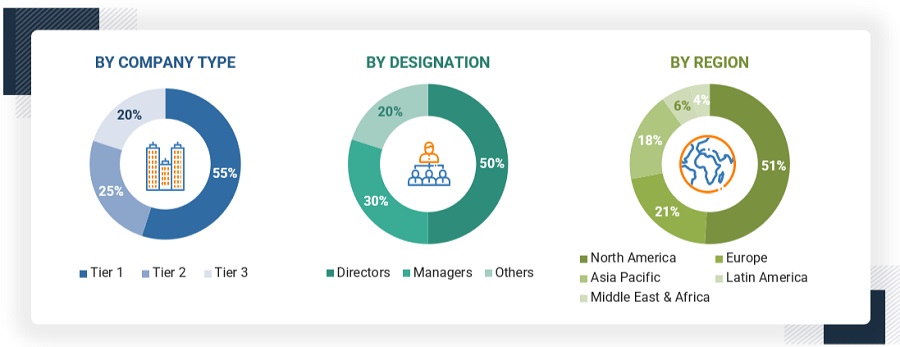
Note 1: Others include sales managers, marketing managers, and product managers.
Note 2: Companies are classified into tiers based on their total revenues. As of 2023, Tier 1 = >USD 100 million, Tier 2 = USD 10 million to USD 100 million, and Tier 3 = <USD 10 million.
To know about the assumptions considered for the study, download the pdf brochure
|
COMPANY NAME |
DESIGNATION |
|
YourBio Health |
Sales Executive |
|
Capitainer |
Sales Executive |
Market Size Estimation
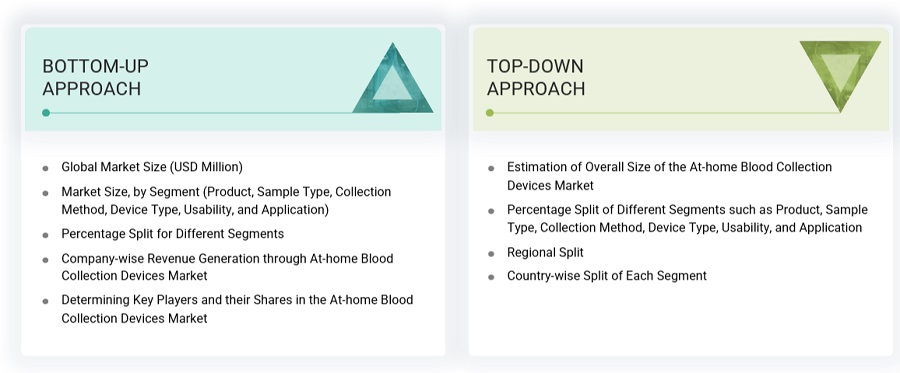
Both top-down and bottom-up approaches were used to estimate and validate the at-home blood collection devices market's total size. These methods were also used extensively to estimate the size of various subsegments in the market. The research methodology used to estimate the market size includes the following:
- The key players in the industry have been identified through extensive secondary research
- The revenues generated by leading players operating in the at-home blood collection devices market have been determined through primary and secondary research.
- All percentage shares, splits, and breakdowns have been determined using secondary sources and verified through primary sources.
Global At-home blood collection Devices Market Size: Bottom Up Approach
To know about the assumptions considered for the study, Request for Free Sample Report
Data Triangulation
After arriving at the overall market size by applying the process mentioned above, the total market was split into several segments and subsegments. To complete the overall market engineering process and arrive at the exact statistics for all segments and subsegments, data triangulation and market breakdown procedures were employed, wherever applicable. The data was triangulated by studying various factors and trends from both the demand and supply sides.
Market Definition
At-home blood collection devices are tools designed to allow individuals or professionals to collect small blood samples from home care settings. These devices are easy to use and minimally invasive, making them suitable for various applications.
Key Stakeholders
- Senior Management
- End User
- R&D Department
Report Objectives
- To define, describe, segment, and forecast the at-home blood collection devices market, by product, sample type, collection method, device type, usability, application, and region
- To provide detailed information regarding the major factors influencing the market growth (drivers, restraints, opportunities, and challenges)
- To analyze micromarkets1 with respect to individual growth trends, prospects, and contributions to the overall market
- To analyze market opportunities for stakeholders and provide details of the competitive landscape for key players
- To forecast the size of the market segments in six regions: North America, Europe, the Asia Pacific, Middle East & Africa, Latin America, and GCC countries
- To profile the key players and comprehensively analyze their product portfolios, market positions, and core competencies
- To track and analyze company developments such as acquisitions, collaborations, partnerships, agreements, and product launches & approvals in the at-home blood collection devices market
- To benchmark players within the at-home blood collection devices market using the Company Evaluation Matrix framework, which analyzes market players on various parameters within the broad categories of business strategy, market share, and product offerings
Available Customizations
MarketsandMarkets offers the following customizations for this market report.
Country Information
- Additional country-level analysis of the at-home blood collection devices market
Company profiles
- Additional five company profiles of players operating in the at-home blood collection devices market.
Product Analysis
- Product matrix, which provides a detailed comparison of the product portfolio of each company in the at-home blood collection devices market
Get the Full Microsampling Devices Market Report
Full forecast, segment splits, and company analysis for all Microsampling Devices Market.
- US Microsampling Devices Market
- Canada Microsampling Devices Market
- Germany Microsampling Devices Market
- UK Microsampling Devices Market
- France Microsampling Devices Market
- Italy Microsampling Devices Market
- Spain Microsampling Devices Market
- China Microsampling Devices Market
- Japan Microsampling Devices Market
- India Microsampling Devices Market
- Brazil Microsampling Devices Market
- Mexico Microsampling Devices Market
- Rest Of Europe Microsampling Devices Market
- Rest Of Asia Pacific Microsampling Devices Market
- Rest Of Latin America Microsampling Devices Market
Need a Tailored Report?
Customize this report to your needs
Get 10% FREE Customization
Customize This Report
