
Rest Of Asia Pacific Microsampling Devices Market (2024-2029)

The Rest Of Asia Pacific Microsampling Devices Market was valued at $2.2 Million in 2024 and projected to reach to $3.4 Million by 2029, representing a compound annual growth rate of 9.8%. The Rest Of Asia Pacific microsampling devices market is positioned for sustained growth through 2029, driven by expanding healthcare accessibility and technological adoption across emerging economies in the region.


| Market Size in | USD 26.32 MN |
| Market Forecast in | |
| CAGR | |
| Forecast Period | |
| Units Considered | Value (USD MN) |
Rest Of Asia Pacific Microsampling Devices Market Trends and Insights
- Rest Of Asia Pacific represents a dynamic segment within the broader Asia Pacific region, driven by increasing adoption of minimally invasive diagnostic techniques and rising healthcare infrastructure investments.
- The region's microsampling devices market is benefiting from growing demand for point-of-care testing and decentralized diagnostics across emerging economies. Rest Of Asia Pacific's microsampling devices sector is expanding at a compound annual growth rate (CAGR) of 9.8%, outpacing global trends and reflecting strong regional momentum.
- Rest Of Asia Pacific's market growth is supported by improving healthcare accessibility, rising patient awareness, and technological advancements in sampling methodologies.
- The forecast period through 2029 indicates sustained expansion as Rest Of Asia Pacific continues to modernize its diagnostic capabilities and embrace innovative sampling solutions..
Key Market Statistics
- CAGR (2024-2029) 9.8% CAGR
- Market Size, 2024 ~USD 2.2 Million
- Forecast, 2029 ~USD 3.4 Million
- Country Rest Of Asia Pacific
Rest Of Asia Pacific Microsampling Devices Market Overview
Strong Regional Growth Trajectory :
Rest Of Asia Pacific microsampling devices market is expanding at 9.8% CAGR, outpacing the global average of 7.6%, indicating accelerating regional adoption and market maturation.
Minimally Invasive Diagnostic Adoption :
Increasing preference for less invasive sampling techniques across Rest Of Asia Pacific countries is driving demand for microsampling devices in clinical diagnostics and patient monitoring applications.
Healthcare Infrastructure Investment :
Rising government and private sector investments in healthcare infrastructure across Rest Of Asia Pacific nations are creating favorable conditions for microsampling device deployment and market expansion.
Market Valuation Growth :
Market size is projected to grow from $2.2 million in 2024 to $3.4 million by 2029, representing a 54.5% increase over the five-year forecast period in Rest Of Asia Pacific.
Rest Of Asia Pacific Microsampling Devices Market Dynamics
- Increasing awareness of minimally invasive diagnostic benefits, coupled with improving reimbursement policies and healthcare spending, will accelerate market penetration.
- The region's younger demographic profile and rising chronic disease prevalence create significant demand drivers for efficient sampling solutions. Key growth catalysts include strengthening regulatory frameworks, growing pharmaceutical and biotech research activities, and expanding point-of-care testing infrastructure.
- Investment in healthcare digitalization and remote patient monitoring capabilities will further enhance microsampling device adoption.
- Rest Of Asia Pacific's competitive advantage lies in cost-effective manufacturing and rising local healthcare innovation, positioning the region as a critical growth engine within the broader Asia Pacific microsampling market landscape..
Market Ecosystem
Related Ecosystem
Key Takeaways
- Rest Of Asia Pacific's microsampling devices market is valued at $2.2 million in 2024 and is forecast to reach $3.4 million by 2029.
- Rest Of Asia Pacific is growing at a 9.8% CAGR, demonstrating accelerated adoption compared to global market trends.
- Rest Of Asia Pacific's market expansion is driven by increased healthcare infrastructure investment and demand for minimally invasive diagnostics.
- Rest Of Asia Pacific's growth trajectory through 2029 reflects rising patient awareness and technological innovation in sampling solutions.
Microsampling Devices Market Report Scope
| Report Metric | Details |
|---|---|
| Base Year | 2024 |
| Fastest Growing Segment | LANCETS (Product) |
| Forecast Period | 2024-2029 |
| Growth Rate | CAGR of 7.6% from 2024 to 2029 |
| Largest Segment | SINGLE-USE BLOOD COLLECTION DEVICES (Usability) |
| Market Size Base Year (Billions) | ~USD 0.09 (2024) |
| Revenue Forecast (Billions) | ~USD 0.14 (2029) |
| Segments Covered | Product, Sample Type, Collection Method, Device Type, Usability, Application |
Rest Of Asia Pacific Microsampling Devices Market Report Segmentation
6 segment dimensions are covered across the global market.
By Product
- Dbs Collection Kits
- Fingerstick Blood Collection Kits
- Lancets
- Other Products
By Sample Type
- Dried Blood Samples
- Liquid Blood Samples
By Collection Method
- Fingerstick
- Other Methods
- Push-Button
By Device Type
- Professional Collection Devices
- Self-Collection Devices
By Usability
- Reusable Blood Collection Devices
- Single-Use Blood Collection Devices
By Application
- Clinical Trials & Research
- Disease Diagnostics
- Health Screening & Preventive Health
- Other Applications
Target Audience
- Medical Device Manufacturers : Manufacturers seeking to expand microsampling device portfolios in Rest Of Asia Pacific need regional market data to assess growth potential, identify distribution channels, and develop localized product strategies.
- Healthcare System Operators : Hospital networks and diagnostic centers in Rest Of Asia Pacific require market intelligence to evaluate microsampling technology adoption, procurement planning, and integration with existing diagnostic workflows.
- Pharmaceutical and Biotech Companies : Pharma and biotech firms conducting clinical trials and research in Rest Of Asia Pacific need microsampling market insights to optimize patient recruitment, sampling protocols, and trial site infrastructure planning.
- Healthcare Investors and Consultants : Investment firms and management consultants evaluating healthcare opportunities in Rest Of Asia Pacific require detailed market analysis to assess portfolio companies, identify acquisition targets, and guide strategic recommendations.
- Government and Healthcare Policy Makers : Healthcare authorities and policy makers in Rest Of Asia Pacific nations need market data to inform diagnostic infrastructure planning, reimbursement policy development, and healthcare technology adoption initiatives.
Reasons to Buy this Report
- Regional Market Differentiation : Gain specific insights into Rest Of Asia Pacific dynamics distinct from broader Asia Pacific trends, enabling targeted market entry and localized strategy development for this high-growth segment.
- Competitive Intelligence : Understand regional competitive landscape, local player strategies, and market consolidation patterns specific to Rest Of Asia Pacific to identify partnership and acquisition opportunities.
- Growth Opportunity Identification : Identify emerging sub-markets and application areas within Rest Of Asia Pacific where microsampling adoption is accelerating, enabling first-mover advantages in underserved segments.
- Investment Decision Support : Access validated market sizing and forecasts for Rest Of Asia Pacific to support capital allocation decisions, business case development, and investor presentations with regional specificity.
- Regulatory and Market Access Insights : Understand Rest Of Asia Pacific-specific regulatory requirements, reimbursement frameworks, and healthcare infrastructure conditions essential for successful market entry and commercialization planning.
Frequently asked questions
What is the current market size of microsampling devices in Rest Of Asia Pacific?
Rest Of Asia Pacific's microsampling devices market was valued at $2.2 million in 2024 and is expected to grow to $3.4 million by 2029.
What is the projected growth rate for Rest Of Asia Pacific's microsampling devices market?
Rest Of Asia Pacific's microsampling devices market is projected to grow at a CAGR of 9.8% from 2024 to 2029.
What factors are driving growth in Rest Of Asia Pacific's microsampling devices market?
Rest Of Asia Pacific's market growth is driven by increasing healthcare infrastructure investments, rising demand for point-of-care testing, improved diagnostic accessibility, and technological advancements in sampling methodologies.
How does Rest Of Asia Pacific's growth compare to the global microsampling devices market?
Rest Of Asia Pacific is growing at 9.8% CAGR, which exceeds the global market CAGR of 7.6%, indicating stronger regional momentum and adoption.
What is the forecast market size for Rest Of Asia Pacific by 2029?
Rest Of Asia Pacific's microsampling devices market is forecast to reach $3.4 million by 2029, representing a $1.2 million increase from 2024 levels.
RESEARCH METHODOLOGY
The objective of the study is to analyze the key market dynamics, such as drivers, opportunities, restraints, challenges, and key player strategies. To track company developments such as acquisitions, product launches, expansions, agreements, and partnerships of the leading players, the competitive landscape of the at-home blood collection devices market to analyze market players on various parameters within the broad categories of business and product strategy. Top-down and bottom-up approaches were used to estimate the market size. To estimate the market size of segments and subsegments, the market breakdown and data triangulation were used.
The four steps involved in estimating the market size are
Secondary Research
In the secondary research process, various secondary sources such as annual reports, press releases & investor presentations of companies, white papers, certified publications, articles by recognized authors, gold-standard & silver-standard websites, regulatory bodies, and databases (such as D&B Hoovers, Bloomberg Business, and Factiva) were referred to identify and collect information for this study.
Primary Research
In the primary research process, various sources from both the supply and demand sides were interviewed to obtain qualitative and quantitative information for this report. Primary sources were mainly industry experts from the core and related industries and preferred suppliers, manufacturers, distributors, service providers, technology developers, researchers, and organizations related to all segments of this industry’s value chain. In-depth interviews were conducted with various primary respondents, including key industry participants, subject-matter experts, C-level executives of key market players, and industry consultants, to obtain and verify critical qualitative and quantitative information as well as assess prospects.
The following is a breakdown of the primary respondents:
Breakdown Of Primary Participants:
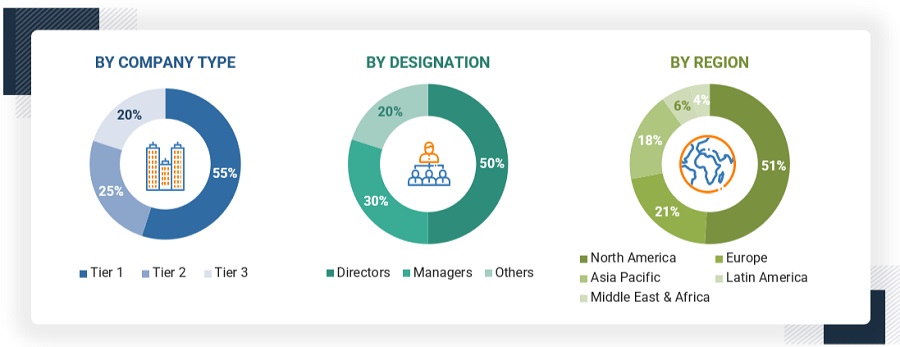
Note 1: Others include sales managers, marketing managers, and product managers.
Note 2: Companies are classified into tiers based on their total revenues. As of 2023, Tier 1 = >USD 100 million, Tier 2 = USD 10 million to USD 100 million, and Tier 3 = <USD 10 million.
To know about the assumptions considered for the study, download the pdf brochure
|
COMPANY NAME |
DESIGNATION |
|
YourBio Health |
Sales Executive |
|
Capitainer |
Sales Executive |
Market Size Estimation
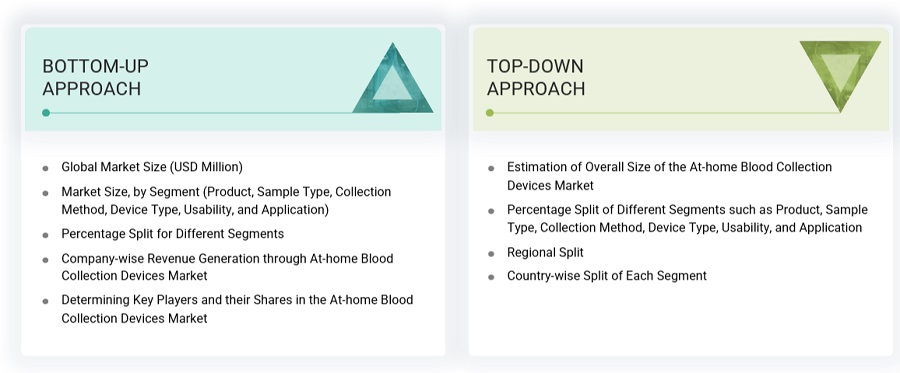
Both top-down and bottom-up approaches were used to estimate and validate the at-home blood collection devices market's total size. These methods were also used extensively to estimate the size of various subsegments in the market. The research methodology used to estimate the market size includes the following:
- The key players in the industry have been identified through extensive secondary research
- The revenues generated by leading players operating in the at-home blood collection devices market have been determined through primary and secondary research.
- All percentage shares, splits, and breakdowns have been determined using secondary sources and verified through primary sources.
Global At-home blood collection Devices Market Size: Bottom Up Approach
To know about the assumptions considered for the study, Request for Free Sample Report
Data Triangulation
After arriving at the overall market size by applying the process mentioned above, the total market was split into several segments and subsegments. To complete the overall market engineering process and arrive at the exact statistics for all segments and subsegments, data triangulation and market breakdown procedures were employed, wherever applicable. The data was triangulated by studying various factors and trends from both the demand and supply sides.
Market Definition
At-home blood collection devices are tools designed to allow individuals or professionals to collect small blood samples from home care settings. These devices are easy to use and minimally invasive, making them suitable for various applications.
Key Stakeholders
- Senior Management
- End User
- R&D Department
Report Objectives
- To define, describe, segment, and forecast the at-home blood collection devices market, by product, sample type, collection method, device type, usability, application, and region
- To provide detailed information regarding the major factors influencing the market growth (drivers, restraints, opportunities, and challenges)
- To analyze micromarkets1 with respect to individual growth trends, prospects, and contributions to the overall market
- To analyze market opportunities for stakeholders and provide details of the competitive landscape for key players
- To forecast the size of the market segments in six regions: North America, Europe, the Asia Pacific, Middle East & Africa, Latin America, and GCC countries
- To profile the key players and comprehensively analyze their product portfolios, market positions, and core competencies
- To track and analyze company developments such as acquisitions, collaborations, partnerships, agreements, and product launches & approvals in the at-home blood collection devices market
- To benchmark players within the at-home blood collection devices market using the Company Evaluation Matrix framework, which analyzes market players on various parameters within the broad categories of business strategy, market share, and product offerings
Available Customizations
MarketsandMarkets offers the following customizations for this market report.
Country Information
- Additional country-level analysis of the at-home blood collection devices market
Company profiles
- Additional five company profiles of players operating in the at-home blood collection devices market.
Product Analysis
- Product matrix, which provides a detailed comparison of the product portfolio of each company in the at-home blood collection devices market
Get the Full Microsampling Devices Market Report
Full forecast, segment splits, and company analysis for all Microsampling Devices Market.
- US Microsampling Devices Market
- Canada Microsampling Devices Market
- Germany Microsampling Devices Market
- UK Microsampling Devices Market
- France Microsampling Devices Market
- Italy Microsampling Devices Market
- Spain Microsampling Devices Market
- China Microsampling Devices Market
- Japan Microsampling Devices Market
- India Microsampling Devices Market
- Brazil Microsampling Devices Market
- Mexico Microsampling Devices Market
- Rest Of Europe Microsampling Devices Market
- Rest Of Latin America Microsampling Devices Market
Need a Tailored Report?
Customize this report to your needs
Get 10% FREE Customization
Customize This Report
