
India Midstream Oil & Gas Filtration Market (2025-2030)

The India Midstream Oil & Gas Filtration Market was valued at $82.3 Million in 2025 and projected to reach to $113.6 Million by 2030, representing a compound annual growth rate of 6.7%. India's midstream oil & gas filtration market is positioned for robust expansion driven by the country's expanding refining capacity and substantial pipeline infrastructure investments.


| Market Size in | USD 26.32 MN |
| Market Forecast in | |
| CAGR | |
| Forecast Period | |
| Units Considered | Value (USD MN) |
India Midstream Oil & Gas Filtration Market Trends and Insights
- India's growing refining capacity and pipeline infrastructure investments are driving demand for advanced filtration solutions to ensure operational efficiency and regulatory compliance.
- The market in India is benefiting from increased crude oil processing volumes and stricter environmental standards that mandate higher filtration performance across transmission and distribution networks. The 6.7% compound annual growth rate reflects India's strategic focus on energy security and infrastructure modernization.
- India's expanding midstream sector, coupled with rising investments in pipeline maintenance and upgrades, creates sustained demand for filtration technologies that enhance product quality and reduce equipment downtime.
- Between 2025 and 2030, India's market growth will be supported by both capacity expansions at existing facilities and new pipeline projects connecting production regions to consumption centers..
Key Market Statistics
- CAGR (2025-2030) 6.7% CAGR
- Market Size, 2025 ~USD 82.3 Million
- Forecast, 2030 ~USD 113.6 Million
- Country India
India Midstream Oil & Gas Filtration Market Overview
Market Valuation Growth :
India's midstream oil & gas filtration market is valued at USD 82.3 million in 2025, with a projected CAGR of 6.7% through 2030, reaching USD 113.6 million by forecast end.
Refining Capacity Expansion :
India's growing refining capacity and modernization initiatives are driving significant demand for advanced filtration solutions to maintain operational efficiency and meet stringent quality standards.
Pipeline Infrastructure Investment :
Substantial investments in pipeline infrastructure across India are creating opportunities for filtration technologies that ensure product purity and system reliability in midstream operations.
Regulatory Compliance Drivers :
Increasing environmental regulations and operational standards in India are compelling midstream operators to adopt advanced filtration systems for regulatory compliance and risk mitigation.
India Midstream Oil & Gas Filtration Market Dynamics
- The market growth is underpinned by increasing demand for advanced filtration solutions that enhance operational efficiency, ensure product quality, and maintain system reliability across midstream operations. Regulatory compliance requirements and environmental standards are accelerating the adoption of sophisticated filtration technologies among Indian operators.
- With a CAGR of 6.7% through 2030, the market reflects India's strategic focus on strengthening its energy infrastructure and optimizing midstream operations to support growing domestic and export demands..
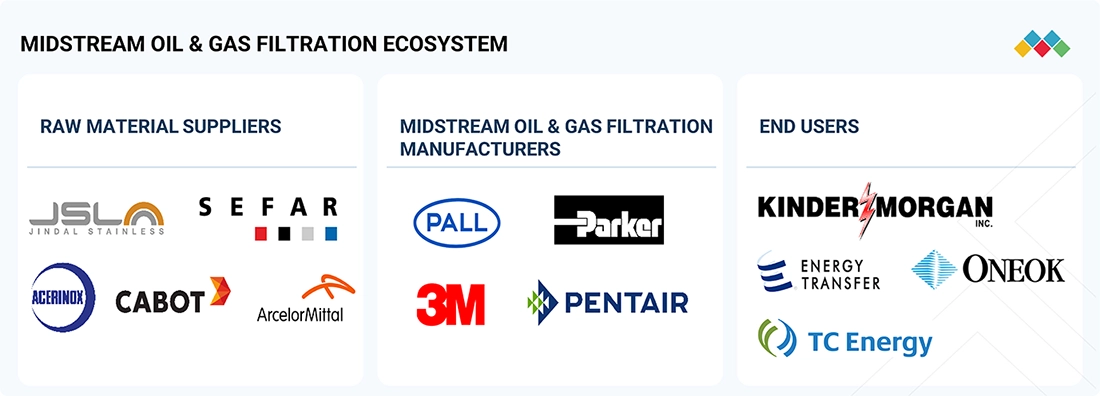
Market Ecosystem
MIDSTREAM OIL & GAS FILTRATION MARKET: COMMERCIAL USE CASES ACROSS INDUSTRIES
| COMPANY | USE CASE DESCRIPTION | BENEFITS |
|---|---|---|
 |
Gas and liquid filtration across pipeline networks and compressor stations | Protects compressors, reduces pressure drop, and improves system reliability |
 |
Coalescing and particulate filtration in gas processing and gathering systems | Ensures consistent gas quality, lowers maintenance costs, and improves uptime |
 |
High-efficiency filtration before LNG liquefaction and boil-off gas handling | Prevents cryogenic equipment fouling and improves operational efficiency |
 |
Filtration during crude and refined product transport and storage operations | Maintains product quality and reduces contamination and rework risk |
Logos and trademarks shown above are the property of their respective owners. Their use here is for informational and illustrative purposes only.
Related Ecosystem
Energy Storage
- Energy Harvesting
- HVAC System
- Applicant Tracking System
- Battery Electric Vehicle (BEV)
- Carboxymethyl Cellulose (CMC)
- MOMENTIVE PERFORMANCE MATERIALS INC.
- Panasonic Holdings Corporation
- Lg corp
- ABB India Limited
- Byd company ltd.
Industrial Equipment
- HVAC System
- Fiberglass
- Actuators
- Cartridge Filters
- Electrostatic Precipitators
- Siemens ag
- GRUNDFOS GROUP
- ABB India Limited
- SCHNEIDER ELECTRIC SE
- Emerson Electric Co.
Key Takeaways
- India's midstream oil & gas filtration market is valued at USD 82.3 million in 2025 and expected to grow to USD 113.6 million by 2030.
- India's market is expanding at a 6.7% CAGR, outpacing global growth, driven by refinery capacity additions and pipeline infrastructure development.
- India's regulatory environment and focus on product quality are accelerating adoption of advanced filtration technologies across midstream operations.
- India's strategic energy independence initiatives and rising crude oil throughput volumes are key catalysts for sustained market expansion through 2030.
Midstream Oil & Gas Filtration Market Report Scope
| Report Metric | Details |
|---|---|
| Base Year | 2025 |
| Fastest Growing Segment | LNG PROCESSING (Application) |
| Forecast Period | 2025–2030 |
| Growth Rate | CAGR of 5.9% from 2025 to 2030 |
| Largest Segment | OIL FILTRATION (Filtration Phase) |
| Market Size Base Year (Billions) | ~USD 2.8 (2025) |
| Revenue Forecast (Billions) | ~USD 3.73 (2030) |
| Segments Covered | Filter Technology, Filter Media, Application, Filtration Phase, End User |
India Midstream Oil & Gas Filtration Market Report Segmentation
5 segment dimensions are covered across the global market.
By Filter Technology
- Activated Carbon Filters
- Bag Filters
- Cartridge Filters
- Coalescer Filters
- Mechanical Filters
- Other Filter Technologies
- Particulate Filters
- Strainers
By Filter Media
- Activated Carbon
- Fiberglass
- Metallic
- Other Filter Media
- Synthetic Polymer
By Application
- Compression Stations
- Gas Processing Plants
- Lng Processing
- Other Applications
- Pipeline Transportation
- Storage & Distribution
By Filtration Phase
- Gas Filtration
- Oil Filtration
By End User
- Petrochemical Industry
- Refineries
INDIA: MIDSTREAM OIL & GAS FILTRATION MARKET, BY END USER, 2025–2030
| Segment | 2025 | 2026 | 2027 | 2028 | 2029 | 2030 | CAGR (%) |
|---|---|---|---|---|---|---|---|
| PETROCHEMICAL INDUSTRY | 40 | 42.8 | 46 | 49.4 | 52.9 | 56.7 | 7.2 |
| REFINERIES | 42.3 | 44.9 | 47.6 | 50.7 | 53.7 | 56.9 | 6.1 |
| TOTAL | 82.3 | 87.7 | 93.6 | 100.1 | 106.6 | 113.6 | 6.7 |
Target Audience
- Filtration Equipment Manufacturers : Need India-specific market data to assess growth opportunities, understand local demand drivers, and develop product strategies tailored to Indian midstream operators' requirements.
- Oil & Gas Operators : Require market insights to benchmark filtration technology investments, evaluate supplier options, and align capital expenditure plans with India's midstream infrastructure expansion trends.
- Investment & Private Equity Firms : Seek detailed India market analysis to evaluate investment opportunities in filtration technology companies, assess market growth potential, and identify strategic acquisition targets.
- Consulting & Engineering Firms : Need comprehensive India market data to advise clients on midstream infrastructure projects, recommend filtration solutions, and support feasibility studies for refining and pipeline operations.
- Government & Policy Bodies : Require market intelligence to inform energy policy decisions, infrastructure planning, and regulatory frameworks that support India's midstream sector development and operational efficiency.
Key Companies in the India Midstream Oil & Gas Filtration Market
| Company | HQ | Ownership | Strongest segments |
|---|---|---|---|
| PARKER HANNIFIN | United States | Public Company | Coalescer Filter,Cartridge Filter,Mechanical Filter, |
| EATON | Ireland | Public Company | Coalescer Filter,Cartridge Filter,Mechanical Filter, |
| PENTAIR | United Kingdom | Public Company | Coalescer Filter Systems,Cartridge Filter Systems,Mechanical Filter Systems, |
| 3M | United States | Public Company | Coalescer Filters,Cartridge Filters,Mechanical Filters, |
| CECO ENVIRONMENTAL | United States | Public Company | Coalescer Filter Systems (incl. separators),Mechanical Filtration & Cyclone-Based Systems,Cartridge Filters & Configured Filtration Packages, |
PARKER HANNIFIN
Parker Hannifin is a publicly traded United States company founded in 1917 with 57,950 employees.
EATON
Eaton is a publicly traded company founded in 1911 with 97,303 employees, headquartered in Ireland.
PENTAIR
Pentair is a publicly traded company founded in 1966 with 9,000 employees, based in the United Kingdom.
3M
3M is a publicly traded United States company founded in 1902 with 60,500 employees.
CECO ENVIRONMENTAL
CECO Environmental is a publicly traded United States company founded in 1869 with 1,540 employees.
Reasons to Buy this Report
- India-Specific Market Sizing : Access precise valuation data for India's midstream filtration market with detailed 2025-2030 forecasts, enabling accurate investment planning and resource allocation decisions.
- Growth Driver Analysis : Understand the unique factors driving India's 6.7% CAGR, including refining capacity expansion, pipeline infrastructure investments, and regulatory compliance requirements specific to the Indian market.
- Competitive Landscape Insights : Identify market opportunities and competitive positioning within India's midstream sector, with insights into regional demand patterns and operator preferences for filtration solutions.
- Regulatory & Compliance Framework : Gain clarity on India-specific environmental regulations and operational standards driving filtration technology adoption, helping align product offerings with local compliance requirements.
- Strategic Market Entry Planning : Leverage India market intelligence to develop targeted go-to-market strategies, identify key customer segments, and optimize product positioning for the Indian midstream sector.
Frequently asked questions
What is the current size of India's midstream oil & gas filtration market?
India's midstream oil & gas filtration market is valued at USD 82.3 million in 2025 and is projected to reach USD 113.6 million by 2030.
What is the growth rate of India's midstream oil & gas filtration market?
India's market is growing at a compound annual growth rate (CAGR) of 6.7% from 2025 to 2030, reflecting strong demand for filtration solutions.
What factors are driving growth in India's midstream filtration market?
India's market growth is driven by expanding refinery capacity, pipeline infrastructure investments, stricter environmental regulations, and increased crude oil processing volumes.
How does India's market growth compare to global trends?
India's 6.7% CAGR outpaces the global midstream oil & gas filtration market CAGR of 5.9%, indicating stronger regional demand and investment momentum.
What is the forecast market size for India by 2030?
India's midstream oil & gas filtration market is forecasted to reach USD 113.6 million by 2030, representing a USD 31.3 million increase from 2025 levels.
RESEARCH METHODOLOGY
The study involves two major activities in estimating the current market size for the midstream oil & gas filtration market. Exhaustive secondary research was done to collect information on the market, peer market, and parent market. The next step was to validate these findings, assumptions, and sizing with industry experts across the value chain through primary research. Both top-down and bottom-up approaches were employed to estimate the complete market size. After that, market breakdown and data triangulation were used to estimate the market size of segments and subsegments.
Secondary Research
Secondary sources referred to for this research study include financial statements of companies offering midstream oil & gas filtration and information from various trade, business, and professional associations. Secondary research has been used to obtain critical information about the industry’s value chain, the total pool of key players, market classification, and segmentation according to industry trends to the bottom-most level and regional markets. The secondary data was collected and analyzed to arrive at the overall size of the midstream oil & gas filtration market, which was validated by primary respondents.
Primary Research
Extensive primary research was conducted after obtaining information regarding the midstream oil & gas filtration market scenario through secondary research. Several primary interviews were conducted with market experts from both the demand and supply sides across major countries of North America, Europe, Asia Pacific, Middle East & Africa, and South America. Primary data was collected through questionnaires, emails, and telephonic interviews. The primary sources from the supply side included various industry experts, such as chief executive officers (CXOs), vice presidents (VPs), directors from business development, marketing, product development/innovation teams, and related key executives from the midstream oil & gas filtration industry, such as vendors, material providers, distributors, and key opinion leaders. Primary interviews were conducted to gather insights into market statistics, revenue from products and services, market breakdowns, market size estimates, market forecasting, and data triangulation. Primary research also helped in understanding the various trends related to membrane type, system configuration, capacity, application, and region. Stakeholders from the demand side, such as CIOs, CTOs, CSOs, and installation teams of the customer/end users who are seeking midstream oil & gas filtration services, were interviewed to understand the buyer’s perspective on the suppliers, products, component providers, and their current usage of midstream oil & gas filtration and future outlook of their business which will affect the overall market.
Breakdown of Primary Respondents:

To know about the assumptions considered for the study, download the pdf brochure
Market Size Estimation
The research methodology used to estimate the size of the midstream oil & gas filtration market includes the following details. The market sizing of the market was undertaken from the demand side. The market was upsized based on the demand for midstream oil & gas filtration in different end-use industries at the regional level. Such procurements provide information on the demand aspects of the midstream oil & gas filtration industry for each end-use industry. For each end-use, all possible segments of the midstream oil & gas filtration market were integrated and mapped.

Data Triangulation
After arriving at the overall size from the market size estimation process explained above, the total market was split into several segments. The data triangulation and market breakdown procedures explained below were implemented, wherever applicable, to complete the overall market engineering process and arrive at the exact statistics for various market segments. The data was triangulated by studying various factors and trends from the demand and supply sides. Along with this, the market size was validated using both the top-down and bottom-up approaches.
Market Definition
The midstream oil and gas filtration market is composed of all the systems and methods that are able to remove impurities and thus allow the seamless transfer, storage, and processing of oil, gas, and their refined products from upstream to downstream. To remove the unwanted materials of solids, liquids, and aerosols, the market includes the complete set of devices consisting of filters, separators, coalescers, and others, for application at pipelines, compressor stations, terminals, and gas processing facilities. The final product quality, equipment safety, corrosion management, and finally regulatory compliance all depend on the effectiveness of the filtration process. The major market drivers are the safe and productive operations of midstream infrastructure, the construction of pipelines, and the rising gas processing activities.
Stakeholders
- Midstream Oil & Gas Filtration Manufacturers
- Midstream Oil & Gas Filtration Distributors and Suppliers
- End-use Industries
- Universities, Governments, and Research Organizations
- Associations and Industrial Bodies
- R&D Institutes
- Environmental Support Agencies
- Investment Banks and Private Equity Firms
- Research and Consulting Firms
Report Objectives
- To define, describe, and forecast the midstream oil & gas filtration market size in terms of volume and value
- To provide detailed information regarding the key factors, such as drivers, restraints, opportunities, and challenges influencing market growth
- To analyze and forecast the market by filter technology, filter media, application, filtration phase, and region
- To forecast the market size concerning five main regions (along with country-level data), namely, North America, Europe, Asia Pacific, Middle East & Africa, and South America, and analyze the significant region-specific trends
- To strategically analyze micromarkets with respect to individual growth trends, prospects, and contributions of the submarkets to the overall market
- To analyze the market opportunities and the competitive landscape for stakeholders and market leaders
- To assess recent market developments and competitive strategies, such as agreements, contracts, acquisitions, partnerships, collaborations, and new product developments/new product launches, to draw the competitive landscape
- To strategically profile the key market players and comprehensively analyze their core competencies
Available Customizations
MarketsandMarkets offers the following customizations for this market report:
- Additional country-level analysis of the midstream oil & gas filtration market
Product Analysis
- Product matrix, which provides a detailed comparison of the product portfolio of each company
Get the Full Midstream Oil & Gas Filtration Market Report
Full forecast, segment splits, and company analysis for all Midstream Oil & Gas Filtration Market.
- US Midstream Oil & Gas Filtration Market
- Canada Midstream Oil & Gas Filtration Market
- Mexico Midstream Oil & Gas Filtration Market
- Germany Midstream Oil & Gas Filtration Market
- UK Midstream Oil & Gas Filtration Market
- France Midstream Oil & Gas Filtration Market
- Italy Midstream Oil & Gas Filtration Market
- Russia Midstream Oil & Gas Filtration Market
- China Midstream Oil & Gas Filtration Market
- Japan Midstream Oil & Gas Filtration Market
- Australia Midstream Oil & Gas Filtration Market
- South Korea Midstream Oil & Gas Filtration Market
- Saudi Arabia Midstream Oil & Gas Filtration Market
- UAE Midstream Oil & Gas Filtration Market
- South Africa Midstream Oil & Gas Filtration Market
- Brazil Midstream Oil & Gas Filtration Market
- Argentina Midstream Oil & Gas Filtration Market
- Rest Of Europe Midstream Oil & Gas Filtration Market
- Rest Of Asia Pacific Midstream Oil & Gas Filtration Market
- Rest Of South America Midstream Oil & Gas Filtration Market
Need a Tailored Report?
Customize this report to your needs
Get 10% FREE Customization
Customize This Report
