
Mexico Military Drones Market (2026-2031)

The Mexico Military Drones Market was valued at $91 Million in 2026 and projected to reach to $193 Million by 2031, representing a compound annual growth rate of 16.2%. Mexico's military drones market is positioned for sustained growth through 2031, driven by escalating security challenges and the government's commitment to modernizing defense capabilities.


| Market Size in | USD 26.32 MN |
| Market Forecast in | |
| CAGR | |
| Forecast Period | |
| Units Considered | Value (USD MN) |
Mexico Military Drones Market Trends and Insights
- This represents a compound annual growth rate of 16.2%, reflecting Mexico's increasing investment in unmanned aerial systems for defense and border security operations.
- Mexico's strategic geographic position and evolving security challenges are driving demand for advanced drone technologies across military and paramilitary applications. The growth trajectory in Mexico reflects broader regional trends in North America, though Mexico's market dynamics are shaped by unique domestic security priorities.
- Between 2026 and 2031, Mexico is expected to nearly double its military drone market value, signaling strengthened commitment to modernizing aerial surveillance and reconnaissance capabilities.
- Mexico's market expansion is supported by both domestic procurement initiatives and potential partnerships with international defense contractors seeking to establish regional presence..
Key Market Statistics
- CAGR (2026-2031) 16.2% CAGR
- Market Size, 2026 ~USD 91 Million
- Forecast, 2031 ~USD 193 Million
- Country Mexico
Mexico Military Drones Market Overview
Market Valuation Growth :
Mexico's military drones market is valued at $91 million in 2026 and projected to reach $193 million by 2031, representing a 112% increase over the five-year forecast period.
Strong CAGR Performance :
The Mexican market is growing at a 16.2% CAGR from 2026-2031, outpacing many regional markets and reflecting sustained government investment in unmanned aerial capabilities.
Border Security Drivers :
Mexico's geographic position and complex security landscape, including border surveillance and counter-narcotics operations, are primary catalysts for increased military drone procurement and deployment.
Defense Modernization Initiative :
Mexico's armed forces are actively modernizing their defense infrastructure, with unmanned systems becoming central to operational strategy for reconnaissance, monitoring, and tactical support missions.
Mexico Military Drones Market Dynamics
- The country's strategic location and ongoing border security operations create consistent demand for advanced unmanned aerial systems.
- Investment in drone technology is expected to accelerate as Mexico strengthens its defense posture and enhances surveillance infrastructure. The forecast period will likely see increased adoption of both tactical and strategic drone platforms across Mexican military branches.
- Regional partnerships and technology transfer agreements may further stimulate market expansion.
- As Mexico continues to address security threats through technological advancement, the military drones sector will remain a critical component of national defense spending and operational effectiveness..
Market Ecosystem
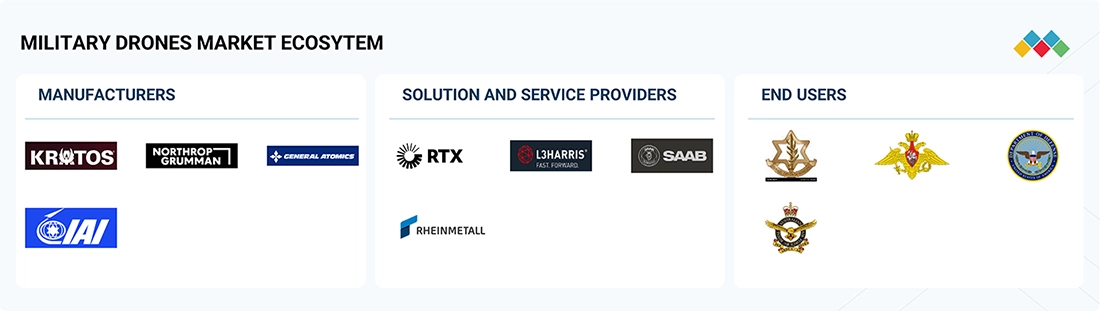
MILITARY DRONE (UAV) MARKET SIZE, SHARE & TRENDS, 2025 TO 2031: COMMERCIAL USE CASES ACROSS INDUSTRIES
| COMPANY | USE CASE DESCRIPTION | BENEFITS |
|---|---|---|
 |
Development of high altitude surveillance drones and autonomous unmanned systems for intelligence gathering and defense monitoring operations | Supports long-range surveillance missions, improves battlefield awareness, strengthens autonomous defense capabilities, and enhances real-time intelligence collection |
 |
Supply of radar systems, targeting technologies, and counter drone solutions for military unmanned platforms | Improves threat detection capabilities, supports electronic warfare operations, enhances mission accuracy, and strengthens air defense systems |
 |
Design and production of remotely piloted aircraft for surveillance missions and combat support operations | Supports long endurance military missions, improves intelligence gathering operations, enhances border monitoring capabilities, and reduces risks for defense personnel |
 |
Development of tactical drones and battlefield surveillance systems for defense applications | Improves tactical surveillance operations, supports border security missions, enhances operational response capabilities, and strengthens reconnaissance activities |
 |
Supply of imaging sensors and surveillance technologies for military drone platforms | Enhances real time monitoring capabilities, improves target identification accuracy, supports surveillance operations, and strengthens situational awareness across combat environments |
Logos and trademarks shown above are the property of their respective owners. Their use here is for informational and illustrative purposes only.
Related Ecosystem
Key Takeaways
- Mexico's military drones market is valued at $91 million in 2026 and projected to reach $193 million by 2031, representing a 16.2% CAGR.
- Mexico's market growth is driven by border security needs and modernization of defense capabilities across military and paramilitary forces.
- Mexico's strategic location in North America positions it as a key market for drone technology adoption and regional defense partnerships.
- Mexico's market expansion reflects increasing government investment in unmanned aerial systems for surveillance, reconnaissance, and operational support.
Military Drones Market Report Scope
| Report Metric | Details |
|---|---|
| Base Year | 2026 |
| Fastest Growing Segment | FUEL CELL POWERED (Propulsion) |
| Forecast Period | 2026–2031 |
| Growth Rate | CAGR of 25.7% from 2026 to 2031 |
| Largest Segment | REMOTELY PILOTED (Autonomy Level) |
| Market Size Base Year (Billions) | ~USD 34.8 (2026) |
| Revenue Forecast (Billions) | ~USD 109.22 (2031) |
| Segments Covered | Class, Small Class, Tactical Class, Strategic Class, Drone Type, Combat Drones, Mtow, Payload Capacity, Endurance, Wing Type, Autonomy Level, Launch Mode, Propulsion, Fuel-Powered Propulsion, Battery Powered, Battery-Powered Propulsion |
Mexico Military Drones Market Report Segmentation
16 segment dimensions are covered across the global market.
By Class
- Small
- Strategic
- Tactical
By Small Class
- Micro (251 Gm - 2 Kg)
- Micro (251 Gm – 2 Kg)
- Mini (2-25 Kg)
- Mini (2–25 Kg)
- Nano (Up To 250 Gm)
By Tactical Class
- Extended Range (201-500 Km)
- Medium Range (51-200 Km)
- Short Range (Up To 50 Km)
By Strategic Class
- Hale
- Male
By Drone Type
- Combat
- Combat/Strike
- Delivery
- Isr
- Target
By Combat Drones
- Loitering Munition
- Ucav
By Mtow
- 151-1,200 Kg
- 151–1,200 Kg
- >1,200 Kg
- Up To 150 Kg
By Payload Capacity
- 5-50 Kg
- 51-250 Kg
- <5 Kg
- >250 Kg
By Endurance
- 21-40 Hours
- 5-20 Hours
- <5 Hours
- >40 Hours
By Wing Type
- Fixed Wing
- Hybrid
- Rotary Wing
By Autonomy Level
- Fully Autonomous
- Remotely Piloted
- Semi-Autonomous
By Launch Mode
- Catapult Launched
- Hand Launched
- Runway Dependent
- Vertical Take-Off & Landing (Vtol)
By Propulsion
- Battery Powered
- Fuel Cell
- Fuel Cell Powered
- Fuel Powered
By Fuel-Powered Propulsion
- Piston Engines
- Turbo Engines
By Battery Powered
- Fully Electric
- Hybrid Electric
By Battery-Powered Propulsion
- Fully Electric
- Hybrid Electric
Target Audience
- Defense Contractors & Manufacturers : Drone manufacturers and aerospace defense companies need Mexico-specific market data to identify growth opportunities, assess demand for unmanned systems, and develop localized sales strategies.
- Government & Military Procurement : Mexican defense ministry officials and military procurement teams require market intelligence to benchmark spending, evaluate technology options, and justify budget requests for drone acquisitions.
- Investment & Private Equity Firms : Investors targeting the aerospace and defense sector need Mexico market analysis to evaluate investment opportunities in drone manufacturers, technology providers, and defense-related ventures.
- Technology & Systems Integrators : Systems integrators and technology providers require Mexico market insights to understand demand for drone platforms, support services, and integration solutions for military applications.
- Strategic Consultants & Analysts : Business consultants and market analysts need comprehensive Mexico drone market data to support client advisory work, competitive analysis, and strategic planning in the defense sector.
Key Companies in the Mexico Military Drones Market
| Company | HQ | Ownership | Strongest segments |
|---|---|---|---|
| EXYN TECHNOLOGIES INC | United States | Public Company | ExynAI autonomy and mapping software,Exyn Nexys modular 3D mapping solutions,ExynView mission planning and analytics suite, |
| CYIENT | India | Public Company | Digital, Engineering & Technology,Design Led Manufacturing,Others (Networks, Geospatial, Specialized Platforms), |
| NORTHROP GRUMMAN | United States | Public Company | Aeronautics Systems,Defense Systems,Mission Systems, |
| RTX | United States | Public Company | Collins Aerospace (avionics, interiors, mission systems, aftermarket),Pratt & Whitney (commercial and military engines, APU, MRO),Raytheon (sensors, effectors, command and control, space), |
| ISRAEL AEROSPACE INDUSTRIES | Israel | Private Company | Aerial defense, special mission aircraft, and UAS,Naval and land defense systems,Space systems and satellites, |
| TELEDYNE FLIR LLC | United States | Private Company | Thermal imaging cameras (industrial, commercial, first responder),Optical gas imaging (FLIR G-Series and related OGI),Defense and government sensing systems, |
| AEROVIRONMENT, INC. | United States | Public Company | Small and Medium UAS,Loitering Munitions & Precision Strike,Counter-UAS & Electronic Warfare, |
| AIRBUS | Netherlands | Public Company | Commercial aircraft (Airbus segment),Helicopters (civil and military),Defence and military air systems, |
| TEXTRON INC. | United States | Public Company | Textron Aviation (business, trainer, and special mission aircraft plus aftermarket),Bell (military and commercial rotorcraft plus support),Textron Systems (UAS, weapons, marine, armored vehicles), |
| LOCKHEED MARTIN CORPORATION | United States | Public Company | Aeronautics (combat and air mobility aircraft, UAVs),Missiles and Fire Control,Rotary and Mission Systems, |
| ELBIT SYSTEMS LTD. | Israel | Public Company | Aerospace and Unmanned Airborne Solutions,C4I, Cyber, and Communications,ISTAR, Electro-Optics, EW and Radar, |
| BAE SYSTEMS | United Kingdom | Public Company | Air,Maritime,Electronic Systems, |
| THALES | France | Public Company | Defence & Security Systems (air defence, C4ISR, EW, mission systems),Aerospace & Air Traffic Management (avionics, ATM, IFE/connectivity),Digital Identity & Security (banking, IAM, biometrics, secure IoT), |
| LEONARDO S.P.A. | Italy | Public Company | Helicopters (platforms and support),Defense electronics and security systems,Aircraft and aerostructures, |
| KRATOS | United States | Public Company | Unmanned Systems (jet-powered drones, hypersonic and target vehicles),Space & Satellite Ground Systems (virtualized C2, TT&C software),C5ISR & Mission Systems (command, control, communication, computing, ISR), |
EXYN TECHNOLOGIES INC
EXYN Technologies Inc is a United States-based public company founded in 2014 with 42 employees. The company specializes in autonomous systems and robotics technology.
CYIENT
Cyient is an India-based public company founded in 1991 with 12,049 employees. The company provides engineering, design, and technology services to aerospace, defense, and other industries.
NORTHROP GRUMMAN
Northrop Grumman is a major United States-based public defense contractor founded in 1939 with 95,000 employees. The company develops and manufactures advanced aerospace, defense, and security systems.
RTX
RTX is a United States-based public company founded in 1934 with 180,000 employees. The company is a leading provider of aerospace and defense technologies and systems.
ISRAEL AEROSPACE INDUSTRIES
Israel Aerospace Industries is a private aerospace and defense company founded in 1953 with 15,151 employees. The company designs and manufactures aircraft, unmanned systems, and defense technologies.
TELEDYNE FLIR LLC
Teledyne FLIR LLC is a private United States-based company founded in 1978 with 4,179 employees. The company specializes in thermal imaging, infrared, and sensing technologies for defense and commercial applications.
AEROVIRONMENT, INC.
AeroVironment, Inc. is a United States-based public company founded in 1971 with 4,041 employees. The company designs and manufactures unmanned aircraft systems and electric vehicle charging solutions.
AIRBUS
Airbus is a Netherlands-based public company founded in 1998 with 166,876 employees. The company is a leading manufacturer of commercial aircraft, helicopters, and defense systems.
TEXTRON INC.
Textron Inc. is a United States-based public company founded in 1923 with 34,000 employees. The company manufactures aircraft, defense systems, and industrial products across multiple business segments.
LOCKHEED MARTIN CORPORATION
Lockheed Martin Corporation is a United States-based public defense contractor founded in 1912 with 123,000 employees. The company develops and manufactures advanced aerospace, defense, and security technologies.
ELBIT SYSTEMS LTD.
Elbit Systems Ltd. is an Israel-based public company founded in 1966 with 20,000 employees. The company provides defense electronics, unmanned systems, and advanced technologies to military and commercial customers.
BAE SYSTEMS
BAE Systems is a United Kingdom-based public company founded in 1979 with 111,400 employees. The company is a major defense, aerospace, and security contractor serving global markets.
THALES
Thales is a France-based public company founded in 1893 with 82,111 employees. The company provides aerospace, defense, security, and transportation technologies and services.
LEONARDO S.P.A.
Leonardo S.p.A. is an Italy-based public company founded in 1948 with 65,455 employees. The company manufactures defense systems, aerospace products, and security technologies.
KRATOS
Kratos is a United States-based public company founded in 1994 with 4,300 employees. The company provides defense and aerospace systems, including unmanned systems and satellite communications.
Reasons to Buy this Report
- Market Size & Growth Data : Access precise valuation figures for Mexico's military drones market with detailed forecasts through 2031, enabling accurate budget allocation and investment planning for defense contractors and government agencies.
- Competitive Landscape Intelligence : Understand Mexico-specific market dynamics, key players, and competitive positioning to identify partnership opportunities and market entry strategies tailored to the Mexican defense sector.
- Security Trend Analysis : Gain insights into Mexico's unique security challenges and defense priorities that drive drone adoption, including border operations and counter-narcotics initiatives affecting procurement decisions.
- Strategic Investment Guidance : Leverage Mexico-focused market intelligence to guide capital allocation, technology development priorities, and go-to-market strategies for defense technology providers and investors.
- Government & Policy Insights : Understand Mexican government defense spending trends, modernization initiatives, and regulatory frameworks governing military drone acquisition and deployment in the region.
Frequently asked questions
What is the current size of Mexico's military drones market?
Mexico's military drones market is estimated at $91 million in 2026 and is projected to grow to $193 million by 2031.
What is the growth rate of Mexico's military drones market?
Mexico's military drones market is expected to grow at a compound annual growth rate (CAGR) of 16.2% from 2026 to 2031.
What factors are driving growth in Mexico's military drones market?
Mexico's market growth is primarily driven by border security requirements, modernization of defense infrastructure, and increased investment in unmanned aerial surveillance systems.
How does Mexico's military drones market compare to other North American countries?
Mexico's military drones market, while growing at 16.2% CAGR, operates within the broader North American defense ecosystem, with unique domestic security priorities shaping procurement decisions.
What applications are driving demand for military drones in Mexico?
Mexico's demand for military drones is driven by border surveillance, counter-narcotics operations, reconnaissance missions, and general defense modernization initiatives.
RESEARCH METHODOLOGY
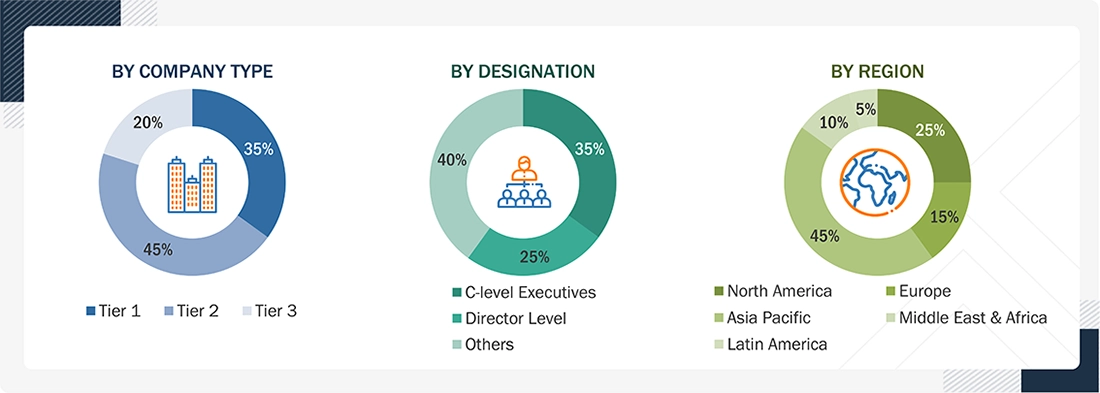
The study followed four main steps to estimate the size of the military drones market. Secondary research was conducted to collect data on military drone platforms, surveillance systems, combat operations, payload technologies, autonomous systems, and defense modernization programs across major countries. These findings were validated through primary interviews with defense agencies, drone manufacturers, OEMs, and industry experts. The research team analyzed defense spending trends, military procurement programs, drone deployment activities, and technology advancements to assess market demand. Market estimates were then segmented by class system, drone Type, MTOW, payload capacity, endurance, wing type, autonomy level, launch mode, and propulsion. Data triangulation was applied to validate the final figures for each segment and subsegment.
Secondary Research
Secondary research was conducted to build the foundation for this study. Data was collected from defense reports, military procurement programs, drone manufacturers, and government defense publications across major regions. Company information was reviewed through annual reports, product documents, press releases, and investor presentations of military drone manufacturers. The study also examined industry articles, white papers, and research studies related to unmanned aerial systems, autonomous technologies, payload systems, and surveillance applications. Additional insights were gathered from defense associations and industry platforms to analyze market trends, technology developments, and regional adoption patterns.
Primary Research
Primary research was conducted after key insights from secondary analysis were identified. The study team engaged with executives, engineers, cabin designers, and suppliers involved in the military drone ecosystem. Discussions included drone manufacturers, defense organization representatives, OEMs, material suppliers, and industry experts across major regions. Interviews were conducted via calls and written correspondence to validate market size estimates and customer requirements. These inputs helped refine perspectives on competition, product innovation, and deployment strategies. Feedback was also used to adjust assumptions and improve data accuracy.
To know about the assumptions considered for the study, download the pdf brochure
Market Size Estimation
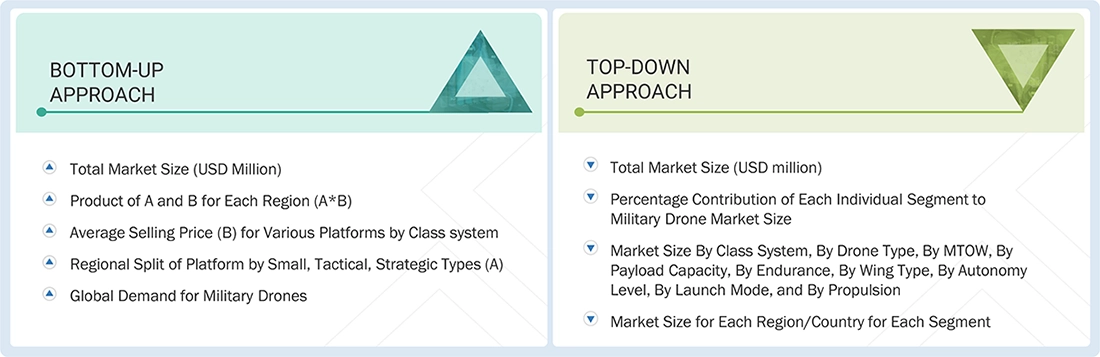
The top-down and bottom-up methods were used to estimate and validate the size of the military drones market. The research process involved several steps to ensure accuracy.
- Key companies active in the military drones market were identified through secondary research. Their market share was evaluated using a combination of primary inputs and published data. This included reviewing annual reports, financial disclosures, certification updates, and public filings from various organizations. Interviews were also conducted with industry participants such as company executives, program managers, operators, infrastructure providers, and aviation experts. These inputs were used to validate assumptions and refine market size estimates across regions.
- All percentage shares, segment splits, and market breakdowns were first developed using secondary information. These values were then verified through primary discussions with industry participants.
- The analysis evaluated key factors shaping the military drones market, including defense spending trends, military drone procurement programs, autonomous technology developments, payload integration capabilities, and surveillance requirements. Each factor was assessed through primary research and used to develop both quantitative and qualitative market estimates for this report.
Military Drones Market : Top-Down and Bottom-Up Approach
Data Triangulation
After determining the overall market size, the total market was divided into multiple segments and subsegments. The data triangulation and market breakdown procedures described below were carried out, where applicable, to complete the overall market analysis and determine the estimated market figures for the segments and subsegments. The data was triangulated by examining various factors and trends from both demand and supply sides. Additionally, the market size was validated using the top-down and bottom-up approaches.
Market Definition
The military drones market encompasses unmanned aerial systems (UAS) designed, manufactured, and deployed for defense and security operations across tactical and strategic environments. These systems operate across varying levels of autonomy, ranging from remotely piloted to fully autonomous, and are purpose-built to execute mission-critical applications, including intelligence, surveillance, and reconnaissance (ISR), precision strike operations, loitering missions, logistics, and battlefield resupply, and target simulation.
Modern military drones are highly engineered platforms integrating advanced subsystems such as electro-optical/infrared (EO/IR) sensors, radar systems, secure communication links, navigation and guidance systems, propulsion architectures, and AI-enabled autonomy software. Platform configurations vary significantly based on operational requirements, with differentiation driven by parameters such as payload capacity, endurance, range, propulsion type, launch mode, and mission profile.
As defense forces globally transition toward network-centric and unmanned warfare strategies, military drones are increasingly central to force modernization programs. These systems enable enhanced situational awareness, persistent surveillance, precision engagement capabilities, and risk reduction for personnel, while delivering cost-effective operational scalability across diverse combat and non-combat scenarios.
Key Stakeholders
- Defense agencies responsible for military drone procurement and deployment programs
- Military drone manufacturers developing surveillance drones and combat unmanned systems
- Original Equipment Manufacturers (OEMs) supplying drone platforms and mission technologies
- Payload system providers offering radar systems, imaging sensors, communication equipment, and targeting technologies
- Autonomous technology companies developing artificial intelligence-based drone systems
- Component suppliers providing propulsion systems, navigation systems, batteries, and electronic warfare equipment
- Defense technology companies supporting counter-drone systems and surveillance operations
- Maintenance, repair, and overhaul (MRO) service providers supporting drone maintenance and lifecycle management
- Government organizations responsible for defense regulations and military drone certifications
- Research institutions and defense associations supporting unmanned system innovation and technology development
Report Objectives
- To define, describe, and forecast the size of the military drones market based on class system, drone type, MTOW, payload capacity, endurance, wing type, autonomy level, launch mode, and propulsion
- To forecast the size of market segments with respect to key countries in the following regions: North America, Europe, the Asia Pacific, the Middle East, Latin America, and Africa
- To identify and analyze drivers, restraints, opportunities, and challenges influencing the growth of the market
- To identify industry trends, market trends, and technology trends currently prevailing in the market
- To provide an overview of the regulatory landscape with respect to the global military drones market regulations
- To analyze micromarkets with respect to individual growth trends, prospects, and their contribution to the overall market
- To analyze opportunities in the market for stakeholders by identifying key market trends
- To profile key market players and comprehensively analyze their market share and core competencies
- To analyze the degree of competition in the market by identifying growth strategies, such as agreements, acquisitions, partnerships, collaborations, and product launches, adopted by leading market players
- To identify detailed financial positions, key products, and unique selling points of leading market players
Available Customizations
MarketsandMarkets offers the following customizations for this market report:
- Additional country-level analysis of the military drones market
- Profiling of other market players (up to 5)
Product Analysis
- Product matrix, which provides a detailed comparison of the product portfolio of each company in the military drones market
Company Information
- Detailed analysis and profiles of additional market players (up to five)
Get the Full Military Drones Market Report
Full forecast, segment splits, and company analysis for all Military Drones Market.
- US Military Drones Market
- Canada Military Drones Market
- UK Military Drones Market
- France Military Drones Market
- Germany Military Drones Market
- Sweden Military Drones Market
- Italy Military Drones Market
- China Military Drones Market
- India Military Drones Market
- Japan Military Drones Market
- Australia Military Drones Market
- South Korea Military Drones Market
- Saudi Arabia Military Drones Market
- UAE Military Drones Market
- Israel Military Drones Market
- Turkey Military Drones Market
- Brazil Military Drones Market
- South Africa Military Drones Market
- Nigeria Military Drones Market
- Rest Of Asia Pacific Military Drones Market
Need a Tailored Report?
Customize this report to your needs
Get 10% FREE Customization
Customize This Report
