
South Africa Modular Flooring Market (2026-2031)

The South Africa Modular Flooring Market was valued at $118.2 Million in 2026 and projected to reach to $142.5 Million by 2031, representing a compound annual growth rate of 3.8%. South Africa's modular flooring market demonstrates steady growth momentum driven by robust demand from the construction and mining sectors.


| Market Size in | USD 26.32 MN |
| Market Forecast in | |
| CAGR | |
| Forecast Period | |
| Units Considered | Value (USD MN) |
South Africa Modular Flooring Market Trends and Insights
- This steady expansion in South Africa reflects increasing demand from the construction, mining, and industrial sectors, where modular flooring solutions offer durability, cost-efficiency, and rapid installation benefits.
- South Africa's market growth is driven by infrastructure development, warehouse modernization, and the adoption of flexible flooring systems in commercial and industrial facilities. The modular flooring sector in South Africa is characterized by rising investments in logistics hubs, manufacturing facilities, and retail spaces that require adaptable flooring solutions.
- South Africa's market dynamics are shaped by the need for sustainable, low-maintenance flooring alternatives that can withstand heavy traffic and harsh environmental conditions.
- Between 2026 and 2031, South Africa is expected to see increased penetration of modular flooring in data centers, pharmaceutical facilities, and mining operations, positioning the country as a key growth market within the Middle East Africa region..
Key Market Statistics
- CAGR (2026-2031) 3.8% CAGR
- Market Size, 2026 ~USD 118.2 Million
- Forecast, 2031 ~USD 142.5 Million
- Country South Africa
South Africa Modular Flooring Market Overview
Market Size & Growth :
South Africa's modular flooring market is valued at USD 118.2 million in 2026, expanding to USD 142.5 million by 2031, with a robust CAGR of 3.8%, outpacing the global growth rate of 3.3%.
Sector Drivers :
The construction, mining, and industrial sectors in South Africa are primary growth catalysts, leveraging modular flooring for enhanced durability, cost-efficiency, and rapid installation capabilities in demanding environments.
Installation Advantages :
South African enterprises increasingly adopt modular flooring solutions due to faster deployment timelines, reduced labor costs, and minimal operational disruption compared to traditional flooring systems.
Regional Demand Momentum :
Growing infrastructure development and industrial expansion across South Africa's major economic hubs are driving sustained demand for innovative, flexible flooring solutions that meet evolving workplace standards.
South Africa Modular Flooring Market Dynamics
- The country's industrial expansion and infrastructure development initiatives create significant opportunities for modular flooring adoption, particularly in facilities requiring rapid installation and operational flexibility.
- The 3.8% CAGR reflects strong market confidence and increasing recognition of modular solutions' cost and efficiency benefits. Looking ahead to 2031, South Africa's market is poised for continued expansion as enterprises prioritize sustainable, durable flooring systems that minimize downtime.
- Investment in commercial real estate, warehouse facilities, and mining operations will sustain demand.
- The market's outperformance versus global averages underscores South Africa's unique growth potential and the region's strategic importance for modular flooring manufacturers and distributors..
Market Ecosystem
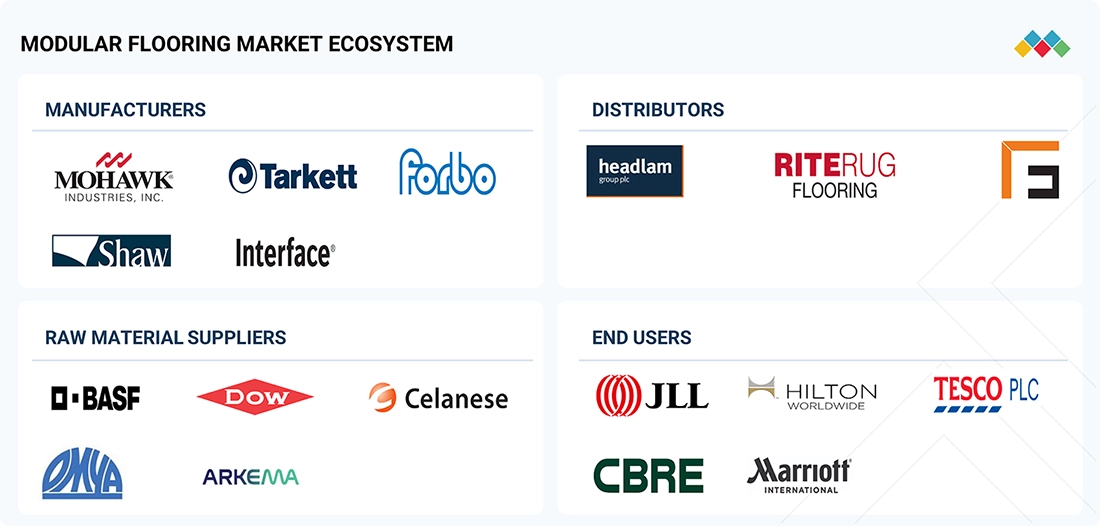
MODULAR FLOORING MARKET: COMMERCIAL USE CASES ACROSS INDUSTRIES
| COMPANY | USE CASE DESCRIPTION | BENEFITS |
|---|---|---|
 |
Sustainable office renovation using circular, recycled flooring materials to create flexible, modern workspace aligned with environmental and user wellbeing goals | Enables circular economy integration, reduces environmental impact, improves maintenance efficiency, enhances workplace comfort, and supports flexible, technology-driven office design aligned with sustainability objectives |
 |
Energy-efficient conveyor belt system installed at airports to reduce friction and significantly lower energy consumption in baggage handling operations | Achieves up to 40% energy savings, maintains long-term performance stability, reduces operational costs, minimizes friction-related wear, and supports sustainable airport infrastructure efficiency improvements |
 |
Modular flooring used in modern offices to create flexible, collaborative workspace with a strong focus on acoustics, sustainability, and biophilic design principles | Improves acoustic comfort, enhances collaboration through flexible zoning, supports sustainability with low-carbon materials, increases durability, and creates a calm, productive, and people-centric work environment |
Logos and trademarks shown above are the property of their respective owners. Their use here is for informational and illustrative purposes only.
Related Ecosystem
Building And Construction
- HVAC System
- Acoustic Insulation
- Alkyd Resins
- Fiberglass
- Thermal Insulation
- Snc-lavalin group inc.
- Saint-gobain
- LHOIST S.A
- USG CORPORATION
- Basf se
Key Takeaways
- South Africa's modular flooring market is valued at USD 118.2 million in 2026 and will reach USD 142.5 million by 2031.
- South Africa is experiencing a 3.8% CAGR, driven by industrial modernization and infrastructure development.
- South Africa's mining and logistics sectors are primary growth drivers for modular flooring adoption.
- South Africa's market is positioned for sustained growth through increased demand for durable, cost-effective flooring solutions.
Modular Flooring Market Report Scope
| Report Metric | Details |
|---|---|
| Base Year | 2026 |
| Fastest Growing Segment | HOUSEHOLD (End User) |
| Forecast Period | 2026–2031 |
| Growth Rate | CAGR of 3.3% from 2026 to 2031 |
| Largest Segment | LUXURY VINYL TILES (Product Type) |
| Market Size Base Year (Billions) | ~USD 14.01 (2026) |
| Revenue Forecast (Billions) | ~USD 16.48 (2031) |
| Segments Covered | Product Type, Installation Technique, End User |
South Africa Modular Flooring Market Report Segmentation
3 segment dimensions are covered across the global market.
By Product Type
- Ceramic
- Luxury Vinyl Tile
- Luxury Vinyl Tiles
- Other Product Types
- Polyolefin
- Rubber
By Installation Technique
- Interlocking
- Loose Lay
- Magnetic Systems
By End User
- Education
- Healthcare
- Household
- Other End Users
- Retail
- Workplace
Target Audience
- Construction & Real Estate Developers : South African developers need market intelligence on modular flooring adoption rates, cost-benefit analysis, and installation timelines to make informed decisions on commercial and industrial projects.
- Mining & Industrial Operators : Mining companies and industrial facilities require data on durable, cost-efficient flooring solutions that minimize operational downtime and meet South Africa's demanding workplace safety standards.
- Flooring Manufacturers & Distributors : Regional and international flooring suppliers need South Africa-specific market sizing, growth forecasts, and sector demand analysis to optimize inventory, pricing, and distribution strategies.
- Facility & Operations Managers : Facility managers across South African enterprises need evidence-based insights on modular flooring ROI, installation benefits, and long-term cost savings to justify capital expenditure decisions.
- Investment & Strategy Consultants : Consultants advising South African businesses require localized market data and growth projections to develop competitive strategies, identify market entry opportunities, and support M&A activities.
Key Companies in the South Africa Modular Flooring Market
| Company | HQ | Ownership | Strongest segments |
|---|---|---|---|
| MOHAWK INDUSTRIES, INC. | United States | Public Company | Global Ceramic (tile, slabs, countertops, installation materials),Resilient and Hybrid Flooring (LVT, vinyl tiles, sheet vinyl, hybrid),Carpet and Rugs (broadloom, carpet tiles, pads, rugs, mats), |
| SHAW INDUSTRIES GROUP, INC. | United States | Private Company | Carpet (residential and commercial),Resilient flooring (LVT, rigid core, sheet),Hardwood and laminate, |
| TARKETT | France | Private Company | Heterogeneous & homogeneous vinyl flooring,Parquet, laminate, and wood flooring,Resilient, rubber flooring, linoleum, and accessories, |
| ARMSTRONG FLOORING, INC. | United States | Public Company | Commercial resilient flooring,Residential resilient flooring,Institutional / public sector projects, |
| FORBO HOLDING AG | Switzerland | Public Company | Flooring Systems – linoleum and vinyl,Flooring Systems – entrance systems, carpet tiles, Flotex, needle felt,Building and construction adhesives (Eurocol) and accessories, |
| INTERFACE, INC. | United States | Public Company | Modular carpet and carpet tiles,Luxury vinyl tiles and modular resilient flooring,Rubber flooring (NORAPLAN, NORAMENT), |
| TOLI CORPORATION | Japan | Public Company | Commercial flooring (carpet tile, vinyl, resilient),Wallcoverings and interior finishes,Curtains, fabrics, and soft furnishings, |
| JAMES HALSTEAD PLC | United Kingdom | Public Company | Commercial sheet vinyl (Polyflor, Polysafe, Palettone),Luxury vinyl tile & planks (Camaro, Expona),Safety flooring & specialist solutions (Polysafe, healthcare-focused), |
| DIXIE GROUP, INC. | United States | Public Company | Residential tufted broadloom carpets and rugs (DH Floors and private label),High-end carpet, custom rugs, and engineered wood (Fabrica),Luxury vinyl flooring and broadloom (Masland Residential), |
| VICTORIA PLC | United Kingdom | Public Company | Broadloom carpets, carpet tiles, and rugs,Underlay, accessories, and installation systems,Ceramic and porcelain tiles, |
| LX HAUSYS, LTD. | South Korea | Public Company | Building Materials – Windows & Insulation,Building Materials – Flooring & Wallcoverings,Interior Stone & Surfaces, |
MOHAWK INDUSTRIES, INC.
Mohawk Industries, Inc. is a United States-based public company founded in 1988 that employs 40,500 people. The company operates as a major flooring and building materials manufacturer.
SHAW INDUSTRIES GROUP, INC.
Shaw Industries Group, Inc. is a private company established in 1946 in the United States with 30,000 employees. The company is a significant manufacturer of flooring products and building materials.
TARKETT
Tarkett is a French private company founded in 1886 with 11,635 employees. The company specializes in flooring and building materials manufacturing.
ARMSTRONG FLOORING, INC.
Armstrong Flooring, Inc. is a United States-based public company with roots dating back to 1860 and 1,568 employees. The company manufactures flooring products and related building materials.
FORBO HOLDING AG
Forbo Holding AG is a Swiss public company founded in 1928 with 5,195 employees. The company operates in the flooring and building materials industry.
INTERFACE, INC.
Interface, Inc. is a United States-based public company founded in 1973 with 3,570 employees. The company manufactures flooring products and related materials.
TOLI CORPORATION
Toli Corporation is a Japanese public company founded in 1919. The company operates in the flooring and building materials industry.
JAMES HALSTEAD PLC
James Halstead PLC is a United Kingdom-based public company founded in 1914 with 834 employees. The company manufactures flooring products.
DIXIE GROUP, INC.
Dixie Group, Inc. is a United States-based public company with 928 employees. The company operates in the flooring and building materials industry.
VICTORIA PLC
Victoria PLC is a United Kingdom-based public company founded in 1895 with 5,020 employees. The company manufactures flooring and related building materials.
LX HAUSYS, LTD.
LX Hausys, Ltd. is a South Korean public company with 2,776 employees. The company operates in the flooring and building materials sector.
Reasons to Buy this Report
- Market-Specific Sizing & Forecasts : Access precise valuation data for South Africa's modular flooring market (2026-2031) with country-specific CAGR analysis, enabling accurate budget allocation and investment planning for regional operations.
- Sector-Focused Insights : Understand demand drivers specific to South Africa's construction, mining, and industrial sectors, identifying high-growth subsegments and emerging opportunities within the local market landscape.
- Competitive Positioning Strategy : Benchmark your offerings against regional market trends and growth trajectories unique to South Africa, optimizing product development and go-to-market strategies for maximum local relevance.
- Risk & Opportunity Assessment : Evaluate South Africa-specific market dynamics, regulatory environment, and infrastructure investment trends to identify growth catalysts and potential headwinds affecting your business strategy.
- Stakeholder Decision Support : Provide board members, investors, and partners with credible, localized market intelligence for South Africa, strengthening business cases and securing buy-in for regional expansion initiatives.
Frequently asked questions
What is the current size of South Africa's modular flooring market?
South Africa's modular flooring market is estimated at USD 118.2 million in 2026.
What is the projected market size for South Africa by 2031?
South Africa's modular flooring market is forecast to reach USD 142.5 million by 2031.
What is the CAGR for South Africa's modular flooring market?
South Africa's modular flooring market is growing at a compound annual growth rate of 3.8% from 2026 to 2031.
Which industries drive demand for modular flooring in South Africa?
South Africa's primary demand drivers include construction, mining, logistics, manufacturing, and industrial sectors requiring durable and flexible flooring solutions.
Why is South Africa's modular flooring market growing?
South Africa's market growth is fueled by infrastructure development, warehouse modernization, mining operations expansion, and the need for sustainable, low-maintenance flooring alternatives.
RESEARCH METHODOLOGY
The study involved four major activities to estimate the current size of the global modular flooring market. Exhaustive secondary research was carried out to collect information on the market, the peer product market, and the parent product group market. The next step was to validate these findings, assumptions, and sizes with the industry experts across the value chain of modular flooring through primary research. The top-down and bottom-up approaches were employed to estimate the overall size of the modular flooring market. After that, market breakdown and data triangulation procedures were used to determine the size of different segments of the market.
Secondary Research
The market for companies offering modular flooring was arrived at by studying the secondary data available through paid and unpaid sources, analyzing the product portfolios of the major companies in the ecosystem, and rating the companies by their performance and quality. Various secondary sources, such as Business Standard, Bloomberg, World Bank, and Factiva, were referred to identify and collect information for this study on the modular flooring market. In the secondary research process, various secondary sources were referred to for identifying and collecting information related to the study. Secondary sources included annual reports, press releases, investor presentations, modular flooring vendors, forums, certified publications, and white papers. The secondary research was used to obtain critical information on the industry’s value chain, the total pool of key players, market classification, and segmentation from the market and technology-oriented perspectives.
Primary Research
In the primary research process, various primary sources from the supply and demand sides were interviewed to obtain qualitative and quantitative information for this report. The primary sources from the supply side included industry experts, such as Chief Executive Officers (CEOs), Vice Presidents (VPs), marketing directors, technology and innovation directors, and related key executives from several key companies and organizations operating in the modular flooring market. After the complete market engineering (calculations for market statistics, market breakdown, market size estimations, market forecasting, and data triangulation), extensive primary research was conducted to gather information and verify and validate the critical numbers arrived at. Primary research was also conducted to identify the segmentation, industry trends, competitive landscape of modular flooring offered by various market players, and key market dynamics, such as drivers, restraints, opportunities, challenges, industry trends, and key player strategies. In the complete market engineering process, the top-down and bottom-up approaches and several data triangulation methods were extensively used to perform the market estimation and market forecasting for the overall market segments and subsegments listed in this report. Extensive qualitative and quantitative analysis was performed on the complete market engineering process to list the key information/insights throughout the report.
The following is the breakdown of primary respondents:
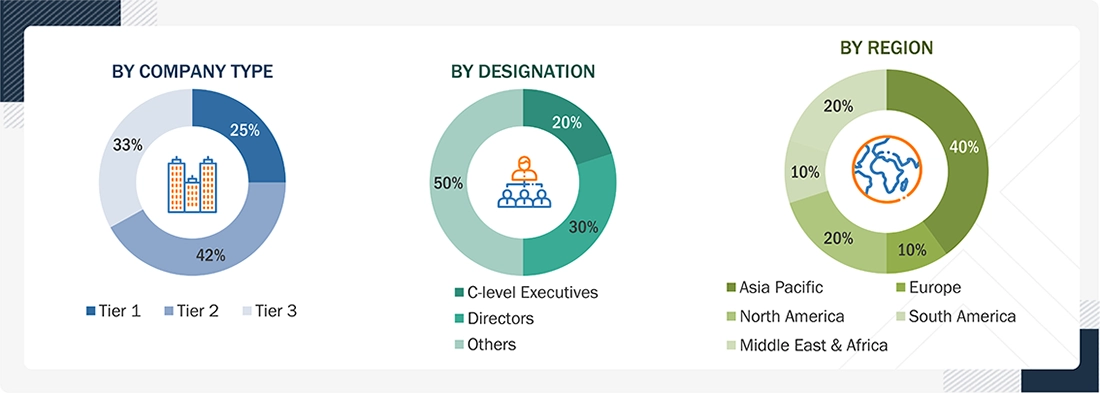
Notes: Others include sales, marketing, and product managers.
Tier 1: > USD 1 billion; Tier 2: USD 500 million–1 billion; and Tier 3: < USD 500 million
To know about the assumptions considered for the study, download the pdf brochure
Market Size Estimation
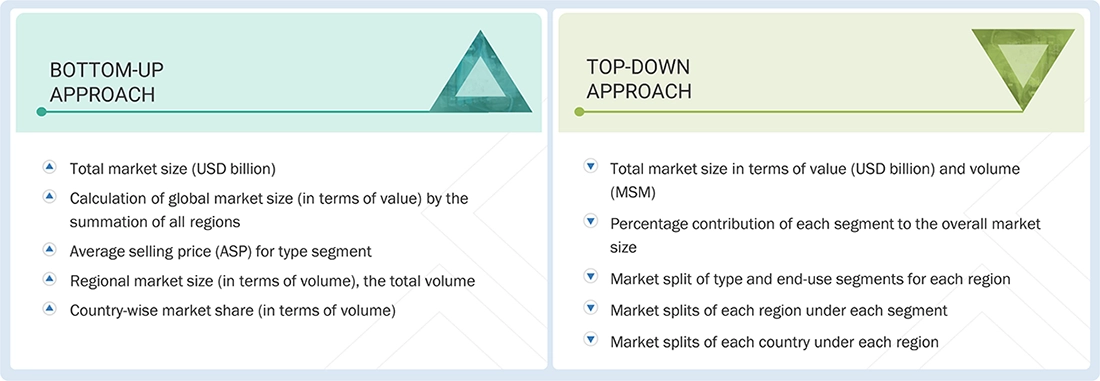
The top-down and bottom-up approaches were used to estimate and validate the size of the global modular flooring market. These approaches were also used extensively to estimate the size of various dependent market segments.
The research methodology used to estimate the market size included the following approaches:
Data Triangulation
After arriving at the overall market size using the market size estimation processes, the market was split into several segments and subsegments. The data triangulation and market breakup procedures were employed, wherever applicable, to complete the overall market engineering process and arrive at the exact statistics of each market segment and subsegment. The data was triangulated by studying various factors and trends from both the demand and supply sides.
Market Definition
Modular flooring refers to pre-engineered flooring units such as tiles or planks designed for easy installation, replacement, and reconfiguration, excluding carpet tile systems. These flooring solutions are typically manufactured using materials such as luxury vinyl, ceramic, rubber, polyolefin, and other resilient compounds to deliver durability, moisture resistance, and dimensional stability. Modular flooring is widely used in commercial, institutional, and residential spaces due to its ease of maintenance, flexibility in design, and ability to support fast, low-disruption installations.
Stakeholders
- Raw Material Suppliers
- Regulatory Bodies
- Government and Consulting Firms
- End Users
- Research and Development Organizations
- Modular Flooring Manufacturers, Dealers, Traders, and Suppliers
Report Objectives
- To define, describe, and forecast the size of the global modular flooring market based on product type, installation technique, end-use, and region in terms of value and volume
- To provide detailed information on the significant drivers, restraints, opportunities, and challenges influencing the market
- To analyze and forecast the market based on product type, installation technique, end-use, and manufacturing process
- To strategically analyze micro markets concerning individual growth trends, prospects, and their contribution to the market
- To assess the growth opportunities in the market for stakeholders and provide details on the competitive landscape for market leaders
- To forecast the market size of segments for North America, Europe, the Asia Pacific, South America, and the Middle East & Africa
- To strategically profile key players and comprehensively analyze their market shares and core competencies
- To analyze competitive developments, such as product launches, expansions, partnerships, and acquisitions in the modular flooring market
- To provide the impact of AI on the modular flooring market
Get the Full Modular Flooring Market Report
Full forecast, segment splits, and company analysis for all Modular Flooring Market.
- US Modular Flooring Market
- Canada Modular Flooring Market
- Mexico Modular Flooring Market
- Germany Modular Flooring Market
- France Modular Flooring Market
- UK Modular Flooring Market
- Italy Modular Flooring Market
- China Modular Flooring Market
- India Modular Flooring Market
- Japan Modular Flooring Market
- South Korea Modular Flooring Market
- Brazil Modular Flooring Market
- Argentina Modular Flooring Market
- Rest Of Europe Modular Flooring Market
- Rest Of Asia Pacific Modular Flooring Market
- GCC Countries Modular Flooring Market
- –Other GCC Countries Modular Flooring Market
Need a Tailored Report?
Customize this report to your needs
Get 10% FREE Customization
Customize This Report
