
Rest Of Europe Modular UPS Market (2024-2029)

The Rest Of Europe Modular UPS Market was valued at $403.8 Million in 2024 and projected to reach to $625.4 Million by 2029, representing a compound annual growth rate of 7.6%. Rest Of Europe's modular UPS market is positioned for sustained expansion as organizations prioritize business continuity and energy efficiency.


| Market Size in | USD 26.32 MN |
| Market Forecast in | |
| CAGR | |
| Forecast Period | |
| Units Considered | Value (USD MN) |
Rest Of Europe Modular UPS Market Trends and Insights
- This represents a compound annual growth rate (CAGR) of 7.6%, reflecting increasing demand for scalable and efficient power backup solutions across the region.
- Rest Of Europe is witnessing rising adoption of modular UPS systems driven by digital transformation initiatives, data center expansion, and heightened focus on business continuity across enterprises. The modular architecture of UPS systems in Rest Of Europe appeals to organizations seeking flexibility and cost optimization, particularly in mid-market and large-scale deployments.
- Rest Of Europe's market growth is supported by regulatory compliance requirements, aging infrastructure modernization, and the proliferation of cloud computing services.
- Between 2024 and 2029, Rest Of Europe is expected to see accelerated investment in IT infrastructure resilience, positioning modular UPS solutions as a critical component of enterprise power management strategies..
Key Market Statistics
- CAGR (2024-2029) 7.6% CAGR
- Market Size, 2024 ~USD 403.8 Million
- Forecast, 2029 ~USD 625.4 Million
- Country Rest Of Europe
Rest Of Europe Modular UPS Market Overview
Steady Regional Growth :
Rest Of Europe's modular UPS market is valued at USD 403.8 million in 2024, with a projected CAGR of 7.6% through 2029, reaching USD 625.4 million. This growth trajectory reflects consistent demand for scalable power solutions across diverse European markets.
Digital Transformation Drivers :
Rising digitalization across Rest Of Europe is accelerating adoption of modular UPS systems. Enterprises are increasingly investing in flexible, scalable power backup infrastructure to support cloud migration, data center expansion, and IT modernization initiatives.
SME and Mid-Market Expansion :
Small and medium-sized enterprises in Rest Of Europe are driving significant demand for modular UPS solutions. The scalability and cost-efficiency of modular systems make them attractive for businesses seeking to optimize capital expenditure while maintaining operational resilience.
Regulatory Compliance Focus :
Stricter EU energy efficiency regulations and data protection standards are compelling organizations across Rest Of Europe to upgrade to modern modular UPS systems that offer better monitoring, efficiency ratings, and compliance capabilities.
Rest Of Europe Modular UPS Market Dynamics
- The region's diverse industrial base, combined with increasing digitalization across manufacturing, healthcare, and financial services sectors, creates robust demand for scalable power solutions.
- Investment in critical infrastructure modernization and growing awareness of modular systems' flexibility are key growth catalysts. Looking ahead to 2029, Rest Of Europe will benefit from technological advancements in modular architecture, improved battery technologies, and enhanced remote monitoring capabilities.
- The shift toward sustainable operations and renewable energy integration will further drive adoption of efficient modular UPS systems.
- Regional players and global vendors are expected to intensify competition, offering customized solutions tailored to local market needs and regulatory requirements..
Market Ecosystem
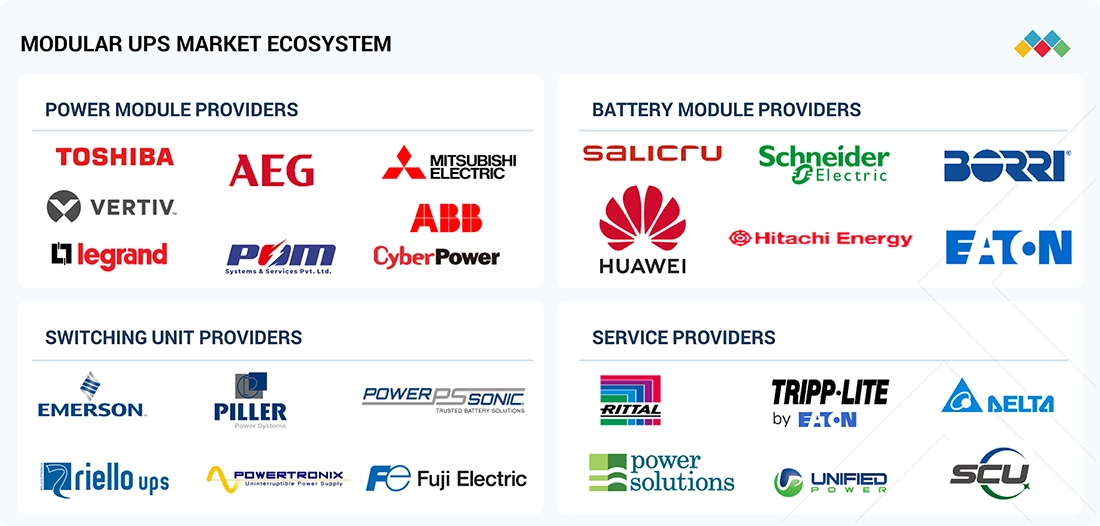
Modular UPS Market: COMMERCIAL USE CASES ACROSS INDUSTRIES
| COMPANY | USE CASE DESCRIPTION | BENEFITS |
|---|---|---|
 |
Ficolo, a leading data center operator, deployed ABB's DPA UPS system to address challenges in maintaining uninterrupted power, scaling operations, and improving energy efficiency. The solution featured: Hot-swappable modules for zero-downtime maintenance Scalable architecture to support dynamic load growth Integration with renewable energy sources for sustainable operations | Flexible power scalability aligned with workload expansion Lower operational costs through high-efficiency power conversion Continuous uptime with modular redundancy and real-time monitoring |
 |
Faced with space limitations, Converge ICT Solutions Inc. required ultra-reliable power and implemented a Huawei SmartLi UPS solution equipped with intelligent lithium-ion battery systems. This deployment enabled: High-density power delivery in a compact footprint An extended battery lifecycle reducing replacement frequency Modular design for seamless expansion and maintenance | Optimized space utilization for power infrastructure Long-lasting lithium-ion batteries enhancing reliability and sustainability Redundant, scalable power architecture supporting mission-critical workloads |
Logos and trademarks shown above are the property of their respective owners. Their use here is for informational and illustrative purposes only.
Related Ecosystem
Engines And Gensets
- Fuel Cell
- Agricultural Tractors
- Analytics Software
- Biometric Systems
- Cogeneration
- General Electric Company
- Wartsila
- Siemens ag
- Cummins Inc.
- UNIPER GLOBAL COMMODITIES SE
Data Centre And Networking
- Software-Defined Networking (SDN)
- Mid-Sized Data Centers
- Small Data Centers
- Remote Monitoring
- Smart Healthcare
- Cisco Systems, Inc.
- HUAWEI TECHNOLOGIES CO LTD
- Hewlett Packard Enterprise Company
- MITSUBISHI ELECTRIC INFORMATION NETWORK CORPORATION
- MITSUBISHI ELECTRIC INFORMATION SYSTEMS CORPORATION
Key Takeaways
- Rest Of Europe's modular UPS market is valued at USD 403.8 million in 2024 and will grow to USD 625.4 million by 2029, representing a 7.6% CAGR.
- Rest Of Europe is experiencing increased demand for modular UPS systems due to digital transformation and data center expansion initiatives.
- Scalability and cost-efficiency of modular UPS architectures are driving adoption across mid-market and enterprise segments in Rest Of Europe.
- Rest Of Europe's market growth is supported by regulatory compliance, infrastructure modernization, and cloud computing proliferation through 2029.
Modular UPS Market Report Scope
| Report Metric | Details |
|---|---|
| Base Year | 2024 |
| Fastest Growing Segment | ALL-IN-ONE MODULES (Type) |
| Forecast Period | 2024-2029 |
| Growth Rate | CAGR of 9.8% from 2024 to 2029 |
| Largest Segment | PREFABRICATED MODULES (Type) |
| Market Size Base Year (Billions) | ~USD 5.43 (2024) |
| Revenue Forecast (Billions) | ~USD 9.52 (2029) |
| Segments Covered | Component, Service, Type, Power Capacity, Voltage, Phase Type, Form Factor, Battery Type, Organization Size, Technology Type, End User, Professional Service, Solution |
Rest Of Europe Modular UPS Market Report Segmentation
13 segment dimensions are covered across the global market.
By Component
- Services
- Solutions
By Service
- Design & Consulting
- Integration & Deployment
- Managed Services
- Professional Services
- Support & Maintenance
By Type
- All-In-One Modules
- Cabling Infrastructure
- Design & Consulting
- Design And Consulting
- Installation & Deployment
- Integration & Deployment
- Integration And Deployment
- Maintenance & Support
- Power Backup
- Power Distribution
- Power Monitoring
- Prefabricated Modules
- Support & Maintenance
- Support And Maintenance
- Training & Education
By Power Capacity
- Large (Above 500 Kw)
- Large(Above 500 Kw)
- Medium (101-500 Kw)
- Medium(101-500 Kw)
- Small (Up To 100 Kw)
By Voltage
- High-Voltage Modular Ups (481-1,000 V)
- Low-Voltage Modular Ups (100-250 V)
- Medium-Voltage Modular Ups (251-480 V)
- Ultrahigh-Voltage Modular Ups (>1,000 V)
By Phase Type
- Single-Phase Ups
- Three-Phase Ups
By Form Factor
- Freestanding Ups
- Rack-Mounted Ups
By Battery Type
- Lead-Acid Batteries
- Lithium-Ion Batteries
- Nickel-Cadmium Batteries
By Organization Size
- Large Enterprises
- Smes
By Technology Type
- Double Conversion Online Ups
- Line-Interactive Ups
By End User
- Bfsi
- Commercial
- Data Centers
- Government & Defense
- Healthcare & Life Science
- Healthcare & Life Sciences
- Industrial
- It & Telecom
- Other End Users
- Residential
By Professional Service
- Installation & Deployment
- Maintenance & Support
- Training & Education
By Solution
- Cooling Modules
- It Modules
- Power Modules
Target Audience
- UPS Manufacturers & Vendors : Develop region-specific product strategies and pricing models for Rest Of Europe. Understand local demand patterns, competitive positioning, and growth opportunities to optimize market share and revenue expansion across diverse European markets.
- System Integrators & Resellers : Identify high-potential customer segments and vertical markets in Rest Of Europe. Access market intelligence to guide solution design, channel partnerships, and sales strategies tailored to regional enterprise requirements and budget constraints.
- Enterprise IT & Facilities Managers : Evaluate modular UPS solutions for data center upgrades and business continuity planning. Benchmark Rest Of Europe market trends, best practices, and vendor offerings to make informed procurement decisions aligned with organizational resilience goals.
- Investment & Private Equity Firms : Assess growth potential and investment opportunities in Rest Of Europe's modular UPS market. Analyze market dynamics, competitive landscape, and financial projections to identify acquisition targets and portfolio optimization strategies.
- Consulting & Advisory Firms : Support client engagements with authoritative Rest Of Europe market data and insights. Provide strategic recommendations on infrastructure investments, vendor selection, and market entry strategies backed by comprehensive regional market analysis.
Reasons to Buy this Report
- Regional Market Sizing & Forecasts : Obtain precise market valuation data specific to Rest Of Europe (USD 403.8M in 2024) with detailed 5-year forecasts. Make informed investment and expansion decisions based on region-specific growth trajectories and CAGR analysis.
- Competitive Landscape Intelligence : Understand Rest Of Europe's competitive dynamics, key players, and market positioning. Identify growth opportunities, market gaps, and strategic partnerships tailored to the region's unique business environment and customer preferences.
- Segment & Application Analysis : Access detailed breakdowns of modular UPS adoption across Rest Of Europe's key sectors including IT, healthcare, manufacturing, and financial services. Identify high-growth segments and vertical-specific opportunities for targeted market penetration.
- Regulatory & Compliance Insights : Stay informed on EU energy efficiency standards, data protection regulations, and local compliance requirements affecting modular UPS adoption in Rest Of Europe. Align product development and go-to-market strategies with regional regulatory frameworks.
- Customer Demand & Trend Analysis : Discover emerging trends driving modular UPS adoption in Rest Of Europe, including digital transformation initiatives, sustainability goals, and infrastructure modernization. Anticipate customer needs and develop solutions aligned with regional market dynamics.
Frequently asked questions
What is the current market size of modular UPS in Rest Of Europe?
Rest Of Europe's modular UPS market is valued at USD 403.8 million in 2024.
What is the projected market size for Rest Of Europe by 2029?
Rest Of Europe's modular UPS market is forecast to reach USD 625.4 million by 2029.
What is the CAGR for Rest Of Europe's modular UPS market?
Rest Of Europe's modular UPS market is expected to grow at a CAGR of 7.6% from 2024 to 2029.
What factors are driving growth in Rest Of Europe's modular UPS market?
Rest Of Europe's market growth is driven by digital transformation, data center expansion, regulatory compliance requirements, infrastructure modernization, and cloud computing adoption.
Which segments are adopting modular UPS solutions in Rest Of Europe?
Rest Of Europe's mid-market and enterprise organizations are increasingly adopting modular UPS systems for their scalability, flexibility, and cost-optimization benefits.
RESEARCH METHODOLOGY
The study comprised four main activities to estimate the modular UPS market size. We conducted significant secondary research to gather data on the market, the competing market, and the parent market. The following stage involved conducting primary research to confirm these conclusions and hypotheses and sizing with industry experts throughout the value chain. The overall market size was evaluated using a blend of top-down and bottom-up approach methodologies. After that, we estimated the market sizes of the various modular UPS market segments using the market breakup and data triangulation techniques.
Secondary Research
We determined the size of companies offering modular UPS based on secondary data from paid and unpaid sources. We also analyzed major companies' product portfolios and rated them based on their performance and quality.
In the secondary research process, various sources were referred to identify and collect information for this study. Secondary sources included annual reports, press releases, and investor presentations of companies; white papers, journals, and certified publications; and articles from recognized authors, directories, and databases. The data was also collected from other secondary sources, such as journals, government websites, blogs, and vendors' websites. Additionally, the spending of various countries on the modular UPS market was extracted from the respective sources. We used secondary research to obtain the critical information related to the industry's value chain and supply chain to identify the key players based on offering, market classification, and segmentation according to components of the major players, industry trends related to components, users, and regions, and the key developments from both market- and technology-oriented perspectives.
Primary Research
In the primary research process, we interviewed various primary sources from the supply and demand sides of the modular UPS market to obtain qualitative and quantitative information. The primary sources from the supply side included industry experts, such as Chief Executive Officers (CEOs), Vice Presidents (VPs), marketing directors, technology and innovation directors, and related key executives from vendors providing offerings, associated service providers, and operating in the targeted countries. All possible parameters that affect the market covered in this research study have been accounted for, viewed in extensive detail, verified through primary research, and analyzed to arrive at the final quantitative and qualitative data.
After the complete market engineering process (including calculations for market statistics, market breakup, market size estimations, market forecasting, and data triangulation), we conducted extensive primary research to gather information and verify and validate the critical numbers arrived at. The primary research also helped identify and validate the segmentation, industry trends, key players, competitive landscape, and market dynamics, such as drivers, restraints, opportunities, challenges, and key strategies. In the complete market engineering process, the bottom-up approach and several data triangulation methods were extensively used to perform market estimation and market forecasting for the overall market segments and subsegments listed in this report. We conducted an extensive qualitative and quantitative analysis of the complete market engineering process to list the key information/insights throughout the report.
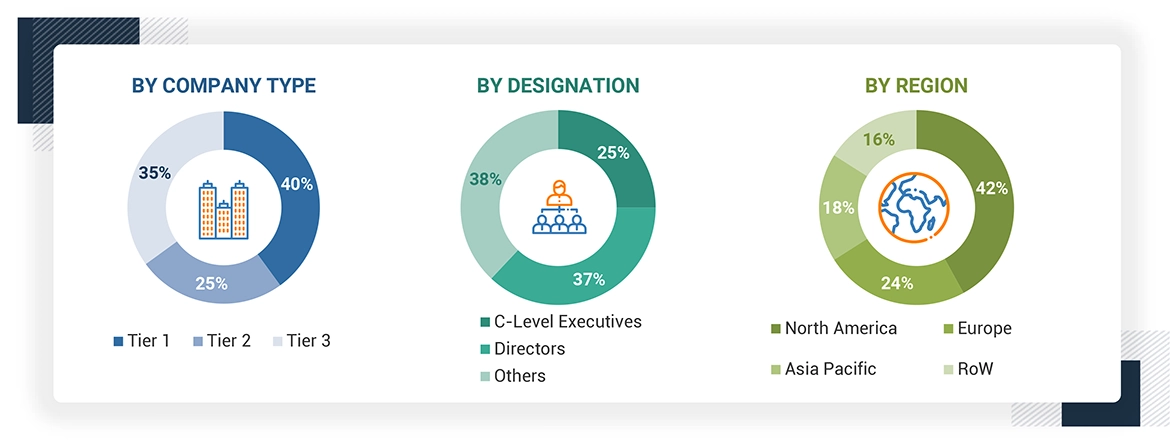
Note 1: Tier 1 companies have revenues greater than USD 10 billion; tier 2 companies' revenues
range between USD 1 and 10 billion; and tier 3 companies' revenues range between USD 500 million
and 1 billion
Note 2: Others include sales, marketing, and product managers.
Source: Secondary Literature, Interviews with Experts, and MarketsandMarkets Analysis
To know about the assumptions considered for the study, download the pdf brochure
Market Size Estimation
Multiple approaches were adopted for estimating and forecasting the web content management market. The first approach involves estimating the market size by companies’ revenue generated through the sale of WCM products.
Market Size Estimation Methodology- Top-down approach
The modular UPS market and related submarkets were estimated and forecasted using top-down and bottom-up methodologies. We used the bottom-up method to determine the market's overall size, using the revenues and product offerings of the major market players. This research ascertained and validated the precise value of the total parent market size through data triangulation techniques and primary interview validation. Next, using percentage splits of the market segments, we utilized the overall market size in the top-down approach to estimate the size of other individual markets.
Modular UPS Market : Top-Down and Bottom-Up Approach
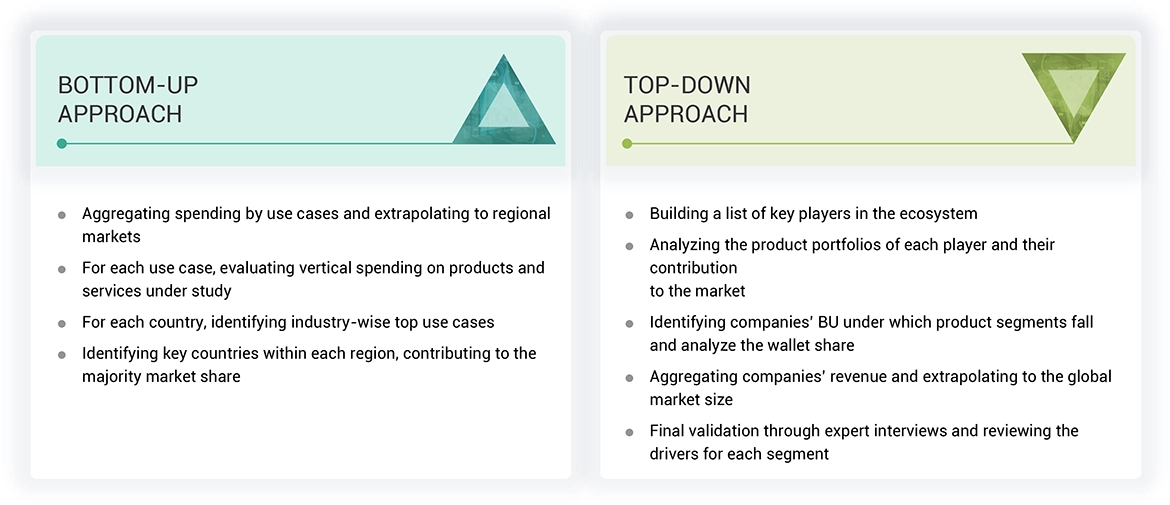
The research methodology used to estimate the market size included the following:
- We used primary and secondary research to determine the revenue contributions of the major market participants in each country after secondary research helped identify them.
- Throughout the process, we obtained critical insights by conducting in-depth interviews with industry professionals, including directors, CEOs, VPs, and marketing executives, and by reading the annual and financial reports of the top firms in the market.
- We used primary sources to verify all percentage splits and breakups, which we calculated using secondary sources.
Data Triangulation
Once the overall market size was determined, we divided the market into segments and subsegments using the previously described market size estimation procedures. When required, market breakdown and data triangulation procedures were employed to complete the market engineering process and specify the exact figures for every market segment and subsegment. The data was triangulated by examining several variables and patterns from government entities' supply and demand sides.
Market Definition
Considering the views of various sources and associations, MarketsandMarkets defines Modular UPS (Uninterruptible Power Supply) as a power backup system designed with a modular architecture, allowing individual components such as power, battery, and control modules to be added or removed as needed. This flexibility enables users to scale the system according to their power requirements, optimize efficiency, and ensure ease of maintenance through hot-swappable modules.
The design enhances adaptability and minimizes downtime, making modular UPS systems especially useful for applications in dynamic environments such as data centers, healthcare facilities, industrial operations, and IT infrastructure. Their scalability, energy efficiency, and fault-tolerant capabilities address the growing need for reliable and customizable power solutions.
Stakeholders
- Modular UPS vendors
- Technology partners
- Consulting firms
- Resellers and distributors
- Enterprise users
- Technology providers
- IT infrastructure equipment providers
- Component providers
- System integrators
- Support service providers
- Consulting service providers
- Cloud service providers
- Data center vendors
- Colocation providers
- Government and standardization bodies
Report Objectives
- To define, describe, and forecast the modular UPS market based on Component (Solutions [Power Modules, Battery Modules, Display Units, Switching Units], Services [Professional Services and Managed Services]), Power Capacity, Voltage, Phase Type, Technology Type, Form Factor, Battery Type, Organization Size, End User, and Region.
- To forecast the market size of the five major regional segments: North America, Europe, Asia Pacific, the Middle East & Africa, and Latin America
- To strategically analyze the market subsegments concerning individual growth trends, prospects, and contributions to the total market
- To provide detailed information related to the significant factors influencing the growth of the market (drivers, restraints, opportunities, and challenges)
- To strategically analyze macro and micro-markets for growth trends, prospects, and their contributions to the overall market
- To analyze industry trends, patents and innovations, and pricing data related to the market
- To analyze the opportunities in the market for stakeholders and provide details of the competitive landscape for major players
- To analyze the impact of AI/GenAI on the modular UPS market
- To profile key players in the market and comprehensively analyze their market share/ranking and core competencies.
- To track and analyze competitive developments, such as mergers & acquisitions, product launches and enhancements, and partnerships & collaborations in the market.
Available Customizations
MarketsandMarkets provides customizations based on the company's unique requirements using market data. The following customization options are available for the report:
Product Analysis
- The product matrix provides a detailed comparison of each company's portfolio.
Geographic Analysis as per Feasibility
- Further breakup of the modular UPS market
Company Information
- Detailed analysis and profiling of five additional market players
Get the Full Modular UPS Market Report
Full forecast, segment splits, and company analysis for all Modular UPS Market.
- US Modular UPS Market
- Canada Modular UPS Market
- UK Modular UPS Market
- Germany Modular UPS Market
- France Modular UPS Market
- Italy Modular UPS Market
- China Modular UPS Market
- Japan Modular UPS Market
- India Modular UPS Market
- UAE Modular UPS Market
- South Africa Modular UPS Market
- Brazil Modular UPS Market
- Mexico Modular UPS Market
- Rest Of Asia Pacific Modular UPS Market
- Rest Of Latin America Modular UPS Market
- GCC Modular UPS Market
- Rest Of GCC Modular UPS Market
- Saudi Arabia Modular UPS Market
Need a Tailored Report?
Customize this report to your needs
Get 10% FREE Customization
Customize This Report
