
India Motor & Motor-Drive Sensors Market (2026-2035)

The India Motor & Motor-Drive Sensors Market was valued at $156.4 Million in 2026 and projected to reach to $393.6 Million by 2035, representing a compound annual growth rate of 10.8%. India's motor and motor-drive sensors market is positioned for exceptional growth over the next decade, driven by the country's ambitious electrification goals and industrial transformation.


| Market Size in | USD 26.32 MN |
| Market Forecast in | |
| CAGR | |
| Forecast Period | |
| Units Considered | Value (USD MN) |
India Motor & Motor-Drive Sensors Market Trends and Insights
- This represents a compound annual growth rate of 10.8%, significantly outpacing global averages, driven by India's rapid industrialization, automotive electrification, and manufacturing sector growth.
- India's expanding EV adoption, coupled with increased automation in factories and smart appliance demand, is accelerating sensor deployment across multiple end-use verticals. The Indian market benefits from favorable government policies promoting electric vehicles and renewable energy integration, alongside rising domestic semiconductor manufacturing capabilities.
- India's position as a global manufacturing hub and growing consumer electronics production further amplify demand for advanced motor control and sensing technologies.
- Between 2026 and 2035, India is expected to capture increasing market share within the Asia Pacific region, supported by infrastructure investments and technology localization initiatives that enhance competitive positioning in motor-drive sensor applications..
Key Market Statistics
- CAGR (2026-2035) 10.8% CAGR
- Market Size, 2026 ~USD 156.4 Million
- Forecast, 2035 ~USD 393.6 Million
- Country India
India Motor & Motor-Drive Sensors Market Overview
Rapid Market Expansion :
India's motor and motor-drive sensors market is projected to grow from USD 156.4 million in 2026 to USD 393.6 million by 2035, representing a robust 10.8% CAGR that significantly exceeds the global average of 6.1%.
EV Adoption Catalyst :
India's expanding electric vehicle adoption is a primary growth driver, with increasing demand for advanced motor control and sensor technologies in both passenger and commercial EV segments across the country.
Industrial Modernization :
Rapid industrialization and manufacturing sector growth in India are accelerating demand for motor-drive sensors in automation, robotics, and industrial machinery applications across diverse sectors.
Automotive Electrification :
India's automotive industry transition toward electrification is creating substantial opportunities for motor and motor-drive sensor manufacturers to supply OEMs and tier-1 suppliers with advanced sensing solutions.
India Motor & Motor-Drive Sensors Market Dynamics
- The 10.8% CAGR reflects strong tailwinds from government initiatives promoting EV adoption, manufacturing expansion, and smart factory implementations across India's industrial landscape. The market's trajectory is supported by increasing investments in automotive technology, rising consumer demand for electric vehicles, and the integration of IoT and Industry 4.0 solutions in Indian manufacturing.
- As India strengthens its position as a global manufacturing hub and accelerates its green energy transition, motor-drive sensor adoption will become increasingly critical for competitive advantage and regulatory compliance..
Market Ecosystem

MOTOR & MOTOR-DRIVE SENSORS MARKET: COMMERCIAL USE CASES ACROSS INDUSTRIES
| COMPANY | USE CASE DESCRIPTION | BENEFITS |
|---|---|---|
 |
Provides current-sensing solutions for DC motor drives, servo motors, motor drives, mobile robots, and industrial motor-control systems, supporting phase-current feedback and motor-drive protection | Enables precise motor control | Improves power efficiency | Enables real-time current feedback | Supports overcurrent and fault detection |
 |
Provides current, voltage, position, and encoder feedback solutions for motor-control systems, including industrial automation, robotics, servo drives, and motor-driven equipment | Improves speed and torque control | Enables precise position feedback | Supports high-performance motion control | Improves system efficiency and stability |
 |
Provides current and position sensing for motor-control applications, including EV traction inverters, industrial motor drives, servo drives, cobots, e-mobility, and BLDC/PMSM motors | Enables accurate rotor-position and phase-current feedback | Improves field-oriented control | Reduces torque ripple | Enhances motor efficiency and responsiveness |
 |
Uses vibration, temperature, shaft-speed, and electrical measurements for condition monitoring of motors, drives, generators, and complete powertrains. | Enables early fault detection | Supports predictive maintenance | Reduces unplanned downtime | Extends equipment lifetime |
 |
Provides motor-phase current sensing for BLDC, stepper, and other motor-drive architectures, including inline, high-side, and low-side current measurement | Enables field-oriented and direct-torque control | Improves motor performance | Enables accurate phase-current measurement | Supports efficient motor operation |
Logos and trademarks shown above are the property of their respective owners. Their use here is for informational and illustrative purposes only.
Related Ecosystem
Electronics System And Components
- Sensors
- Temperature Sensors
- Image Sensors
- Pressure Sensors
- Actuators
- Lenovo
- Samsung
- Texas Instruments Incorporated
- HONEYWELL INTERNATIONAL INC.
- Teledyne Technologies Incorporated
Sensors And Control
- Sensors
- Temperature Sensors
- Image Sensors
- Pressure Sensors
- Flow Sensors
- BAUMER ELECTRIC AG
- HONEYWELL INTERNATIONAL INC.
- Stmicroelectronics
- Lenovo
- Texas Instruments Incorporated
Key Takeaways
- India's motor & motor-drive sensors market will grow from USD 156.4M (2026) to USD 393.6M (2035) at a 10.8% CAGR, outpacing global growth rates.
- India's EV sector expansion and automotive electrification are primary catalysts driving sensor adoption across the country's transportation ecosystem.
- Government initiatives supporting Make in India and renewable energy integration are accelerating domestic semiconductor manufacturing and sensor localization.
- India's industrial automation and smart appliance markets are creating sustained demand for advanced motor control and sensing technologies through 2035.
Motor & Motor-Drive Sensors Market Report Scope
| Report Metric | Details |
|---|---|
| Base Year | 2026 |
| Fastest Growing Segment | LOGISTICS & WAREHOUSING (End-Use Industry) |
| Forecast Period | 2026-2030 |
| Growth Rate | CAGR of 6.1% from 2026 to 2030 |
| Largest Segment | NON-CONTACT (Sensing Type) |
| Market Size Base Year (Billions) | ~USD 3.21 (2026) |
| Revenue Forecast (Billions) | ~USD 4.07 (2030) |
| Segments Covered | Sensor Type, Motor Type, End-Use Industry, Technology Type, Type, Sensing Type |
India Motor & Motor-Drive Sensors Market Report Segmentation
6 segment dimensions are covered across the global market.
By Sensor Type
- Current Sensor
- Other Sensor Types
- Position Sensor
- Speed Sensor
- Temperature Sensor
- Torque Sensor
By Motor Type
- Ac Motor
- Dc Motor
- Linear Motor
- Stepper Motor
By End-Use Industry
- Automotive
- Building Automation
- Industrial Automation
- Logistics & Warehousing
- Medical Devices
- Oil & Gas
- Other End-Use Industries
- Rail/Marine/Aerospace & Defense
- Telecommunications
By Technology Type
- Capacitive
- Inductive
- Magnetic Sensing Technologies
- MEMS
- Optical
- Other Technology Types
- Ultrasonic
By Type
- Amr
- Gmr
- Hall
- Tmr
By Sensing Type
- Contact
- Non-Contact
Target Audience
- Automotive OEMs & Suppliers : Indian and international automotive manufacturers need India-specific sensor market data to optimize supply chain strategies, evaluate local supplier capabilities, and plan EV platform development for the Indian market.
- Sensor & Component Manufacturers : Motor and motor-drive sensor producers require detailed India market insights to identify growth opportunities, assess competitive positioning, and develop localized product strategies for Indian industrial and automotive customers.
- Industrial Automation Companies : Automation and robotics firms targeting India's manufacturing sector need market intelligence on motor-drive sensor adoption rates, technology preferences, and industrial modernization trends to capture emerging opportunities.
- Investment & Private Equity Firms : Investors evaluating opportunities in India's semiconductor and automotive sectors require comprehensive market data on motor-drive sensors to assess portfolio companies, identify acquisition targets, and evaluate growth potential.
- Government & Policy Bodies : Indian government agencies and policy makers need market research on motor-drive sensors to inform industrial policy, EV adoption initiatives, and manufacturing competitiveness strategies aligned with national growth objectives.
Reasons to Buy this Report
- India-Specific Market Sizing : Access precise market valuations and forecasts tailored exclusively to India, enabling accurate budgeting and investment decisions for market entry or expansion strategies in this high-growth region.
- Competitive Positioning Intelligence : Understand India's market dynamics, local competitor landscape, and regional growth drivers to identify strategic opportunities and differentiation strategies specific to Indian automotive and industrial sectors.
- EV Adoption Insights : Gain detailed analysis of India's electric vehicle market trajectory and sensor requirements, critical for suppliers targeting OEMs and tier-1 manufacturers in India's rapidly expanding EV ecosystem.
- Regulatory & Policy Context : Understand India-specific regulatory frameworks, government incentives, and manufacturing policies that directly impact motor-drive sensor demand and market opportunities across automotive and industrial segments.
- Growth Forecasting Accuracy : Leverage India-focused CAGR projections and segment breakdowns to forecast revenue potential, allocate resources effectively, and plan product development roadmaps aligned with regional market evolution.
Frequently asked questions
What is the projected size of India's motor & motor-drive sensors market by 2035?
India's motor & motor-drive sensors market is projected to reach USD 393.6 million by 2035, growing from USD 156.4 million in 2026.
What is the CAGR for India's motor & motor-drive sensors market?
India's motor & motor-drive sensors market is expected to grow at a compound annual growth rate of 10.8% between 2026 and 2035.
What are the primary growth drivers for motor & motor-drive sensors in India?
Key growth drivers include India's automotive electrification, industrial automation expansion, smart appliance adoption, government EV promotion policies, and domestic semiconductor manufacturing initiatives.
How does India's market growth compare to global trends?
India's 10.8% CAGR significantly exceeds the global average of 6.1%, reflecting accelerated industrialization and technology adoption across the country's manufacturing and automotive sectors.
Which industries are driving demand for motor & motor-drive sensors in India?
Primary demand sources include the automotive and EV sectors, industrial manufacturing and automation, consumer electronics and smart appliances, renewable energy systems, and HVAC applications.
RESEARCH METHODOLOGY
The study involved major activities in estimating the current market size for the motor & motor-drive sensors market. Exhaustive secondary research was conducted to collect information on the motor & motor-drive sensors industry. The next step was to validate these findings and assumptions with industry experts across the value chain through primary research. Different approaches, including top-down and bottom-up methods, were employed to estimate the total market size. Following this, market breakdown and data triangulation procedures were used to determine the market size of segments and subsegments.
Secondary Research
Secondary research for this study involved gathering information from various credible sources, including company reports, defense publications, government documents, white papers, journals, and industry publications. This process helped understand the supply and value chains, identify key players, analyze market segmentation and regional trends, and track major market and technology developments. The collected data was used to estimate the overall market size, which was subsequently validated through primary research.
Primary Research
Extensive primary research was conducted after gaining knowledge about the current scenario of the motor & motor-drive sensors market through secondary research. Several primary interviews were conducted with experts from the demand and supply sides across four major regions: North America, Asia Pacific, Europe, and RoW. This primary data was collected through questionnaires, emails, and telephonic interviews.
Breakdown of Primary Interviews
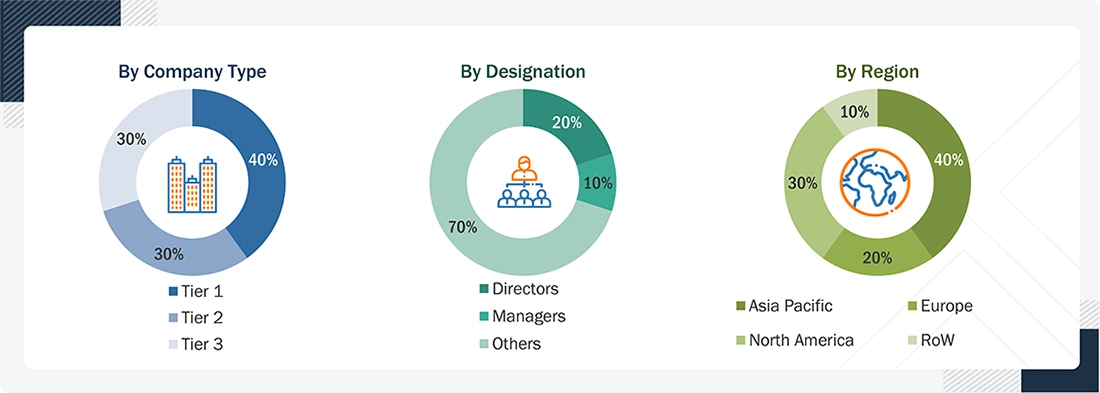
Notes: Other designations include product managers, sales managers, and marketing managers.
Tier 1 companies include market players with revenues above USD 500 million; tier 2 companies earn revenues between USD 100 million and USD 500 million; and tier 3 companies earn up to USD 100 million.
To know about the assumptions considered for the study, download the pdf brochure
Market Size Estimation
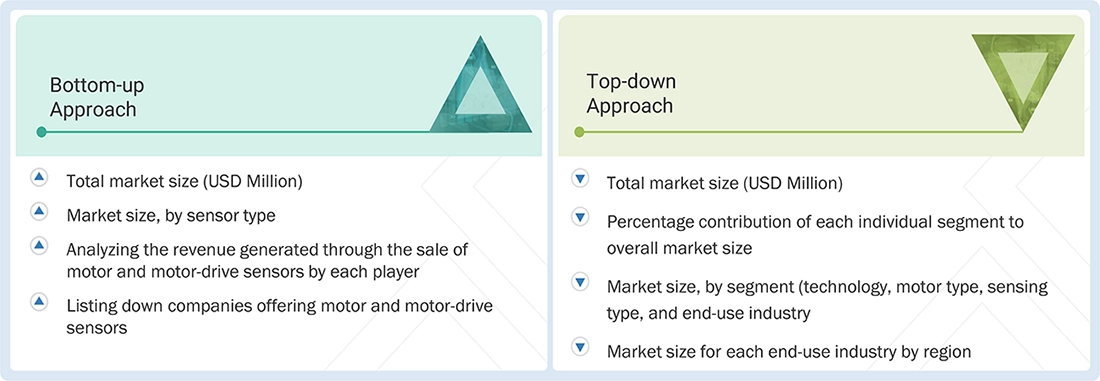
The bottom-up procedure has been employed to arrive at the overall size of the motor and motor-drive sensors market.
- Identifying motor and motor-drive sensors, including temperature, position, speed, current, torque, and other sensors, offered or expected to be offered by players in the value chain
- Tracking the major manufacturers and suppliers of motor and motor-drive sensors across different regions and assessing their relevant product portfolios and application coverage.
- Analyzing company-level revenues and identifying the portion attributable to motor and motor-drive sensor products based on product portfolios, business segments, and application exposure
- Tracking the ongoing and upcoming product launches and different inorganic strategies, such as acquisitions, partnerships, and collaborations
- Estimating the motor and motor-drive sensor revenue for each identified company and aggregating the company-level estimates to derive the market size at the global level
- Validating company-level estimates through product offerings, sensor applications, regional presence, customer industries, shipments, and available financial disclosures
- Conducting multiple discussions with key opinion leaders to understand the types of motor and motor-drive sensors deployed by market players and analyzing the breakup of the scope of work carried out by each major company
- Verifying and cross-checking the estimates at every level by discussing with key opinion leaders, including CEOs, directors, and operations managers, and then finally with the domain experts at MarketsandMarkets
- Studying various paid and unpaid information sources, such as annual reports, press releases, white papers, defense publications, and others
The top-down approach has been used to estimate and validate the total size of the motor and motor-drive sensors market.
- Focusing on top-line investments and expenditures being made in the ecosystems of various end users
- Calculating the market size considering revenues generated by major players through motor and motor-drive sensors
- Segmenting each application of motor and motor-drive sensors in each region and deriving the global market size based on region
- Acquiring and analyzing information related to revenues generated by players through their key product offerings
- Conducting multiple on-field discussions with key opinion leaders involved in the development of various motor and motor-drive sensors, motors, and motor-drive systems
- Estimating the geographic split using secondary sources based on various factors, such as the adoption of motor-driven equipment, industrial automation, automotive production, electrification, and the types of motor and motor-drive sensors deployed across end-use industries
Motor & Motor-Drive Sensors Market : Top-Down and Bottom-Up Approach
Data Triangulation
After arriving at the overall market size using the market size estimation processes as explained above, the market has been split into several segments and subsegments. Data triangulation and market breakdown procedures have been employed to complete the entire market engineering process and arrive at the exact statistics of each market segment and subsegment. The data has been triangulated by studying various factors and trends from the demand and supply sides in the motor and motor-drive sensors market.
Market Definition
Motor and motor-drive sensors are sensing devices used to measure and monitor key operating parameters of electric motors and motor-drive systems, enabling accurate control, protection, and performance monitoring. These sensors measure parameters such as current, position, speed, temperature, torque, and vibration and provide feedback to motor controllers, inverters, and drive systems. The market includes sensor ICs, sensor modules, encoders, resolvers, and other sensing devices based on technologies such as magnetic, inductive, capacitive, MEMS, ultrasonic, and optical sensing. These technologies enable contact and non-contact measurement across different motor architectures and operating conditions, supporting precise motor control, fault detection, and equipment monitoring.
Key Stakeholders
- Sensor IC and Semiconductor Suppliers
- Motor & Motor-Drive Sensor Manufacturers
- Encoder and Resolver Manufacturers
- Motor Manufacturers
- Motor-Drive and Inverter Manufacturers
- Servo and Motion-Control System Providers
- Industrial Automation and Robotics Companies
- Automotive and Electric Vehicle Manufacturers
- Industrial Equipment and Machinery Manufacturers
- OEMs and End-Use Industries
- Research Institutions and Technology Developers
- Distributors and Resellers
- Regulatory and Standards Bodies
- System Integrators and Solution Providers
Report Objectives
- To describe, segment, and forecast the size of the motor and motor-drive sensors market by sensor type, technology type, motor type, sensing type, end-use industry, and region, in terms of value
- To describe, segment, and forecast the size of the motor and motor-drive sensors market by sensor type and country, in terms of volume
- To forecast the size of various market segments across North America, Europe, Asia Pacific, and the Rest of the World (RoW), in terms of value
- To provide detailed information on the drivers, restraints, opportunities, and challenges influencing the growth of the motor and motor-drive sensors market
- To strategically analyze the micro markets with respect to individual growth trends, future prospects, and their contribution to the overall market
- To study industry trends through Porter's Five Forces analysis, macroeconomic outlook, supply chain and ecosystem analyses, technology trends, impact of AI, trade analysis, the impact of US tariffs, patent analysis, case studies, and regulatory frameworks influencing the global motor and motor-drive sensors market.
- To strategically analyze the micromarkets with respect to individual growth trends, prospects, and contributions to the total market
- To benchmark the key market players and analyze their market position in terms of revenue, market share, product portfolio, technological capabilities, regional presence, and core competencies, and provide a detailed competitive landscape for market leaders
- To study competitive developments, such as collaborations, partnerships, product launches, agreements, acquisitions, and investments, in the market
Customization Options
With the given market data, MarketsandMarkets offers customizations according to the company's specific needs. The following customization options are available for the report.
Company Information:
- Detailed analysis and profiling of additional market players (up to five)
Get the Full Motor & Motor-Drive Sensors Market Report
Full forecast, segment splits, and company analysis for all Motor & Motor-Drive Sensors Market.
- Canada Motor & Motor-Drive Sensors Market
- Mexico Motor & Motor-Drive Sensors Market
- US Motor & Motor-Drive Sensors Market
- UK Motor & Motor-Drive Sensors Market
- Germany Motor & Motor-Drive Sensors Market
- France Motor & Motor-Drive Sensors Market
- Italy Motor & Motor-Drive Sensors Market
- Spain Motor & Motor-Drive Sensors Market
- China Motor & Motor-Drive Sensors Market
- Japan Motor & Motor-Drive Sensors Market
- South Korea Motor & Motor-Drive Sensors Market
- Rest Of Europe Motor & Motor-Drive Sensors Market
- Rest Of Asia Pacific Motor & Motor-Drive Sensors Market
Need a Tailored Report?
Customize this report to your needs
Get 10% FREE Customization
Customize This Report
