Position Sensor Market Size, Share & Trends

Position Sensor Market Size, Share and Trends by Type (Linear, Rotary, Proximity, Photoelectric, 3D Sensor), Signal ( Digital, Analog), Technology (Capacitive, Inductive, Optical, Magnetic, Ultrasonic) - Global Forecast to 2032




OVERVIEW
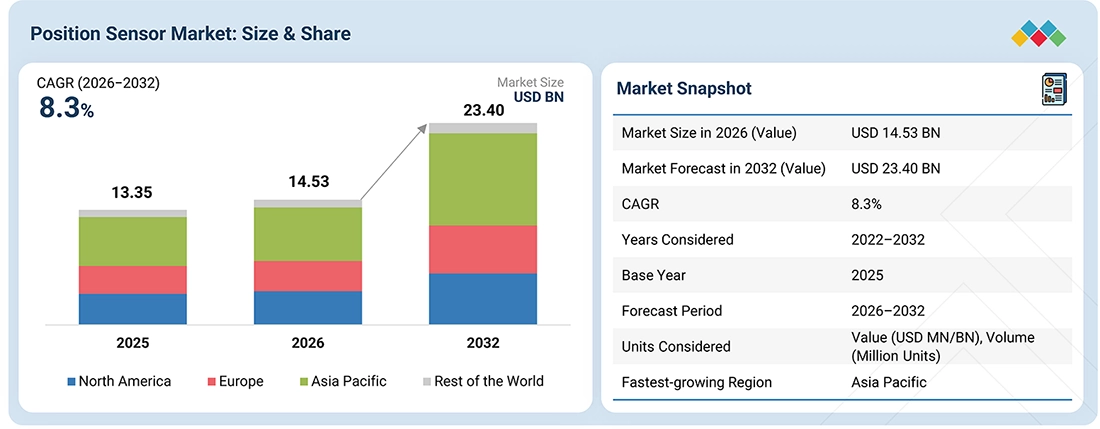
Source: Secondary Research, Interviews with Experts, MarketsandMarkets Analysis
The position sensor market is projected to reach USD 23.40 billion by 2032 from USD 14.53 billion in 2026, growing at a CAGR of 8.3%. The market is witnessing steady growth due to increasing industry investments in industrial automation, robotics, electric vehicles, ADAS, and smart manufacturing across automotive, industrial, aerospace & defense, healthcare, electronics, and packaging applications. The growing demand for precise position measurement, real-time motion control, equipment safety, and automated operations is accelerating the deployment of position sensing solutions. Additionally, advancements in 3D, magnetic, inductive, non-contact, digital, and high-resolution sensing technologies are improving accuracy, reliability, response time, and system integration, supporting the demand for position sensors across diverse applications.
KEY TAKEAWAYS
-
BY REGIONBy region, Asia Pacific accounted for the largest share (~42.5%), in terms of value, of the position sensor market in 2025.
-
BY TYPEBy type, the 3D sensor segment is expected to record a CAGR of 14.4% during the forecast period.
-
BY CONTACT TYPEBy contact type, the non-contact type segment is expected to register a CAGR of ~8.5% between 2026 and 2032.
-
BY SIGNAL OUTPUTBy signal output, the digital segment is expected to exhibit a CAGR of ~8.9% during the forecast period.
-
BY CONNECTIVITYBy connectivity, the wired segment is expected to register a high growth rate during the forecast period.
-
BY TECHNOLOGYBy technology, the inductive segment is expected to register a high growth rate during the forecast period.
-
BY APPLICATIONBy application, the machine tools segment is expected to register a high growth rate during the forecast period.
-
BY END-USER INDUSTRYBy end-user industry, the automotive segment is expected to capture the largest market share in 2032.
-
COMPETITIVE LANDSCAPE (KEY PLAYERS)Honeywell International, TDK Corporation, STMicroelectronics, Amphenol Corp., and SICK AG are identified as key players in the position sensor market due to their strong market presence, extensive sensing portfolios, and advanced capabilities in magnetic, Hall-effect, inductive, optical, 3D, non-contact, and digital position-sensing technologies. Their solutions support applications across automotive, industrial automation, robotics, aerospace & defense, healthcare, and electronics, with a focus on precision position measurement, motion control, reliability, and system integration.
-
COMPETITIVE LANDSCAPE (STARTUPS/SMES)NXP Semiconductors and Renishaw plc, among others, have distinguished themselves through a strong presence in specialized position-sensing applications, particularly magnetic and angular position sensing, optical and inductive encoders, and high-precision motion-control solutions in the global position sensor market
The position sensor market is expected to grow significantly as industries increase investments in industrial automation, robotics, electric vehicles, advanced driver assistance systems (ADAS), and smart manufacturing across automotive, manufacturing, aerospace & defense, healthcare, electronics, and packaging applications. The market is further driven by rising demand for precise position measurement, real-time motion control, equipment reliability, and automated operations. Product innovations and strategic developments by key players such as Honeywell, TDK, STMicroelectronics, Amphenol, SICK, and Infineon Technologies, including advancements in 3D, magnetic, inductive, non-contact, and digital position-sensing technologies, are further strengthening adoption across high-value applications.
TRENDS & DISRUPTIONS IMPACTING CUSTOMERS' CUSTOMERS
Advanced 3D position sensing, inductive and magnetic technologies, digital signal outputs, non-contact sensing, and wired connectivity are transforming automotive, industrial automation, robotics, aerospace & defense, healthcare, and electronics applications. These innovations enable precise position measurement, real-time motion feedback, high reliability, reduced mechanical wear, and improved system performance. Advancements in 3D Hall-effect sensing, TMR sensors, miniaturized sensing elements, digital interfaces, and smart sensing technologies are improving accuracy, noise immunity, and integration with control systems. As automotive OEMs, industrial manufacturers, robotics companies, and other end users increasingly adopt advanced position sensors for EVs, ADAS, actuators, motors, automated machinery, and precision equipment, these technologies are supporting the shift toward higher-value sensing solutions and sustained growth of the global position sensor market.
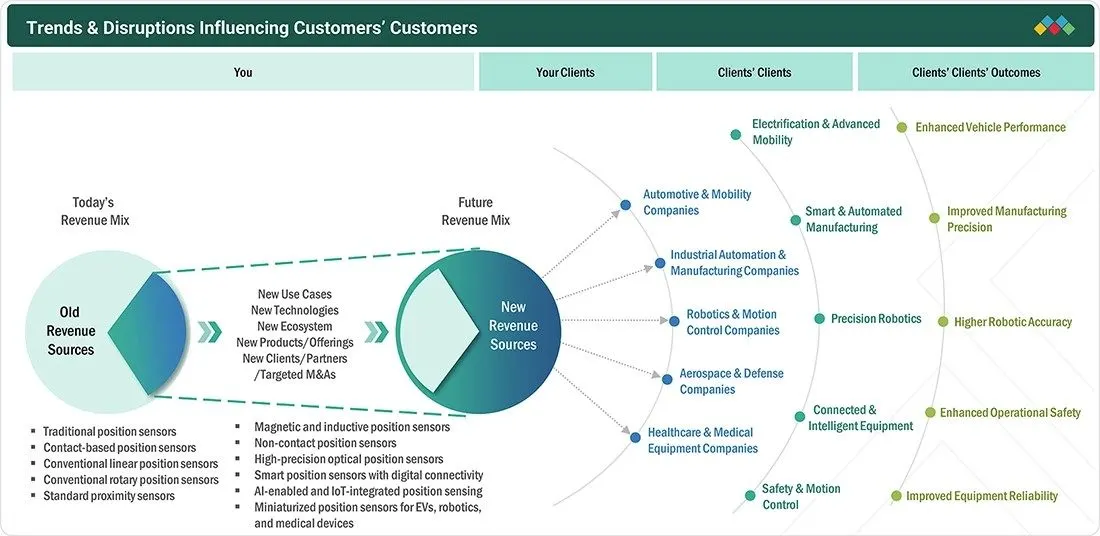
Source: Secondary Research, Interviews with Experts, MarketsandMarkets Analysis
MARKET DYNAMICS

Level
-
Increase in adoption of Industry 4.0 technologies

-
Rise in adoption of position sensors in automotive industry


Level
-
High cost of ownership


Level
-
Integration of position sensors into IoT devices

-
Advancements in robotics and automation


Level
-
Operational limitations in range, performance, and precision of position sensors

Source: Secondary Research, Interviews with Experts, MarketsandMarkets Analysis
Driver: Increase in adoption of Industry 4.0 technologies
The adoption of Industry 4.0 technologies is a key factor driving growth in the position sensor market. Industry 4.0 focuses on automation, data analytics, and connectivity to create smart factories where machines and workers collaborate to optimize production.
Restraint: High cost of ownership
The position sensor market faces restraints due to the complexity of manufacturing and rising cost pressures. Position sensors are made using various components such as magnets, sensing rods, electronic housings, LEDs, and connectors, all of which are sourced from different suppliers.
Opportunity: Integration of position sensors into IoT devices
The integration of position sensors into IoT devices is driving innovation across various applications, enhancing automation, security, and efficiency. In smart homes, position sensors play a pivotal role in automating daily functions and improving user convenience.
Challenge: Operational limitations in range, performance, and precision of position sensors
Many existing position and distance sensors face significant limitations in performance and precision, which impact their usability in high-demand applications. One of the key challenges is the limited range of some sensors, which restricts their effectiveness in tasks requiring long-distance detection, such as in autonomous vehicles or aerospace systems.
POSITION SENSOR MARKET SIZE, SHARE & TRENDS: COMMERCIAL USE CASES ACROSS INDUSTRIES
| COMPANY | USE CASE DESCRIPTION | BENEFITS |
|---|---|---|
 |
Honeywell offers a broad portfolio of position sensors, including magnetic, Hall-effect, resolver, potentiometer, and proximity-based solutions for precise linear, angular, and rotary position measurement. Its non-contact SMART Position Sensors use magnetoresistive technology for accurate motion feedback across transportation, industrial, aerospace, and other demanding applications. | Enables precise motion control | Reduces mechanical wear | Supports harsh-environment operation | Improves equipment reliability and safety |
 |
TDK develops magnetic position-sensing solutions based on TMR and Hall-effect technologies, including 3D position and angle sensors. Its solutions support accurate position and angle detection in automotive and industrial applications, including motors, steering systems, actuators, and precision equipment. | Enables high-accuracy position detection | Supports contactless sensing | Improves motor and actuator control | Enables automotive safety applications |
 |
STMicroelectronics provides digital sensing technologies for position and motion monitoring, including MEMS-based accelerometers, gyroscopes, and inclinometers used to detect orientation, displacement, and rotational movement. These solutions support industrial automation and smart motion-monitoring applications. | Enables accurate motion and orientation sensing | Supports low-power operation | Facilitates automation and control | Enables real-time motion monitoring |
 |
Amphenol offers position sensors through its sensor portfolio, including Hall-effect, inductive, resistive, and magnetostrictive solutions. Its Piher position sensors provide linear, rotary, and angular position measurement for automotive, off-highway, and industrial applications, including harsh operating environments. | Provides accurate position feedback | Supports contactless operation | Withstands harsh environments | Reduces mechanical wear and maintenance |
 |
SICK provides a broad range of position and motion sensing solutions, including absolute, incremental, linear, wire-draw, and non-contact encoders. Its sensors are designed for precise position, speed, and movement measurement across factory, logistics, robotics, and process automation applications. | Enables precise positioning | Supports real-time motion control | Facilitates industrial automation | Improves machine productivity and monitoring |
Logos and trademarks shown above are the property of their respective owners. Their use here is for informational and illustrative purposes only.
MARKET ECOSYSTEM
The position sensor ecosystem comprises sensor component suppliers, position sensor manufacturers and suppliers, system integrators, OEMs, and end users, forming an integrated value chain for position measurement and motion-control solutions. Component suppliers provide sensing elements, magnetic materials, semiconductors, signal-conditioning components, connectors, and other components required for sensor production, while position sensor manufacturers develop linear, rotary, angular, magnetic, inductive, potentiometric, Hall-effect, optical, capacitive, and non-contact sensing solutions for diverse applications. Manufacturers and suppliers such as Honeywell, TE Connectivity, Sensata Technologies, SICK, TDK, Balluff, and AMETEK support the development and deployment of advanced position-sensing technologies across industrial and automotive applications. End users, including automotive OEMs, industrial automation companies, robotics manufacturers, aerospace & defense organizations, electronics manufacturers, healthcare equipment providers, and packaging companies, drive demand for position sensors across automotive, manufacturing, robotics, aerospace, healthcare, and other applications.
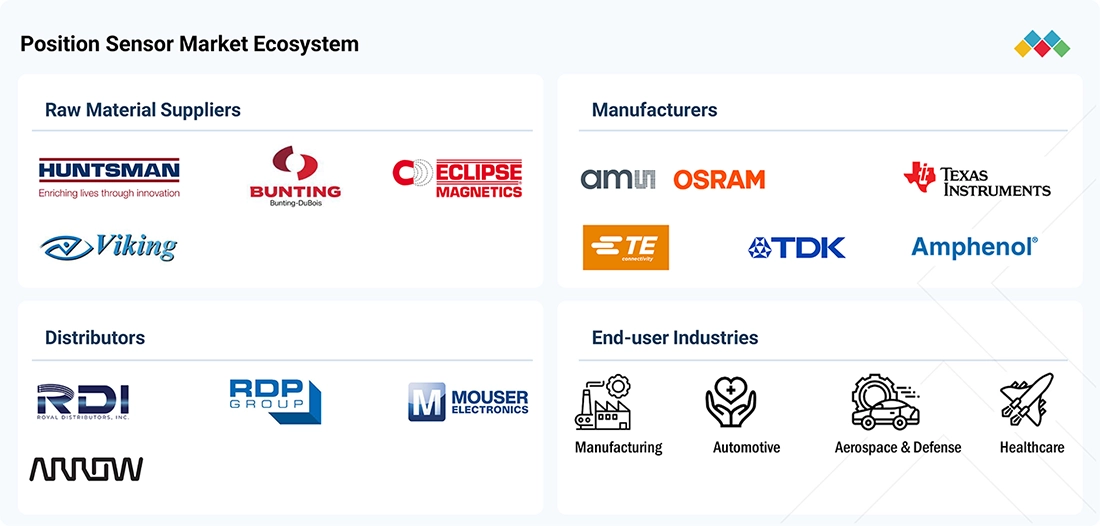
Logos and trademarks shown above are the property of their respective owners. Their use here is for informational and illustrative purposes only.
MARKET SEGMENTS
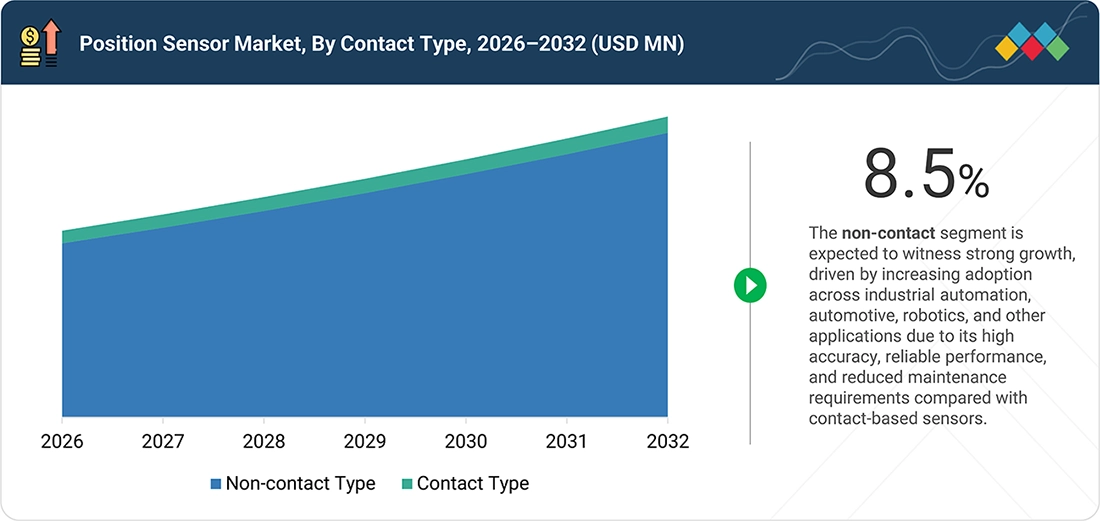
Source: Secondary Research, Interviews with Experts, MarketsandMarkets Analysis
Position Sensor Market, by Type
3D position sensors are expected to register the highest CAGR, driven by increasing adoption of advanced sensing technologies that provide precise spatial and motion measurement across multiple axes. Their ability to deliver accurate, real-time position feedback is expanding their use across robotics, industrial automation, automotive, healthcare, and other advanced applications.
Position Sensor Market, by Contact Type
Non-contact position sensors are estimated to account for the largest market share, driven by their ability to provide accurate position measurement without mechanical contact, reducing wear and maintenance requirements. Their reliability, durability, and suitability for harsh operating environments are supporting widespread adoption across industrial automation, automotive, robotics, aerospace, and other applications.
Position Sensor Market, by Signal Output
Digital signal output is estimated to account for a significant market share due to its high accuracy, noise immunity, and reliable data transmission. Its easy integration with control systems, real-time monitoring capabilities, and suitability for automated applications are driving adoption across industrial automation, automotive, robotics, and other end-use industries.
Position Sensor Market, by Connectivity
Wired connectivity is expected to maintain a prominent position in the position sensor market due to its reliable data transmission, low latency, and stable communication with control systems. Its widespread use in industrial automation, automotive, robotics, and manufacturing applications supports continued adoption where consistent and real-time position feedback is required.
Position Sensor Market, by Technology
Inductive position sensors are expected to maintain a prominent position in the position sensor market due to their high accuracy, contactless operation, and reliable performance in harsh environments. Their resistance to dust, moisture, vibration, and mechanical wear supports widespread adoption across industrial automation, automotive, robotics, aerospace, and other precision sensing applications
Position Sensor Market, by Application
Machine tools are expected to maintain a prominent position in the position sensor market due to the increasing need for precise and reliable position feedback in machining operations. Position sensors, including linear and rotary encoders, inductive sensors, and other non-contact technologies, are used to monitor the position and movement of machine axes, cutting tools, workpieces, and spindles, supporting high-precision machining and automated operations.
Position Sensor Market, by End-user Industry
The automotive segment is anticipated to maintain a prominent position in the position sensor market due to increasing demand for accurate position sensing in vehicle systems. Rising adoption of electric vehicles, advanced driver assistance systems (ADAS), automated transmissions, and electronic control systems, along with growing demand for enhanced vehicle safety, performance, and efficiency, is supporting segment growth.
REGION
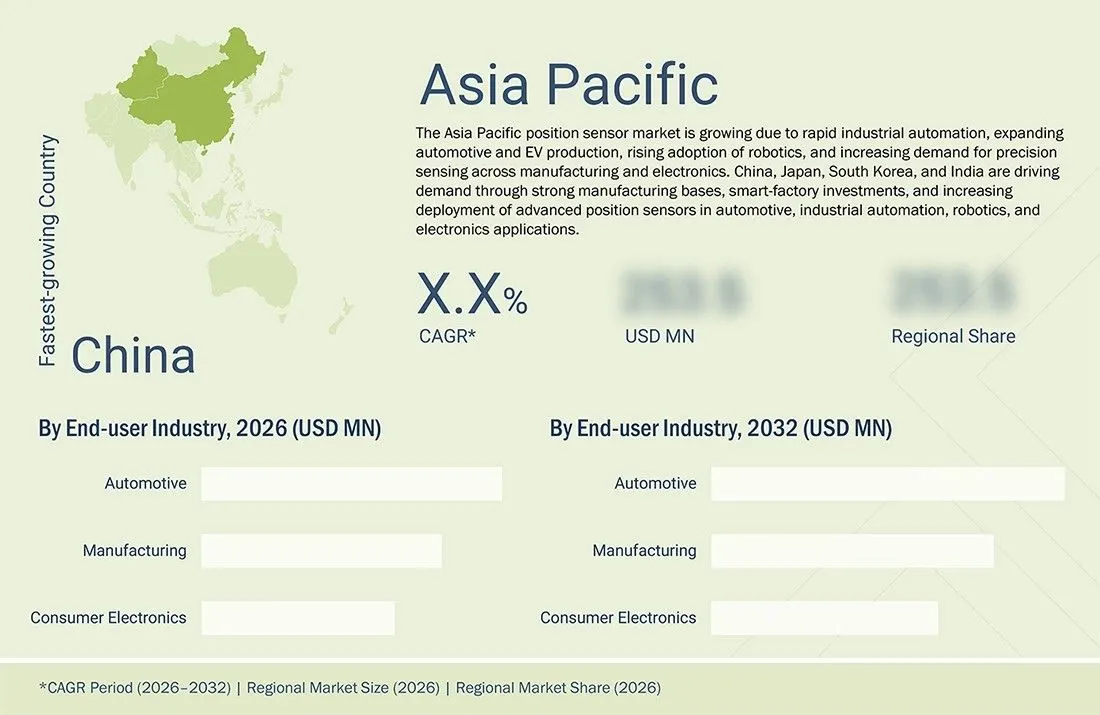
Asia Pacific to be fastest-growing region in global position sensor market during forecast period
The Asia Pacific position sensor market is growing due to rapid industrial automation, expanding automotive and EV production, rising adoption of robotics, and increasing demand for precision sensing across manufacturing and electronics. China, Japan, South Korea, and India are driving demand through strong manufacturing bases, smart-factory investments, and increasing deployment of advanced position sensors in automotive, industrial automation, robotics, and electronics applications.
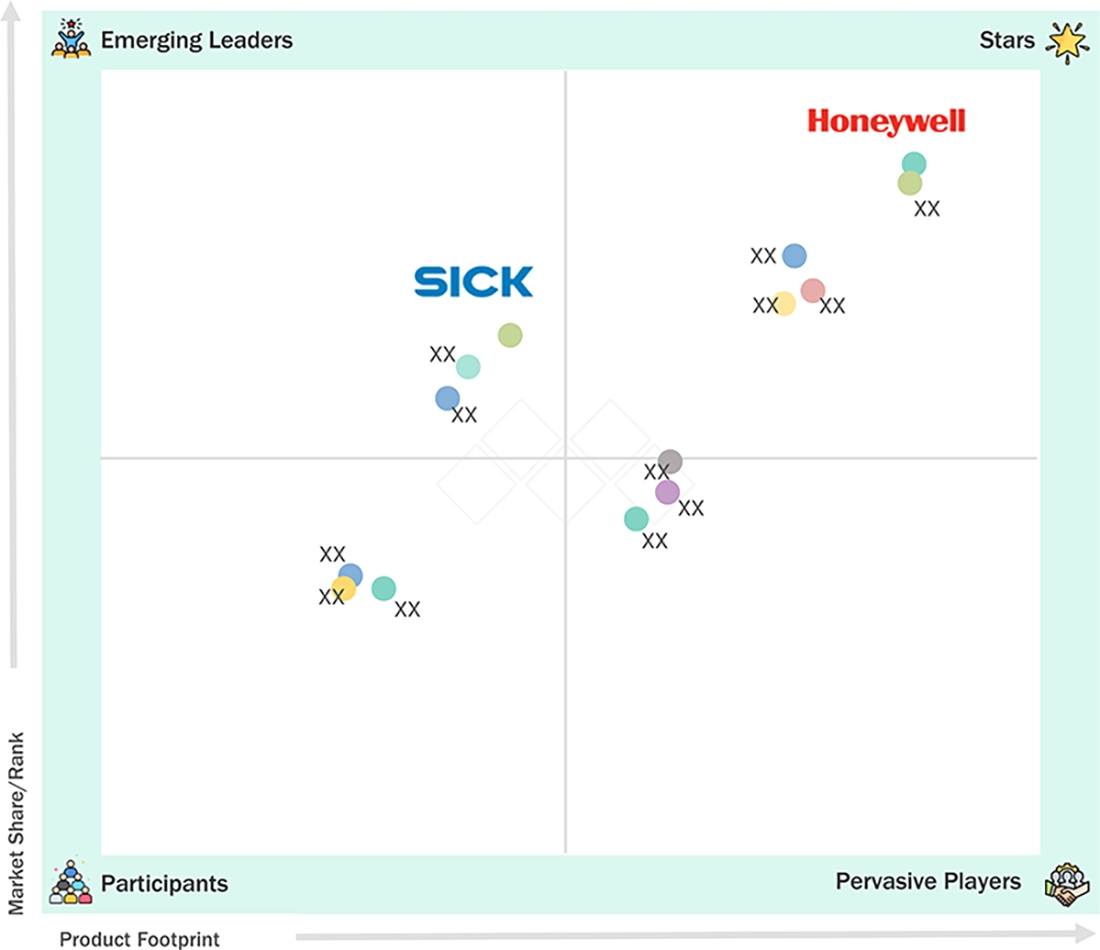
POSITION SENSOR MARKET SIZE, SHARE & TRENDS: COMPANY EVALUATION MATRIX
In the position sensor market matrix, Honeywell (STAR) strengthens its position through its broad portfolio of magnetic, Hall-effect, resolver, potentiometer, proximity, and SMART position sensors, supporting accurate linear, angular, and rotary position measurement across industrial, transportation, and aerospace applications. Its focus on non-contact sensing, precision feedback, rugged operation, and reduced mechanical wear supports applications requiring reliable motion control and equipment performance. SICK (Emerging Leader) is strengthening its position through its portfolio of position and measurement sensors, including non-contact position sensors, displacement measurement technologies, and motion-control solutions. Its sensors support precise positioning, machine automation, robot guidance, quality monitoring, and process control, with technologies such as IO-Link and advanced optical measurement supporting integration into automated manufacturing environments.
Source: Secondary Research, Interviews with Experts, MarketsandMarkets Analysis
KEY MARKET PLAYERS
- Honeywell International (US)
- TDK Corporation (Japan)
- STMicroelectronics (Switzerland)
- Amphenol Corp. (US)
- SICK AG (Germany)
- TE Connectivity (Ireland)
- Texas Instrument Inc. (US)
- Analog Devices Inc. (US)
- CTS Corporation (US)
- Infineon Technologies AG (Germany)
MARKET SCOPE
| REPORT METRIC | DETAILS |
|---|---|
| Market Size in 2025 (Value) | USD 13.35 Billion |
| Market Forecast in 2026 (Value) | USD 14.53 Billion |
| Market Forecast in 2032 (Value) | USD 23.40 Billion |
| Growth Rate | CAGR of 8.3% from 2026 to 2032 |
| Years Considered | 2022–2032 |
| Base Year | 2025 |
| Forecast Period | 2026–2032 |
| Units Considered | Value (USD Million/Billion), Volume (Million Units) |
| Report Coverage | Revenue Forecast, Company Ranking, Competitive Landscape, Growth Factors, and Trends |
| Segments Covered |
|
| Regions Covered | North America, Europe, Asia Pacific, Rest of the World |
WHAT IS IN IT FOR YOU: POSITION SENSOR MARKET SIZE, SHARE & TRENDS REPORT CONTENT GUIDE
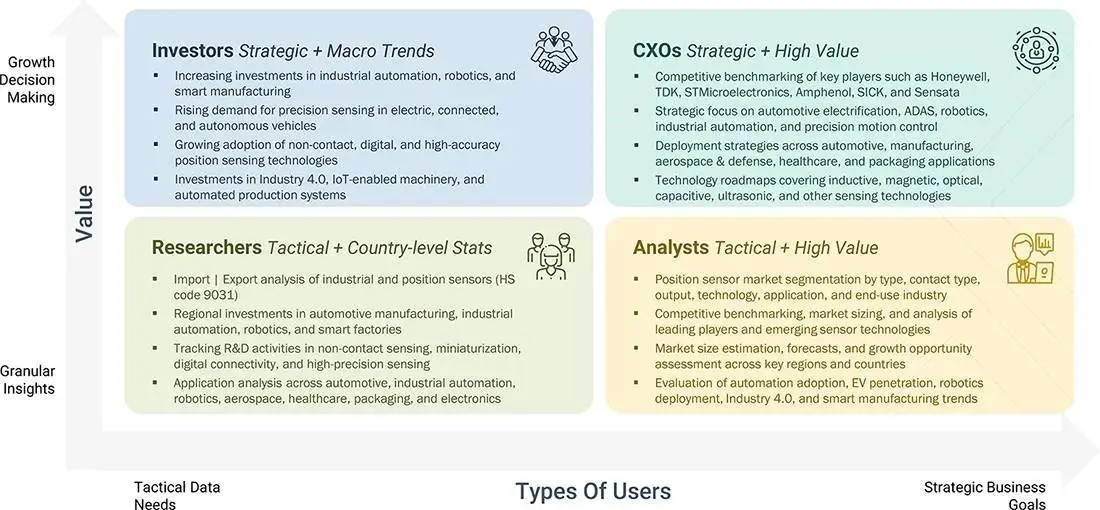
DELIVERED CUSTOMIZATIONS
We have successfully delivered the following deep-dive customizations:
| CLIENT REQUEST | CUSTOMIZATION DELIVERED | VALUE ADDS |
|---|---|---|
| Position Sensor Manufacturer |
|
|
| Position Sensor Technology Supplier |
|
|
| Industrial Automation / System Integrator |
|
|
| Automotive & Transportation Enterprise |
|
|
| Private Equity / Investment Firm |
|
|
RECENT DEVELOPMENTS
- May 2026 : TDK launched the HAL 3025 Fast Hall position sensor, featuring high-speed analog sine/cosine outputs and stray-field compensation. The sensor is designed for high-speed motor control applications, including EV powertrains, steering, and braking systems, with ASIL D readiness for safety-critical applications.
- February 2026 : STMicroelectronics completed the acquisition of NXP’s MEMS sensors business, expanding its sensor capabilities across automotive safety and industrial applications. The transaction strengthens ST’s MEMS portfolio and capabilities for automotive and industrial sensing applications.
- January 2026 : Honeywell expanded its industrial sensing portfolio with updated sensing solutions documentation covering motion and position sensing applications. Its portfolio includes magnetic position sensors, proximity sensors, resolvers, and potentiometers for accurate movement and position detection across industrial and transportation applications.
- July 2025 : Infineon Technologies launched the third generation of its XENSIV 3D magnetic Hall-effect sensor family, supporting high-precision position detection in automotive, industrial, and consumer applications. The portfolio targets applications including linear and angular position measurement, automotive controls, and pedal and valve position sensing.
- May 2025 : SICK introduced the next-generation ANS/ANM58 PROFINET absolute encoder, designed to improve machine and system productivity while providing easier integration into automation systems. The development strengthens SICK’s position in industrial motion-control and position-sensing applications.
Table of Contents
 Exclusive indicates content/data unique to MarketsandMarkets and not available with any competitors.
Methodology
This study involved four major activities in estimating the current size of the global position sensor market. Extensive secondary research was conducted to gather information on the position sensor ecosystem, including sensor manufacturers, technology providers, semiconductor companies, component suppliers, distributors, system integrators, automotive companies, industrial automation providers, and end users. This was followed by primary research with industry stakeholders across the value chain, including position sensor manufacturers, technology developers, component suppliers, distributors, OEMs, automotive companies, industrial automation firms, robotics companies, and end users, to validate assumptions and market sizing. Both top-down and bottom-up approaches were used to estimate the overall market size. Market breakdowns and data triangulation techniques were then applied to determine the size of individual segments and subsegments by type, contact type, signal output, technology, connectivity, application, end-user industry, and region. Both secondary and primary sources were used to support a comprehensive technical, commercial, and competitive analysis of the global position sensor market.
Secondary Research
Various secondary sources were referred to during the secondary research process to identify and collect information relevant to the position sensor market. These sources included annual reports, company presentations, press releases, product catalogs, technical datasheets, patents, technical journals, industry publications, company websites, trade directories, and government databases. Secondary research was conducted to obtain key insights into the market’s supply chain, value chain, competitive landscape, and segmentation by type, contact type, signal output, technology, connectivity, application, end-user industry, and region. It also helped assess industry trends, adoption of position sensors across automotive, industrial automation, robotics, aerospace & defense, healthcare, electronics, and manufacturing applications, and advancements in magnetic, inductive, optical, proximity, Hall-effect, and 3D sensing technologies. The collected information was further analyzed to estimate the overall market size and validate market assumptions, which were subsequently refined through primary research with industry experts and key stakeholders.
Primary Research
Extensive primary research was conducted after gaining knowledge about the current scenario of the position sensor market through secondary research. Several primary interviews were conducted with experts from the demand and supply sides across four major regions: North America, Europe, Asia Pacific, and the Rest of the World (RoW). This primary data was collected through questionnaires, emails, and telephonic interviews.
Breakdown of Primary Interviews
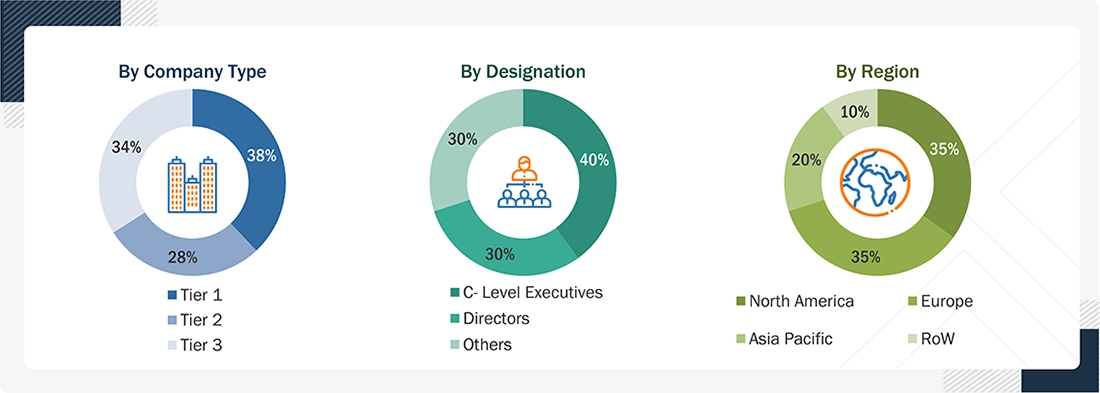
Note: The three tiers of the companies are defined based on their total revenue in 2025: Tier 1 - revenue greater than or equal to USD 1 billion; Tier 2 - revenue between USD 100 million and USD 1 billion; and Tier 3 revenue less than or equal to USD 100 million. Other designations include sales managers, marketing managers, and product managers.
To know about the assumptions considered for the study, download the pdf brochure
Market Size Estimation
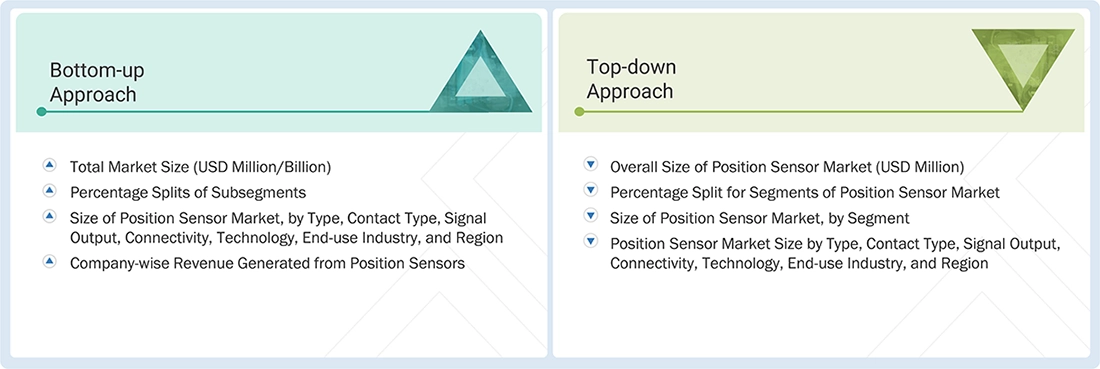
Both top-down and bottom-up approaches were used to estimate and validate the total size of the position sensor market. These methods were also used extensively to estimate the size of various subsegments in the market. The following research methodology was used to estimate the market size:
- Major players in the position sensor market and related markets were identified through extensive secondary research.
- The industry’s value chain and market size in terms of value and volume were determined through primary and secondary research processes.
- All percentage shares, splits, and segment-level breakdowns were determined using secondary sources and verified through primary research and data triangulation.
The market size includes the following:
Data Triangulation
After arriving at the overall size of the position sensor market through the market size estimation process, the total market was divided into relevant segments and subsegments. Data triangulation and market breakdown procedures were employed, wherever applicable, to complete the market engineering process and derive the statistics for each segment and subsegment. The data were triangulated by evaluating factors and trends from the demand and supply sides, including technology adoption, product offerings, application requirements, manufacturing developments, automotive electrification, industrial automation, and regional trends. The analysis considered key position-sensing technologies such as capacitive, inductive, optical, magnetic, ultrasonic, and piezoelectric, along with linear, rotary, proximity, photoelectric, and other sensor types and digital and analog output configurations. Along with this, the market size was validated using top-down and bottom-up approaches to ensure consistency across the overall market and individual segments.
Market Definition
Position sensors refer to sensing devices that detect and measure the position, movement, displacement, angle, or presence of an object and convert the detected physical parameter into an electrical signal for transmission, control, or processing. Position sensors can measure linear, rotary, angular, or three-dimensional movement and are used across automotive, industrial automation, robotics, aerospace & defense, healthcare, electronics, packaging, and other applications. Depending on the sensing principle and application requirements, position sensors can incorporate linear, rotary, proximity, photoelectric, and 3D sensing technologies, with contact and non-contact configurations.
Position sensors play a crucial role across automotive and electric vehicles, manufacturing and industrial automation, robotics, aerospace & defense, healthcare equipment, packaging machinery, and consumer electronics. These solutions enable precise motion measurement, position feedback, equipment control, automation, and safety functions. Position sensors are commonly integrated into steering and braking systems, actuators, motors, machine tools, robotic systems, material-handling equipment, and automated production lines. A typical position-sensing system may consist of a sensing element, signal-conditioning or processing circuitry, output interface, and associated control electronics, with its configuration varying according to the sensing technology, measurement range, accuracy requirements, application, and operating environment.
Key Stakeholders
- Raw Material Providers
- OEMs (Original Equipment Manufacturers)
- System Integrators
- Distributors and Retailers
- Research Institutions and Organizations
- Service Providers
- End-user Industries
Report Objectives
- To estimate and forecast the size of the position sensors market, in terms of value, based on type, contact type, signal output, technology, connectivity, application, end-user industry, and region
- To identify market opportunities across manufacturing, automotive, aerospace, packaging, healthcare, consumer electronics, and other end-user industries
- To analyze different position sensor types and their adoption across various end-user industries
- To describe and forecast the market size, in terms of value, for four major regions—North America, Europe, Asia Pacific, and Rest of the World (RoW)
- To provide detailed information regarding major factors such as drivers, restraints, opportunities, and challenges influencing market growth
- To provide a detailed overview of the position sensor value chain
- To strategically analyze micromarkets regarding individual market trends, growth prospects, and contributions to the total market
- To strategically profile key players and comprehensively analyze their market position in terms of ranking and core competencies, along with a detailed competitive landscape for the market leaders
- To analyze significant growth strategies such as product launches/developments and acquisitions adopted by the key market players to enhance their market position
- To analyze the impact of the macroeconomic factors impacting the position sensors market.
Available customizations:
With the given market data, MarketsandMarkets offers customizations according to the company’s specific needs. The following customization options are available for the report:
Company Information:
- Detailed analysis and profiling of additional market players (up to 5)
Key Questions Addressed by the Report
What is the current size of the Position Sensor Market?
The global Position Sensor Market is estimated at USD 14.53 billion in 2026, driven by growing demand for automation, robotics, industrial IoT, and advanced sensing technologies across multiple industries.
What is the projected market size of the Position Sensor Market by 2032?
The Position Sensor Market is projected to reach USD 23.40 billion by 2032, growing at a CAGR of 8.3% during the forecast period from 2026 to 2032.
What are the major growth drivers of the Position Sensor Market?
Key growth drivers include increasing adoption of Industry 4.0 technologies, rising demand for industrial automation, growth in robotics applications, expansion of electric vehicles (EVs), and growing deployment of smart manufacturing systems.
What are the key trends shaping the Position Sensor industry?
Major trends include non-contact sensing technologies, integration of sensors with Industrial IoT platforms, smart factory deployments, advanced photoelectric sensors, AI-enabled automation, and increasing use of position sensors in autonomous and connected vehicles.
Which type segment holds the largest share of the Position Sensor Market?
The Proximity Sensor segment is expected to account for the largest market share, representing approximately 35.1% of the market in 2025 due to its extensive use in industrial automation, manufacturing, and automotive applications.
Which technology segment is expected to grow the fastest?
The Ultrasonic Technology segment is projected to register the highest CAGR of 10.9% during the forecast period because of its high accuracy, reliability, and growing use in robotics, automation, and advanced industrial applications.
Which end-user industry dominates the Position Sensor Market?
The Automotive industry is expected to hold the largest market share due to increasing adoption of ADAS, electric vehicles, autonomous driving systems, steering controls, and battery management applications.
Which region leads the Position Sensor Market?
Asia Pacific is expected to dominate the global market with approximately 42.5% market share in 2025, supported by strong manufacturing activity, industrial automation investments, semiconductor production, and rapid adoption of smart factory technologies.
Who are the leading companies operating in the Position Sensor Market?
Major market participants include Honeywell International Inc., TDK Corporation, STMicroelectronics, Amphenol Corporation, SICK AG, and Sensata Technologies. These companies focus on innovation, product development, and strategic partnerships.
What opportunities and challenges are highlighted in the Position Sensor Market report?
Key opportunities include advancements in robotics, automation, smart factories, and Industry 4.0 initiatives. Major challenges include performance limitations in certain sensing environments, precision requirements, and integration complexities in advanced industrial systems.


Personalize This Research
- Triangulate with your Own Data
- Get Data as per your Format and Definition
- Gain a Deeper Dive on a Specific Application, Geography, Customer or Competitor
- Any level of Personalization
Let Us Help You
- What are the Known and Unknown Adjacencies Impacting the Position Sensor Market
- What will your New Revenue Sources be?
- Who will be your Top Customer; what will make them switch?
- Defend your Market Share or Win Competitors
- Get a Scorecard for Target Partners

Custom Market Research Services
We Will Customise The Research For You, In Case The Report Listed Above Does Not Meet With Your Requirements
Get 10% Free CustomisationTESTIMONIALS

Tetsuya Ohhira
Business Development Manager-Technology Business
Nikon Corporation,
Leading Japanese MNC specializing in optics and imaging productswww.nikon.com
MarketsandMarkets™ response
is quick. Their attitude is flexible and positive. Analyst Insights are globally considered and
significant. Client Services quickly respond to our inquiry and demand. Their wide range of global
surveys help us make our strategic plan.
We hope Knowledge Store will be easier to search
for a report.
VP - Marketing & Business Development
Leading Provider of Process Control Solutions
We engaged with MarketsandMarkets on a study to perform an analysis and recommend a Go-To-Market strategy for metrology and process control in the semiconductor market. The study was tailored to our targets and needs with well-defined milestones. Our overall experience with the MarketsandMarkets team was very good throughout the project in all aspects including the analysis methodologies used, the quality and depth of primary and secondary data sets, the professionalism and flexibility of the team and the ability to meet the target schedule and milestones. We want to thank MarketsandMarkets team for a job well done.
Growth opportunities and latent adjacency in Position Sensor Market






Jamie
Apr, 2026
Does the report clearly define what is included and excluded in the position sensors market?.
Mason
Apr, 2026
Does it provide competitive benchmarking or hidden opportunities?.
Corinna
Mar, 2017
Dear Sir or Madam, if it is possible to send executive summary of position sensor market, however we are interested in Analyze the Japanese MPS market? Our interest in detail as -->market forecast of Motor Position Sensors with Steering application -->breakdown into different sensor Technologies -->explanation of choice of Technology -->competitors, customers and future Trends. .