
Germany mRNA Synthesis & Manufacturing Market (2024-2029)

The Germany mRNA Synthesis & Manufacturing Market was valued at $126.6 Million in 2024 and projected to reach to $164.1 Million by 2029, representing a compound annual growth rate of 5.3%. Germany's mRNA synthesis and manufacturing market is poised for sustained growth through 2029, driven by increasing demand for mRNA-based therapeutics and vaccines across Europe.


| Market Size in | USD 26.32 MN |
| Market Forecast in | |
| CAGR | |
| Forecast Period | |
| Units Considered | Value (USD MN) |
Germany mRNA Synthesis & Manufacturing Market Trends and Insights
- Germany has established itself as a key hub for biopharmaceutical innovation in Europe, with significant investments in mRNA technology infrastructure and manufacturing capabilities.
- The country's strong regulatory framework, advanced research institutions, and established pharmaceutical sector position Germany as a critical player in the global mRNA supply chain. The growth trajectory for Germany's mRNA market reflects increasing demand for mRNA-based therapeutics and vaccines, coupled with government support for biotechnology development.
- Germany's manufacturing sector is expanding to meet both domestic and European Union demand, with investments in contract manufacturing organizations (CMOs) and specialized production facilities.
- By 2029, Germany is expected to capture a larger share of European mRNA manufacturing activity, driven by technological advancements and strategic partnerships between academic institutions and industry players..
Key Market Statistics
- CAGR (2024-2029) 5.3% CAGR
- Market Size, 2024 ~USD 126.6 Million
- Forecast, 2029 ~USD 164.1 Million
- Country Germany
Germany mRNA Synthesis & Manufacturing Market Overview
Market Valuation Growth :
Germany's mRNA synthesis and manufacturing market reached $126.6 million in 2024, with projections to expand to $164.1 million by 2029, demonstrating steady market expansion at 5.3% CAGR.
European Biopharmaceutical Hub :
Germany has positioned itself as a leading center for mRNA technology innovation in Europe, attracting significant capital investments and fostering a robust ecosystem for advanced manufacturing capabilities.
Infrastructure Development :
The country has invested substantially in mRNA technology infrastructure, including state-of-the-art manufacturing facilities and research centers that support both domestic and international biopharmaceutical companies.
Competitive CAGR Performance :
Germany's 5.3% CAGR slightly trails the global market growth rate of 5.8%, reflecting regional market maturity while maintaining strong growth momentum within the European context.
Germany mRNA Synthesis & Manufacturing Market Dynamics
- The country's established regulatory framework, skilled workforce, and existing biopharmaceutical infrastructure provide competitive advantages for market expansion.
- Strategic partnerships between German manufacturers and global pharmaceutical companies are expected to accelerate capacity development and technological advancement. The market outlook remains positive as Germany continues to strengthen its position as Europe's premier mRNA manufacturing destination.
- Investment in automation, quality control systems, and sustainable production methods will be critical growth drivers.
- Additionally, government support for biotechnology innovation and the rising prevalence of personalized medicine applications will further propel market growth through the forecast period..
Market Ecosystem
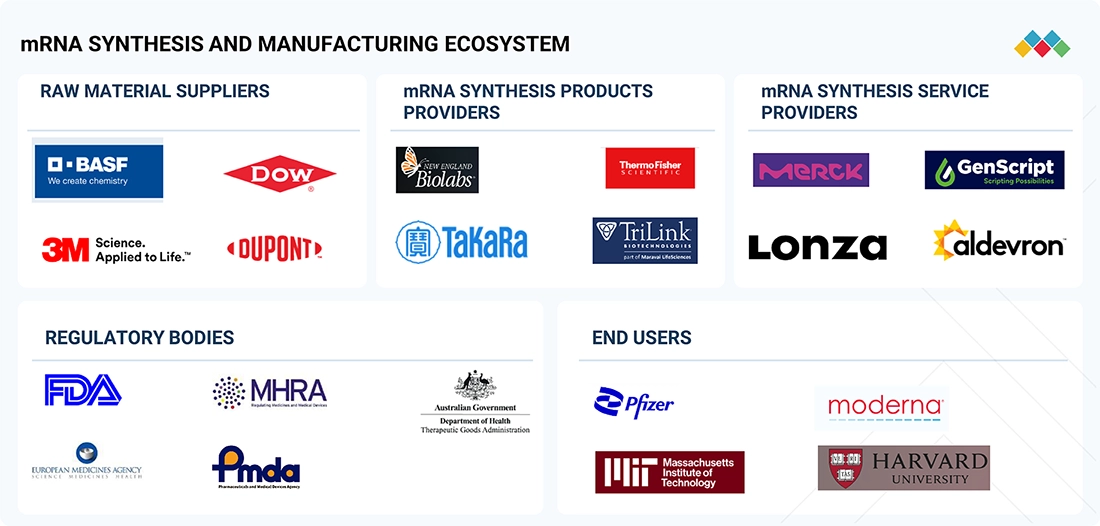
mRNA Synthesis & Manufacturing Market: COMMERCIAL USE CASES ACROSS INDUSTRIES
| COMPANY | USE CASE DESCRIPTION | BENEFITS |
|---|---|---|
 |
Partnered with Lonza to scale the rapid manufacturing of its mRNA-1273 COVID-Ig vaccine (IVT mRNA production, LNP formulation, and commercial fill/finish) | Rapid scale-up | diversified global manufacturing footprint | risk reduction through multi-partner supply chain |
 |
Built a network of COMO partners across Europe for each key manufacturing step (IW reaction, downstream processing, formulation, fill/finish) of their vaccine candidate CVnCoV |Included technology transfers to partners so multiple sites could produce intermediate or finished products | Achieved scale-up of production capacity more quickly | reduced dependency on a single site | improved resilience to the supply chain or logistics disruptions |
Logos and trademarks shown above are the property of their respective owners. Their use here is for informational and illustrative purposes only.
Related Ecosystem
Advanced Genetic Sequencing
- Polymerase Chain Reaction (PCR)
- Reagents
- Assay Kits
- Bioinformatics
- Flow Cytometry
- Thermo Fisher Scientific Inc.
- Illumina, Inc.
- Agilent Technologies, Inc.
- Qiagen N.V.
- Danaher Corporation
Analytical And Scientific Instrumentation
- Environmental Testing
- Gas Chromatography
- Polymerase Chain Reaction (PCR)
- Automated Liquid Handling Systems
- Flow Cytometry
- Thermo Fisher Scientific Inc.
- Danaher Corporation
- Agilent Technologies, Inc.
- Shimadzu Corporation
- Merck KGaA
Pharmaceuticals
- Bioreactors
- Analytical Testing
- Bioanalytical Testing Services
- Cell Counters
- Data Management Services
- Thermo Fisher Scientific Inc.
- SANOFI
- Merck KGaA
- NOVARTIS
- Pfizer Inc.
Key Takeaways
- Germany's mRNA synthesis & manufacturing market is valued at $126.6 million in 2024 and will reach $164.1 million by 2029 at a 5.3% CAGR.
- Germany serves as a strategic European hub for mRNA manufacturing with strong regulatory infrastructure and research capabilities.
- Government support and investment in biotechnology are driving expansion of mRNA production facilities across Germany.
- Germany's market growth is fueled by rising demand for mRNA therapeutics and vaccines in both domestic and EU markets.
mRNA Synthesis & Manufacturing Market Report Scope
| Report Metric | Details |
|---|---|
| Base Year | 2024 |
| Fastest Growing Segment | MRNA SYNTHESIS & MODIFICATION SERVICES (Service) |
| Forecast Period | 2024-2029 |
| Growth Rate | CAGR of 5.8% from 2024 to 2029 |
| Largest Segment | CONSUMABLES (Product) |
| Market Size Base Year (Billions) | ~USD 2.23 (2024) |
| Revenue Forecast (Billions) | ~USD 2.96 (2029) |
| Segments Covered | Product, Type, Application, End User, Service, Consumables, Transcription Consumables, Purification Consumables, Analysis & Characterization Consumables |
Germany mRNA Synthesis & Manufacturing Market Report Segmentation
9 segment dimensions are covered across the global market.
By Product
- Consumables
- Instruments
By Type
- Analysis & Characterization Consumables
- Analysis Kits And Reagents
- Chromatography Filters & Membrane
- Mrna Profiling Kits
- Mrna Synthesis Kits
- Nucleotides
- Other Products
- Other Purification Consumables
- Other Transcription Consumables
- Plasmid Dna/Dna Templates
- Purification Consumables
- Purification Kits & Reagents
- Rna Polymerases
- Transcription Consumables
- Vectors
By Application
- Cell & Gene Therapies
- Other Applications
- Vaccines
By End User
- Academic & Research Institutions
- Cros & Cdmos
- Cros And Cdmos
- Pharmaceutical & Biotechnology Companies
- Small-Scale Cros & Cdmos
By Service
- Manufacturing & Scale-Up Services
- Mrna Analysis & Characterization Services
- Mrna Purification Services
- Mrna Synthesis & Modification Services
By Consumables
- Analysis & Characterization Consumables
- Purification Consumables
- Transcription Consumables
By Transcription Consumables
- Mrna Profiling Kits
- Mrna Synthesis Kits
- Nucleotides
- Other Transcription Consumables
- Plasmid Dna/Dna Templates
- Rna Polymerases
- Vectors
By Purification Consumables
- Chromatography Filters & Membranes
- Other Purification Consumables
- Purification Kits & Reagents
- Purification Kits And Reagents
By Analysis & Characterization Consumables
- Analysis Kits & Reagents
- Analysis Kits And Reagents
- Other Analysis & Characterization Consumables
GERMANY: MRNA SYNTHESIS & MANUFACTURING SERVICE MARKET, BY END USER, 2022–2029
| Segment | 2022 | 2023 | 2024 | 2025 | 2026 | 2027 | 2028 | 2029 | CAGR (%) |
|---|---|---|---|---|---|---|---|---|---|
| ACADEMIC & RESEARCH INSTITUTIONS | 23 | 20 | 20.3 | 21.2 | 22.7 | 24.4 | 26.3 | 29 | 7.5 |
| PHARMACEUTICAL & BIOTECHNOLOGY COMPANIES | 65.7 | 57.4 | 58.3 | 61.3 | 65.7 | 70.9 | 77 | 85.2 | 7.9 |
| SMALL-SCALE CROS & CDMOS | 8.2 | 7.1 | 7.1 | 7.4 | 7.9 | 8.4 | 9 | 9.8 | 6.6 |
| TOTAL | 97 | 84.6 | 85.7 | 89.9 | 96.2 | 103.6 | 112.3 | 124.1 | 7.7 |
GERMANY: MRNA SYNTHESIS & MANUFACTURING PRODUCT MARKET, BY END USER, 2022–2029
| Segment | 2022 | 2023 | 2024 | 2025 | 2026 | 2027 | 2028 | 2029 | CAGR (%) |
|---|---|---|---|---|---|---|---|---|---|
| ACADEMIC & RESEARCH INSTITUTIONS | 40.4 | 29.7 | 30 | 31.1 | 32.8 | 34.5 | 36.3 | 38.7 | 5.2 |
| CROS & CDMOS | 34.6 | 25.4 | 25.7 | 26.6 | 28 | 29.4 | 30.9 | 32.9 | 5.1 |
| PHARMACEUTICAL & BIOTECHNOLOGY COMPANIES | 95.3 | 70.2 | 71 | 73.9 | 77.9 | 82.1 | 86.6 | 92.4 | 5.4 |
| TOTAL | 170.3 | 125.3 | 126.6 | 131.6 | 138.7 | 146.1 | 153.8 | 164.1 | 5.3 |
Target Audience
- Pharmaceutical & Biotech Companies : Manufacturers and developers seeking to establish or expand mRNA production capabilities in Germany need market-specific data to evaluate investment viability, capacity planning, and competitive positioning in Europe's leading biotech hub.
- Investment & Private Equity Firms : Investors evaluating opportunities in German mRNA manufacturing require detailed market sizing, growth forecasts, and infrastructure insights to assess portfolio companies, identify acquisition targets, and optimize capital deployment.
- Government & Policy Makers : German regulatory bodies and economic development agencies need market intelligence to inform biotechnology policy, infrastructure funding decisions, and strategic initiatives supporting the country's mRNA sector competitiveness.
- Contract Manufacturing Organizations (CMOs) : CMOs operating in or considering entry into Germany's market require localized demand forecasts, capacity benchmarking data, and competitive analysis to optimize service offerings and resource allocation.
- Market Research & Consulting Professionals : Analysts and consultants advising clients on German market opportunities need comprehensive, country-specific data to support strategic recommendations, feasibility studies, and competitive intelligence reports.
Reasons to Buy this Report
- Market-Specific Sizing Data : Access precise valuation figures for Germany's mRNA market ($126.6M in 2024) with detailed 5-year forecasts, enabling accurate budget allocation and investment planning specific to the German market.
- Competitive Landscape Intelligence : Understand Germany's position within Europe's mRNA ecosystem, including local manufacturing capabilities, regulatory advantages, and competitive dynamics that differentiate the German market from other regions.
- Growth Trajectory Analysis : Leverage Germany-specific CAGR data (5.3%) to benchmark performance expectations, identify growth opportunities, and develop market entry or expansion strategies tailored to German market conditions.
- Infrastructure & Investment Insights : Gain detailed understanding of Germany's mRNA technology infrastructure investments, manufacturing facility developments, and capital allocation patterns critical for partnership and investment decisions.
- Regulatory & Strategic Context : Obtain Germany-focused analysis of regulatory frameworks, government support initiatives, and strategic partnerships that shape market dynamics and influence long-term business planning in the region.
Frequently asked questions
What is the current market size of mRNA synthesis & manufacturing in Germany?
Germany's mRNA synthesis & manufacturing market was valued at $126.6 million in 2024.
What is the projected market size for Germany's mRNA market by 2029?
Germany's mRNA synthesis & manufacturing market is projected to reach $164.1 million by 2029.
What is the CAGR for Germany's mRNA synthesis & manufacturing market?
Germany's mRNA market is expected to grow at a compound annual growth rate (CAGR) of 5.3% from 2024 to 2029.
Why is Germany a key market for mRNA manufacturing in Europe?
Germany possesses advanced research institutions, strong regulatory frameworks, established pharmaceutical infrastructure, and government support for biotechnology, making it a strategic hub for mRNA production and innovation.
What factors are driving growth in Germany's mRNA market?
Key growth drivers include increasing demand for mRNA-based therapeutics and vaccines, government investments in biotechnology, expansion of contract manufacturing organizations, and strategic partnerships between academic and industry sectors.
RESEARCH METHODOLOGY
The study involved major activities in estimating the current market size for the mRNA synthesis and manufacturing market. Exhaustive secondary research was done to collect information on the mRNA synthesis and manufacturing industry. The next step was to validate these findings, assumptions, and sizing with industry experts across the value chain using primary research. Different approaches, such as market share analysis, MnM repository analysis, were employed to estimate the total market size. After that, the market breakup and data triangulation procedures were used to estimate the market size of the segments and subsegments of the mRNA synthesis and manufacturing market.
Secondary Research
The market for the companies offering mRNA synthesis and manufacturing solutions is arrived at by secondary data available through paid and unpaid sources, analyzing the product & service portfolios of the major companies in the ecosystem, and rating the companies by their performance and quality. Various sources were referred to in the secondary research process to identify and collect information for this study. The secondary sources include annual reports, press releases, investor presentations of companies, white papers, journals, certified publications, and articles from recognized authors, directories, and databases. In the secondary research process, various secondary sources were referred to for identifying and collecting information related to the study. Secondary sources included annual reports, press releases, and investor presentations of blockchain vendors, forums, certified publications, and whitepapers. The secondary research was used to obtain critical information on the industry’s value chain, the total pool of key players, market classification, and segmentation from the market and product-oriented perspectives.
Primary Research
Extensive primary research was conducted after acquiring basic knowledge about the global mRNA synthesis and manufacturing market scenario. Several primary interviews were conducted with market experts from both the demand side (such as personnel from the pharmaceutical & biopharmaceutical industry) and the supply side (such as C-level and D-level executives, product managers, marketing and sales managers of key manufacturers, distributors, as well as channels) across five major regions, namely, North America, Europe, the Asia Pacific, Latin America, and the Middle East & Africa. Approximately 80% and 20% of primary interviews were conducted with supply-side and demand-side participants, respectively. This primary data was collected through questionnaires, e-mails, and online, personal, and telephonic interviews.
The following is a breakdown of the primary respondents:
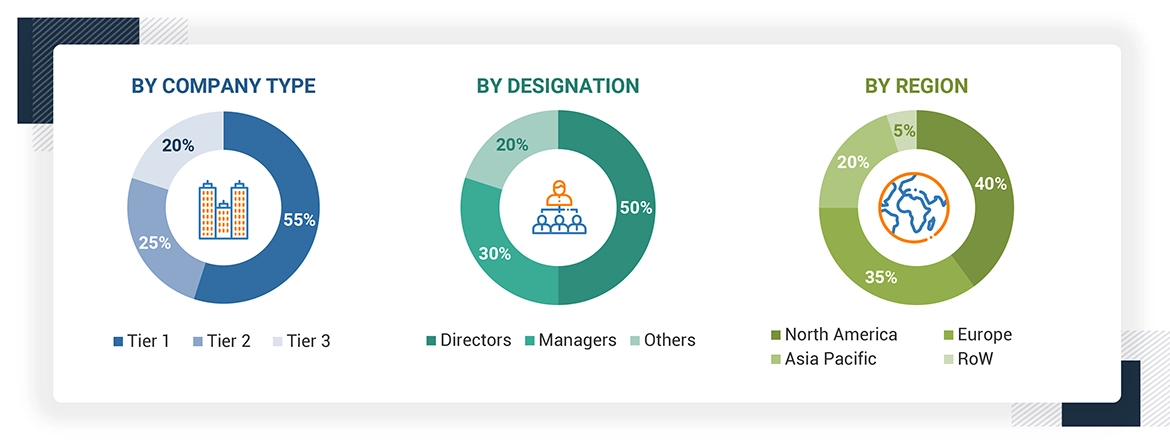
To know about the assumptions considered for the study, download the pdf brochure
Market Size Estimation
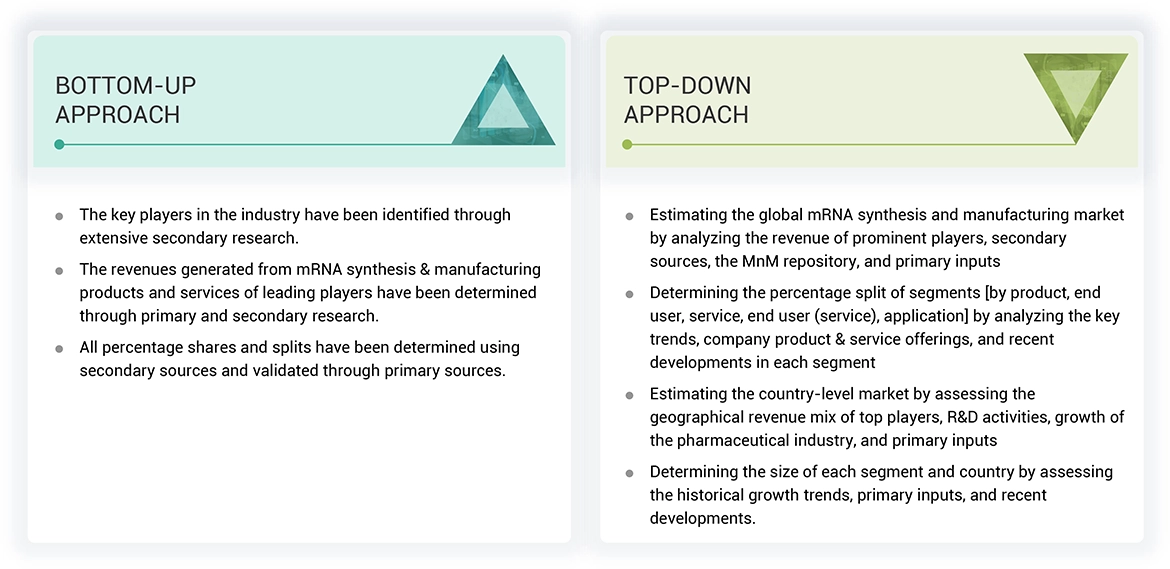
Top-down approache was used to estimate and validate the total size of the mRNA synthesis and manufacturing market. These methods include market share analysis, MnM repository analysis were also used extensively to estimate the size of various subsegments in the market. The research methodology used to estimate the market size includes the following:
- The key players in the industry and market have been identified through extensive secondary research.
- The revenues generated from the mRNA synthesis and manufacturing market business of leading players have been determined through primary and secondary research.
- All percentage shares, splits, and breakdowns have been determined using secondary sources and verified through primary sources.
After arriving at the overall market size from the market size estimation process, the total market was split into several segments and subsegments.
Data Triangulation
After arriving at the market size from the market size estimation process explained above, the total market was divided into several segments and subsegments. To complete the overall market engineering process and arrive at the exact statistics for all segments and subsegments, data triangulation and market breakdown procedures were employed, wherever applicable.
Market Definition
mRNA synthesis and manufacturing refers to the process of producing messenger RNA (mRNA) through in vitro transcription, followed by various purification, and characterization steps to create high-quality mRNA products suitable for research, therapeutic, or vaccine applications. The mRNA synthesis and manufacturing market encompasses the development, production, and commercialization of messenger RNA (mRNA) products, including their synthesis via in vitro transcription, large-scale manufacturing, and formulation. This market serves various applications such as vaccines, therapeutic treatments, and potentially other areas like protein replacement. It involves specialized technologies and equipment, adherence to regulatory standards, and a global supply chain network.
The study provides an in-depth analysis of the mRNA synthesis and manufacturing market based on contemporary market trends and developments, and its potential growth from 2024 to 2029. It includes detailed market trends, the competitive landscape, market size, forecasts, and the analysis of the key mRNA synthesis and manufacturing product and service providers.
Stakeholders
- Academic & Research Institutes
- Pharmaceutical & Biotechnology Companies
- Contract Development and Manufacturing Organizations (CDMOs)
- Raw Material Suppliers
- Market Research and Consulting Firms
- Regulatory Agencies
- Venture Capitalists
- Government Organizations
- Industry Associations and Professional Societies
Report Objectives
- To define, describe, and forecast the mRNA synthesis and manufacturing market based on product, service, application, and region
- To define, describe, and forecast the mRNA synthesis and manufacturing market based on product by end user and service by end user
- To provide detailed information regarding the major factors influencing the market growth (such as drivers, restraints, opportunities, and challenges)
- To strategically analyze micromarkets with respect to individual growth trends, prospects, and contributions to the mRNA synthesis and manufacturing market
- To analyze the opportunities in the market for stakeholders and provide details of the competitive landscape for market leaders
- To forecast the size of the market segments with respect to six main regions, namely, North America, Europe, the Asia Pacific, Latin America, the Middle East, and Africa
- To profile the key players in the global mRNA synthesis and manufacturing market and comprehensively analyze their products and services portfolios, market positions, and core competencies.
- To track and analyze competitive developments such as product/service launches, expansions, agreements, and collaborations in the mRNA synthesis and manufacturing market
- To benchmark players within the mRNA synthesis and manufacturing market using the Company Evaluation Matrix framework, which analyzes market players based on various parameters within the broad categories of business and service strategy
Get the Full mRNA Synthesis & Manufacturing Market Report
Full forecast, segment splits, and company analysis for all mRNA Synthesis & Manufacturing Market.
- Canada mRNA Synthesis & Manufacturing Market
- US mRNA Synthesis & Manufacturing Market
- UK mRNA Synthesis & Manufacturing Market
- France mRNA Synthesis & Manufacturing Market
- Switzerland mRNA Synthesis & Manufacturing Market
- Italy mRNA Synthesis & Manufacturing Market
- Spain mRNA Synthesis & Manufacturing Market
- China mRNA Synthesis & Manufacturing Market
- Japan mRNA Synthesis & Manufacturing Market
- India mRNA Synthesis & Manufacturing Market
- South Korea mRNA Synthesis & Manufacturing Market
- Brazil mRNA Synthesis & Manufacturing Market
- Rest Of Europe mRNA Synthesis & Manufacturing Market
- Rest Of Asia Pacific mRNA Synthesis & Manufacturing Market
- Rest Of Latin America mRNA Synthesis & Manufacturing Market
Need a Tailored Report?
Customize this report to your needs
Get 10% FREE Customization
Customize This Report
