
Brazil Mulch Films Market (2026-2031)

The Brazil Mulch Films Market was valued at $321.1 Million in 2026 and projected to reach to $437.5 Million by 2031, representing a compound annual growth rate of CAGR 6.4%. Brazil's mulch films market is poised for sustained growth through 2031, supported by the country's position as a global agricultural powerhouse and increasing farmer awareness of soil conservation benefits.


| Market Size in | USD 26.32 MN |
| Market Forecast in | |
| CAGR | |
| Forecast Period | |
| Units Considered | Value (USD MN) |
Brazil Mulch Films Market Trends and Insights
- Brazil's agricultural sector, driven by large-scale crop production and increasing adoption of modern farming practices, is a primary catalyst for mulch film demand.
- The country's favorable climate for agriculture and growing awareness of soil conservation benefits are positioning Brazil as a key market within Latin America. The expansion of Brazil's mulch films market reflects broader trends in sustainable agriculture and resource efficiency.
- Brazil's farmers are increasingly recognizing the value of mulch films in moisture retention, weed suppression, and soil temperature regulation.
- Between 2026 and 2031, Brazil is expected to see heightened investment in agricultural technologies, with mulch films playing an integral role in improving crop yields and reducing environmental impact.
- This growth trajectory underscores Brazil's commitment to modernizing its agricultural infrastructure while maintaining competitive advantage in global commodity markets..
Key Market Statistics
- CAGR (2026-2031) CAGR 6.4%
- Market Size, 2026 ~USD 321.1 Million
- Forecast, 2031 ~USD 437.5 Million
- Country Brazil
Brazil Mulch Films Market Overview
Market Valuation :
Brazil's mulch films market is valued at USD 321.1 million in 2026 and is projected to reach USD 437.5 million by 2031, demonstrating robust expansion in the agricultural sector.
Consistent Growth Trajectory :
With a CAGR of 6.4% from 2026 to 2031, Brazil's mulch films market outpaces many emerging markets, driven by mechanization and sustainable farming adoption across major agricultural regions.
Agricultural Sector Drivers :
Large-scale crop production in Brazil, particularly in sugarcane, corn, and soybean cultivation, combined with increasing adoption of modern farming practices, fuels sustained demand for mulch film solutions.
Climate and Geographic Advantage :
Brazil's favorable tropical and subtropical climate, coupled with vast arable land, creates ideal conditions for year-round agricultural production and mulch film utilization across diverse crop types.
Brazil Mulch Films Market Dynamics
- The shift toward precision agriculture and sustainable farming practices is accelerating mulch film adoption among both large-scale commercial operations and mid-sized producers seeking to improve crop yields and reduce water consumption. Government initiatives promoting agricultural modernization and environmental sustainability will further bolster market expansion.
- As input costs rise, farmers increasingly recognize mulch films as cost-effective solutions for weed control, moisture retention, and soil temperature regulation.
- Regional expansion into underutilized agricultural areas and technological innovations in biodegradable mulch films present significant growth opportunities for market participants through 2031..
Market Ecosystem
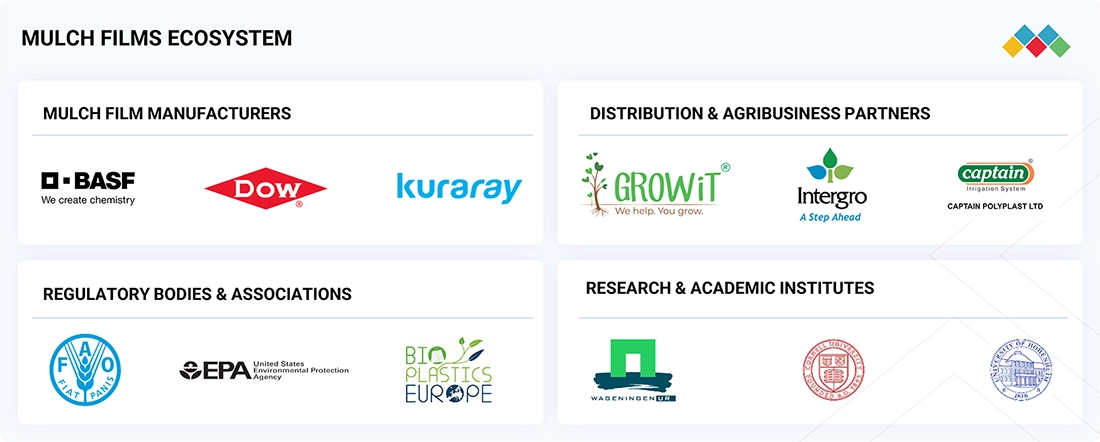
MULCH FILMS MARKET TRENDS, GROWTH, AND FORECAST [LATEST]: COMMERCIAL USE CASES ACROSS INDUSTRIES
| COMPANY | USE CASE DESCRIPTION | BENEFITS |
|---|---|---|
 |
Development of biodegradable mulch films for horticulture and vegetable cultivation | Reduces plastic waste, improves soil health, and aligns with sustainable farming regulations |
 |
Use of advanced polyethylene mulch films with high durability in row crops | Enhances moisture retention, improves crop yield, and ensures longer field performance |
 |
Application of high-performance mulch films with UV stabilization in open-field farming | Extends film lifespan, improves temperature control, and boosts crop productivity |
 |
Production of customized mulch films (black, transparent, reflective) for crop-specific applications | Optimizes weed control, regulates soil temperature, and enhances crop quality |
Logos and trademarks shown above are the property of their respective owners. Their use here is for informational and illustrative purposes only.
Related Ecosystem
Farm Equipment And Irrigation
- Sensors
- Hydroponics
- Aeroponics
- Camera Systems
- Global Positioning System (GPS)
- MSK FARM MACHINERY CORPORATION
- MITSUBISHI AGRICULTURAL MACHINERY
- MITSUBISHI CHEMICAL AGRI DREAM
- RIVULIS IRRIGATION
- AGCO Corporation
Key Takeaways
- Brazil's mulch films market is valued at USD 321.1 million in 2026 and is forecast to reach USD 437.5 million by 2031.
- Brazil demonstrates a 6.4% CAGR, reflecting strong demand from the country's large-scale agricultural sector.
- Brazil's adoption of sustainable farming practices is driving increased mulch film utilization for soil and water conservation.
- Brazil's market growth is supported by technological advancement and farmer awareness of mulch film benefits in crop productivity.
Mulch Films Market Report Scope
| Report Metric | Details |
|---|---|
| Base Year | 2026 |
| Fastest Growing Segment | –BIODEGRADABLE MULCH (Type) |
| Forecast Period | 2026–2031 |
| Growth Rate | CAGR of 6.5% from 2026 to 2031 |
| Largest Segment | CONVENTIONAL POLYOLEFIN-BASED MULCH FILMS (Element) |
| Market Size Base Year (Billions) | ~USD 11.04 (2026) |
| Revenue Forecast (Billions) | ~USD 15.13 (2031) |
| Segments Covered | Element, Type, Application, Crop Type |
Brazil Mulch Films Market Report Segmentation
4 segment dimensions are covered across the global market.
By Element
- Biodegradable & Compostable Mulch Films
- Conventional Polyolefin-Based Mulch Films
- Eva
- Hdpe
- Ldpe
- Lldpe
- Other Elements
- Pbat
- Pha
- Pla
- –Eva
- –Hdpe
- –Ldpe
- –Lldpe
- –Pbat
- –Pha
- –Pla
By Type
- Black Mulch
- Clear/Transparent
- Clear/Transparent Mulch
- Colored Mulch
- Degradable Mulch
- Other Types
- Photoselective Mulch
- –Biodegradable Mulch
- –Photodegradable Mulch
By Application
- Cereals & Grains
- Field Crops
- Flowers & Ornamentals
- Fruits & Vegetables
- Horticultural Crops
- Oilseeds & Pulses
- Other Field Crops
- Other Horticultural Crops
By Crop Type
- Cereals & Grains
- Flowers & Ornamentals
- Fruits & Vegetables
- Oilseeds & Pulses
- Other Field Crops
- Other Horticultural Crops
Target Audience
- Agricultural Input Manufacturers : Mulch film producers and agricultural chemical companies need Brazil-specific market data to assess production capacity requirements, pricing strategies, and distribution partnerships in this expanding market.
- Farm Equipment & Supply Distributors : Regional distributors require detailed market insights to forecast inventory needs, identify growth segments, and develop targeted sales approaches for Brazil's diverse agricultural customer base.
- Investment & Private Equity Firms : Investors evaluating opportunities in Brazil's agricultural sector need comprehensive market analysis to assess growth potential, competitive dynamics, and ROI projections for mulch film-related ventures.
- Agricultural Consultants & Advisors : Farm management consultants and agronomists require market data to advise clients on mulch film adoption, cost-benefit analysis, and best practices aligned with Brazil's regional agricultural conditions.
- Government & Policy Organizations : Agricultural ministries and policy bodies need market intelligence to develop informed agricultural modernization strategies, sustainability initiatives, and support programs for Brazil's farming community.
Reasons to Buy this Report
- Market Size & Growth Data : Access precise valuation figures for Brazil's mulch films market (USD 321.1M in 2026) with detailed 5-year forecasts, enabling accurate business planning and investment decisions specific to this high-growth region.
- Competitive Landscape Intelligence : Understand market dynamics, key players, and competitive positioning within Brazil's agricultural mulch films sector to identify partnership opportunities and market entry strategies tailored to local conditions.
- Sector-Specific Insights : Gain detailed analysis of Brazil's major crop segments (sugarcane, corn, soybean) and their mulch film requirements, enabling targeted product development and marketing strategies for specific agricultural applications.
- Regulatory & Sustainability Trends : Stay informed on Brazil's environmental policies, biodegradable mulch film regulations, and sustainability initiatives shaping market demand, ensuring compliance and alignment with emerging market preferences.
- Regional Growth Opportunities : Identify high-potential geographic zones within Brazil for market expansion, distribution channel optimization, and localized sales strategies based on agricultural concentration and adoption rates.
Frequently asked questions
What is the current size of Brazil's mulch films market?
Brazil's mulch films market is valued at USD 321.1 million in 2026.
What is the projected market size for Brazil's mulch films by 2031?
Brazil's mulch films market is forecast to reach USD 437.5 million by 2031.
What is the CAGR for Brazil's mulch films market?
Brazil's mulch films market is expected to grow at a compound annual growth rate of 6.4% from 2026 to 2031.
What factors are driving growth in Brazil's mulch films market?
Brazil's growth is driven by large-scale agricultural production, adoption of sustainable farming practices, and increasing farmer awareness of mulch film benefits for soil conservation and crop productivity.
Why is Brazil an important market for mulch films in Latin America?
Brazil's favorable agricultural climate, extensive crop production base, and commitment to modernizing farming infrastructure position it as a key market for mulch films within the Latin American region.
RESEARCH METHODOLOGY
The study involved four major activities in estimating the current size of the mulch films market. Exhaustive secondary research was done to collect information on the market, peer market, and parent market. The next step was to validate these findings, assumptions, and sizing with industry experts across the value chain through primary research. Both top-down and bottom-up approaches were employed to estimate the complete market size. After that, data triangulation was used to estimate the market size of segments and subsegments.
Secondary Research
This research study involved the extensive use of secondary sources—directories and databases such as Bloomberg Businessweek and Factiva—to identify and collect information useful for a technical, market-oriented, and commercial study of the mulch films market.
In the secondary research process, various sources such as annual reports, press releases & investor presentations of companies, white papers, certified publications, articles from recognized authors, gold & silver standard websites, directories, and databases were referred to identify and collect information. This research study involved the extensive use of secondary sources—directories and databases such as Bloomberg Businessweek and Factiva—to identify and collect information useful for a technical, market-oriented, and commercial study of the mulch films market.
Secondary research was mainly used to obtain key information about the industry’s supply chain, the total pool of key players, and market classification and segmentation as per the industry trends to the bottom-most level, regional markets, and key developments from both market- and technology-oriented perspectives.
Primary Research
Extensive primary research was conducted after obtaining information regarding the Mulch films market scenario through secondary research. Several primary interviews were conducted with market experts from both the demand and supply sides across major countries of North America, Europe, Asia Pacific, South America, and RoW. Primary data was collected through questionnaires, emails, and telephonic interviews. The primary sources from the supply side included various industry experts, such as Chief X Officers (CXOs), Vice Presidents (VPs), Directors from business development, marketing, research, and development teams, and key opinion leaders. Primary interviews were conducted to gather insights such as market statistics, data on revenue collected from the products and services, market breakdowns, market size estimations, market forecasting, and data triangulation. Primary research also helped in understanding the various trends related to the Mulch films market, core material, shell material, method, technology, and application. Stakeholders from the demand side, such as research institutions and universities, and third-party vendors, were interviewed to understand the buyer’s perspective on the service, and their current usage of encapsulation and the outlook of their business, which will affect the overall market.
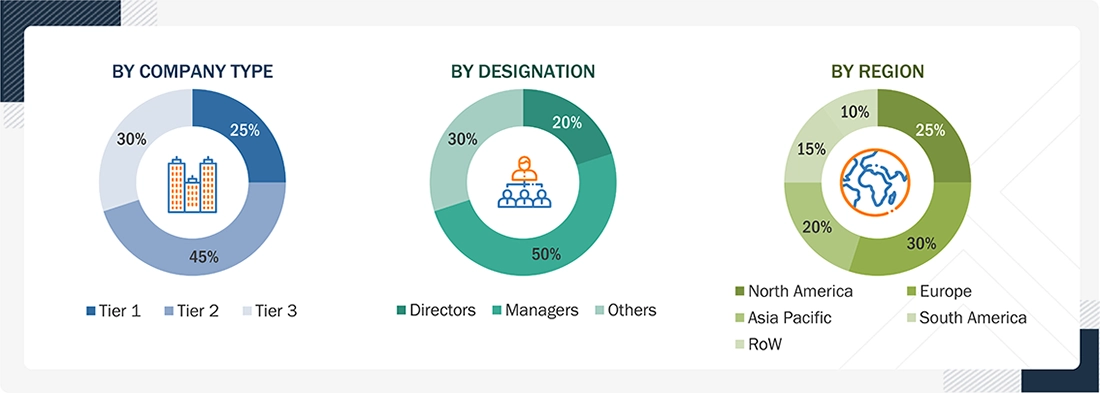
Note: The three tiers of the companies are defined based on their total revenues in 2023 or 2024, as per the availability of financial data: Tier 1: Revenue >USD 1 billion; Tier 2: USD 100 million ≤ Revenue ≤ USD 1 billion; Tier 3: Revenue USD 100 million.
To know about the assumptions considered for the study, download the pdf brochure
|
COMPANY NAME |
DESIGNATION |
|
BASF SE (Germany) |
R&D Expert |
|
Amcor Plc (Switzerland) |
Sales Manager |
|
Dow Inc. (US) |
Manager |
|
Kuraray Co., Ltd. (Japan) |
Sales Manager |
|
Exxon Mobil Corporation (US) |
Marketing Manager |
Market Size Estimation
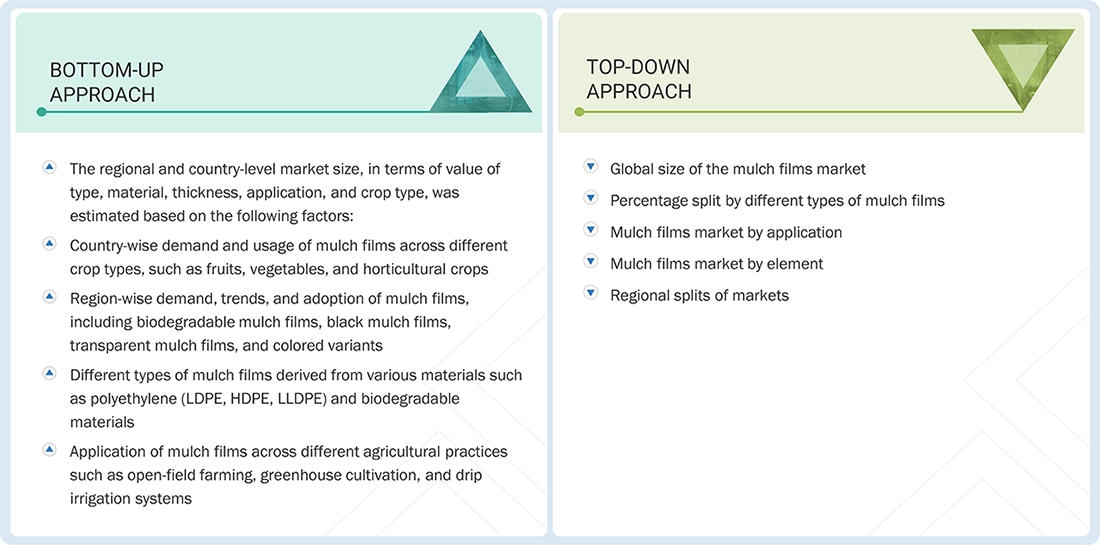
Both the top-down and bottom-up approaches were used to estimate and validate the total size of the mulch films market. These approaches were also used extensively to determine the size of various subsegments in the market. The research methodology used to estimate the market size includes the following details:
- The key players in the industry and the overall markets were identified through extensive secondary research.
- All shares, splits, and breakdowns were determined using secondary sources and verified through primary sources.
- All possible parameters that affect the market covered in this research study were accounted for, viewed in extensive detail, verified through primary research, and analyzed to obtain final quantitative and qualitative data.
- The research included the study of reports, reviews, and newsletters of top market players, along with extensive interviews for opinions from leaders, such as CEOs, directors, and marketing executives.
Mulch Films Market : Top-Down and Bottom-Up Approach
Data Triangulation
After arriving at the overall market size from the estimation process explained above, the total market was split into several segments and subsegments. Data triangulation procedure was employed, wherever applicable, to estimate the overall mulch films market and arrive at the exact statistics for all segments and subsegments. The data was triangulated by studying various factors and trends from the demand and supply sides. Along with this, the market size was validated using both the top-down and bottom-up approaches.
Market Definition
The mulch films market refers to the global industry focused on the production and use of thin plastic or biodegradable films applied over soil to improve agricultural productivity and efficiency. These films help regulate soil temperature, retain moisture, suppress weed growth, and enhance crop yield and quality, making them widely used in open-field farming, greenhouse cultivation, and horticulture. The market includes various types, such as black, transparent, and biodegradable mulch films made from materials like polyethylene (PE) and other advanced polymers. Growth in this market is driven by rising demand for high-yield farming, increasing adoption of modern agricultural practices, and a growing shift toward sustainable and eco-friendly farming solutions across major agricultural regions.
Key Stakeholders
- Raw material suppliers and manufacturers
- Key manufacturers of mulch films
- Distributors, traders, and suppliers of agricultural films
- Importers and exporters
-
Regulatory bodies:
- Food and Drug Administration (FDA)
- Food and Agriculture Organization (FAO)
- The United States Department of Agriculture (USDA)
- European Commission (EC)
- Commercial research & development (R&D) institutions and financial institutions:
-
Associations:
- International Plastics and Agricultural Film Associations
- Micronutrient Manufacturers Association (MMA)
- Organisation for Economic Co-operation and Development (OECD)
Report Objectives
- Determining and projecting the size of the mulch films market with respect to type, crop type, mode of application, source, formulation, and region
- Identifying the attractive opportunities in the market by determining the largest and fastest-growing segments
- Providing detailed information about the key factors influencing the market growth (drivers, restraints, opportunities, and industry-specific challenges)
- Providing the regulatory framework and market entry process related to the mulch films market
- Analyzing the micromarkets with respect to individual growth trends, prospects, and their contribution to the total market
Customization Options:
With the given market data, MarketsandMarkets offers customizations according to company-specific scientific needs.
The following customization options are available for the report:
Product Analysis
- Products Matrix, which gives a detailed comparison of the product portfolio of each company
Geographic Analysis
With the given market data, MarketsandMarkets offers customizations according to company-specific scientific needs
- Further breakdown of Rest of Europe mulch films market into key countries
- Further breakdown of Rest of Asia Pacific mulch films market into key countries
- Further breakdown of Rest of South America mulch films market into key countries
Company Information
- Detailed analyses and profiling of additional market players (up to five)
Get the Full Mulch Films Market Report
Full forecast, segment splits, and company analysis for all Mulch Films Market.
- US Mulch Films Market
- Canada Mulch Films Market
- Mexico Mulch Films Market
- Germany Mulch Films Market
- France Mulch Films Market
- UK Mulch Films Market
- Italy Mulch Films Market
- Spain Mulch Films Market
- China Mulch Films Market
- India Mulch Films Market
- Japan Mulch Films Market
- Argentina Mulch Films Market
- Rest Of Europe Mulch Films Market
- Rest Of Asia Pacific Mulch Films Market
- Rest Of South America Mulch Films Market
Need a Tailored Report?
Customize this report to your needs
Get 10% FREE Customization
Customize This Report
