
South Korea Natural Gas Power Generation Market (2025-2030)

The South Korea Natural Gas Power Generation Market was valued at $4077.1 Million in 2025 and projected to reach to $5296.1 Million by 2030, representing a compound annual growth rate of 5.4%. South Korea's natural gas power generation market is poised for robust expansion through 2030, driven by the government's energy diversification strategy and commitment to phasing out coal-dependent power generation.


| Market Size in | USD 26.32 MN |
| Market Forecast in | |
| CAGR | |
| Forecast Period | |
| Units Considered | Value (USD MN) |
South Korea Natural Gas Power Generation Market Trends and Insights
- The market in South Korea is expected to expand to $5,296.1 million by 2030, reflecting a compound annual growth rate of 5.4%.
- This growth trajectory in South Korea is driven by the nation's strategic shift toward cleaner energy sources and the need to balance baseload power generation with renewable energy integration. The natural gas power generation sector in South Korea benefits from established infrastructure, technological advancement, and supportive regulatory frameworks aimed at reducing carbon emissions.
- South Korea's commitment to energy security and decarbonization targets continues to reinforce investment in efficient gas-fired generation facilities.
- Between 2025 and 2030, South Korea's market expansion will be shaped by aging coal plant retirements, grid modernization initiatives, and the country's broader transition toward a low-carbon energy economy..
Key Market Statistics
- CAGR (2025-2030) 5.4% CAGR
- Market Size, 2025 ~USD 4077.1 Million
- Forecast, 2030 ~USD 5296.1 Million
- Country South Korea
South Korea Natural Gas Power Generation Market Overview
Market Valuation :
South Korea's natural gas power generation market is valued at $4,077.1 million in 2025, demonstrating the significant economic importance of gas-fired power infrastructure in the country's energy sector.
Strong Growth Trajectory :
With a CAGR of 5.4% from 2025 to 2030, South Korea's market growth outpaces the global average of 4.8%, indicating accelerating investment and expansion in natural gas generation capacity.
Energy Transition Driver :
South Korea's strategic pivot toward cleaner energy sources positions natural gas as a critical bridge fuel, supporting the nation's commitment to reducing carbon emissions while maintaining reliable baseload power.
Forecast Growth :
The market is projected to reach $5,296.1 million by 2030, representing a $1,219 million increase over five years, reflecting sustained demand for natural gas infrastructure modernization and capacity expansion.
South Korea Natural Gas Power Generation Market Dynamics
- The country's aging power infrastructure requires significant modernization, creating substantial opportunities for natural gas-fired plants that offer lower emissions than coal while providing flexible, dispatchable power to support grid stability. Regulatory support for cleaner energy sources, combined with South Korea's industrial demand and growing electricity consumption, will sustain market growth.
- Investment in LNG import infrastructure and gas distribution networks will further strengthen the sector.
- The transition toward renewable energy integration also necessitates natural gas plants for load balancing, ensuring continued relevance and expansion of the market through the forecast period..
Market Ecosystem
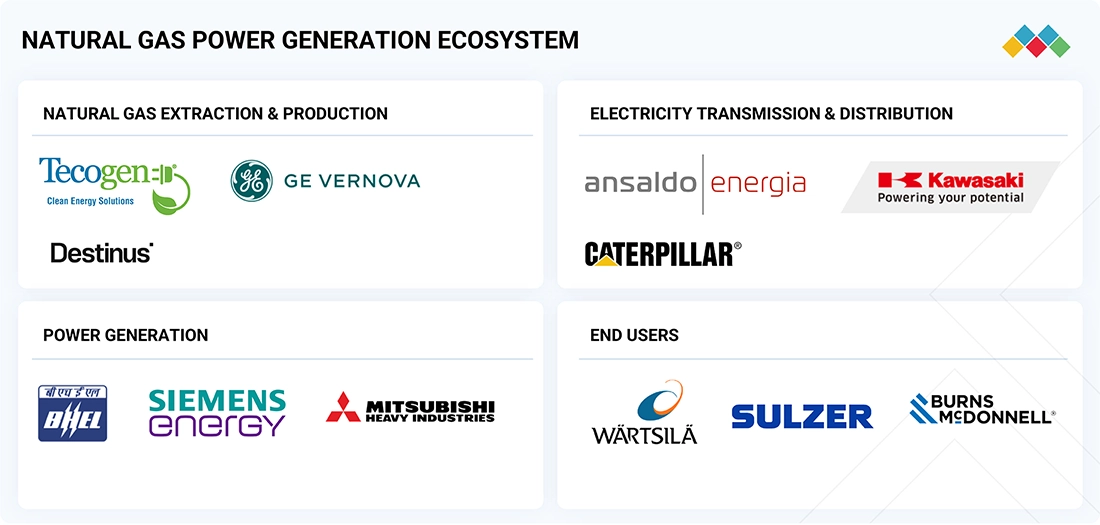
Natural Gas Power Generation Market: COMMERCIAL USE CASES ACROSS INDUSTRIES
| COMPANY | USE CASE DESCRIPTION | BENEFITS |
|---|---|---|
 |
|
|
 |
|
|
 |
|
|
Logos and trademarks shown above are the property of their respective owners. Their use here is for informational and illustrative purposes only.
Related Ecosystem
Power Infrastructure
- Geographical Information System (GIS)
- Cogeneration
- Battery Electric Vehicle (BEV)
- Cellular Network
- Fuel Cell
- Siemens ag
- ABB India Limited
- SCHNEIDER ELECTRIC SE
- General Electric Company
- Eaton Corporation plc
Key Takeaways
- South Korea's natural gas power generation market is valued at $4,077.1 million in 2025 and is projected to reach $5,296.1 million by 2030.
- South Korea's market is growing at a 5.4% CAGR, outpacing the global average of 4.8%, indicating strong regional momentum.
- South Korea's energy transition strategy prioritizes natural gas as a bridge fuel to support renewable energy integration and phase out coal dependency.
- South Korea's market growth is supported by infrastructure modernization, regulatory incentives, and corporate sustainability commitments through 2030.
Natural Gas Power Generation Market Report Scope
| Report Metric | Details |
|---|---|
| Base Year | 2025 |
| Fastest Growing Segment | ABOVE 1,000 MW (Power Output) |
| Forecast Period | 2025–2030 |
| Growth Rate | CAGR of 4.8% from 2025 to 2030 |
| Largest Segment | LIQUEFIED NATURAL GAS (Fuel Source) |
| Market Size Base Year (Billions) | ~USD 96.89 (2025) |
| Revenue Forecast (Billions) | ~USD 122.49 (2030) |
| Segments Covered | Technology, Fuel Source, Power Output, End-Use Application, Type, Application |
South Korea Natural Gas Power Generation Market Report Segmentation
6 segment dimensions are covered across the global market.
By Technology
- Cogeneration
- Combined Cycle
- Open Cycle
By Fuel Source
- Liquefied Natural Gas
- Pipeline Natural Gas
By Power Output
- 201–500 Mw
- 501–1,000 Mw
- 51–200
- 51–200 Mw
- Above 1,000 Mw
- Up To 50 Mw
By End-Use Application
- Industrial
- Power Utilities
- Residential & Commercial
By Type
- 201–500 Mw
- 501–1,000 Mw
- 51–200 Mw
- Above 1,000 Mw
- Up To 50 Mw
By Application
- Liquefied Natural Gas
- Pipeline Natural Gas
Target Audience
- Energy Utility Companies : South Korean and international utilities need detailed market data to evaluate investment opportunities, assess competitive positioning, and plan capacity expansion in South Korea's growing natural gas power sector.
- Government & Policy Makers : South Korean government agencies and energy regulators require market intelligence to inform energy policy decisions, infrastructure planning, and alignment with national clean energy transition goals.
- Infrastructure & Engineering Firms : Engineering and construction companies targeting South Korea's power generation sector need market forecasts and growth drivers to identify project opportunities and bid on LNG and gas infrastructure development.
- Investment & Financial Institutions : Private equity firms, venture capital, and institutional investors evaluating South Korea's energy sector require market sizing and growth projections to assess investment returns and portfolio allocation decisions.
- Technology & Equipment Suppliers : Manufacturers of gas turbines, power generation equipment, and related technologies need South Korea-specific market data to forecast demand, plan production capacity, and develop localized sales strategies.
Key Companies in the South Korea Natural Gas Power Generation Market
| Company | HQ | Ownership | Strongest segments |
|---|---|---|---|
| TECOGEN, INC. | United States | Public Company | Cogeneration Systems (InVerde e+, TecoPower and related CHP),Chillers and Refrigeration (Tecochill, Tecofrost and hybrid-drive solutions),Services (Operations, Maintenance, Parts, Installation), |
| FLUOR CORPORATION | United States | Public Company | Combined Cycle EPC,Open Cycle / Peaker EPC,Cogeneration / CHP EPC, |
| WORLEY | Australia | Public Company | Combined Cycle (EPC, consulting, asset performance),Open Cycle (peakers and fast-start plants),Cogeneration / CHP (industrial and district energy), |
| CATERPILLAR | United States | Public Company | Open Cycle (Gas Engines & Simple-Cycle Turbines),Cogeneration / CHP,Combined Cycle, |
| MCDERMOTT | United States | Private Company | Combined Cycle,Open Cycle,Cogeneration, |
| CALPINE | United States | Private Company | Combined Cycle Gas Power Generation,Open Cycle / Peaker Gas Generation,Cogeneration & Steam Sales, |
TECOGEN, INC.
Tecogen, Inc. is a U.S.-based public company founded in 2000 with 120 employees that develops and manufactures clean energy and power generation technologies.
FLUOR CORPORATION
Fluor Corporation is a U.S.-based public engineering and construction company founded in 1912 with approximately 23,000 employees, providing services to energy and industrial sectors.
WORLEY
Worley is an Australian-based public company founded in 1971 with over 38,000 employees, providing professional services in engineering, procurement, and project delivery.
CATERPILLAR
Caterpillar is a U.S.-based public company founded in 1925 with 118,000 employees, manufacturing heavy equipment, engines, and power generation systems.
MCDERMOTT
McDermott is a U.S.-based private company founded in 1959 with 42,600 employees, providing engineering, procurement, and construction services to the energy industry.
CALPINE
Calpine is a U.S.-based private company founded in 1984 with 2,500 employees, operating as an independent power producer generating electricity from natural gas and renewable sources.
Reasons to Buy this Report
- Market-Specific Sizing & Forecasts : Access precise valuation data for South Korea's natural gas power generation market with detailed projections through 2030, enabling accurate financial planning and investment decisions tailored to this specific geography.
- Competitive Landscape Intelligence : Understand South Korea's unique market dynamics, key players, and competitive positioning within the country's energy sector to identify partnership and investment opportunities in this high-growth market.
- Regulatory & Policy Insights : Gain comprehensive understanding of South Korea's energy policies, government incentives, and regulatory framework driving natural gas adoption and infrastructure development in the country.
- Growth Driver Analysis : Identify the specific factors fueling South Korea's 5.4% CAGR, including energy transition strategies, industrial demand patterns, and infrastructure modernization needs unique to the Korean market.
- Strategic Market Entry Planning : Develop informed market entry and expansion strategies for South Korea with localized insights on demand trends, investment requirements, and growth opportunities in the natural gas power sector.
Frequently asked questions
What is the current market size of natural gas power generation in South Korea?
South Korea's natural gas power generation market is valued at $4,077.1 million in 2025 and is expected to grow to $5,296.1 million by 2030.
What is the growth rate of South Korea's natural gas power generation market?
South Korea's market is expanding at a compound annual growth rate of 5.4% from 2025 to 2030, which exceeds the global CAGR of 4.8%.
Why is natural gas power generation important to South Korea's energy strategy?
South Korea views natural gas as a critical bridge fuel that enables the transition away from coal while supporting renewable energy integration and meeting decarbonization targets.
What factors are driving growth in South Korea's natural gas power generation market?
Key drivers include coal plant retirements, grid modernization, regulatory support for cleaner energy, energy security concerns, and corporate sustainability initiatives across South Korea.
How does South Korea's market growth compare to global trends?
South Korea's 5.4% CAGR outpaces the global average of 4.8%, reflecting stronger regional demand and accelerated energy transition efforts within the country.
RESEARCH METHODOLOGY
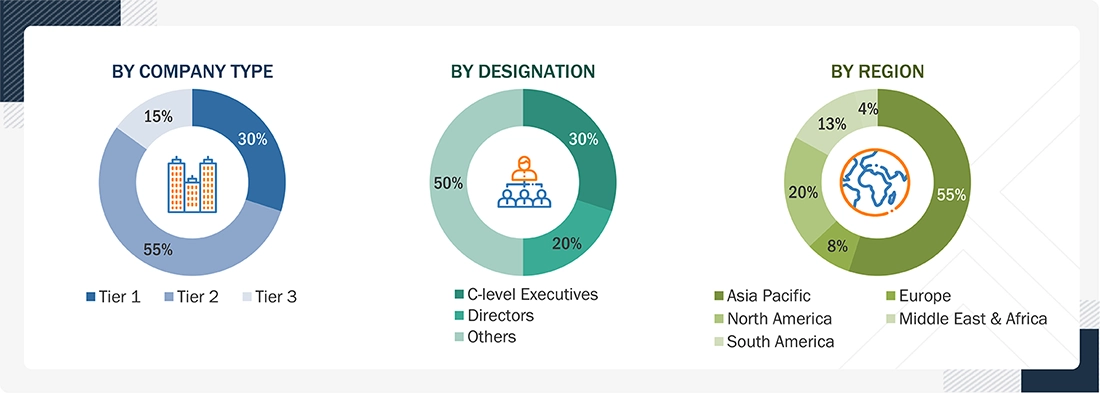
This research study involved the use of extensive secondary sources such as press releases, investment reports, industry white papers, presentations, and other publicly available sources to identify and collect information useful for a technical, market-oriented, and commercial study of the natural gas power generation market. Primary sources include several industry experts from the core and related industries, preferred suppliers, manufacturers, distributors, service providers, technology developers, standards and certification organizations from companies, and organizations related to all the segments of this industry’s value chain. In-depth interviews were conducted with various primary respondents, which include key industry participants, subject-matter experts, C-level executives of key market players, and industry consultants, among other experts, to obtain and verify qualitative and quantitative information as well as assess prospects.
Secondary Research
Secondary sources referred to for this research study include annual reports, press releases, investor presentations of companies, white papers, certified publications, articles from recognized authors, and databases of various companies and associations. Secondary research has been mainly used to obtain key information about the industry’s supply chain to identify the key players offering various products and services, market classification and segmentation according to the offerings of major players, industry trends to the bottom-most level, regional markets, and key developments from market- and technology-oriented perspectives.
Primary Research
In the primary research process, various primary sources from both supply and demand sides were interviewed to obtain qualitative and quantitative information for this report. Primary sources from the supply side include industry experts such as chief executive officers (CEO), vice presidents, marketing directors, technology and innovation directors, and related key executives from various companies and organizations operating in the natural gas power generation market.
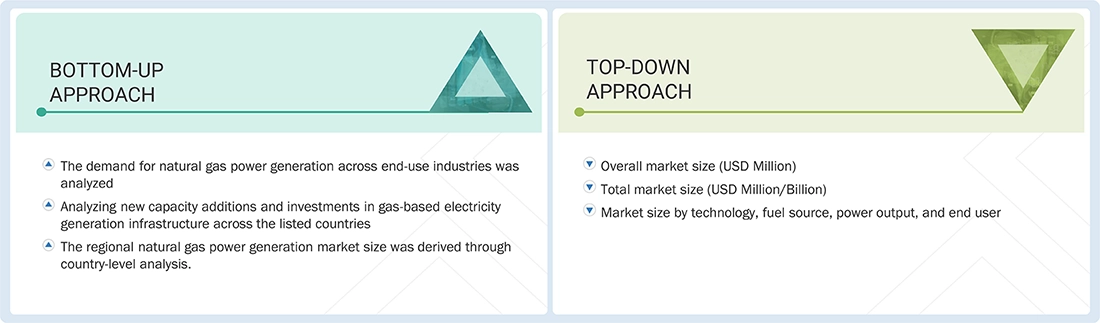
In the complete market engineering process, both top-down and bottom-up approaches were extensively used, along with several data triangulation methods, to perform the market size estimations and forecasts for all segments and subsegments listed in this report. Extensive qualitative and quantitative analyses were conducted to complete the market engineering process to list key information/insights throughout the report.
To know about the assumptions considered for the study, download the pdf brochure
Market Size Estimation
Both top-down and bottom-up approaches were used to estimate and validate the size of the global Natural gas power generation market and its dependent submarkets. The key players in the market were identified through secondary research, and their market shares in the respective regions were determined through both primary and secondary research. The research methodology included in the study is from the annual and financial reports of the top market players, and from interviews with industry experts, such as CEOs, VPs, directors, sales managers, and marketing executives, for key insights, both quantitative and qualitative, into the market. The following segments provide details about the overall market size estimation process employed in this study.
Natural Gas Power Generation Market : Top-Down and Bottom-Up Approach
Data Triangulation
After arriving at the overall market size from the estimation process explained below, the total market was split into several segments and subsegments. The data triangulation and market breakdown procedures were employed, wherever applicable, to complete the overall market engineering process and arrive at the exact statistics for all the segments and subsegments. The data was triangulated by studying various factors and trends from both the demand and supply sides. Along with this, the market was validated using both the top-down and bottom-up approaches.
Market Definition
According to IEA, the natural gas power generation market encompasses the production of electricity through the combustion of natural gas, primarily methane (CH4), which is the largest component of natural gas. Natural gas is a fossil fuel energy source consisting of various hydrocarbons, with methane being the most prevalent. It is easily stored and can be delivered through pipelines or liquefied and transported by ship. Gas-fired power plants are valued for their ability to turn on and off quickly, making them a convenient way to respond to both seasonal and short-term demand fluctuations. Natural gas accounts for about a quarter of global electricity generation and plays a significant role in providing a reliable and flexible power supply.
Stakeholders
- Natural Gas Suppliers & Producers
- Power Generation Companies / Utilities
- Engineering, Procurement, and Construction (EPC) Contractors
- Turbine & Equipment Manufacturers
- Operation & Maintenance (O&M) Service Providers
- Consulting Companies
- Energy Regulators & Authorities
- Government and Research Organizations
- Industry Associations & Power/Utility Forums
- Standards & Certification Bodies
- Technology & Innovation Partners
Report Objectives
- To define, describe, segment, and forecast the size of the natural gas power generation market, by technology, fuel source, power output, end user, and region, in terms of value
- To segment and forecast the size of the natural gas power generation market by region, in terms of volume
- To forecast the market sizes for five key regions, namely North America, Europe, Asia Pacific, Middle East & Africa, and South America
- To provide detailed information regarding key drivers, restraints, opportunities, and challenges influencing the growth of the natural gas power generation market
- To offer the supply chain analysis, trends/disruptions impacting customer business, ecosystem analysis, regulatory landscape, patent analysis, case study analysis, technology analysis, key conferences & events, the impact of AI/Gen AI, macroeconomic outlook, pricing analysis, Porter’s five forces analysis, and regulatory analysis, the impact of the 2025 US tariff on the market
- To analyze opportunities for stakeholders in the natural gas power generation market and draw a competitive landscape of the market
- To benchmark market players using the company evaluation matrix, which analyzes market players on broad categories of business and product strategies adopted by them
- To compare key market players for the market share, product specifications, and end uses
- To strategically profile key players and comprehensively analyze their market ranking and core competencies
- To analyze competitive developments, such as contracts, agreements, partnerships, and joint ventures, in the natural gas power generation market
Available Customizations
MarketsandMarkets offers customizations according to the specific needs of the companies with the given market data.
The following customization options are available for the report:
Product Analysis
- Product matrix, which gives a detailed comparison of the product portfolio of each company
Geographic Analysis as per Feasibility
- Further breakdown of the natural gas power generation market, by North America, Europe, Asia Pacific, Middle East & Africa, and South America.
Company Information
- Detailed analysis and profiling of additional market players (up to five)
Get the Full Natural Gas Power Generation Market Report
Full forecast, segment splits, and company analysis for all Natural Gas Power Generation Market.
- China Natural Gas Power Generation Market
- Indonesia Natural Gas Power Generation Market
- Thailand Natural Gas Power Generation Market
- Japan Natural Gas Power Generation Market
- Canada Natural Gas Power Generation Market
- Mexico Natural Gas Power Generation Market
- US Natural Gas Power Generation Market
- Brazil Natural Gas Power Generation Market
- Argentina Natural Gas Power Generation Market
- Russia Natural Gas Power Generation Market
- UK Natural Gas Power Generation Market
- Germany Natural Gas Power Generation Market
- Italy Natural Gas Power Generation Market
- France Natural Gas Power Generation Market
- Saudi Arabia Natural Gas Power Generation Market
- UAE Natural Gas Power Generation Market
- Iran Natural Gas Power Generation Market
- Nigeria Natural Gas Power Generation Market
- Rest Of Europe Natural Gas Power Generation Market
- Rest Of Asia Pacific Natural Gas Power Generation Market
- Algeria Natural Gas Power Generation Market
- GCC Natural Gas Power Generation Market
- Rest Of South America Natural Gas Power Generation Market
- Rest Of GCC Natural Gas Power Generation Market
Need a Tailored Report?
Customize this report to your needs
Get 10% FREE Customization
Customize This Report
