
Netherlands Natural Language Processing (NLP) Market (2026-2031)

The Netherlands Natural Language Processing (NLP) Market was valued at $2711.5 Million in 2026 and projected to reach to $8873.5 Million by 2031, representing a compound annual growth rate of 26.8%. The Netherlands NLP market demonstrates exceptional growth potential, driven by digital transformation initiatives across enterprise sectors and strong government support for AI innovation.


| Market Size in | USD 26.32 MN |
| Market Forecast in | |
| CAGR | |
| Forecast Period | |
| Units Considered | Value (USD MN) |
Netherlands Natural Language Processing (NLP) Market Trends and Insights
- Japan is leveraging advanced AI capabilities and linguistic expertise to drive NLP adoption across enterprise and consumer applications.
- The country's strong technology infrastructure and investment in AI research position Japan as a key growth engine within the Asia Pacific region. Driving Japan's NLP market growth are increasing demand for intelligent automation, customer service optimization, and multilingual content processing.
- Japan's unique language complexity and cultural emphasis on precision create specialized opportunities for NLP solutions tailored to Japanese text analysis and sentiment detection.
- Between 2026 and 2031, Japan is expected to capture significant market share through innovations in conversational AI and enterprise language understanding platforms. Japan's competitive advantage stems from its established semiconductor and robotics industries, which are increasingly integrating NLP capabilities.
- The country's regulatory environment and focus on responsible AI development further strengthen Japan's position as a trusted NLP innovation hub in Asia Pacific..
Key Market Statistics
- CAGR (2026-2031) 26.8% CAGR
- Market Size, 2026 ~USD 2711.5 Million
- Forecast, 2031 ~USD 8873.5 Million
- Country Netherlands
Netherlands Natural Language Processing (NLP) Market Overview
Strong Market Growth :
Netherlands' NLP market is expanding at 26.8% CAGR, growing from $2,711.5 million in 2026 to $8,873.5 million by 2031, outpacing the global average of 25.7%.
Digital Innovation Hub :
The Netherlands' advanced digital infrastructure and tech-savvy population drive rapid NLP adoption across financial services, healthcare, and e-commerce sectors.
Enterprise Transformation :
Dutch enterprises are increasingly deploying NLP solutions for customer service automation, sentiment analysis, and multilingual content processing to enhance operational efficiency.
AI Research Leadership :
The country's investment in AI research institutions and tech startups positions Netherlands as a regional innovation center for NLP development and implementation.
Netherlands Natural Language Processing (NLP) Market Dynamics
- Dutch organizations are rapidly adopting NLP technologies to enhance customer engagement, streamline operations, and gain competitive advantages in the European market.
- The country's multilingual environment and international business focus create unique opportunities for advanced language processing solutions.
- By 2031, the market is expected to nearly triple in value, reflecting sustained investment in AI capabilities and increasing demand for intelligent automation across industries..
Market Ecosystem
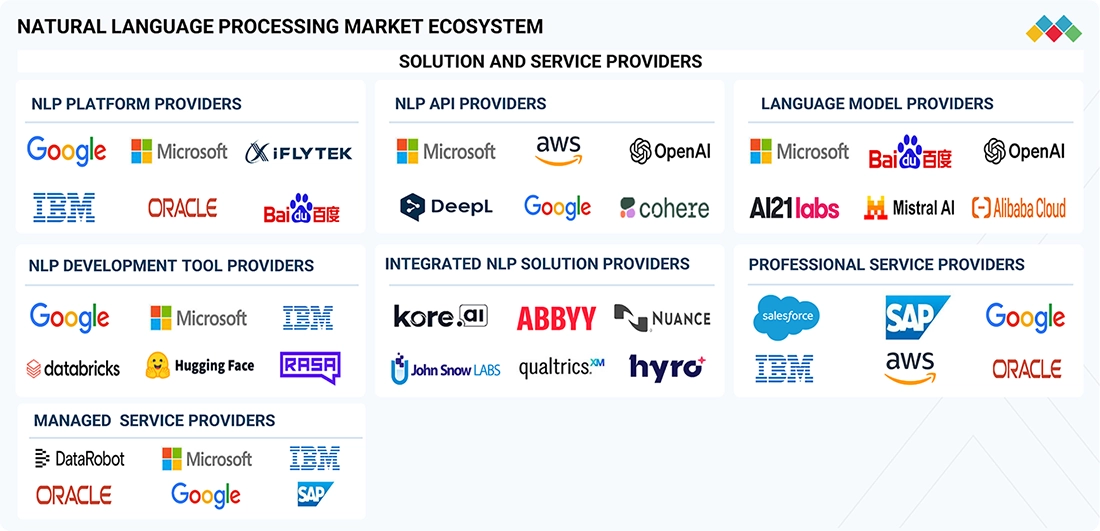
NATURAL LANGUAGE PROCESSING (NLP) MARKET: COMMERCIAL USE CASES ACROSS INDUSTRIES
| COMPANY | USE CASE DESCRIPTION | BENEFITS |
|---|---|---|
 |
Bank of America deployed Erica, a conversational NLP virtual assistant built on Microsoft Azure infrastructure, across retail, Merrill, and Private Bank channels to handle customer queries, surface proactive financial alerts, and route complex requests to human agents. | 3 billion client interactions since 2018, 58 million per month as of August 2025. 98% of inquiries resolved without human escalation | Equivalent capacity of 11,000 staff | 60% of interactions are proactive |
 |
WellSpan Health deployed Nuance DAX Copilot within its Epic EHR environment to automatically draft structured clinical notes from ambient patient-physician conversations across primary care, specialist, and telehealth settings. | 94% of physicians reported improved patient interaction quality | 85% reported better work-life balance due to reduced documentation load | 97% of patients said physicians were more focused during visits | 88% reported higher overall visit satisfaction vs. pre-deployment |
 |
Pearson deployed AWS NLP services, including Amazon Comprehend, across its Pearson+ digital learning platform to automate student response classification, adaptive content recommendation, and feedback generation across 70 countries. | Pearson+ reached 4.6 million registered users in FY2023 | Digital revenue grew 10% year-over-year | Platform processed over 100 million learner interactions in 2023 | AI-driven personalization cited as a contributor to reduced subscriber churn |
 |
Maersk deployed IBM watsonx NLP tools to automate the extraction and classification of shipping documents, including bills of lading, customs declarations, and cargo manifests across operations in 130-plus countries, feeding structured data directly into logistics and compliance systems. | 10% reduction in document handling time across select trade lanes | Applied across a growing share of Asia-Europe and transpacific corridor shipments within a total volume of 12 million container shipments in 2023 |
 |
Walmart deployed Microsoft Azure OpenAI Service NLP capabilities to power My Assistant, an internal knowledge tool for approximately 50,000 corporate employees handling HR, policy, and operational queries. Separately, NLP-based semantic search was deployed across Walmart.com to improve product discovery for 120 million weekly US online visitors. | Material reduction in time spent by corporate employees on routine HR and policy queries | Ecommerce sales grew 21% year-over-year in FY2024, with search relevance improvements cited as a contributing factor | AI investments contributed to 20 basis points of operating expense leverage |
Logos and trademarks shown above are the property of their respective owners. Their use here is for informational and illustrative purposes only.
Related Ecosystem
Analytics
- Natural Language Processing (NLP)
- Machine Learning
- Supply Chain Management
- Predictive Analytics
- Image Sensors
- International Business Machines Corporation
- MICROSOFT CORPORATION
- Oracle Corporation
- SAP SE
Key Takeaways
- Japan's NLP market will grow from $2,711.5M (2026) to $8,873.5M (2031), representing a 26.8% CAGR.
- Japan's linguistic complexity and precision-focused culture drive demand for specialized NLP solutions.
- Japan's semiconductor and robotics sectors are major integrators of NLP technology.
- Japan's regulatory framework positions the country as a trusted leader in responsible AI development.
Natural Language Processing (NLP) Market Report Scope
| Report Metric | Details |
|---|---|
| Base Year | 2026 |
| Fastest Growing Segment | RAG-ENABLED NLP (Technology) |
| Forecast Period | 2026–2031 |
| Growth Rate | CAGR of 25.7% from 2026 to 2031 |
| Largest Segment | SOFTWARE (Offering) |
| Market Size Base Year (Billions) | ~USD 69.11 (2026) |
| Revenue Forecast (Billions) | ~USD 216.89 (2031) |
| Segments Covered | Offering, Software, Solution, Deployment Mode, Service, Professional Service, Type, Managed Service, Technology, Application, Capability, Vertical |
Netherlands Natural Language Processing (NLP) Market Report Segmentation
12 segment dimensions are covered across the global market.
By Offering
- Services
- Software
- Solution
- Solutions
By Software
- Integrated Nlp Software
- Language Model Platforms
- Nlp Apis
- Nlp Development Tools
- Nlp Platforms
By Solution
- Platform
- Platforms
- Software Tools
By Deployment Mode
- Cloud
- On-Premises
By Service
- Managed Services
- Professional Services
By Professional Service
- Consulting Services
- Custom Model Development Services
- Model Fine-Tuning Services
- Support & Maintenance
- System Integration & Implementation
- System Integration Services
- Training & Consulting
By Type
- Hybrid
- Rule-Based
- Statistical
- Support & Maintenance
- System Integration & Implementation
- Training & Consulting
By Managed Service
- Data Annotation Services
- Model Monitoring Services
- Support & Maintenance
By Technology
- Auto Coding
- Deep Learning & Neural Nlp
- Image & Pattern Recognition
- Ivr
- Ocr
- Rag-Enabled Nlp
- Rule-Based & Symbolic Nlp
- Simulation & Modeling
- Speech Analytics
- Statistical & Classical Machine Learning Nlp
- Text Analytics
- Transformer-Based & Generative Nlp
By Application
- Compliance, Legal, & Risk Intelligence
- Customer Experience & Support
- Customer Experience Management
- Document Process Automation
- Employee Onboarding & Recruiting
- Employee Onboarding And Recruiting
- Knowledge Management & Discovery
- Language Generation & Speech Recognition
- Machine Translation
- Marketing & Brand Intelligence
- Other Applications
- Research & Information Intelligence
- Sentiment Analysis
- Social Media Monitoring
- Text Classification & Summarization
- Translation & Localization
- Virtual Assistants/Chatbots
- Workforce Productivity & Automation
By Capability
- Machine Translation & Multilingual Processing
- Natural Language Generation
- Natural Language Understanding
- Speech & Spoken Language Processing
By Vertical
- Bfsi
- Education & Ed-Tech
- Government & Defense
- Government & Public Sector
- Healthcare & Life Sciences
- It & Ites
- Logistics & Transportation
- Manufacturing
- Media & Entertainment
- Other Verticals
- Retail & E-Commerce
- Retail & Ecommerce
- Software & Technology
- Telecom
- Telecommunications
- Transportation & Logistics
NETHERLANDS: NATURAL LANGUAGE PROCESSING MARKET, BY APPLICATION, 2026–2031
| Segment | 2026 | 2027 | 2028 | 2029 | 2030 | 2031 | CAGR (%) |
|---|---|---|---|---|---|---|---|
| COMPLIANCE, LEGAL, & RISK INTELLIGENCE | 74.3 | 101.5 | 134.6 | 176.7 | 219.1 | 278.5 | 30.2 |
| CUSTOMER EXPERIENCE & SUPPORT | 199.2 | 278.4 | 378.6 | 506.3 | 659.3 | 844.8 | 33.5 |
| DOCUMENT PROCESS AUTOMATION | 94.4 | 130.7 | 177.4 | 238.4 | 298.3 | 377.7 | 32 |
| KNOWLEDGE MANAGEMENT & DISCOVERY | 39.9 | 53.5 | 78.2 | 103.3 | 130.2 | 172.6 | 34 |
| MARKETING & BRAND INTELLIGENCE | 59.8 | 76.7 | 102.3 | 123 | 160.7 | 188.8 | 25.8 |
| OTHER APPLICATIONS | 33.2 | 44.8 | 53.6 | 72.2 | 88.3 | 102.7 | 25.4 |
| RESEARCH & INFORMATION INTELLIGENCE | 53 | 70.6 | 91.3 | 123 | 149.3 | 196.1 | 29.9 |
| TRANSLATION & LOCALIZATION | 73.7 | 98.5 | 128.9 | 162.6 | 208.7 | 244.6 | 27.1 |
| WORKFORCE PRODUCTIVITY & AUTOMATION | 56.3 | 79 | 110.5 | 150.2 | 192.5 | 261.7 | 36 |
| TOTAL | 683.8 | 933.7 | 1255.2 | 1655.7 | 2106.4 | 2667.4 | 31.3 |
Target Audience
- Enterprise Technology Leaders : CIOs and digital transformation officers need Netherlands-specific NLP market data to evaluate vendor solutions, budget allocation, and technology roadmap alignment.
- NLP Solution Providers : Software vendors and AI companies require detailed Netherlands market analysis to assess growth opportunities, competitive positioning, and customer acquisition strategies.
- Investment & Private Equity Firms : Investors evaluating Dutch tech companies and NLP startups need market sizing, growth projections, and sector trends to support due diligence and valuation decisions.
- Management Consultants : Strategy consultants advising Dutch enterprises on digital transformation require market intelligence to benchmark NLP adoption and recommend technology investments.
- Government & Policy Makers : Dutch government agencies and economic development organizations need market data to inform AI policy, innovation funding, and digital economy initiatives.
Key Companies in the Netherlands Natural Language Processing (NLP) Market
| Company | HQ | Ownership | Strongest segments |
|---|---|---|---|
| EXL | United States | Public Company | Insurance digital operations and platforms,Healthcare and Life Sciences services,Banking, Capital Markets, and Diversified Industries, |
| SDL PLC | New Zealand | Public Company | GenComm AI CCM SaaS and digital document management,Print mailing management and mail house processing,Creative, campaign optimisation, and data/analytics services, |
| LENOVO | China | Public Company | Small form factor PCs / signage controllers,Thin clients and embedded systems,Tablets and smart devices for kiosks/PoS, |
| L&T TECHNOLOGY SERVICES LIMITED | India | Public Company | Mobility,Sustainability,Tech, |
| IBM | United States | Public Company | Software (Hybrid Cloud & AI Platforms),Consulting,Infrastructure, |
| MICROSOFT | United States | Public Company | Intelligent Cloud (Azure, Server, GitHub, Nuance, enterprise services),Productivity and Business Processes (Microsoft 365, LinkedIn, Dynamics),Personal Computing (Windows, Devices, Gaming, Search & News Ads), |
| United States | Public Company | Search and other advertising,YouTube ads and subscriptions,Google Cloud (infrastructure, data, AI, Workspace), | |
| ORACLE | United States | Public Company | Fusion Cloud ERP & EPM,Fusion Cloud HCM,Supply Chain & Manufacturing (SCM), |
| BAIDU | China | Public Company | Search and Online Marketing Services,AI Cloud and Enterprise AI Solutions,iQIYI (Online Entertainment and Membership), |
| SAP | Germany | Public Company | SAP S/4HANA and core ERP,SAP SuccessFactors and HCM,SAP Business Technology Platform (BTP), |
| SALESFORCE | United States | Public Company | Sales and Service Cloud (incl. Agentforce Sales & Service),Platform, Data 360, Informatica, Integration & Analytics,Slack and Collaboration, |
| IFLYTEK | China | Public Company | Intelligent speech software and platforms,Education and training solutions,Smart devices (recorders, translators, dictionary pens, microphones), |
EXL
EXL is a United States-based public company founded in 1999, employing approximately 65,000 people. The company provides business process management and analytics services.
SDL PLC
SDL PLC is a New Zealand-based public company founded in 1996 with 62 employees.
LENOVO
Lenovo is a Chinese technology company founded in 1984 and operates as a public company. The company is a global leader in personal computers and computing devices.
L&T TECHNOLOGY SERVICES LIMITED
L&T Technology Services Limited is an Indian public company founded in 2012 with 21,039 employees. The company provides engineering and technology services to global clients.
IBM
IBM is a United States-based public company founded in 1911 with 264,300 employees. The company is a global leader in information technology, cloud computing, and enterprise solutions.
MICROSOFT
Microsoft is a United States-based public company founded in 1975 with 228,000 employees. The company develops software, cloud services, and computing devices for consumers and enterprises worldwide.
Google is a United States-based public company founded in 1998 with 194,668 employees. The company operates as a leading search engine and technology platform offering advertising, cloud services, and software solutions.
ORACLE
Oracle is a United States-based public company founded in 1977 with 141,000 employees. The company develops database software, cloud computing solutions, and enterprise applications.
BAIDU
Baidu is a Chinese public company founded in 2000 with 33,500 employees. The company operates as a leading search engine and artificial intelligence platform in China.
SAP
SAP is a Germany-based public company founded in 1972 with 111,038 employees. The company develops enterprise resource planning software and business applications.
SALESFORCE
Salesforce is a United States-based public company founded in 1999 with 83,334 employees. The company provides cloud-based customer relationship management and enterprise software solutions.
IFLYTEK
iFLYTEK is a Chinese public company founded in 1999 with 16,818 employees. The company specializes in artificial intelligence and voice recognition technology.
Reasons to Buy this Report
- Market-Specific Sizing & Forecasts : Access precise Netherlands market valuations ($2.7B in 2026, $8.9B in 2031) with country-specific CAGR analysis to inform investment and expansion strategies.
- Competitive Landscape Intelligence : Understand key players, market consolidation trends, and competitive positioning specific to the Dutch NLP ecosystem to identify partnership and acquisition opportunities.
- Sector-Specific Adoption Insights : Gain detailed analysis of NLP implementation across Netherlands' key industries including finance, healthcare, retail, and government to target high-growth segments.
- Regional Growth Drivers : Identify Netherlands-specific factors driving 26.8% CAGR including digital infrastructure maturity, regulatory environment, and enterprise transformation initiatives.
- Strategic Market Entry Planning : Develop data-driven go-to-market strategies for Netherlands with insights on customer segments, technology preferences, and investment priorities for successful market penetration.
Frequently asked questions
What is the projected size of Japan's NLP market in 2031?
Japan's NLP market is projected to reach $8,873.5 million by 2031, growing from $2,711.5 million in 2026.
What is the CAGR for Japan's NLP market?
Japan's NLP market is expected to grow at a compound annual growth rate (CAGR) of 26.8% between 2026 and 2031.
What are the primary drivers of NLP adoption in Japan?
Key drivers include demand for intelligent automation, customer service optimization, multilingual content processing, and Japan's unique linguistic complexity requiring specialized solutions.
Which industries in Japan are leading NLP adoption?
Japan's semiconductor, robotics, enterprise automation, and customer service sectors are among the leading adopters of NLP technology.
Why is Japan positioned as a key NLP market in Asia Pacific?
Japan's advanced technology infrastructure, strong AI research ecosystem, established hardware industries, and responsible AI regulatory framework make it a trusted innovation hub for NLP solutions.
RESEARCH METHODOLOGY
The research methodology for the global natural language processing (NLP) market report involved the use of extensive secondary sources and directories, as well as various reputed open-source databases, to identify and collect information useful for this technical and market-oriented study. In-depth interviews were conducted with various primary respondents, including NLP software providers, NLP service providers, language service providers, translation & localization solution vendors, and enterprise end users; high-level executives of multiple companies offering natural language processing software & services; and industry consultants to obtain and verify critical qualitative and quantitative information and assess the market prospects and industry trends.
Secondary Research
In the secondary research process, various secondary sources were referred to for identifying and collecting information for the study. The secondary sources included annual reports; press releases and investor presentations of companies; white papers, certified publications such as computational linguistics, transactions of the association for computational linguistics, natural language engineering, journal of natural language engineering research, language resources and evaluation, machine translation, information processing & management, ACM Transactions on Asian and Low-Resource Language Information Processing, Journal of Artificial Intelligence Research, Artificial Intelligence, IEEE/ACM Transactions on Audio, Speech, and Language Processing, and Computer Speech & Language; and articles from recognized associations and government publishing sources including but not limited to Association for Computational Linguistics (ACL), International Committee on Computational Linguistics (ICCL), European Association for Machine Translation (EAMT), Asia-Pacific Association for Machine Translation (AAMT), International Speech Communication Association (ISCA), National Science Foundation (NSF), Defense Advanced Research Projects Agency (DARPA), European Commission, OECD.AI Policy Observatory, UK Department for Science, Innovation and Technology (DSIT), Alan Turing Institute, Singapore Infocomm Media Development Authority (IMDA), Indian Ministry of Electronics and Information Technology (MeitY), and Japan’s National Institute of Information and Communications Technology (NICT).
The secondary research was used to obtain key information about the industry’s value chain, the market’s monetary chain, the overall pool of key players, market classification and segmentation according to industry trends to the bottom-most level, regional markets, and key developments from the market and technology-oriented perspectives.
Primary Research
In the primary research process, a diverse range of stakeholders from both the supply and demand sides of the natural language processing ecosystem were interviewed to gather qualitative and quantitative insights specific to this market. From the supply side, key industry experts, such as chief executive officers (CEOs), vice presidents (VPs), marketing directors, technology & innovation directors, as well as technical leads from vendors offering natural language processing software & services, were consulted. Additionally, system integrators, service providers, and IT service firms that implement and support natural language processing solutions were included in the study. On the demand side, input from IT decision-makers, AI infrastructure managers, and business heads of prominent enterprise end users was collected to understand the user perspectives and adoption challenges within targeted industries.
The primary research ensured that all crucial parameters affecting the natural language processing market—from technological advancements and evolving use cases (customer support automation, document intelligence, enterprise knowledge management, sentiment analysis, content generation & summarization, etc.) to regulatory and compliance needs (GDPR, CCPA, Europe NLP Act, AIDA, etc.) were considered. Each factor was thoroughly analyzed, verified through primary research, and evaluated to obtain precise quantitative and qualitative data for this market.
Once the initial phase of market engineering was completed, including detailed calculations for market statistics, segment-specific growth forecasts, and data triangulation, an additional round of primary research was undertaken. This step was crucial for refining and validating critical data points, such as offerings (natural language processing software & services), industry adoption trends, the competitive landscape, and key market dynamics like demand drivers (Growing enterprise spending on unstructured data intelligence is driving NLP adoption; generative AI is expanding NLP from analytics to content and knowledge workflows; customer support and employee productivity use cases are accelerating deployment; multilingual and voice-led engagement is widening the addressable market), challenges (Hallucination, bias, and weak traceability continue to limit trust; Scaling NLP across languages, formats, and enterprise systems remains difficult), and opportunities (RAG-enabled NLP is emerging as the enterprise layer for trusted knowledge access; vertical-specific NLP is opening high-value regulated workflows; document intelligence offers one of the clearest monetization paths for NLP).
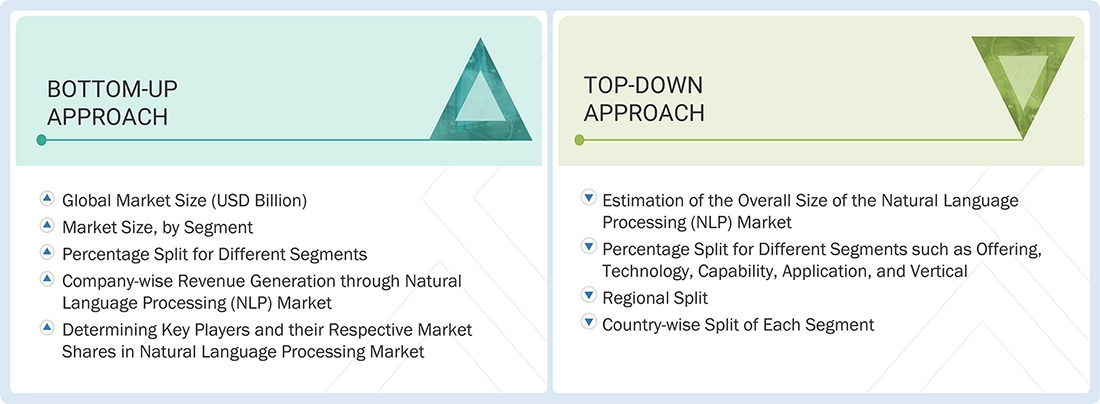
In the comprehensive market engineering process, the top-down and bottom-up approaches, along with several data triangulation methods, were extensively employed to perform market estimation and forecasting for the overall market segments and subsegments listed in this report. Extensive qualitative and quantitative analysis was performed on the complete market engineering process to record the critical information/insights throughout the report.
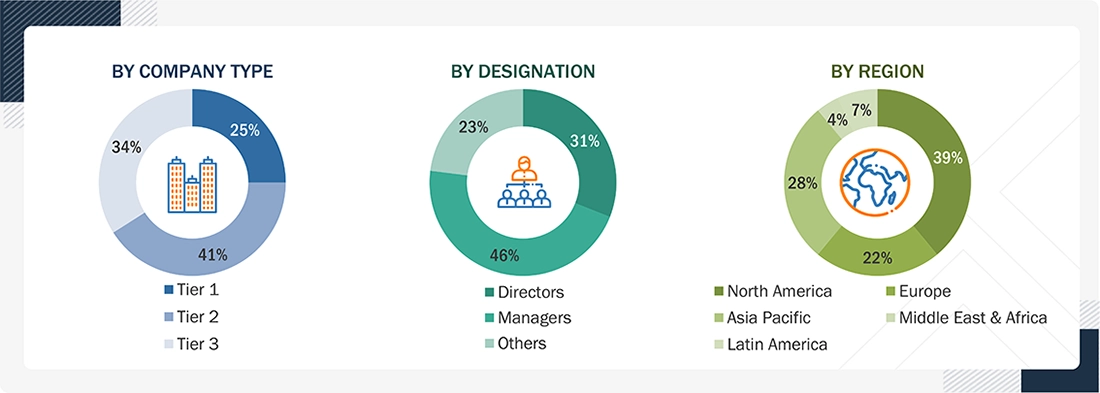
Note: Three tiers of companies are defined based on their total revenue for the year ended 31st December 2025; Tier 1 companies’ revenues are more than USD 1 billion; Tier 2 companies’ revenues range between USD 1 billion and 500 million; and Tier 3 companies’ revenues range less than USD 500 million
To know about the assumptions considered for the study, download the pdf brochure
Market Size Estimation
The top-down and bottom-up approaches were employed to estimate and forecast the natural language processing market, as well as its dependent submarkets. This multi-layered analysis was further reinforced through data triangulation, which incorporated primary and secondary research inputs. The market figures were also validated against the existing MarketsandMarkets repository for accuracy.
Data Triangulation
The market was divided into several segments and subsegments after determining the overall market size using the market size estimation processes described above. To complete the overall market engineering process and determine the exact statistics for each market segment and subsegment, data triangulation and market segmentation procedures were employed, wherever applicable. The overall market size was then used in the top-down approach to estimate the size of other individual markets by applying percentage splits to the market segmentation.
Market Definition
Natural language processing is a field of artificial intelligence that enables computer systems to understand, interpret, generate, translate, and respond to human language in text or speech form. It applies computational linguistics, machine learning, deep learning, and generative AI techniques to convert unstructured language into meaningful outputs, such as intent, context, sentiment, entities, summaries, answers, translations, or automated actions. For this report, NLP is analyzed through its commercial software and services ecosystem, covering enterprise solutions that use language intelligence to improve human-machine interaction, automate language-heavy processes, extract insights from unstructured data, and support decision-making across business workflows. This includes platforms, applications, models, APIs, and implementation or managed services that help organizations deploy NLP capabilities at scale.
Key Stakeholders
- NLP software developers
- NLP service providers
- AI training dataset providers
- Business analysts
- Cloud service providers
- Consulting service providers
- Enterprise end-users
- Managed service providers
- Market research and consulting firms
- Support & maintenance service providers
- System Integrators (SIs)/migration service providers
- Language service providers
- Technology providers
- Investors & venture capital firms
- Independent software vendors (ISVs)
- Channel partners, distributors, and value-added resellers (VARs)
- Government and regulatory bodies
- Academia and research institutions
Report Objectives
- To define, describe, and forecast the natural language processing market, by offering (software and services), technology, capability, application, and vertical
- To provide detailed information related to major factors (drivers, restraints, opportunities, and industry-specific challenges) influencing market growth
- To analyze the micro markets with respect to individual growth trends, prospects, and their contribution to the total market
- To analyze the opportunities in the market for stakeholders by identifying the high-growth segments of the natural language processing market
- To analyze opportunities in the market and provide details of the competitive landscape for stakeholders and market leaders
- To forecast the market size of segments for five main regions: North America, Europe, Asia Pacific, the Middle East & Africa, and Latin America
- To profile the key players and comprehensively analyze their market ranking and core competencies
- To analyze competitive developments, such as partnerships, product launches, and mergers & acquisitions, in the natural language processing market
- To analyze the impact of various macroeconomic factors on the natural language processing market across all regions
Available customizations:
With the given market data, MarketsandMarkets offers customizations based on the company’s specific needs. The following customization options are available for the report.
Brand/Product Comparative Analysis
- Brand/product comparative analysis of additional vendors
Geographic analysis
- Breakup of additional European countries by offering, technology, capability, application, and vertical
- Breakup of additional Asia Pacific countries by offering, technology, capability, application, and vertical
- Breakup of additional Middle East & African countries by offering, technology, capability, application, and vertical
- Breakup of additional Latin American countries by offering, technology, capability, application, and vertical
Company information
- Detailed analysis and profiling of additional market players (up to five)
Get the Full Natural Language Processing (NLP) Market Report
Full forecast, segment splits, and company analysis for all Natural Language Processing (NLP) Market.
- Canada Natural Language Processing (NLP) Market
- US Natural Language Processing (NLP) Market
- UK Natural Language Processing (NLP) Market
- Germany Natural Language Processing (NLP) Market
- France Natural Language Processing (NLP) Market
- Italy Natural Language Processing (NLP) Market
- Spain Natural Language Processing (NLP) Market
- China Natural Language Processing (NLP) Market
- India Natural Language Processing (NLP) Market
- Japan Natural Language Processing (NLP) Market
- South Korea Natural Language Processing (NLP) Market
- Saudi Arabia Natural Language Processing (NLP) Market
- UAE Natural Language Processing (NLP) Market
- South Africa Natural Language Processing (NLP) Market
- Turkey Natural Language Processing (NLP) Market
- Qatar Natural Language Processing (NLP) Market
- Brazil Natural Language Processing (NLP) Market
- Mexico Natural Language Processing (NLP) Market
- Argentina Natural Language Processing (NLP) Market
- Rest Of Europe Natural Language Processing (NLP) Market
- Rest Of Asia Pacific Natural Language Processing (NLP) Market
Need a Tailored Report?
Customize this report to your needs
Get 10% FREE Customization
Customize This Report
