
Asia Pacific Natural Refrigerants Market (2026-2031)

The Asia Pacific Natural Refrigerants Market was valued at $441.8 Million in 2026 and projected to reach to $672.3 Million by 2031, representing a compound annual growth rate of 8.8%. Asia Pacific is positioned as a critical growth engine for the natural refrigerants market, driven by aggressive environmental policies and industrial modernization across major economies.


| Market Size in | USD 26.32 MN |
| Market Forecast in | |
| CAGR | |
| Forecast Period | |
| Units Considered | Value (USD MN) |
Asia Pacific Natural Refrigerants Market Trends and Insights
- The region is experiencing accelerated adoption driven by stringent environmental regulations, industrial modernization, and increasing demand for sustainable cooling solutions across manufacturing and commercial sectors.
- Asia Pacific's market is projected to expand to $672.3 million by 2031, reflecting a compound annual growth rate of 8.8%. The natural refrigerants market in Asia Pacific is characterized by rising investments in HVAC infrastructure and growing awareness of ozone-depleting substance phase-out requirements.
- Asia Pacific countries are increasingly transitioning from conventional refrigerants to hydrofluoroolefins (HFOs), hydrofluorocarbons (HFCs), and ammonia-based solutions.
- This shift is supported by government incentives, corporate sustainability commitments, and technological advancements in refrigeration efficiency. Key markets within Asia Pacific, including China, India, and Southeast Asia, are driving demand through rapid urbanization and expanding cold chain logistics networks.
- Asia Pacific's natural refrigerants market growth trajectory reflects both regulatory compliance pressures and genuine market demand for environmentally responsible cooling technologies through 2031..
Key Market Statistics
- CAGR (2026-2031) 8.8% CAGR
- Market Size, 2026 ~USD 441.8 Million
- Forecast, 2031 ~USD 672.3 Million
- Geography Asia Pacific
Asia Pacific Natural Refrigerants Market Overview
China Dominates Regional Market :
China leads Asia Pacific's natural refrigerants market with $250.6 million in 2026, representing over 56% of the region's total market share. Rapid industrialization and strict environmental compliance drive massive adoption across HVAC and refrigeration sectors.
Regulatory Push Accelerates Growth :
Stringent environmental regulations including phase-out of HCFCs and CFCs across Asia Pacific nations are compelling manufacturers to transition to natural refrigerants like ammonia, hydrocarbons, and CO2, creating sustained market expansion.
Manufacturing & Commercial Sector Expansion :
Asia Pacific's booming manufacturing, food processing, and commercial cooling sectors are increasingly adopting natural refrigerant solutions to meet sustainability targets and reduce operational carbon footprints.
8.8% CAGR Through 2031 :
The Asia Pacific natural refrigerants market is projected to grow from $441.8 million in 2026 to $672.3 million by 2031, outpacing many global regions with strong double-digit growth momentum driven by industrial modernization.
Asia Pacific Natural Refrigerants Market Dynamics
- China, Japan, South Korea, and India collectively represent the region's largest opportunities, with manufacturing and commercial sectors rapidly transitioning to sustainable cooling solutions.
- The region's 8.8% CAGR reflects accelerating adoption of ammonia, hydrocarbons, and CO2-based refrigerants as alternatives to synthetic compounds. Government mandates, corporate sustainability commitments, and rising energy costs are compelling businesses to invest in natural refrigerant technologies.
- Asia Pacific's expanding middle class and urbanization further drive demand for efficient cooling systems in residential and commercial applications.
- By 2031, the market is expected to reach $672.3 million, with emerging economies contributing significantly to this growth trajectory..
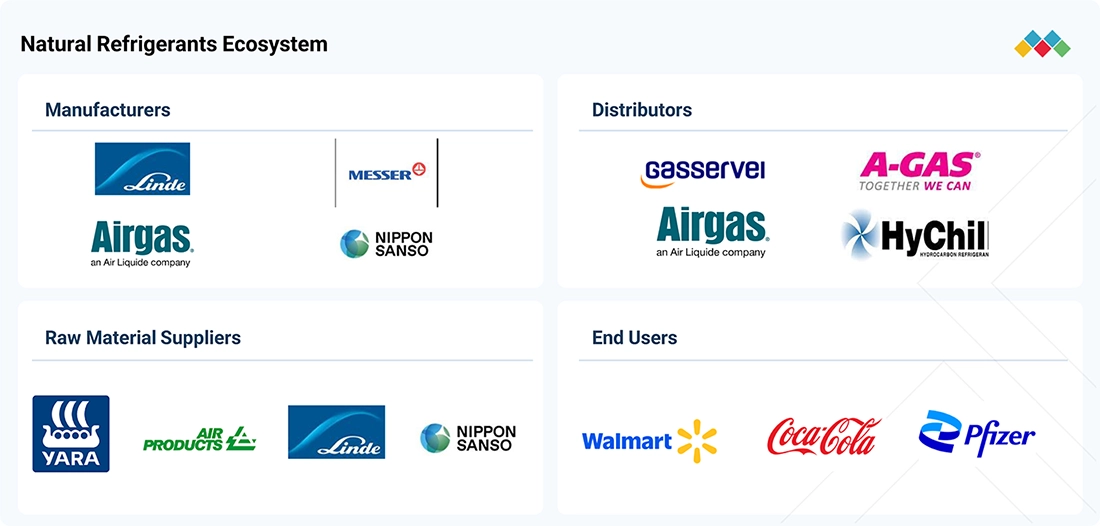
Market Ecosystem
NATURAL REFRIGERANTS MARKET: COMMERCIAL USE CASES ACROSS INDUSTRIES
| COMPANY | USE CASE DESCRIPTION | BENEFITS |
|---|---|---|
 |
Supply of refrigerant gases, including natural refrigerant-related gases such as carbon dioxide, ammonia, propane, and isobutane, for commercial refrigeration, HVAC systems, industrial cooling, and refrigerant servicing applications | Supports refrigerant availability, system maintenance, technical gas requirements, and refrigerant recovery and reclamation activities |
 |
Supply of natural refrigerants, including R717 (ammonia), R744 (carbon dioxide), and hydrocarbon-based refrigerants, for industrial refrigeration, commercial cooling, and air-conditioning systems | Supports regulatory compliance, refrigerant transition, operational reliability, and the adoption of lower-GWP cooling solutions through technical assistance and supply services |
 |
Blended natural hydrocarbon refrigerants for air-conditioning retrofits, commercial buildings, hospitality facilities, and refrigeration applications. Its reported applications include air-conditioning conversions in commercial buildings and winery refrigeration | Supports reduced electricity consumption, lower-GWP refrigerant adoption, and improved energy efficiency. The company reports energy savings from specific applications, which should be validated independently before generalizing across the market |
 |
Supply and distribution of refrigerants and hydrocarbon-based products for refrigeration and air-conditioning applications across the UK and international markets, supported by replacement guidance and cylinder management services | Supports refrigerant replacement, supply continuity, compliance-related recordkeeping, and access to refrigerants for cooling system maintenance and servicing |
 |
Supply and lifecycle management of refrigerants for commercial refrigeration, food retail, industrial process cooling, and heat pump applications. Services include refrigerant recovery, reclamation, and retrofit support | Supports refrigerant transition, reduced refrigerant emissions, equipment maintenance, regulatory compliance, and circular refrigerant management |
Logos and trademarks shown above are the property of their respective owners. Their use here is for informational and illustrative purposes only.
Related Ecosystem
Speciality Chemicals
- Corrosion Inhibitors
- Polyetheretherketone (PEEK)
- Acrylonitrile Butadiene Styrene (ABS)
- Epoxy Resin
- Polycarbonate
- Basf se
- DOW CHEMICAL COMPANY
- Evonik industries ag
- Clariant ag.
- Solvay sa
Key Takeaways
- Asia Pacific natural refrigerants market valued at $441.8M in 2026, expanding to $672.3M by 2031 at 8.8% CAGR
- Asia Pacific regulatory frameworks and Kigali Amendment implementation are accelerating transition from conventional to natural refrigerants
- Asia Pacific's rapid urbanization and cold chain expansion create sustained demand for sustainable cooling solutions
- Asia Pacific manufacturers are investing in ammonia, HFO, and hydrocarbon-based refrigerant technologies to meet environmental compliance
Natural Refrigerants Market Report Scope
| Report Metric | Details |
|---|---|
| Base Year | 2026 |
| Fastest Growing Segment | MOBILE AIR CONDITIONING REFRIGERATION (Application) |
| Forecast Period | 2026-2030 |
| Growth Rate | CAGR of 9.5% from 2026 to 2030 |
| Largest Segment | HYDROCARBON (Type) |
| Market Size Base Year (Billions) | ~USD 2.11 (2026) |
| Revenue Forecast (Billions) | ~USD 3.03 (2030) |
| Segments Covered | Type, Application |
Asia Pacific Natural Refrigerants Market Report Segmentation
2 segment dimensions are covered across the global market.
By Type
- Ammonia
- Co2
- Co2
- Hydrocarbon
- Other Refrigerants
By Application
- Commercial Refrigeration
- Domestic Refrigeration
- Industrial Refrigeration
- Mobile Air Conditioning Refrigeration
- Other Applications
- Stationary Air Conditioning Refrigeration
Target Audience
- Refrigerant Manufacturers & Suppliers : Need Asia Pacific market data to identify high-growth countries, assess competitive intensity, and develop localized product strategies for natural refrigerant solutions across the region.
- HVAC & Cooling Equipment Manufacturers : Require regional market insights to align product portfolios with natural refrigerant adoption trends, understand regulatory requirements, and capture growing demand in manufacturing and commercial sectors.
- Industrial & Commercial End-Users : Seek market intelligence on natural refrigerant availability, cost trends, and compliance pathways to make informed decisions on cooling system upgrades and sustainability investments.
- Investment & Private Equity Firms : Need comprehensive Asia Pacific market analysis with growth forecasts and country-level data to evaluate investment opportunities in natural refrigerant companies and related technologies.
- Government & Regulatory Bodies : Require market data to assess natural refrigerant adoption rates, identify compliance gaps, and develop effective environmental policies and incentive programs across Asia Pacific nations.
Countries within Asia Pacific - compare and drill down
| Country | 2025 size (native) |
|---|---|
| China | USD 250.6 Million |
| Japan | USD 71.6 Million |
| South Korea | USD 32.9 Million |
| India | USD 58.9 Million |
| Rest Of Asia Pacific | USD 60 Million |
Country market size visualization
Reasons to Buy this Report
- Regional Market Sizing & Forecasts : Gain precise market valuations for Asia Pacific ($441.8M in 2026, $672.3M in 2031) with country-level breakdowns for China, Japan, India, and South Korea to inform regional expansion strategies.
- Regulatory Landscape Intelligence : Understand stringent environmental compliance requirements driving natural refrigerant adoption across Asia Pacific nations, enabling businesses to align product development with regional mandates.
- Competitive Positioning Analysis : Identify market leaders and emerging players in Asia Pacific's natural refrigerants sector to benchmark performance, assess competitive threats, and discover partnership opportunities.
- Sector-Specific Growth Opportunities : Analyze demand drivers across manufacturing, food processing, commercial HVAC, and industrial cooling sectors in Asia Pacific to prioritize market entry and investment decisions.
- Investment & Expansion Planning : Leverage Asia Pacific market insights with 8.8% CAGR projections to develop data-driven business strategies, capital allocation plans, and go-to-market approaches for sustainable refrigerant solutions.
Frequently asked questions
What is the current market size of natural refrigerants in Asia Pacific?
Asia Pacific's natural refrigerants market was valued at $441.8 million in 2026 and is projected to reach $672.3 million by 2031.
What is the expected growth rate for Asia Pacific natural refrigerants market?
Asia Pacific's natural refrigerants market is expected to grow at a compound annual growth rate (CAGR) of 8.8% from 2026 to 2031.
Which countries drive the Asia Pacific natural refrigerants market?
China, India, and Southeast Asian nations are primary growth drivers in Asia Pacific, supported by urbanization, regulatory compliance, and cold chain infrastructure expansion.
What types of natural refrigerants are gaining adoption in Asia Pacific?
Asia Pacific markets are increasingly adopting hydrofluoroolefins (HFOs), ammonia-based solutions, and hydrocarbon refrigerants to comply with environmental regulations and sustainability goals.
What regulatory factors influence Asia Pacific's natural refrigerants market?
Asia Pacific's market is shaped by the Kigali Amendment, ozone-depleting substance phase-out requirements, and national environmental policies mandating transition to low-GWP refrigerants.
RESEARCH METHODOLOGY
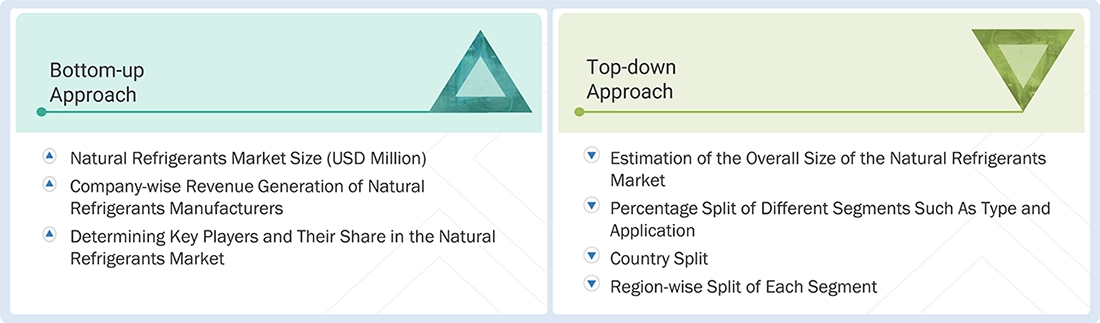
The study involves two major activities to estimate the current market size for natural refrigerants. Exhaustive secondary research was conducted to collect information on the market, peer market, and parent market. The next step was to validate these findings, assumptions, and sizing with industry experts across the value chain through primary research. Both top-down and bottom-up approaches were employed to estimate the total market size. After that, market breakdown and data triangulation were used to estimate the market size of segments and subsegments.
Secondary Research
Secondary sources for this research study include financial statements of companies offering natural refrigerants and information from various trade, business, and professional associations. Secondary research was used to obtain critical information about the industry’s value chain, the total pool of key players, market classification, and segmentation by industry trends down to the bottom-most level and by regional markets. Secondary data were collected and analyzed to determine the overall size of the natural refrigerants market, which was validated by primary respondents.
Primary Research
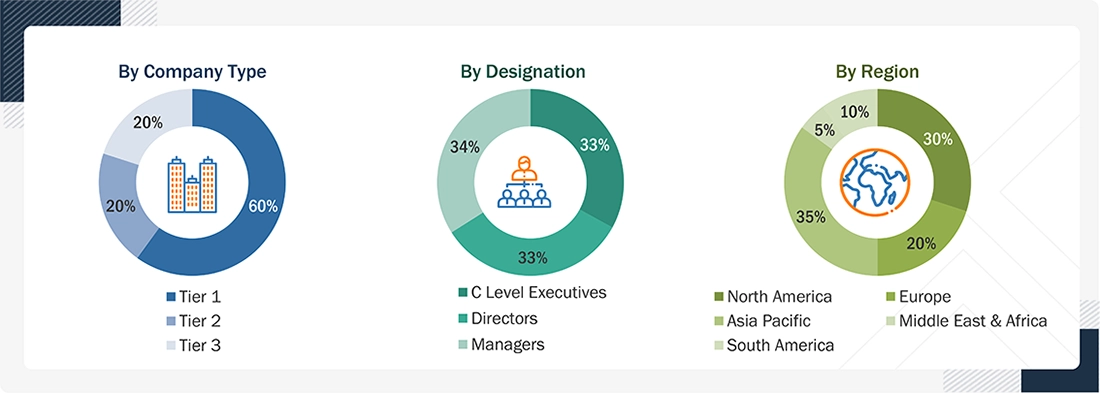
Extensive primary research was conducted after gathering information on the natural refrigerants market through secondary research. Several primary interviews were conducted with market experts from both the demand and supply sides across major countries in North America, Europe, Asia-Pacific, the Middle East & Africa, and South America. Primary data was collected through questionnaires, emails, and telephonic interviews. Primary sources from the supply side included industry experts such as chief executive officers (CXOs), vice presidents (VPs), directors from business development, marketing, and product development/innovation teams, and related key executives from natural refrigerants industry vendors; material providers; distributors; and key opinion leaders. Primary interviews were conducted to gather insights into market statistics, revenue from products and services, market breakdowns, market size estimates, market forecasting, and data triangulation. Primary research also helped in understanding the various trends related to type, application, and region. Stakeholders from the demand side, such as CIOs, CTOs, CSOs, and installation teams of customer/end users who are seeking natural refrigerants, were interviewed to understand the buyer’s perspective on suppliers and products, their current usage of natural refrigerants, and the future outlook of their business, which will affect the overall market.
The Breakup of Primary Research:
To know about the assumptions considered for the study, download the pdf brochure
Market Size Estimation
The research methodology used to estimate the size of the natural refrigerants market includes the following details. Market sizing was undertaken from the demand side. The market was upsized based on demand for natural refrigerants across different end-use industries at the regional level. These procurement data provide information on the demand aspects of the natural refrigerants industry for each end-use industry. For each end use, all possible segments of the natural refrigerants market were integrated and mapped.
Natural Refrigerants Market : Top-Down and Bottom-Up Approach
Data Triangulation
After determining the overall market size through the market size estimation process described above, the total market was segmented into several segments and subsegments. The data triangulation and market breakdown procedures described below were implemented, wherever applicable, to complete the overall market engineering process and arrive at the exact statistics for various market segments and subsegments. The data was triangulated by analyzing factors and trends from both the demand and supply sides. In addition, the market size was validated using both the top-down and bottom-up approaches.
Market Definition
The natural refrigerants market comprises substances that occur naturally and are used as substitutes for artificial refrigerants in refrigeration, air conditioning, heat pumps, and cooling equipment. They include ammonia (NH3), carbon dioxide (CO2), hydrocarbons such as propane, butane, and isobutane, as well as other natural refrigerants such as water and air. These are employed in various fields, including commercial, industrial, and domestic refrigeration, as well as stationary and mobile air conditioning. Growth in the industry is expected on account of their low global warming potential (GWP) values and good environmental profile, the phase-down of high-GWP refrigerants, energy-efficiency requirements, and the growing trend toward sustainable cooling technologies across the globe.
Key Stakeholders
- Natural Refrigerants Manufacturers
- Natural Refrigerants Distributors and Suppliers
- End-use Industries
- Universities, Governments, and Research Organizations
- Associations and Industrial Bodies
- R&D Institutes
- Environmental Support Agencies
- Investment Banks and Private Equity Firms
- Research and Consulting Firms
Report Objectives
- To define, describe, and forecast the natural refrigerants market size in terms of volume and value
- To provide detailed information regarding the key factors, such as drivers, restraints, opportunities, and challenges influencing market growth
- To analyze and forecast the market by type, application and region
- To forecast the market size concerning five main regions (along with country-level data), namely, North America, Europe, Asia Pacific, Middle East & Africa, and South America, and analyze the significant region-specific trends
- To strategically analyze micromarkets with respect to individual growth trends, prospects, and contributions of the submarkets to the overall market
- To analyze market opportunities and the competitive landscape for stakeholders and market leaders
- To assess recent market developments and competitive strategies, such as agreements, contracts, acquisitions, partnerships & collaboration, and product developments/product launches, to draw the competitive landscape
- To strategically profile key market players and comprehensively analyze their core competencies
Available customizations:
MarketsandMarkets offers the following customizations for this market report:
- Additional country-level analysis of the natural refrigerants market
Product Analysis
-
Product matrix, which provides a detailed comparison of the product portfolio of each company’s market
Get the Full Natural Refrigerants Market Report
Full forecast, segment splits, and company analysis for all Natural Refrigerants Market.
- US Natural Refrigerants Market
- Germany Natural Refrigerants Market
- France Natural Refrigerants Market
- UK Natural Refrigerants Market
- Italy Natural Refrigerants Market
- Spain Natural Refrigerants Market
- Saudi Arabia Natural Refrigerants Market
- South Africa Natural Refrigerants Market
- Brazil Natural Refrigerants Market
- Argentina Natural Refrigerants Market
- Rest Of Europe Natural Refrigerants Market
- Rest Of Asia Pacific Natural Refrigerants Market
- GCC Natural Refrigerants Market
- Rest Of GCC Natural Refrigerants Market
- Rest Of South America Natural Refrigerants Market
- China Natural Refrigerants Market
- Japan Natural Refrigerants Market
- South Korea Natural Refrigerants Market
- India Natural Refrigerants Market
- Canada Natural Refrigerants Market
- Mexico Natural Refrigerants Market
Need a Tailored Report?
Customize this report to your needs
Get 10% FREE Customization
Customize This Report