
North America Network Emulator Market (2025-2030)

The North America Network Emulator Market was valued at $88.7 Million in 2025 and projected to reach to $118.1 Million by 2030, representing a compound annual growth rate of 5.9%. North America's network emulator market is positioned for steady expansion through 2030, supported by continuous enterprise investment in digital transformation and network modernization initiatives.


| Market Size in | USD 26.32 MN |
| Market Forecast in | |
| CAGR | |
| Forecast Period | |
| Units Considered | Value (USD MN) |
North America Network Emulator Market Trends and Insights
- North America's mature telecommunications infrastructure and high adoption of advanced testing technologies drive steady demand for network emulation solutions across the region.
- In North America, enterprises increasingly rely on network emulators to validate application performance, reduce deployment risks, and optimize network configurations before production rollout. During the 2025–2030 forecast period, North America will benefit from accelerating digital transformation initiatives, cloud migration strategies, and the expansion of 5G networks.
- North America's strong presence of technology vendors, service providers, and large-scale enterprises creates a competitive ecosystem that fosters innovation in network emulation capabilities.
- The region's regulatory environment and emphasis on network reliability further support sustained investment in emulation and testing infrastructure..
Key Market Statistics
- CAGR (2025-2030) 5.9% CAGR
- Market Size, 2025 ~USD 88.7 Million
- Forecast, 2030 ~USD 118.1 Million
- Geography North America
North America Network Emulator Market Overview
Market Leadership :
North America commands the largest share of the global network emulator market, driven by the US market valued at $99.5 million in 2025, complemented by Canada's $18.6 million contribution.
Steady Growth Trajectory :
The region is projected to grow from $88.7 million in 2025 to $118.1 million by 2030 at a 5.9% CAGR, reflecting consistent demand for advanced network testing solutions.
Infrastructure Maturity :
North America's mature telecommunications infrastructure and high digital adoption rates create sustained demand for sophisticated network emulation technologies across enterprises and service providers.
Enterprise Investment Focus :
Enterprises across North America are increasingly investing in network emulation solutions to optimize 5G deployments, cloud migration, and edge computing infrastructure testing.
North America Network Emulator Market Dynamics
- The region's advanced telecommunications ecosystem and high technology adoption rates ensure sustained demand for sophisticated testing and validation solutions.
- Major drivers include 5G network rollout acceleration, increased cloud infrastructure complexity, and the growing need for comprehensive network performance validation across distributed environments. The market will benefit from North America's strong focus on network reliability, cybersecurity integration, and quality assurance standards.
- As enterprises expand their digital footprint and adopt hybrid cloud architectures, the demand for robust network emulation capabilities will remain robust.
- The region's competitive landscape and innovation-driven market dynamics will continue to fuel product development and solution enhancement throughout the forecast period..
Market Ecosystem
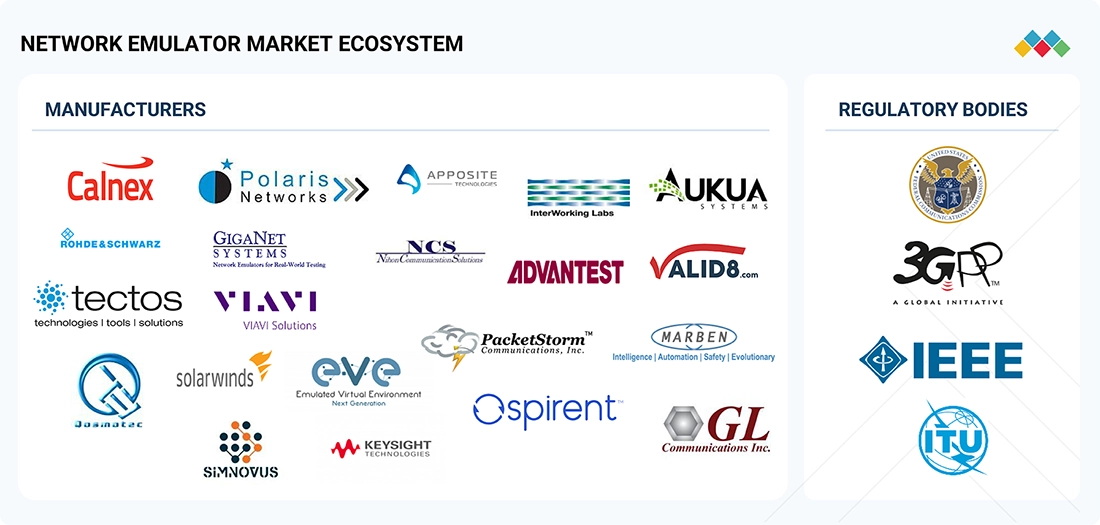
Network Emulator Market: COMMERCIAL USE CASES ACROSS INDUSTRIES
| COMPANY | USE CASE DESCRIPTION | BENEFITS |
|---|---|---|
 |
Nuasis Corporation provides an IP-based contact center solution. The IP-based multimedia offering provides Nuasis Corporation’s customers with a highly reliable and scalable architecture to manage multiple sites as if they were one large call center. Voice communication over the packet data network has unique requirements and needs improvements. | PacketStorm Communication provided its network emulation test tools to ensure the quality of its products. Voice, file transfers, and web interaction, all these functions were tested to improve the Quality of Service (QoS). Nuasis Corporation was able to emulate the queuing algorithms and traffic prioritization that routers execute to deal with different types of traffic issues simultaneously. |
 |
VeriSign operates systems that manage .COM and .NET, handling as many as 21 billion web and email lookups every day. VeriSign also provides managed security services , security consulting, strong authentication solutions, anti-phishing services, and commercial security services to organizations throughout the world. It needs to test SIP solutions developed on a virtual network. | The company chose Spirent Communication’s TTCN-3 Tools, which provides robustness, flexibility, extensibility, and support for the protocols VeriSign desired immediately. It also provides the capability to integrate other protocols with minimal effort in the future. The tool is used to test the company’s home-grown SIP stack with a focus on testing SIP Proxy and Redirect server functionality. |
 |
One of the largest banks in the US was embracing a network transformation project of its WAN from Multi-Protocol Label Switching (MPLS) to SD-WAN. The company worked with its system vendor to add SD-WAN capability to its existing switches and infrastructure but ran into significant issues with the integration of the new features. | Calnex’s network emulator was used by the bank to emulate the complex mesh networks and test the SD-WAN updates on the switches in a test lab. The updates were done one at a time, and the services were tested accordingly until the causes of the issues were identified and resolved. |
Logos and trademarks shown above are the property of their respective owners. Their use here is for informational and illustrative purposes only.
Related Ecosystem
Data Centre And Networking
- Software-Defined Networking (SDN)
- Mid-Sized Data Centers
- Small Data Centers
- Remote Monitoring
- Smart Healthcare
- Cisco Systems, Inc.
- HUAWEI TECHNOLOGIES CO LTD
- Hewlett Packard Enterprise Company
- MITSUBISHI ELECTRIC INFORMATION SYSTEMS CORPORATION
- MITSUBISHI ELECTRIC INFORMATION NETWORK CORPORATION
Key Takeaways
- North America's network emulator market reaches $88.7 million in 2025 and is forecast to expand to $118.1 million by 2030.
- North America demonstrates a 5.9% CAGR, reflecting steady adoption driven by cloud migration and 5G deployment initiatives.
- North America's mature tech ecosystem and large enterprise base create strong demand for advanced network testing and validation solutions.
- North America's regulatory focus on network reliability and performance standards supports continued investment in emulation infrastructure.
Network Emulator Market Report Scope
| Report Metric | Details |
|---|---|
| Base Year | 2025 |
| Fastest Growing Segment | SDN MONITORING (Solution) |
| Forecast Period | 2025–2030 |
| Growth Rate | CAGR of 7.4% from 2025 to 2030 |
| Largest Segment | VERTICALS (End User) |
| Market Size Base Year (Billions) | ~USD 0.25 (2025) |
| Revenue Forecast (Billions) | ~USD 0.36 (2030) |
| Segments Covered | Offering, Application Type, Vertical, Component, Solution, End User, Type |
North America Network Emulator Market Report Segmentation
7 segment dimensions are covered across the global market.
By Offering
- Hardware
- Software
By Application Type
- Cloud
- IoT
- Other Application Types
- Sd-Wan
By Vertical
- Bfsi
- Government
- Government & Defense
- Government And Utilities
- Healthcare
- It & Telecom
- Manufacturing
- Media And Entertainment
- Other Verticals
- Others*
- Retail
- Telecommunications
- Transportation & Logistics
By Component
- Platforms
- Professional Services
- Services
- Solutions
By Solution
- Cloud Monitoring
- Log & Event Management
- Network Configuration
- Network Performance & Monitoring
- Other Solutions
- Sdn Monitoring
- Virtual Monitoring
By End User
- Enterprises
- Service Providers
- Verticals
By Type
- Internet Service Providers And Cable Operators
- Managed Service Providers
- Telecom Operators
Target Audience
- Network Equipment Manufacturers : Require detailed North American market data to develop and position network emulation products that meet enterprise demands for 5G testing, cloud validation, and infrastructure optimization.
- Telecommunications Service Providers : Need market insights to justify investments in network emulation capabilities, understand competitive positioning, and plan service offerings aligned with North American enterprise requirements.
- Enterprise IT Decision Makers : Seek market intelligence to evaluate network emulation solutions, understand regional vendor capabilities, and benchmark testing infrastructure investments against industry standards.
- Software Testing & QA Companies : Require North American market data to expand network testing service portfolios, identify partnership opportunities, and develop solutions addressing regional enterprise validation needs.
- Investment & Strategy Consultants : Need comprehensive regional market analysis to advise clients on market entry strategies, acquisition targets, and investment opportunities in North America's network emulation sector.
Key Companies in the North America Network Emulator Market
| Company | HQ | Ownership | Strongest segments |
|---|---|---|---|
| SPIRENT COMMUNICATIONS | United Kingdom | ||
| KEYSIGHT TECHNOLOGIES | United States | ||
| CALNEX SOLUTIONS | United Kingdom | Public Company | Hardware synchronization and performance test platforms (Paragon family, Attero, Sentinel, Sentry, Rb/GPS, converters),Software-centric network emulation (Calnex SNE, SNE-X, SNE Ignite, NE-ONE Enterprise/Professional, analysis tools),Services, support, and specialized software options (Paragon-ONE profiles, protocol field verifier, customization), |
| VIAVI SOLUTIONS | United States | ||
| SOLARWINDS | United States | Private Company | Software-based performance testing and network emulation (NTA, SAM, VMAN, IPAM-linked),Application testing and observability (observability suites, Squadcast by SolarWinds),Hardware-linked and appliance-adjacent use cases, |
SPIRENT COMMUNICATIONS
Spirent Communications is a United Kingdom-based company providing testing, assurance, and analytics solutions for communications technology and networks.
KEYSIGHT TECHNOLOGIES
Keysight Technologies is a United States-based company specializing in electronic measurement and testing solutions for communications, aerospace, and industrial markets.
CALNEX SOLUTIONS
Calnex Solutions is a United Kingdom-based public company founded in 2006 with 163 employees, specializing in network testing and assurance solutions.
VIAVI SOLUTIONS
Viavi Solutions is a United States-based company offering network testing, software, and analytics solutions for telecommunications and broadband networks.
SOLARWINDS
SolarWinds is a United States-based private company founded in 1999 with 2,107 employees, specializing in IT management and network monitoring software.
Countries within North America - compare and drill down
| Country | 2025 size (native) |
|---|---|
| US | USD 99.5 Million |
| Canada | USD 18.6 Million |
Country market size visualization
Reasons to Buy this Report
- Regional Market Dominance Data : Access comprehensive insights into North America's $88.7 million market with detailed breakdowns of the US ($99.5M) and Canadian ($18.6M) segments to inform strategic positioning.
- Growth Forecasting Accuracy : Leverage precise 5.9% CAGR projections through 2030 to plan product launches, market entry strategies, and resource allocation with confidence in North American demand trajectories.
- Enterprise Investment Trends : Understand North American enterprise spending patterns on network emulation for 5G, cloud migration, and edge computing to identify high-value customer segments and sales opportunities.
- Competitive Landscape Intelligence : Benchmark your solutions against regional competitors and identify market gaps in North America's mature telecommunications ecosystem to differentiate your offerings effectively.
- Strategic Market Expansion : Make informed decisions about market expansion, partnership development, and investment priorities across North America's two major markets with region-specific performance metrics.
Frequently asked questions
What is the current size of the North America network emulator market?
The North America network emulator market is valued at $88.7 million in 2025.
What is the projected market size for North America by 2030?
The North America network emulator market is forecast to reach $118.1 million by 2030.
What is the CAGR for the North America network emulator market?
North America's network emulator market is expected to grow at a compound annual growth rate of 5.9% from 2025 to 2030.
What factors are driving growth in North America's network emulator market?
Key drivers include digital transformation initiatives, cloud migration, 5G network expansion, and enterprise demand for robust application performance validation in North America.
Why is North America a significant market for network emulators?
North America's mature telecommunications infrastructure, large concentration of technology vendors, and emphasis on network reliability create strong demand for advanced emulation and testing solutions.
RESEARCH METHODOLOGY
This research study on the network emulator market involved extensive secondary sources, directories, and several journals and databases, such as D&B Hoovers, Bloomberg Businessweek, and Factiva, to identify and collect information useful for this technical, market-oriented, and commercial study of the network emulator market. Primary sources were industry experts from core and related industries, preferred system developers, service providers, resellers, partners, and organizations related to the various segments of the industry’s value chain. In-depth interviews were conducted with different primary respondents, including key industry participants and subject-matter experts, to obtain and verify critical qualitative and quantitative information, as well as to assess the market’s prospects. These included key industry participants, subject-matter experts, C-level executives of key companies, and industry consultants. Primary sources were mainly industry experts from the core and related industries, preferred network emulator providers, third-party service providers, consulting service providers, end users, and other commercial enterprises. In-depth interviews were conducted with various primary respondents, including key industry participants and subject matter experts, to obtain and verify critical qualitative and quantitative information and assess growth prospects. The following figure highlights the market research methodology applied to make the network emulator market report.
Secondary Research
The market size of companies offering network emulator hardware and software was determined based on secondary data available through paid and unpaid sources. It was also arrived at by analyzing the product portfolios of major companies and rating the companies based on their performance and quality.
In the secondary research process, various sources were referred to to identify and collect information for this study. Secondary sources included annual reports, press releases, and investor presentations of companies; white papers, journals, and certified publications; and articles from recognized authors, directories, and databases. The data was also collected from other secondary sources, such as journals and related magazines. Network emulator spending of various countries was extracted from the respective sources. Secondary research was mainly used to obtain the key information related to the industry’s value chain and supply chain to identify key players, market classification, and segmentation according to offerings of major players; industry trends related to the offering, application type, test type, vertical, and regions; and key developments from both market and technology-oriented perspectives.
Primary Research
In the primary research process, various primary sources from both the supply and demand sides were interviewed to obtain qualitative and quantitative information for the report. The primary sources from the supply side included industry experts, such as Chief Executive Officers (CEOs), Vice Presidents (VPs), marketing directors, technology and innovation directors, and related key executives from various key companies and organizations providing network emulator solutions and services. The primary sources from the demand side included end users, such as Chief Information Officers (CIOs), consultants, service professionals, technicians and technologists, and managers at public and investor-owned utilities.
In the market engineering process, top-down and bottom-up approaches were extensively used, along with several data triangulation methods, to perform market estimation and market forecasting for the overall market segments and subsegments listed in the report. Extensive qualitative and quantitative analyses were performed on the complete market engineering process to list key information/insights throughout the report.
After the complete market engineering (including calculations for market statistics, market breakup, market size estimations, market forecasting, and data triangulation), extensive primary research was conducted to gather information. Primary research was conducted to identify the segmentation, industry trends, key players, competitive landscape, and key market dynamics, such as drivers, restraints, opportunities, challenges, industry trends, and key strategies.
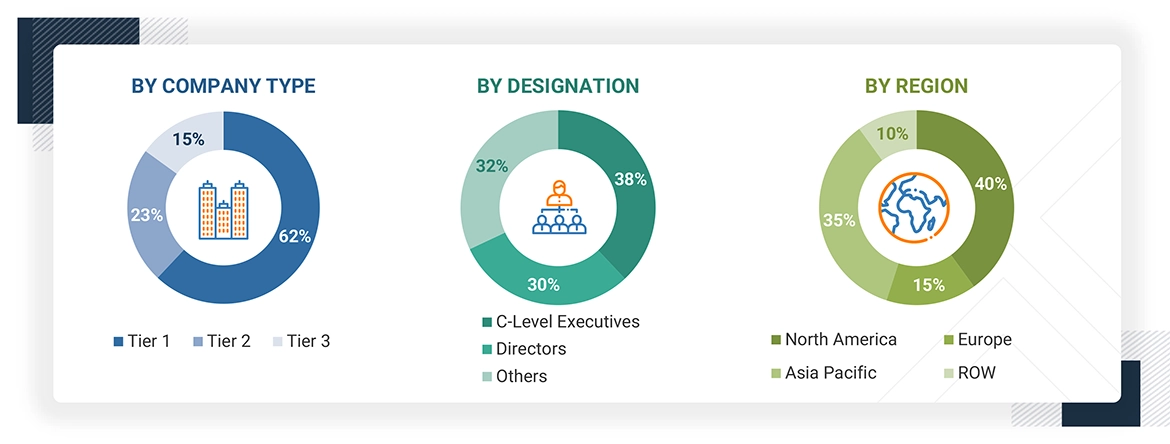
Note: Tier 1 companies have revenues greater than USD 10 billion; tier 2 companies' revenues range between USD 1 and 10 billion; and tier 3 companies' revenues range between USD 500 million and 1 billion. Other designations include sales, marketing, and product managers.
Source: Secondary Research, Interviews with Experts, and MarketsandMarkets Analysis
To know about the assumptions considered for the study, download the pdf brochure
Market Size Estimation
Multiple approaches were adopted to estimate and forecast the network emulator market. The first approach involved estimating the market size by the summation of the companies’ revenue generated through the sale of services.
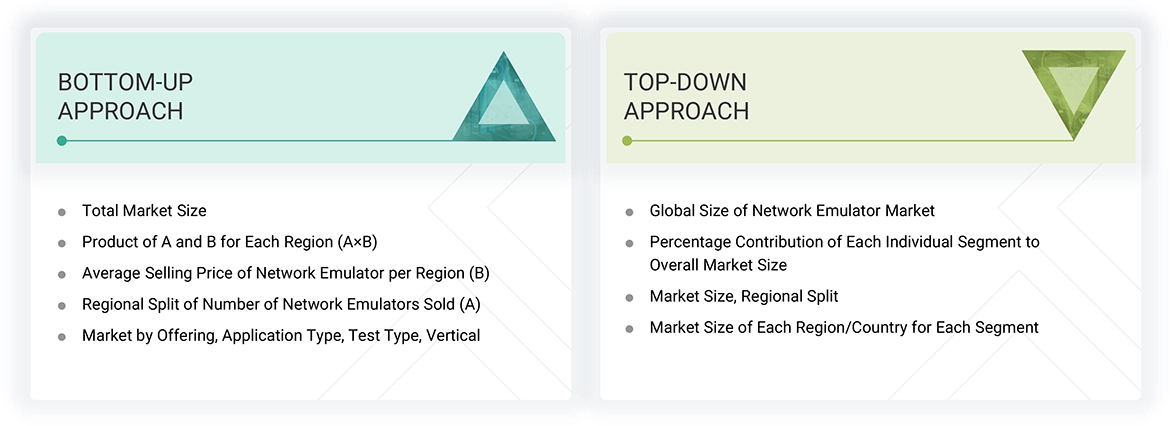
Top-down and Bottom-up Approaches
The research methodology used to estimate the market size included the following:
- Primary and secondary research was used to determine the revenue contributions of the major market participants in each country after secondary research helped identify them.
- Throughout the process, critical insights were obtained by conducting in-depth interviews with industry professionals, including directors, CEOs, VPs, and marketing executives, and by reading the annual and financial reports of the top firms in the market.
- Primary sources were used to verify all percentage splits and breakups, which were calculated using secondary sources.
Network Emulator Market : Top-Down and Bottom-Up Approach
Data Triangulation
Once the overall market size was determined, the market was divided into segments and subsegments using the previously described market size estimation procedures. When required, market breakdown and data triangulation procedures were employed to complete the market engineering process and specify the exact figures for every market segment and subsegment. The data was triangulated by examining several variables and patterns from the government entities' supply and demand sides.
Market Definition
Network emulators are products that replicate real-time network performance, enable manipulation of bandwidth constraints, and apply network impairments, such as packet loss, delay, and jitter, to accurately gauge applications’ responsiveness and throughput and the quality of end-user experience, to provide quality assurance, proof of concept, and troubleshooting.
Network emulators can duplicate various network circumstances, encompassing constraints on bandwidth, latency, packet loss, jitter, and an assortment of network topologies. This capability empowers developers, network administrators, and researchers to evaluate the performance of their applications or systems across diverse network conditions, enabling them to proactively pinpoint potential problems before they manifest in an actual operational environment.
Stakeholders
- Network Emulator Vendors
- Network and System Integrators (SIs)
- Managed Service Providers (MSPs)
- Cloud Service Providers
- Internet Service Providers (ISPs)
- Fixed and Mobile Broadband Network Providers
- Communication Service Providers (CSPs)
- Content Delivery Network (CDN) Providers
- Independent Software Vendors (ISVs)
Report Objectives
- To define, describe, and forecast the network emulator market in terms of value
- To provide detailed information regarding drivers, restraints, opportunities, and challenges influencing the growth of the market
- To forecast the market based on offering (hardware, software), application type, test type, vertical, and region
- To forecast the market size of segments for five main regions: North America, Europe, Asia Pacific, the Middle East & Africa, and Latin America
- To analyze opportunities in the market and provide details of the competitive landscape for stakeholders and market leaders
- To profile the key market players, including top vendors and startups; provide a comparative analysis based on business overviews, regional presence, product offerings, business strategies, and key financials; and provide a detailed competitive landscape of the market
- To analyze competitive developments, such as mergers & acquisitions (M&A), product launches/enhancements, agreements, partnerships, collaborations, expansions, and R&D activities, in the market
Customization Options
MarketsandMarkets provides customizations based on the company's unique requirements using market data. The following customization options are available for the report:
Product analysis
- The product matrix provides a detailed comparison of each company's portfolio.
Geographic analysis
- Further breakup of the network emulator market
Company Information
- Detailed analysis and profiling of five additional market players
Get the Full Network Emulator Market Report
Full forecast, segment splits, and company analysis for all Network Emulator Market.
- UK Network Emulator Market
- Italy Network Emulator Market
- US Network Emulator Market
- Canada Network Emulator Market
- France Network Emulator Market
- Germany Network Emulator Market
- Nordics Network Emulator Market
- Rest Of Europe Network Emulator Market
- Spain Network Emulator Market
- Anz Network Emulator Market
- China Network Emulator Market
- India Network Emulator Market
- Japan Network Emulator Market
- Rest Of Apac Network Emulator Market
- Sea Network Emulator Market
- Brazil Network Emulator Market
- Mexico Network Emulator Market
- Rest Of Latin America Network Emulator Market
- Ksa Network Emulator Market
- South Africa Network Emulator Market
- UAE Network Emulator Market
Need a Tailored Report?
Customize this report to your needs
Get 10% FREE Customization
Customize This Report
