
Japan Next-generation Data Storage Market (2026-2031)

The Japan Next-generation Data Storage Market was valued at $4270.7 Million in 2026 and projected to reach to $6046 Million by 2031, representing a compound annual growth rate of 6.0%. Japan's next-generation data storage market is poised for steady expansion through 2031, driven by increasing enterprise digitalization, cloud adoption, and AI workload requirements.


| Market Size in | USD 26.32 MN |
| Market Forecast in | |
| CAGR | |
| Forecast Period | |
| Units Considered | Value (USD MN) |
Japan Next-generation Data Storage Market Trends and Insights
- Japan's advanced semiconductor ecosystem and high demand for enterprise data solutions drive this expansion at a steady 6.0% compound annual growth rate.
- The market reflects Japan's leadership in storage technology innovation and its role as a regional hub for digital infrastructure investment. Throughout the 2026–2031 forecast period, Japan will benefit from accelerating cloud adoption, AI workload proliferation, and edge computing deployment across manufacturing and financial services sectors.
- Japan's stringent data governance requirements and emphasis on cybersecurity further propel investment in next-generation storage architectures.
- As enterprises modernize legacy systems, Japan emerges as a key market for solid-state drives, NVMe solutions, and hybrid storage platforms tailored to regional compliance standards..
Key Market Statistics
- CAGR (2026-2031) 6.0% CAGR
- Market Size, 2026 ~USD 4270.7 Million
- Forecast, 2031 ~USD 6046 Million
- Country Japan
Japan Next-generation Data Storage Market Overview
Market Valuation Growth :
Japan's next-generation data storage market is valued at $4,270.7 million in 2026, expanding to $6,046.0 million by 2031, representing a robust 6.0% CAGR aligned with global growth trajectories.
Advanced Semiconductor Ecosystem :
Japan's world-class semiconductor manufacturing infrastructure and R&D capabilities position it as a hub for next-generation storage technology innovation, including 3D NAND and emerging memory solutions.
Enterprise Data Solutions Demand :
Strong demand from Japanese enterprises for high-capacity, reliable data storage solutions drives market expansion, particularly in cloud infrastructure, AI applications, and digital transformation initiatives.
Regional Leadership Position :
Japan maintains a critical role within Asia Pacific's data storage landscape, leveraging its technological expertise and established supply chain networks to capture significant market share.
Japan Next-generation Data Storage Market Dynamics
- The country's established semiconductor manufacturing base and technological innovation capabilities provide competitive advantages in developing advanced storage solutions.
- Japanese enterprises' investment in data infrastructure modernization and the growing need for high-performance storage systems will sustain market momentum. The market will benefit from Japan's strategic focus on semiconductor self-sufficiency and government initiatives supporting advanced technology development.
- Integration of emerging technologies such as 3D NAND, persistent memory, and AI-optimized storage architectures will create new growth opportunities.
- Collaboration between Japanese tech leaders and global partners will further accelerate market penetration and technological advancement through 2031..
Market Ecosystem
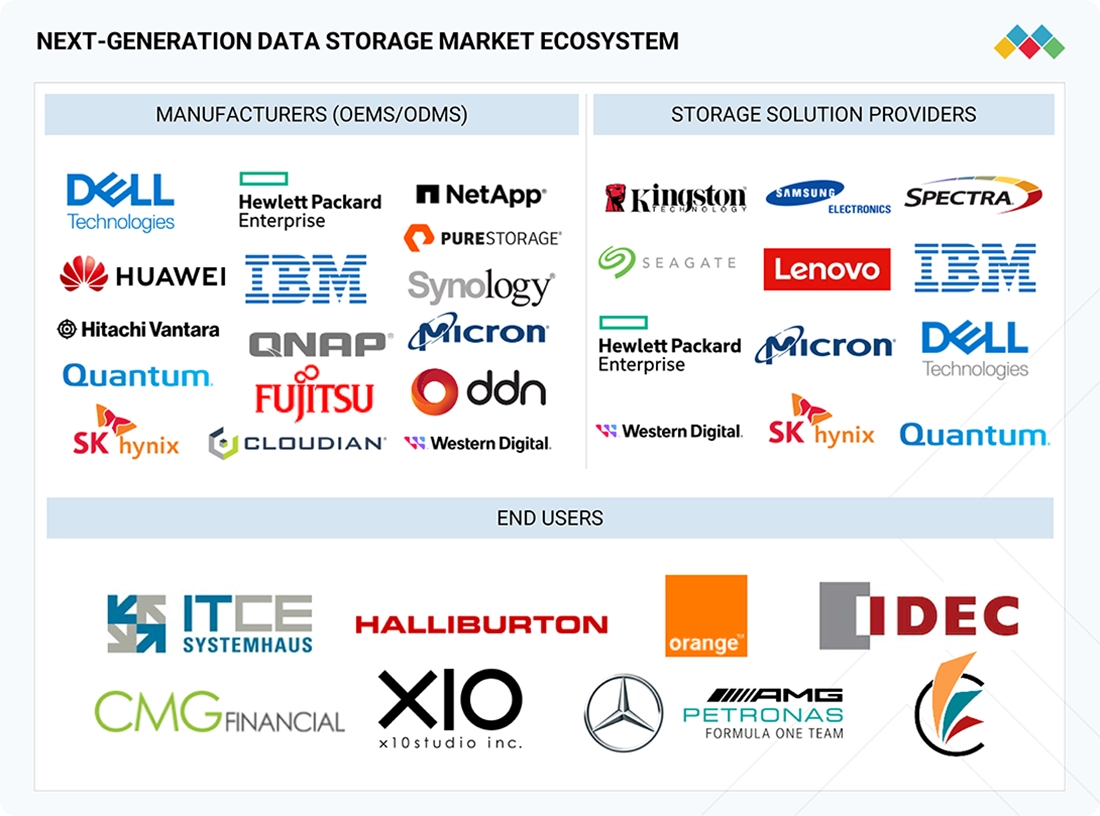
NEXT-GENERATION DATA STORAGE MARKET SIZE, SHARE & TRENDS: COMMERCIAL USE CASES ACROSS INDUSTRIES
| COMPANY | USE CASE DESCRIPTION | BENEFITS |
|---|---|---|
 |
x10studio faced challenges related to data loss, backup failures, and limited IT expertise with its previous customized NAS systems. To address these issues, the company deployed QNAP NAS solutions with 10GbE connectivity and scalable configurations, enabling secure data management, simplified deployment, reliable backup capabilities, and efficient handling of increasing data workloads. | The solution improved secure data management, enabled scalable storage expansion, simplified system setup for non-IT staff, reduced backup failures, and enhanced operational efficiency for growing workloads. |
 |
ITCE required a reliable and cost-effective NAS solution to support its private cloud backup services and manage multiple overnight backup jobs efficiently. The company deployed Buffalo TeraStation 51210RH storage systems with high-capacity rackmount NAS architecture, enabling secure customer data backup, scalable storage capacity, and reliable long-term backup operations. | The solution provided reliable and scalable backup storage, improved operational continuity, supported high-capacity data workloads, and reduced service disruption risks through strong warranty and recovery support. |
 |
Gijima upgraded its aging storage infrastructure by deploying Hitachi VSP 5000 Series and VSP G700 arrays for production and disaster recovery operations. The solution enabled seamless client data migration, improved storage scalability, reduced physical infrastructure requirements, and enhanced operational efficiency through advanced compression, automation, and centralized storage management capabilities. | The solution improved application performance, reduced infrastructure space and energy consumption, enabled seamless disaster recovery, simplified storage management, and enhanced scalability and operational efficiency. |
 |
IDEC Corporation required a modern storage infrastructure to improve operational performance, reliability, and system availability for its ERP environment. The company implemented Dell EMC PowerMax 2000 storage systems, enabling faster processing and backup operations, improved infrastructure efficiency, and significant reduction in physical storage space requirements across enterprise workloads. | The solution improved storage reliability and performance, reduced processing and backup times, minimized rack space requirements, and enhanced operational efficiency for enterprise applications. |
Logos and trademarks shown above are the property of their respective owners. Their use here is for informational and illustrative purposes only.
Related Ecosystem
Electronics System And Components
Information System And Analytics
Key Takeaways
- Japan's next-generation data storage market will grow from $4,270.7M (2026) to $6,046.0M (2031) at a 6.0% CAGR.
- Japan's advanced semiconductor manufacturing base and enterprise digitalization drive sustained demand for next-gen storage solutions.
- Cloud migration, AI adoption, and edge computing initiatives across Japan's industrial and financial sectors accelerate storage modernization.
- Japan's regulatory environment and data residency requirements create differentiated demand for localized, secure storage infrastructure.
Next-generation Data Storage Market Report Scope
| Report Metric | Details |
|---|---|
| Base Year | 2026 |
| Fastest Growing Segment | HYBRID (Deployment Mode) |
| Forecast Period | 2026–2031 |
| Growth Rate | CAGR of 6% from 2026 to 2031 |
| Largest Segment | FILE- & OBJECT-BASED STORAGE (Storage Architecture) |
| Market Size Base Year (Billions) | ~USD 70.13 (2026) |
| Revenue Forecast (Billions) | ~USD 93.85 (2031) |
| Segments Covered | Storage System, End User, Enterprise Type, Storage Medium, Storage Architecture, Type, Deployment Mode |
Japan Next-generation Data Storage Market Report Segmentation
7 segment dimensions are covered across the global market.
By Storage System
- Direct-Attached Storage
- Network-Attached Storage
- Storage Area Network
By End User
- Cloud Service Providers
- Enterprises
- Government Bodies
- Telecom Companies
By Enterprise Type
- Bfsi
- Consumer Goods & Retail
- Healthcare & Life Science
- Healthcare & Life Sciences
- Manufacturing
- Media & Entertainment
- Other Enterprises
By Storage Medium
- Hard Disk Drives
- Solid-State Drives
- Tapes
By Storage Architecture
- Block Storage
- File- & Object-Based Storage
By Type
- File Storage
- Object Storage
By Deployment Mode
- Cloud
- Hybrid
- On-Premises
Target Audience
- Japanese Storage Manufacturers : Need market sizing and competitive benchmarking data to optimize product portfolios, identify growth segments, and plan R&D investments in next-generation storage technologies.
- Enterprise IT Decision Makers : Require market insights to evaluate storage solution providers, understand technology trends, and make informed procurement decisions aligned with Japan's data infrastructure modernization needs.
- Semiconductor & Electronics Investors : Seek Japan-specific market data and growth forecasts to assess investment opportunities, evaluate portfolio companies, and identify emerging players in the storage technology sector.
- Global Technology Vendors : Need localized market intelligence to develop Japan-specific go-to-market strategies, understand customer requirements, and prioritize resource allocation in this advanced technology market.
- Government & Policy Advisors : Require comprehensive market analysis to inform technology policy, semiconductor industry support programs, and strategic initiatives promoting Japan's data storage innovation leadership.
Key Companies in the Japan Next-generation Data Storage Market
| Company | HQ | Ownership | Strongest segments |
|---|---|---|---|
| CAVIUM | United States | Private Company | OCTEON multi-core network processors,ThunderX / ThunderX2 ARM server processors,NITROX security processors and LiquidSecurity, |
| TELIA COMPANY | Sweden | Public Company | Consumer mobile (including sub-brands),Fixed broadband and fiber (consumer and small business),TV and media (TV4, MTV, pay TV, streaming), |
| DELL INC. | United States | Public Company | Client Solutions Group – Commercial PCs and Workstations,Client Solutions Group – Consumer PCs and Peripherals,Infrastructure Solutions Group – Servers and AI-Optimized Compute, |
| HEWLETT PACKARD ENTERPRISE COMPANY | United States | Public Company | Server (ProLiant, Synergy, Cray, NonStop, Edgeline),Hybrid Cloud & Storage (GreenLake, Alletra, InfoSight, CloudPhysics),Networking (Aruba, campus/branch, security), |
| NETAPP | United States | Public Company | Hybrid Cloud (ONTAP software and on-premises storage systems),Public Cloud (cloud storage services and data services),Services (STaaS, professional, managed, and support), |
| EVERPURE, INC. | United States | Public Company | FlashArray portfolio (/X, /C, /XL, /E, File Services),FlashBlade portfolio (/S, /E, /EXA),Evergreen subscriptions (Evergreen/One, Evergreen/Flex, Evergreen Architecture), |
| HITACHI, LTD. | Japan | Public Company | Digital Systems & Services (IT, cloud, integration, social infrastructure IT),Green Energy & Mobility (power grids, energy, rail systems, e-mobility),Connective Industries (industrial automation, machinery, water, environment), |
| FUJITSU | Japan | Public Company | Service Solutions (consulting, cloud, system integration, BPO, managed services),Hardware Solutions (computer platforms, network equipment, infrastructure),Ubiquitous Solutions (devices, edge, and embedded offerings), |
| IBM | United States | Public Company | Software (Hybrid Cloud & AI Platforms),Consulting,Infrastructure, |
| MICRON TECHNOLOGY, INC. | United States | Public Company | DRAM components and modules (incl. LPDDR, graphics, data center, CXL),NAND and SSDs (data center, client, auto/industrial),Multichip packages and managed NAND (mobile and consumer embedded), |
| INFORTREND TECHNOLOGY, INC. | Taiwan | Public Company | EonStor GS (enterprise unified) and GSx,EonStor GSe and GSe Pro (SMB unified),EonStor CS (scale-out NAS), |
| WESTERN DIGITAL CORPORATION | United States | Public Company | Data center HDDs and platforms,Client internal HDDs,External and portable drives, |
| SAMSUNG | South Korea | Public Company | Smartphones, tablets, wearables, and accessories,TVs, audio, and consumer appliances,Semiconductors (memory, foundry, system LSI), |
CAVIUM
CAVIUM is a United States-based private company founded in 2000 with 1,895 employees. The company operates in the technology sector.
TELIA COMPANY
TELIA COMPANY is a public company founded in 1853 and headquartered in Sweden. With 14,552 employees, it is one of the region's established telecommunications and technology providers.
DELL INC.
DELL INC. is a public company founded in 1984 and headquartered in the United States. With 97,000 employees, it is a major player in the technology and computing industry.
HEWLETT PACKARD ENTERPRISE COMPANY
HEWLETT PACKARD ENTERPRISE COMPANY is a public company founded in 1939 and based in the United States. The company employs 67,000 people and operates in the enterprise technology sector.
NETAPP
NETAPP is a United States-based public company founded in 1992 with 11,700 employees. The company operates in the data management and cloud infrastructure technology sector.
EVERPURE, INC.
EVERPURE, INC. is a public company founded in 2009 and based in the United States. The company employs 6,400 people.
HITACHI, LTD.
HITACHI, LTD. is a public company founded in 1910 and headquartered in Japan. With 287,901 employees, it is one of the world's largest diversified technology and industrial conglomerates.
FUJITSU
FUJITSU is a Japanese public company founded in 1935 with 99,203 employees. The company is a major global provider of information technology and business solutions.
IBM
IBM is a public company founded in 1911 and headquartered in the United States. With 264,300 employees, it is a leading global technology and consulting company.
MICRON TECHNOLOGY, INC.
MICRON TECHNOLOGY, INC. is a public company founded in 1978 and based in the United States. With 53,000 employees, it is a major manufacturer of memory and storage solutions.
INFORTREND TECHNOLOGY, INC.
INFORTREND TECHNOLOGY, INC. is a public company founded in 1993 and based in Taiwan. The company employs 408 people.
WESTERN DIGITAL CORPORATION
WESTERN DIGITAL CORPORATION is a public company founded in 1970 and based in the United States. With 40,000 employees, it is a major manufacturer of data storage and memory solutions.
SAMSUNG
SAMSUNG is a public company founded in 1969 and headquartered in South Korea. With 128,735 employees, it is a global leader in electronics, semiconductors, and technology products.
Reasons to Buy this Report
- Japan-Specific Market Sizing : Obtain precise valuation data for Japan's market segment ($4.3B-$6.0B), enabling accurate financial forecasting and investment decisions tailored to the Japanese market landscape.
- Competitive Intelligence : Understand Japan's semiconductor ecosystem dynamics, local player strategies, and competitive positioning to identify market entry opportunities and partnership potential in this advanced technology hub.
- Enterprise Demand Insights : Access detailed analysis of Japanese enterprise storage requirements, cloud adoption rates, and digital transformation spending patterns to align product offerings with regional customer needs.
- Technology Trend Analysis : Gain insights into Japan's leadership in emerging storage technologies including 3D NAND, persistent memory, and AI-optimized solutions to anticipate market shifts and innovation opportunities.
- Strategic Growth Planning : Leverage Japan-focused forecasts and CAGR projections to develop targeted expansion strategies, resource allocation plans, and long-term business development initiatives in this key Asia Pacific market.
Frequently asked questions
What is the market size of next-generation data storage in Japan in 2026?
Japan's next-generation data storage market is estimated at $4,270.7 million in 2026.
What is the projected market size for Japan by 2031?
Japan's next-generation data storage market is forecast to reach $6,046.0 million by 2031.
What is the CAGR for Japan's next-generation data storage market?
Japan's market is expected to grow at a compound annual growth rate of 6.0% from 2026 to 2031.
What are the primary drivers of growth in Japan's data storage market?
Key drivers include cloud adoption, AI workload expansion, edge computing deployment, enterprise modernization, and Japan's stringent data governance requirements.
Which sectors in Japan are leading demand for next-generation storage solutions?
Manufacturing, financial services, and technology sectors in Japan are primary adopters of next-generation storage architectures including SSDs, NVMe, and hybrid platforms.
RESEARCH METHODOLOGY
The research process for this technical, market-oriented, and commercial study of the next-generation data storage market included systematic gathering, recording, and analysis of data about companies operating in the market. It involved the extensive use of secondary sources, directories, and databases (Factiva, Oanda) to identify and collect relevant information. In-depth interviews were conducted with various primary respondents, including experts from core and related industries and preferred manufacturers, to obtain and verify critical qualitative and quantitative information as well as to assess the growth prospects of the market. Key players in the next-generation data storage market were identified through secondary research, and their market rankings were determined through primary and secondary research. This included studying annual reports of top players and interviewing key industry experts, such as CEOs, directors, and marketing executives.
Secondary Research
In the secondary research process, various secondary sources were referred to for identifying and collecting information relevant to this study. Secondary sources included annual reports, press releases, and investor presentations of companies; white papers, certified publications, and articles from recognized authors; directories; and databases. Secondary research was mainly conducted to obtain key information about the supply of the industry; a total pool of key players; segmentation of the market according to industry trends, geographic markets, and key developments from market- and technology-oriented perspectives.
Primary Research
In the primary research process, primary sources from the supply and demand sides were interviewed to obtain qualitative and quantitative information for this report. Primary sources from the supply side included experts, such as CEOs, vice presidents, marketing directors, technology and innovation directors, subject-matter experts, consultants, and related key executives from major companies and organizations operating in the next-generation data storage market.
After the complete market engineering process (market statistics calculations, market breakdown, market size estimations, market forecasting, and data triangulation), extensive primary research was conducted to gather information and verify and validate the critical market numbers.
Several primary interviews were conducted with experts from the demand and supply sides across four major regions—North America, Europe, Asia Pacific, and the Rest of the World (RoW). Approximately 25% of the primary interviews were conducted with the demand side and 75% with the supply side. This primary data was collected through questionnaires, emails, and telephonic interviews.
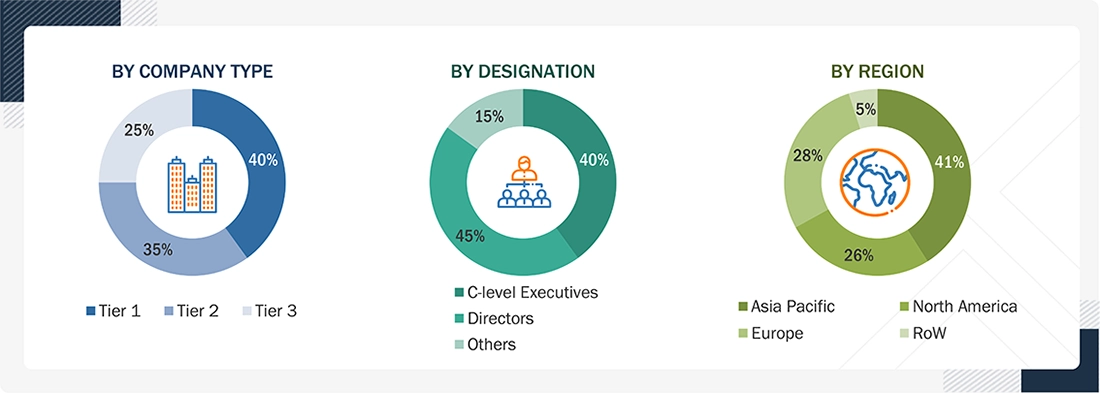
Notes: Tier 1 companies include market players with revenues above USD 500 million; tier 2 companies earn revenues between USD 100 million and USD 500 million; and tier 3 companies earn revenues up to USD 100 million. Other designations include sales, marketing, and product managers.
To know about the assumptions considered for the study, download the pdf brochure
Market Size Estimation
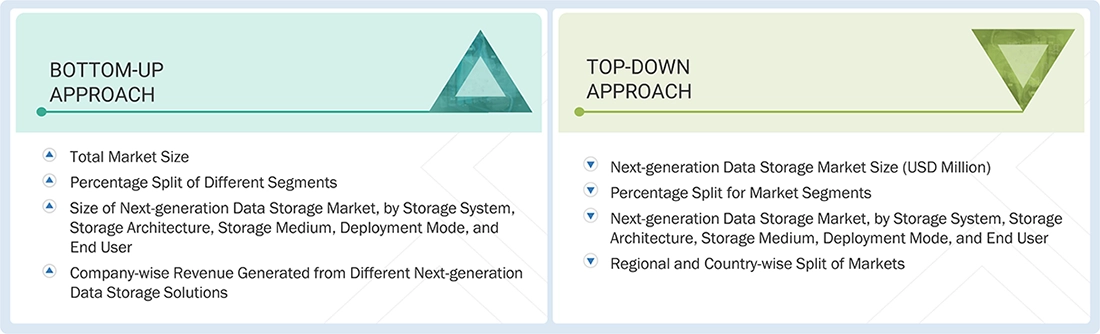
In the complete market estimation process, the top-down and bottom-up approaches were used, along with several data triangulation methods, to estimate and forecast the size of the market and its segments and subsegments listed in the report. Extensive qualitative and quantitative analyses were carried out on the complete market engineering process to list the key information/insights pertaining to the next-generation data storage market.
Key players in the next-generation data storage market were identified through secondary research, and their rankings in the respective regions were determined through primary and secondary research. This entire procedure involved the study of the annual and financial reports of top players and interviews with industry experts, such as chief executive officers, vice presidents, directors, and marketing executives, for quantitative and qualitative insights. All percentage shares, splits, and breakdowns were determined using secondary sources and verified through primary sources. All parameters that affect the markets covered in this research study were accounted for, viewed in extensive detail, verified through primary research, and analyzed to obtain the final quantitative and qualitative data. This data was consolidated and enhanced with detailed inputs and analysis from MarketsandMarkets and presented in this report.
Bottom-Up Approach
- Identifying various next-generation data storage solutions
- Analyzing the penetration of each system through secondary and primary research
- Analyzing the penetration of next-generation data storage solutions based on different storage systems, storage architecture, storage mediums, deployment mode, and end users through secondary and primary research
- Conducting multiple discussion sessions with key opinion leaders to understand the detailed working of next-generation data storage and their implementation in multiple end-user industries, which is expected to help analyze the break-up of the scope of work conducted by each major company
- Verifying and cross-checking the estimates at every level with key opinion leaders, including CEOs, directors, and operations managers, and then finally with the MarketsandMarkets domain experts
- Studying various paid and unpaid sources of information, such as annual reports, press releases, white papers, and databases.
Top-Down Approach
- Focusing initially on the top-line investments and expenditures made in the next-generation data storage ecosystem, further splitting the key market areas into the storage system, storage architecture, storage medium, deployment mode, end user, and region and listing key developments
- Identifying all leading players and end users in the next-generation data storage market-based storage system, storage architecture, storage medium, and deployment mode through secondary research, and fully verifying them through a brief discussion with industry experts
- Analyzing revenues, product mix, geographic presence, and key applications served by all identified players to estimate and arrive at percentage splits for all key segments
- Discussing splits with industry experts to validate the information and identify key growth pockets across all key segments
- Breaking down the total market based on verified splits and key growth pockets across all segments.
Next-generation Data Storage Market : Top-Down and Bottom-Up Approach
Data Triangulation
After arriving at the overall market size from the market size estimation process explained above, the total market was split into several segments and subsegments. To complete the overall market engineering process and arrive at the exact statistics for all segments and subsegments, the market breakdown and data triangulation procedures were employed, wherever applicable. The data was triangulated by studying various factors and trends from both the demand and supply sides. Along with this, the market size was validated using both the top-down and bottom-up approaches.
Market Definition
Next-generation data storage refers to advanced technologies and solutions aimed at meeting the growing needs for storing, managing, and accessing vast amounts of data more efficiently and on a larger scale. These technologies go beyond traditional storage methods, providing improved performance, capacity, reliability, and flexibility. It deals with the security and management of data and harnessing the information to meet the application and software networking needs of end users. Next-generation data storage comprises various computer-controlled systems, equipment, and software used to store and retrieve data more accurately for reuse.
Key Stakeholders
- Next-generation data storage solution providers
- Technology consultants and system integrators
- System distributors and suppliers
- Data storage experts
- Suppliers of accessories related to next-generation data storage systems
- Research organizations and consulting companies
- Government bodies, such as regulating authorities and policymakers
- Venture capitalists and private equity firms
- Associations, organizations, and alliances related to the next-generation data storage ecosystem
- Analysts and strategic business planners
- Technology investors
Report Objectives
- To describe and forecast the next-generation data storage market by storage system, storage medium, storage architecture, deployment mode, end user, and region in terms of value
- To describe and forecast by storage medium in terms of volume
- To describe and forecast the market size across four key regions, namely, North America, Europe, Asia Pacific, and the Rest of the World (RoW), along with their respective country-level market size, in terms of value
- To provide detailed information regarding the drivers, restraints, opportunities, and challenges in the market
- To strategically analyze the micromarkets concerning the individual growth trends, prospects, and their contribution to the market
- To map competitive intelligence based on company profiles, key player strategies, and key developments
- To analyze trends/disruptions impacting customer business; interconnected markets and cross-sector opportunities; strategic moves by tier-1/2/3 players; pricing analysis; patents analysis; trade analysis (export and import scenario); Porter's five forces analysis; Macroeconomics indicators; case studies; investment and funding scenario; decision-making process; buyer stakeholders and buying evaluation criteria; adoption barriers & internal challenges; unmet needs from various industries; technology analysis; technology roadmap; ecosystem analysis; regional regulations and compliance; impact of 2025 US tariff; and key conferences and events related to the market
- To benchmark the market players using the proprietary company evaluation matrix framework, which analyzes them on various parameters within the broad categories of market ranking/share and product portfolio
- To analyze competitive developments such as contracts, acquisitions, product launches & developments, collaborations, and partnerships, along with research & development, in the next-generation data storage market
Available customizations:
With the given market data, MarketsandMarkets offers customizations according to the company’s specific needs. The following customization options are available for the report:
Company Information
- Detailed analysis and profiling of additional market players (up to 7)
Get the Full Next-generation Data Storage Market Report
Full forecast, segment splits, and company analysis for all Next-generation Data Storage Market.
- US Next-generation Data Storage Market
- Canada Next-generation Data Storage Market
- Mexico Next-generation Data Storage Market
- Germany Next-generation Data Storage Market
- UK Next-generation Data Storage Market
- France Next-generation Data Storage Market
- Rest Of Europe Next-generation Data Storage Market
- China Next-generation Data Storage Market
- India Next-generation Data Storage Market
- South Korea Next-generation Data Storage Market
- Rest Of Asia Pacific Next-generation Data Storage Market
- Middle East Next-generation Data Storage Market
- Africa Next-generation Data Storage Market
- South America Next-generation Data Storage Market
Need a Tailored Report?
Customize this report to your needs
Get 10% FREE Customization
Customize This Report
