
South Korea Oligonucleotide Synthesis Market (2025-2030)

The South Korea Oligonucleotide Synthesis Market was valued at $89.7 Million in 2025 and projected to reach to $217.8 Million by 2030, representing a compound annual growth rate of 19.4%. South Korea's oligonucleotide synthesis market is poised for accelerated growth through 2030, driven by increasing investments in genomic research, rising prevalence of genetic disorders, and expanding therapeutic applications.


| Market Size in | USD 26.32 MN |
| Market Forecast in | |
| CAGR | |
| Forecast Period | |
| Units Considered | Value (USD MN) |
South Korea Oligonucleotide Synthesis Market Trends and Insights
- This represents a compound annual growth rate of 19.4%, outpacing global averages and reflecting South Korea's strengthening position in precision medicine and genomic research.
- South Korea's advanced biotechnology infrastructure, coupled with significant government investment in life sciences innovation, is driving demand for oligonucleotide synthesis technologies across therapeutic development and diagnostic applications. The market growth in South Korea is underpinned by increasing adoption of RNA-based therapeutics, rising prevalence of genetic disorders, and expanding pharmaceutical R&D capabilities.
- South Korea's pharmaceutical sector is actively pursuing oligonucleotide-based drug candidates, supported by regulatory frameworks that encourage innovation.
- Between 2025 and 2030, South Korea is expected to consolidate its role as a regional hub for oligonucleotide manufacturing and research, attracting both domestic and international biotech investments. South Korea's competitive advantages—including skilled workforce, state-of-the-art research facilities, and strategic partnerships with global biotech firms—position the country favorably within the Asia Pacific region.
- South Korea's market trajectory reflects sustained momentum in personalized medicine and gene therapy development..
Key Market Statistics
- CAGR (2025-2030) 19.4% CAGR
- Market Size, 2025 ~USD 89.7 Million
- Forecast, 2030 ~USD 217.8 Million
- Country South Korea
South Korea Oligonucleotide Synthesis Market Overview
Market Valuation Growth :
South Korea's oligonucleotide synthesis market is valued at USD 89.7 million in 2025, with projections reaching USD 217.8 million by 2030, demonstrating a 142% increase over five years.
Outpacing Global Growth :
South Korea's 19.4% CAGR significantly exceeds the global average of 18.6%, positioning the country as a high-growth hub for oligonucleotide synthesis technologies and applications.
Precision Medicine Leadership :
South Korea's advanced biotechnology infrastructure and genomic research capabilities are driving demand for oligonucleotide synthesis, supporting the nation's precision medicine and personalized healthcare initiatives.
Strategic Biotech Ecosystem :
The country's robust pharmaceutical R&D sector, government support for life sciences innovation, and skilled workforce are accelerating adoption of oligonucleotide-based therapeutics and diagnostics.
South Korea Oligonucleotide Synthesis Market Dynamics
- The country's commitment to becoming a global precision medicine leader, combined with supportive regulatory frameworks and substantial biotech funding, creates favorable conditions for market expansion.
- South Korea's pharmaceutical companies and research institutions are increasingly integrating oligonucleotide technologies into drug development pipelines, particularly for rare diseases and oncology applications.
- Continued government initiatives promoting biotechnology innovation and international collaborations will further strengthen South Korea's position as a key player in the global oligonucleotide synthesis market..
Market Ecosystem
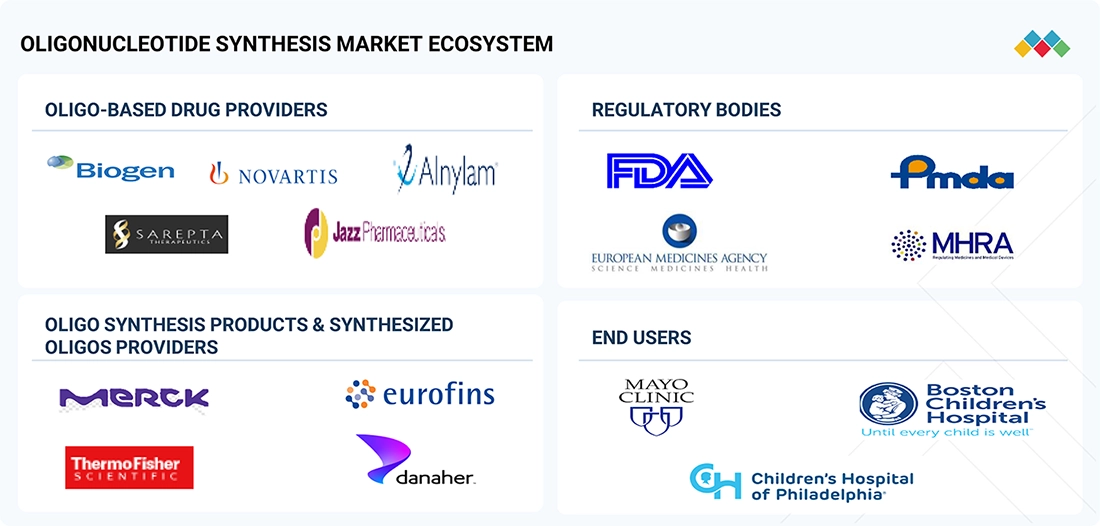
OLIGONUCLEOTIDE SYNTHESIS MARKET: COMMERCIAL USE CASES ACROSS INDUSTRIES
| COMPANY | USE CASE DESCRIPTION | BENEFITS |
|---|---|---|
 |
Deployed high-fidelity single-stranded custom oligonucleotide pools (oPools Oligo Pools) to build massive parallel sequence variations for cell line development and high-throughput CRISPR screening libraries | Delivered industry-leading low error rates under 1 in 2,000 bases |
Logos and trademarks shown above are the property of their respective owners. Their use here is for informational and illustrative purposes only.
Related Ecosystem
Biotechnology
Key Takeaways
- South Korea's oligonucleotide synthesis market is valued at USD 89.7 million in 2025 and is forecast to grow to USD 217.8 million by 2030, representing a 19.4% CAGR.
- South Korea's growth rate exceeds the global average, driven by advanced biotech infrastructure and government support for life sciences innovation.
- South Korea is emerging as a regional manufacturing and research hub for oligonucleotide-based therapeutics and diagnostics within Asia Pacific.
- South Korea's pharmaceutical sector is increasingly investing in RNA-based drug development, supported by favorable regulatory environments and skilled talent pools.
Oligonucleotide Synthesis Market Report Scope
| Report Metric | Details |
|---|---|
| Base Year | 2025 |
| Forecast Period | 2025–2030 |
| Growth Rate | CAGR of 18.6% from 2025 to 2030 |
| Market Size Base Year (Billions) | ~USD 10.53 (2025) |
| Revenue Forecast (Billions) | ~USD 24.7 (2030) |
| Segments Covered | Product, Type, Application, Disease Type, End User |
South Korea Oligonucleotide Synthesis Market Report Segmentation
5 segment dimensions are covered across the global market.
By Product
- Dna Oligos
- Equipment
- Oligonucleotide-Based Drugs
- Other Synthesized Oligos
- Primers
- Probes
- Reagents & Consumables
- Rna Oligos
- Synthesized Oligonucleotides
By Type
- Antisense Oligonucleotide-Based-Drugs
- Custom Oligonucleotides
- Other Oligonucleotide-Based-Drugs
- Other Research Applications
- Pcr
- Predesigned Oligonucleotides
- Sequencing
- Sirna Oligonucleotide-Based-Drugs
By Application
- Diagnostic Applications
- Research Applications
- Therapeutic Applications
By Disease Type
- Neurological Disorders
- Other Diseases
- Rare Diseases
By End User
- Academic Research Institutes
- Cros & Cmos
- Diagnostic Laboratories
- Hospitals
- Pharmaceutical & Biotechnology Companies
Target Audience
- Pharmaceutical Companies : South Korea-based and international pharma firms need market intelligence to guide oligonucleotide drug development investments, clinical trial planning, and commercialization strategies in this high-growth market.
- Biotech Startups & Innovators : Emerging biotech companies require detailed South Korea market data to assess funding opportunities, identify partnership prospects, and position oligonucleotide-based solutions for local and regional markets.
- Healthcare Investors & VCs : Investment firms targeting South Korea's life sciences sector need market forecasts and growth drivers to evaluate investment opportunities and portfolio companies in the oligonucleotide synthesis space.
- Research Institutions & Academia : Universities and research centers in South Korea require market insights to align genomic research initiatives with commercial opportunities and secure funding for oligonucleotide-related projects.
- Medical Device & Diagnostic Manufacturers : Companies developing diagnostic and therapeutic platforms need South Korea-specific market data to integrate oligonucleotide technologies and expand their precision medicine offerings in the region.
Key Companies in the South Korea Oligonucleotide Synthesis Market
| Company | HQ | Ownership | Strongest segments |
|---|---|---|---|
| FLUOR CORPORATION | United States | Public Company | Energy Solutions (oil, gas, chemicals, LNG, power, energy transition),Urban Solutions (advanced technologies, life sciences, mining, infrastructure, staffing, maintenance),Mission Solutions (government, nuclear remediation, security, logistics, O&M), |
FLUOR CORPORATION
Fluor Corporation is a publicly traded engineering and construction company founded in 1912 and headquartered in the United States. With approximately 23,000 employees, the company provides design, engineering, procurement, and construction services across multiple industries.
Reasons to Buy this Report
- Market-Specific Growth Insights : Gain detailed understanding of South Korea's 19.4% CAGR trajectory and identify high-growth segments within the country's oligonucleotide synthesis market through 2030.
- Competitive Landscape Analysis : Understand South Korea's biotech ecosystem, key players, and competitive positioning to inform market entry strategies and partnership opportunities in this high-growth region.
- Investment Decision Support : Access comprehensive market sizing and forecasts specific to South Korea to support capital allocation decisions, R&D investments, and expansion planning in precision medicine.
- Regulatory & Policy Context : Understand South Korea's regulatory environment, government support mechanisms, and policy drivers shaping oligonucleotide synthesis market development and commercialization pathways.
- Strategic Market Positioning : Leverage South Korea-specific data to identify emerging opportunities, assess market timing, and develop targeted go-to-market strategies for oligonucleotide-based products and services.
Frequently asked questions
What is the current size of South Korea's oligonucleotide synthesis market?
South Korea's oligonucleotide synthesis market was valued at USD 89.7 million in 2025 and is expected to grow significantly through 2030.
What is the projected market size for South Korea by 2030?
South Korea's oligonucleotide synthesis market is projected to reach USD 217.8 million by 2030, reflecting a 19.4% compound annual growth rate.
What factors are driving growth in South Korea's oligonucleotide synthesis market?
Key drivers include increasing adoption of RNA-based therapeutics, rising genetic disorder prevalence, expanding pharmaceutical R&D, and government support for biotech innovation in South Korea.
How does South Korea's market growth compare to global trends?
South Korea's 19.4% CAGR outpaces the global average of 18.6%, indicating stronger regional momentum and market opportunity in oligonucleotide synthesis.
What role does South Korea play in the Asia Pacific oligonucleotide market?
South Korea is consolidating its position as a regional hub for oligonucleotide manufacturing and research, attracting domestic and international biotech investments within Asia Pacific.
RESEARCH METHODOLOGY
This research study extensively used secondary sources, directories, and databases to identify and collect valuable information for analyzing the global oligonucleotide synthesis market. In-depth interviews were conducted with primary respondents, including key industry participants, subject-matter experts (SMEs), C-level executives of key market players, and industry consultants, to obtain and verify critical qualitative and quantitative information and to assess the market's growth prospects. The global market size estimated through secondary research was then triangulated with inputs from primary research to arrive at the final market size.
Secondary Research
Secondary research was used primarily to identify and collect information for the extensive, technical, market-oriented, and commercial study. The secondary sources used for this study include annual reports, SEC filings, investor presentations, the World Health Organization (WHO), the United States Food and Drug Administration (US FDA), the National Center for Biotechnology Information (NCBI), and regulatory body websites, among others. These sources also provided key information on major players, market classification and segmentation aligned with industry trends, regional and country-level markets, market developments, and technology perspectives.
Primary Research
In-depth interviews were conducted with primary respondents, including key industry participants, subject-matter experts (SMEs), C-level executives of key market players, and industry consultants, to obtain and verify critical qualitative and quantitative information and to assess the market's prospects. Primary sources from both the supply and demand sides of the market were interviewed to gather qualitative and quantitative information. The following is a breakdown of the primary respondents:
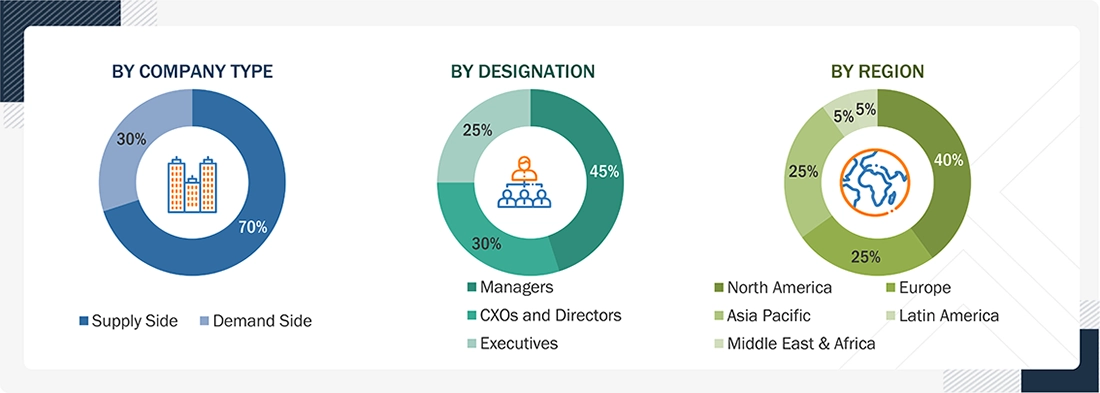
To know about the assumptions considered for the study, download the pdf brochure
Market Size Estimation
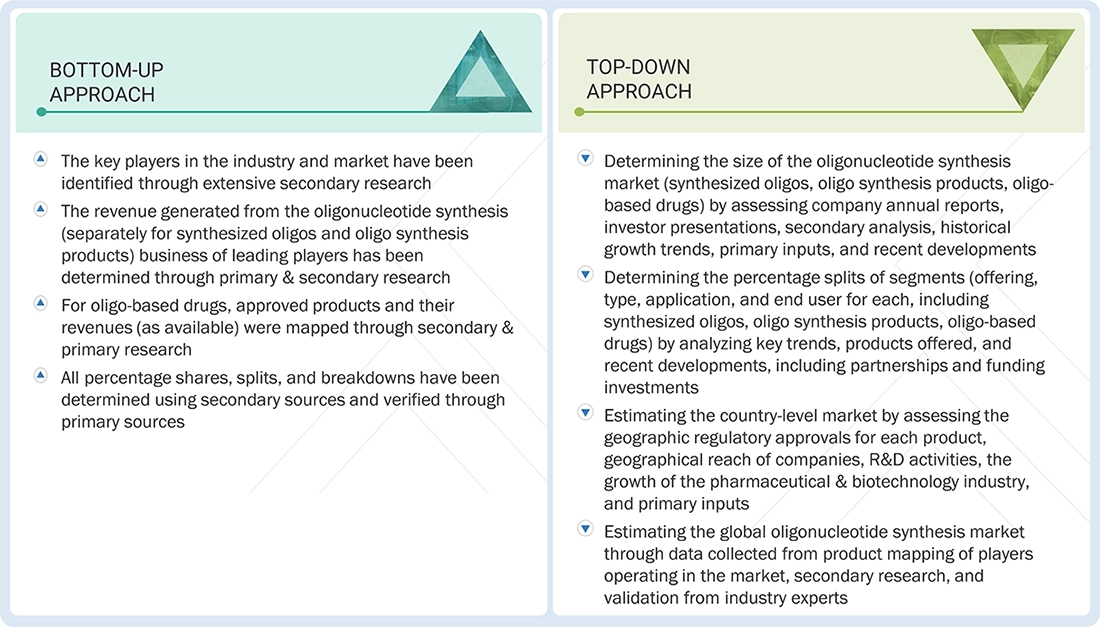
Both top-down and bottom-up approaches were used to estimate and validate the total size of the oligonucleotide synthesis market. These methods were also used extensively to estimate the size of various market subsegments. The research methodology used to estimate the market size includes the following:
Oligonucleotide Synthesis Market : Top-Down and Bottom-Up Approach
Data Triangulation
After determining the overall market size through the estimation process, the total market was segmented into several segments and subsegments. Where applicable, data triangulation and market breakdown procedures were employed to complete the overall market engineering process and arrive at the exact statistics for all segments and subsegments. The data was triangulated by analyzing various factors and trends from both the demand and supply sides.
Market Definition
Oligonucleotide synthesis is the chemical process of creating nucleic acid fragments with specific chemical structures or sequences, of varying sizes, to form a desired product. These fragments, known as oligonucleotides, have several applications in medical and life science research. They can be used for DNA sequencing and amplification, detecting complementary DNA or RNA through hybridization, creating artificial genes, and introducing targeted genetic mutations.
Oligonucleotides are also used to develop therapeutic drugs. These drugs are chemically synthesized and have different mechanisms of action, such as interfering with gene expression, blocking the production of harmful proteins, or restoring the function of mutated genes.
Key Stakeholders
- Pharmaceutical & biotechnology companies
- Hospitals
- Diagnostic laboratories
- Academic researchers and government research organizations
- Private research institutes
- Custom oligonucleotide service providers
- Contract manufacturing organizations (CMOs)
- Oligonucleotide equipment manufacturers
- Contract research organizations (CROs)
- Market research & consulting firms
- Venture capitalists
Report Objectives
- To define, describe, and forecast the global oligonucleotide synthesis market based on the offering, type, application, end user, therapeutic area, and region
- To provide detailed information regarding the major factors influencing the growth of the market (such as drivers, restraints, challenges, and opportunities)
- To strategically analyze micromarkets with respect to individual growth trends, prospects, and contributions to the overall oligonucleotide synthesis market
- To analyze opportunities in the market for stakeholders and provide details of the competitive landscape for market leaders
- To forecast the size of the market segments with respect to six regions, namely, North America, Europe, the Asia Pacific, Latin America, the Middle East, and Africa
- To strategically profile the key players and comprehensively analyze their product portfolios, market positions, and core competencies
- To analyze competitive developments such as acquisitions, product launches, expansions, agreements, partnerships, and R&D activities in the oligonucleotide synthesis market
- To provide information on funding & investment activities, brand/product comparative analysis, vendor valuation, and financial metrics of the oligonucleotide synthesis market
Available customizations:
With the given market data, MarketsandMarkets offers customizations per the company’s specific needs. The following customization options are available for this report:
Portfolio Assessment
- Product Matrix gives a detailed comparison of the product portfolios of the top five companies.
Geographical Analysis
- A further breakdown of the Rest of Europe’s oligonucleotide synthesis market into countries
- A further breakdown of the Rest of Asia Pacific’s oligonucleotide synthesis market into countries
- A further breakdown of the Rest of Latin America’s oligonucleotide synthesis market into countries
- A further breakdown of the Rest of Middle East’s oligonucleotide synthesis market into countries
Company Information
- Detailed analysis and profiling of additional market players (up to five).
Get the Full Oligonucleotide Synthesis Market Report
Full forecast, segment splits, and company analysis for all Oligonucleotide Synthesis Market.
- US Oligonucleotide Synthesis Market
- Canada Oligonucleotide Synthesis Market
- Germany Oligonucleotide Synthesis Market
- UK Oligonucleotide Synthesis Market
- France Oligonucleotide Synthesis Market
- Italy Oligonucleotide Synthesis Market
- Spain Oligonucleotide Synthesis Market
- China Oligonucleotide Synthesis Market
- Japan Oligonucleotide Synthesis Market
- India Oligonucleotide Synthesis Market
- Australia Oligonucleotide Synthesis Market
- Brazil Oligonucleotide Synthesis Market
- Mexico Oligonucleotide Synthesis Market
- Argentina Oligonucleotide Synthesis Market
- Saudi Arabia Oligonucleotide Synthesis Market
- United Arab Emirates Oligonucleotide Synthesis Market
Need a Tailored Report?
Customize this report to your needs
Get 10% FREE Customization
Customize This Report
