
Italy Open Banking Solutions Market (2023-2028)

The Italy Open Banking Solutions Market was valued at $163.5 Million in 2023 and projected to reach to $298.9 Million by 2028, representing a compound annual growth rate of CAGR 12.8%. Italy's open banking solutions market is positioned for sustained growth through 2028, with the market expanding from USD 163.5 million to USD 298.9 million.


| Market Size in | USD 26.32 MN |
| Market Forecast in | |
| CAGR | |
| Forecast Period | |
| Units Considered | Value (USD MN) |
Italy Open Banking Solutions Market Trends and Insights
- This expansion reflects Italy's increasing adoption of open banking frameworks driven by regulatory compliance with PSD2 and evolving consumer demand for seamless financial services integration.
- Italy's fintech ecosystem is maturing rapidly, with banks and third-party providers collaborating to deliver innovative payment solutions and data-sharing capabilities. The 12.8% compound annual growth rate (CAGR) through 2028 positions Italy as a significant growth market within Europe's open banking landscape.
- Italy's financial institutions are investing heavily in API infrastructure and digital transformation initiatives to remain competitive.
- The market's trajectory demonstrates strong momentum as Italy's regulatory environment continues to support open banking innovation and consumer protection standards..
Key Market Statistics
- CAGR (2023-2028) CAGR 12.8%
- Market Size, 2023 ~USD 163.5 Million
- Forecast, 2028 ~USD 298.9 Million
- Country Italy
Italy Open Banking Solutions Market Overview
Strong CAGR Growth :
Italy's open banking solutions market is growing at 12.8% CAGR from 2023 to 2028, demonstrating robust market momentum despite being below the global average of 16%, indicating localized maturation opportunities.
PSD2 Regulatory Compliance :
Italy's market expansion is primarily driven by mandatory compliance with the EU's Payment Services Directive 2 (PSD2), which has accelerated open banking adoption among Italian financial institutions and fintech companies.
Maturing Fintech Ecosystem :
Italy's fintech sector is rapidly evolving with increased venture capital investment, startup formation, and collaboration between traditional banks and digital-native companies, creating a competitive landscape for open banking solutions.
Consumer-Driven Integration Demand :
Italian consumers increasingly demand seamless financial services integration across multiple providers, pushing banks and fintechs to adopt open banking APIs and third-party integrations for enhanced user experiences.
Italy Open Banking Solutions Market Dynamics
- This 83% growth trajectory reflects deepening regulatory compliance requirements and accelerating digital transformation across Italian financial institutions.
- The market will be shaped by increasing API adoption, enhanced data security frameworks, and growing collaboration between incumbent banks and innovative fintech startups. Looking ahead, Italy's open banking market will benefit from rising consumer expectations for integrated financial services, expanded payment initiation services, and account information services.
- Investment in cybersecurity infrastructure and regulatory technology will become critical differentiators.
- Italian banks are expected to leverage open banking to improve customer retention, reduce operational costs, and create new revenue streams through third-party partnerships and ecosystem monetization strategies..
Market Ecosystem
Related Ecosystem
Software And Services
- Natural Language Processing (NLP)
- Machine Learning
- Supply Chain Management
- Predictive Analytics
- Image Sensors
- International Business Machines Corporation
- MICROSOFT CORPORATION
- Oracle Corporation
- SAP SE
- Amazon.com, Inc.
Cloud Computing
- Software as A Service (SaaS)
- Natural Language Processing (NLP)
- Platform as A Service (PaaS)
- Machine Learning
- Supply Chain Management
- International Business Machines Corporation
- MICROSOFT CORPORATION
- Oracle Corporation
- Amazon.com, Inc.
Application Security
- Cloud Security
- Security Analytics
- Network Testing
- Security Testing
- Web Application Security
- REDINGTON
- International Business Machines Corporation
- MICROSOFT CORPORATION
- Cisco Systems, Inc.
- PALO ALTO NETWORKS, INC
Key Takeaways
- Italy's open banking market will nearly double from USD 163.5M (2023) to USD 298.9M (2028), driven by PSD2 compliance and digital transformation.
- Italy's 12.8% CAGR reflects strong fintech adoption and collaboration between traditional banks and third-party providers across the country.
- Italy's regulatory framework and consumer demand for integrated financial services are key catalysts for sustained market expansion through 2028.
- Italy's financial institutions are prioritizing API infrastructure investments to capture growth opportunities in payments, lending, and data analytics.
Open Banking Solutions Market Report Scope
| Report Metric | Details |
|---|---|
| Base Year | 2023 |
| Fastest Growing Segment | MANAGED SERVICES (Service) |
| Forecast Period | 2023-2028 |
| Growth Rate | CAGR of 16% from 2023 to 2028 |
| Largest Segment | CLOUD (Deployment Mode) |
| Market Size Base Year (Billions) | ~USD 5.57 (2023) |
| Revenue Forecast (Billions) | ~USD 11.7 (2028) |
| Segments Covered | Offering, Solution, Service, Application, Deployment Model, Digital Channel, End User, Deployment Mode, Component, Banking Type, Banking Mode, Deployment Type |
Italy Open Banking Solutions Market Report Segmentation
12 segment dimensions are covered across the global market.
By Offering
- Services
- Solutions
By Solution
- Account Information
- Api Management
- Digital Lending Platforms
- Identity Verification & Authentication
- Other Solutions
- Payment Initiation
- Point Solutions
By Service
- Consulting
- Implementation
- Managed Services
- Professional Services
- Support And Maintenance
By Application
- Banking
- Digital Lending
- Other Applications
- Payment
- Wealth Management
By Deployment Model
- Cloud
- On-Premises
By Digital Channel
- Mobile Apps
- Web Portals
By End User
- Account Providers
- Banks
- Credit Unions
- Nbfcs
- Third-Party Providers
By Deployment Mode
- Cloud
- On-Premises
By Component
- Platforms
- Services
By Banking Type
- Corporate Banking
- Investment Banking
- Retail Banking
By Banking Mode
- Mobile Banking
- Online Banking
By Deployment Type
- Cloud
- On-Premises
Target Audience
- Italian Financial Institutions : Banks and credit unions need Italy-specific market data to develop open banking strategies, allocate R&D budgets, assess competitive threats, and plan API infrastructure investments aligned with PSD2 requirements.
- Fintech & Payment Companies : Italian and international fintech startups require market sizing, growth forecasts, and competitive intelligence to validate business models, secure funding, and prioritize Italy as a market entry or expansion destination.
- Technology Solution Providers : Software vendors and API platform providers need Italy market insights to develop localized solutions, understand regulatory requirements, identify customer segments, and build go-to-market strategies for Italian institutions.
- Investment & Consulting Firms : Private equity, venture capital, and management consultants require Italy-specific market data for due diligence, portfolio company strategy, M&A analysis, and investment thesis development in the open banking sector.
- Regulatory & Compliance Bodies : Italian financial regulators, compliance officers, and policy makers need market intelligence to monitor ecosystem development, assess regulatory effectiveness, and inform future open banking policy decisions in Italy.
Reasons to Buy this Report
- Market Size & Growth Validation : Obtain precise market valuation data for Italy (USD 163.5M in 2023) with verified 5-year forecasts to support investment decisions, business planning, and competitive positioning in the Italian open banking sector.
- Regulatory Landscape Intelligence : Understand Italy-specific PSD2 implementation requirements, compliance timelines, and regulatory trends that directly impact product development, go-to-market strategies, and partnership opportunities for open banking solutions.
- Competitive Positioning Analysis : Benchmark your offerings against Italy's maturing fintech ecosystem, identify market gaps, assess competitor strategies, and discover untapped opportunities in payment initiation and account information services.
- Consumer Behavior Insights : Access Italy-specific data on consumer adoption rates, preferences for integrated financial services, and demand drivers to tailor product features, marketing messaging, and customer acquisition strategies effectively.
- Strategic Partnership Opportunities : Identify potential collaboration partners among Italian banks, fintechs, and payment service providers to accelerate market entry, expand distribution channels, and build ecosystem-based revenue models in Italy.
Frequently asked questions
What is the current size of Italy's open banking solutions market?
Italy's open banking solutions market was valued at USD 163.5 million in 2023 and is expected to grow to USD 298.9 million by 2028.
What is the projected growth rate for Italy's open banking market?
Italy's open banking solutions market is projected to grow at a compound annual growth rate (CAGR) of 12.8% from 2023 to 2028.
What regulatory factors are driving Italy's open banking adoption?
Italy's open banking growth is primarily driven by PSD2 (Payment Services Directive 2) compliance requirements and regulatory mandates that promote API standardization and data sharing among financial institutions.
Which sectors are leading Italy's open banking solutions market?
Italy's market is led by payment solutions, lending platforms, and data analytics services, with strong participation from both incumbent banks and emerging fintech companies.
What challenges does Italy's open banking market face?
Italy's market faces challenges including legacy system integration, cybersecurity concerns, consumer trust in data sharing, and varying levels of digital maturity across financial institutions.
RESEARCH METHODOLOGY
The study covered four main actions to estimate the current market size of the Open Banking solutions market. We conducted significant secondary research to gather data on the market, the competing market, and the parent market. The following stage involved conducting primary research to confirm these conclusions' hypotheses and sizing with industry experts throughout the value chain. A combination of top-down and bottom-up methods was used to assess the overall market size. We then estimated the market sizes of the leading Open Banking solutions segments using the market breakup and data triangulation techniques.
Secondary Research
A wide range of secondary sources, directories, and databases were employed in this research project, including product demos, vendor data sheets, D&B Hoovers, DiscoverOrg, Factiva, Vendor Surveys, Global Findex database, Association for Financial Technology (AFT), and Company Websites/Annual Reports/SEC Filings. We referred to sources to locate and gather important data for this technical, commercial, and market-focused analysis of the Open Banking solutions market.
Primary Research
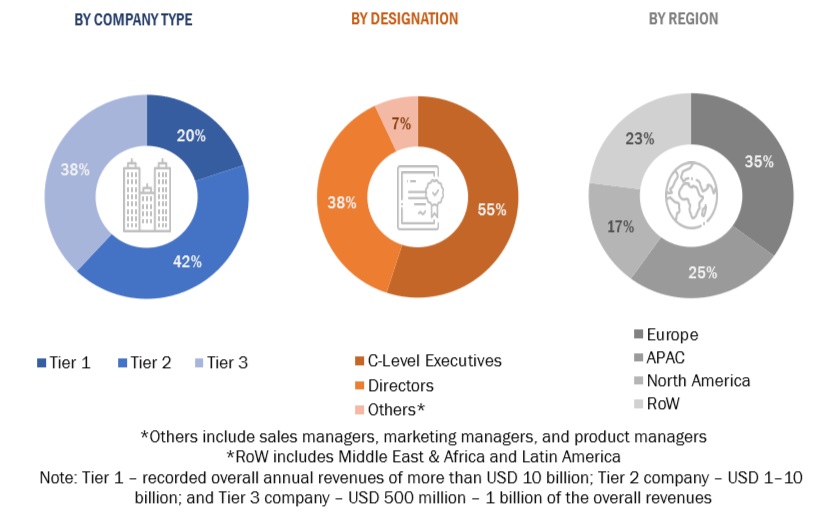
Several industry experts from the core and related industries and providers of preferred software developers, distributors, service providers, technology developers, alliances, and organisations connected to every link in the industry value chain were the primary sources of information. Key industry participants, subject-matter experts, C-level executives of major market players, and industry consultants were among the primary respondents with whom in-depth interviews were conducted to gather and validate crucial qualitative and quantitative data and evaluate the market's potential.
To obtain information, we conducted primary interviews on market statistics, the most recent trends that are upending the industry, newly implemented use cases, data on revenue generated by goods and services, market segmentation, market size estimations, market forecasts, and data triangulation. Understanding different technological developments, segmentation types, industry trends, and geographical areas was also aided by primary research. To understand the buyer's perspective on suppliers, open banking solution providers, and their current use cases, which would affect the overall Open Banking solutions market, demand-side stakeholders, such as Chief Executive Officers (CEOs), Chief Information Officers (CIOs), Chief Technology Officers (CTOs), Vice Presidents (VPs), and Chief Security Officers (CSOs), as well as the installation teams of governments/end users using Open Banking solutions, and digital initiatives project teams, were interviewed.
To know about the assumptions considered for the study, download the pdf brochure
Market Size Estimation
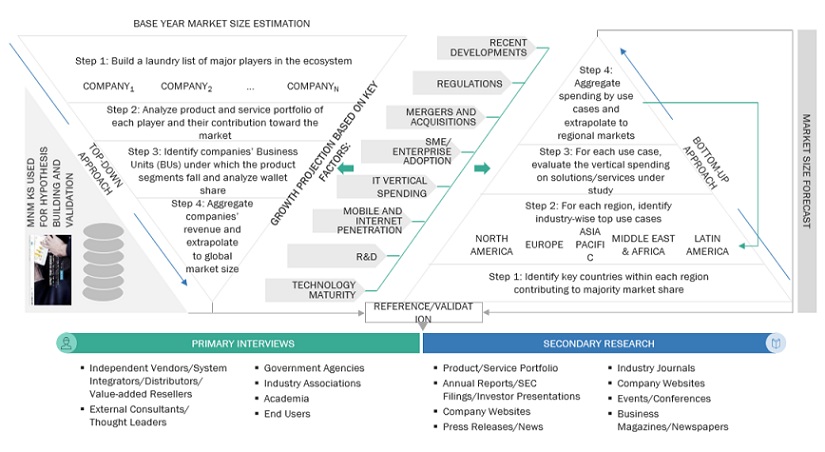
We employed top-down and bottom-up methodologies to estimate and forecast the Open Banking solutions market and other associated submarkets. Using the revenues and product offerings of the major market players, the bottom-up approach assisted in determining the overall market size. This research ascertained and validated the precise value of the total parent market size through data triangulation techniques and primary interview validation. Using percentage splits of the market segments, we were able to estimate the size of other specific markets using the overall market size via the top-down approach.
The bottom-up approach identified the trend of Open Banking solutions adoption among industry verticals in critical countries that contribute the most to the market. The adoption trend of Open Banking solutions and varying cases of use concerning their business segments were identified and extrapolated for cross-validation. We gave weightage to the use cases identified in different solution areas for the calculation. We prepared an exhaustive list of all vendors offering Open Banking solutions. Using annual reports, news releases, fundraising, investor presentations, paid databases, and primary interviews, we calculated the revenue contribution of each vendor in the market.. We evaluated each vendor based on its service offerings across verticals. To get the entire market size, we extrapolated the total revenue of all businesses. The market size and geographical penetration of each subsegment were examined and analysed. We determined the region split through primary and secondary sources based on these numbers.
The top-down approach prepared an exhaustive list of all vendors in the Open Banking solutions market. We estimated the revenue contribution of all vendors in the market through their annual reports, press releases, funding, investor presentations, paid databases, and primary interviews. We estimated the market size from revenues generated by vendors from different Open Banking solutions offerings. Using secondary and primary sources, we located additional vendors and the income produced by each service type, which we then aggregated to calculate the market size. Additionally, the procedure included a regional penetration analysis of the Open Banking solutions market. The investigation was utilized to ascertain and validate the precise values of the market sizes for Open Banking solutions and its sectors, using the data triangulation process and primary data validation. The main procedure to gather essential insights was conducting in-depth interviews with CEOs, CTOs, CIOs, VPs, directors, and marketing executives. To confirm, we further triangulated market numbers using the current MarketsandMarkets repository.
Open Banking solutions Market: Top-Down and Bottom-Up approaches
To know about the assumptions considered for the study, Request for Free Sample Report
Data Triangulation
The market was divided into several segments and subsegments using the previously described market size estimation procedures once the overall market size was determined. When required, market breakdown and data triangulation procedures were employed to complete the market engineering process and specify the exact figures for every market segment and subsegment. The data was triangulated by examining several variables and patterns from government entities' supply and demand sides.
Market Definition
Considering the views of various sources (Software AG company) and associations on Open Banking solutions, MarketsandMarkets defines Open Banking solutions as “a banking practice and regulatory framework that allows customers to grant third-party financial service providers access to their financial data held by traditional banks or financial institutions through secure Application Programming Interfaces (APIs). This sharing of data enables third-party developers to create innovative financial products and services, such as budgeting apps, payment solutions, investment platforms, and lending services, tailored to the individual needs and preferences of customers. Open Banking aims to promote competition, innovation, and transparency in the financial services industry, empowering customers with greater control over their financial data and fostering a more interconnected and dynamic ecosystem of financial services".
Key Stakeholders
- Banks and Financial Institutions
- Fintech Companies
- Investors
- Regulatory Bodies
- Technology Providers
- Third-Party Providers (TPPs)
- Government Agencies
- Industry Associations
- Consulting Firms
- Customers
Report Objectives
- To define, describe, and forecast the Open Banking Solutions market based on offering, application, digital channel, deployment model, end user, and region
- To offer comprehensive details regarding the primary variables impacting the market's growth (drivers, restraints, opportunities, and challenges)
- To determine the high-growth market sectors in order to assess the opportunities for stakeholders in the market
- To forecast the market size with respect to five main regions—North America, Europe, Asia Pacific, the Middle East & Africa, and Latin America
- To analyze the subsegments of the market with respect to individual growth trends, prospects, and contributions to the overall market
- To profile the key players of the market and comprehensively analyze their market size and core competencies
- To track and analyze the competitive developments, such as product enhancements, product launches, acquisitions, partnerships, and collaborations, in the Open Banking Solutions market globally.
Available Customizations
With the given market data, MarketsandMarkets offers customizations per the company's specific needs. The following customization options are available for the report:
Product Analysis
- The product matrix provides a detailed comparison of the product portfolio of each company.
Geographic Analysis
- Further breakup of the Asia Pacific market into countries contributing 75% to the regional market size
- Further breakup of the North American market into countries contributing 75% to the regional market size
- Further breakup of the Latin American market into countries contributing 75% to the regional market size
- Further breakup of the Middle Eastern & African market into countries contributing 75% to the regional market size
- Further breakup of the European market into countries contributing 75% to the regional market size
Company Information
- Detailed analysis and profiling of additional market players (up to 5)
Get the Full Open Banking Solutions Market Report
Full forecast, segment splits, and company analysis for all Open Banking Solutions Market.
- Canada Open Banking Solutions Market
- US Open Banking Solutions Market
- UK Open Banking Solutions Market
- Germany Open Banking Solutions Market
- France Open Banking Solutions Market
- China Open Banking Solutions Market
- Japan Open Banking Solutions Market
- India Open Banking Solutions Market
- South Africa Open Banking Solutions Market
- Brazil Open Banking Solutions Market
- Mexico Open Banking Solutions Market
- Rest Of Europe Open Banking Solutions Market
- Rest Of Asia Pacific Open Banking Solutions Market
- Rest Of Latin America Open Banking Solutions Market
- GCC Open Banking Solutions Market
- Ksa Open Banking Solutions Market
- Rest Of GCC Countries Open Banking Solutions Market
- UAE Open Banking Solutions Market
Need a Tailored Report?
Customize this report to your needs
Get 10% FREE Customization
Customize This Report
