
US Organic Feed Market (2025-2030)

The US Organic Feed Market was valued at $3509.8 Million in 2025 and projected to reach to $5153.7 Million by 2030, representing a compound annual growth rate of 8.0%. The US organic feed market is positioned for sustained expansion through 2030, driven by increasing numbers of farms transitioning to organic certification and consumer demand for organic animal products.


| Market Size in | USD 26.32 MN |
| Market Forecast in | |
| CAGR | |
| Forecast Period | |
| Units Considered | Value (USD MN) |
US Organic Feed Market Trends and Insights
- This 8.0% compound annual growth rate reflects increasing demand from US livestock producers and dairy farmers transitioning to certified organic operations.
- The US market benefits from strong regulatory frameworks, consumer preference for organic products, and rising feed costs that incentivize efficiency improvements across US agricultural operations. Driving this expansion are multiple factors unique to the US market, including heightened consumer awareness of organic certification standards, expansion of US organic dairy and poultry sectors, and investment in domestic organic feed production infrastructure.
- The US organic feed market is also supported by premium pricing power and growing retail distribution networks that make organic feed more accessible to US farmers.
- Between 2025 and 2030, the US market will likely see consolidation among feed manufacturers and increased competition from regional producers seeking to capture share in this high-margin segment..
Key Market Statistics
- CAGR (2025-2030) 8.0% CAGR
- Market Size, 2025 ~USD 3509.8 Million
- Forecast, 2030 ~USD 5153.7 Million
- Country US
US Organic Feed Market Overview
Market Valuation :
The US organic feed market is valued at $3,509.8 million in 2025, with strong momentum driven by certified organic livestock operations across dairy and poultry sectors.
Growth Trajectory :
At an 8.0% CAGR through 2030, the US market is expanding faster than many agricultural segments, reaching $5,153.7 million by forecast end, reflecting sustained producer investment in organic certification.
Regulatory Support :
Robust USDA organic certification frameworks and state-level incentive programs create a stable operating environment for US organic feed manufacturers and distributors.
Consumer-Driven Demand :
Rising US consumer preference for organic dairy, meat, and poultry products directly incentivizes livestock producers to source certified organic feed inputs.
US Organic Feed Market Dynamics
- Dairy operations represent a significant growth segment, with organic milk commanding premium pricing that justifies higher feed costs.
- Regulatory certainty from USDA standards and growing availability of domestically-sourced organic feed ingredients support market confidence.
- However, supply chain constraints and feed ingredient availability may moderate growth rates in certain regions, particularly for specialty organic feeds..
Market Ecosystem
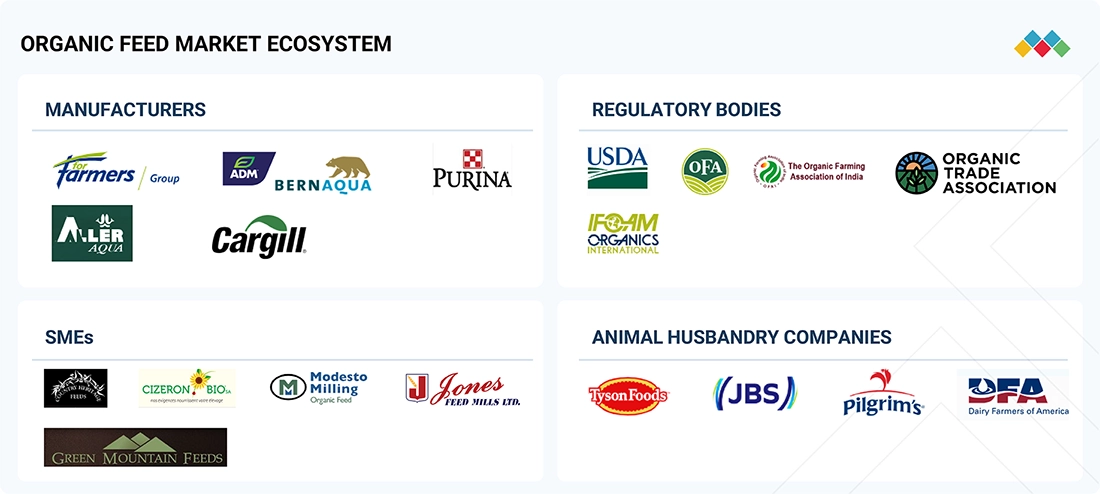
Organic Feed Market: COMMERCIAL USE CASES ACROSS INDUSTRIES
| COMPANY | USE CASE DESCRIPTION | BENEFITS |
|---|---|---|
 |
Expanded capacity to produce organic feed with the recent acquisition of a compound feed plant in West Germany by its subsidiary, Reudink | Increased supply and improved logistics for European organic farmers, promoting high-welfare, sustainable livestock production |
 |
Maintains current certification for producing fish and shrimp feed suitable for organic aquaculture under EU Organic Farming regulations | Regulatory compliance and assurance of sustainable, low environmental impact feed for certified organic fish farms, ensuring premium market access |
 |
Continuously produces and supplies EU-certified organic fish feeds for multiple species, covering the life cycle from hatch to harvest | Provides a complete, non-GMO, and traceable organic diet to support optimal growth and health in certified organic aquaculture operations |
Logos and trademarks shown above are the property of their respective owners. Their use here is for informational and illustrative purposes only.
Related Ecosystem
Key Takeaways
- The US organic feed market will grow from $3,509.8M (2025) to $5,153.7M (2030) at an 8.0% CAGR.
- US dairy and poultry sectors are primary drivers of organic feed adoption and market expansion.
- Strong regulatory oversight and consumer demand for organic certification support premium pricing in the US market.
- Regional US feed manufacturers are increasing investment in organic production capacity to meet growing farmer demand.
Organic Feed Market Report Scope
| Report Metric | Details |
|---|---|
| Base Year | 2025 |
| Fastest Growing Segment | PERFORMANCE ADDITIVES (Nutrient Source) |
| Forecast Period | 2025–2030 |
| Growth Rate | CAGR of 8.5% from 2025 to 2030 |
| Largest Segment | ENERGY SOURCES (Nutrient Source) |
| Market Size Base Year (Billions) | ~USD 12.34 (2025) |
| Revenue Forecast (Billions) | ~USD 18.56 (2030) |
| Segments Covered | Ingredient Source, Subtype, Form, Livestock, Farm Size, Nutrient Source |
US Organic Feed Market Report Segmentation
6 segment dimensions are covered across the global market.
By Ingredient Source
- Additives
- Aquatic Animals
- Cereals & Grains
- Companion Animals
- Fibers & Forage
- Oilseeds, Meals, & Pulses
- Poultry
- Ruminants
- Swine
By Subtype
- Barley
- Beef Cattle
- Breeders
- Broilers
- Calves
- Corn
- Crustaceans
- Dairy Cattle
- Fish
- Functional Additives
- Grower
- Layers
- Minerals
- Mollusks
- Other Aquatic Animals
- Other Cereals & Grains
- Other Oilseeds, Meals, & Pulses
- Other Poultry
- Other Ruminants
- Peas
- Rapeseed
- Sow
- Soybean
- Starter
- Vitamin
- Wheat
By Form
- Crumbles
- Mashes
- Other Forms
- Pellets
By Livestock
- Aquatic Animals
- Companion Animals
- Poultry
- Ruminants
- Swine
By Farm Size
- Large-Scale Commercial Farms (>500 Acres)
- Medium-Scale Farms (50–500 Acres)
- Small-Scale Farms (<50 Acres)
By Nutrient Source
- Energy Sources
- Fiber Sources
- Mineral & Vitamin Sources
- Performance Additives
- Protein Sources
Target Audience
- Organic Feed Manufacturers : Manufacturers need market sizing and growth forecasts to plan production capacity, R&D investments, and geographic expansion strategies within the US organic feed sector.
- Livestock & Dairy Producers : Producers transitioning to organic operations require market intelligence on feed availability, pricing trends, and supplier options to optimize sourcing and operational costs.
- Agricultural Distributors & Retailers : Distributors need demand forecasts and regional market analysis to optimize inventory management, supplier relationships, and sales strategies for organic feed products.
- Investment & Private Equity Firms : Investors evaluating opportunities in US agriculture require market valuation, growth rates, and competitive dynamics to assess acquisition targets and portfolio companies.
- Agricultural Policy & Trade Organizations : Industry associations and policy groups use market data to advocate for organic farming incentives, inform regulatory positions, and support member strategic planning.
Key Companies in the US Organic Feed Market
| Company | HQ | Ownership | Strongest segments |
|---|---|---|---|
| AZELIS HOLDINGS SA | Belgium | Private Company | Life Sciences (food, nutrition, pharma, personal and home care),Industrial Specialties (coatings, plastics, lubricants, advanced materials),Other and cross-portfolio services, |
| CARGI L L, INCORPORATED | United States | Private Company | Grains & Oilseeds Origination, Trading, and Processing,Animal Nutrition & Feed (Livestock and Aquaculture),Meat & Poultry Products, |
| PURINA ANIMAL NUTRITION LLC | United States | Private Company | Dairy and beef cattle feed,Equine feed,Swine and poultry/flock feed, |
| ADM | United States | Public Company | Ag Services and Oilseeds (nutrition-relevant outputs),Carbohydrate Solutions (starches, sweeteners, feed co-products),Nutrition (human and animal specialty ingredients), |
| UNIQUE ORGANICS LTD. | India | Public Company | Compound cattle feed & contract manufacturing,Feed ingredients (DDGS, guar meal, rapeseed meal, mustard oil cake, bypass protein, toxin binders),Spices, herbs, and specialty seeds, |
AZELIS HOLDINGS SA
Azelis Holdings SA is a Belgian private company founded in 2001 that operates with 1,325 employees.
CARGI L L, INCORPORATED
Cargill, Incorporated is a United States-based private company established in 1865 with 155,000 employees.
PURINA ANIMAL NUTRITION LLC
Purina Animal Nutrition LLC is a United States private company founded in 1894 with 8,000 employees.
ADM
ADM is a publicly traded United States company founded in 1902 with 41,147 employees.
UNIQUE ORGANICS LTD.
Unique Organics Ltd. is an India-based public company established in 1993 with 36 employees.
Reasons to Buy this Report
- Market Sizing & Forecasting : Precise valuation of the US organic feed market ($3.5B in 2025) with detailed 5-year projections enables accurate budget allocation and revenue forecasting for feed producers and distributors.
- Regional Growth Insights : Understand state-level and regional variations in organic feed adoption across US dairy, beef, poultry, and swine sectors to identify high-opportunity markets for expansion.
- Competitive Landscape Analysis : Identify leading US organic feed manufacturers, emerging players, and market consolidation trends to benchmark competitive positioning and partnership opportunities.
- Regulatory & Compliance Framework : Navigate USDA organic certification requirements, labeling standards, and state-specific regulations affecting organic feed production, distribution, and marketing in the US.
- Strategic Investment Decisions : Data-driven insights on market drivers, supply chain dynamics, and producer transition rates support M&A, capacity expansion, and product development decisions for stakeholders.
Frequently asked questions
What is the current size of the US organic feed market?
The US organic feed market is valued at $3,509.8 million in 2025 and is expected to reach $5,153.7 million by 2030.
What is the growth rate of the US organic feed market?
The US organic feed market is growing at a compound annual growth rate (CAGR) of 8.0% from 2025 to 2030.
Which sectors drive demand for organic feed in the US?
The US dairy and poultry sectors are the primary drivers of organic feed demand, followed by beef and swine operations seeking organic certification.
What regulatory factors influence the US organic feed market?
The US organic feed market is governed by USDA National Organic Program standards, which mandate specific ingredient sourcing and production practices that support premium pricing.
How competitive is the US organic feed market?
The US organic feed market is moderately consolidated, with regional manufacturers competing alongside larger national players on product quality, certification compliance, and farmer service.
RESEARCH METHODOLOGY
This study employed two primary approaches to estimate the current size of the organic feed market. Exhaustive secondary research was done to collect information on the ingredient source, form, nutrient source, livestock, farm size, and manufacturing technology (qualitative) segments of the market. The next step involved validating these findings, assumptions, and sizing with industry experts across the value chain through primary research. The top-down and bottom-up approaches were employed to estimate the complete market size. Thereafter, data triangulation was used to estimate the market size of segments and subsegments.
Secondary Research
This research study used extensive secondary sources—directories and databases such as Bloomberg Businessweek and Factiva—to identify and collect information for a technical, market-oriented, and commercial market study. In the secondary research process, sources such as annual reports, press releases & investor presentations of companies, white papers, feed journals, certified publications, articles from recognized authors, directories, and databases were referred to identify and collect information. Secondary research was mainly used to obtain key information about the industry’s supply chain, the pool of key players, and market classification and segmentation based on the industry trends to the bottom-most level, regional markets, and key developments from market- and technology-oriented perspectives.
Primary Research
Extensive primary research was conducted after obtaining information regarding the organic feed market scenario through secondary research. Several primary interviews were conducted with market experts from the demand and supply sides across major countries of North America, Europe, Asia Pacific, South America, and the Rest of the World. Primary data was collected through questionnaires, emails, and telephonic interviews. The primary sources from the supply side included various industry experts, such as Chief Experience Officers (CXOs), vice presidents (VPs), directors from business development, marketing, research, and development teams, and related key executives from distributors and key opinion leaders.
Primary interviews were conducted to gather insights, including market statistics, revenue data from products and services, market breakdowns, market size estimations, market forecasting, and data triangulation. Primary research also helped to understand the various trends related to ingredient source, form, livestock, farm size (qualitatively), and region. Stakeholders from the demand side, including distributors, importers, exporters, and end-use sectors such as livestock growers, feed integrators, and livestock farms, were interviewed to understand the buyers’ perspective on suppliers, products, and the outlook for their business, which will impact the overall market.
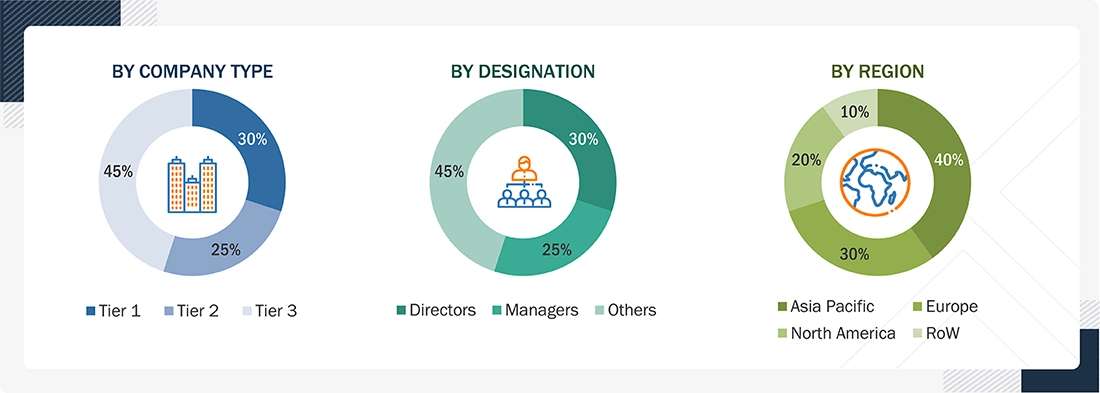
Note: The three tiers of the companies are defined based on their total revenues in 2023 or 2024, based on the
availability of financial data: Tier 1: Revenue > USD 1 billion; Tier 2: USD 100 million = revenue = USD 1 billion; Tier 3: Revenue
< USD 100 million. RoW includes Africa and the Middle East.
To know about the assumptions considered for the study, download the pdf brochure
|
COMPANY NAME |
DESIGNATION |
|
Cargill, Incorporated (US) |
Product Development Manager |
|
Unique Organics Ltd. (India) |
Sales Manager |
|
Purina Animal Nutrition LLC (US) |
Marketing Head |
|
Aller Aqua A/S (Denmark) |
Sales Head |
|
Country Heritage Feeds (Australia) |
Senior Sales Manager |
|
GPF Feed Supplements (India) |
Business Development Manager |
Market Size Estimation
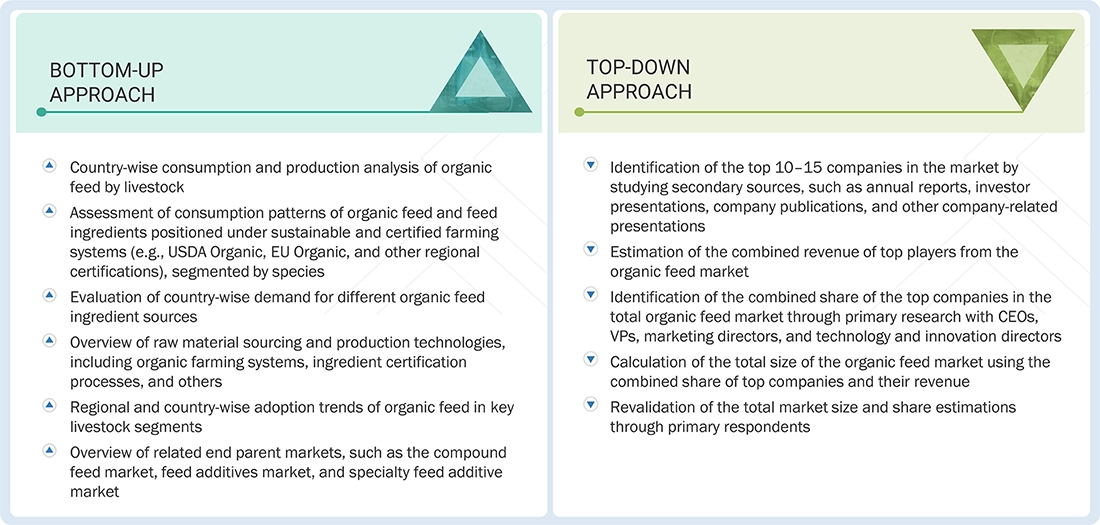
The top-down and bottom-up approaches were used to estimate and validate the total size of the organic feed market. These approaches were also used extensively to determine the size of various subsegments in the market. The research methodology used to estimate the market size includes the following details:
- The key players in the industry and the overall markets were identified through extensive secondary research.
- All shares, splits, and breakdowns were determined using secondary sources and verified through primary sources.
- All possible parameters that affect the market covered in this research study were accounted for, viewed in extensive detail, verified through primary research, and analyzed to obtain final quantitative and qualitative data.
- The research included the study of reports, reviews, and newsletters of top market players, along with extensive interviews for opinions from leaders, such as CEOs, directors, and marketing executives.
Organic Feed Market : Top-Down and Bottom-Up Approach
Data Triangulation
After determining the overall market size from the estimation process explained above, the total market was split into several segments and subsegments. The data triangulation procedure was employed, wherever applicable, to estimate the overall organic feed market and obtain precise statistics for all segments and subsegments. The data was triangulated by studying various factors and trends from the demand and supply sides. The market size was also validated using the top-down and bottom-up approaches.
Market Definition
According to USDA, “Organic is a labeling term that indicates that the food or other agricultural product has been produced through approved methods. The organic standards describe the specific requirements that must be verified by a USDA-accredited certifying agent before products can be labeled USDA organic.”
Organic feed is the product of a farming system that prevents the use of man-made fertilizers, pesticides, growth regulators, chemicals, and feed additives. Irradiation and the use of genetically modified organisms (GMOs) or products produced from GMOs are generally prohibited based on the legislation introduced for organic crop cultivation.
Stakeholders
- Organic feed manufacturers
- Organic raw material providers
- Dairy farms, poultry farms, and other livestock farms
- Feed integrators, feed ingredients manufacturers, compound feed manufacturers
- Livestock growers
- Intermediate stakeholders, including distributors, retailers, associations, regulatory bodies, and others
- Regulatory bodies
- Government organizations, institutes, and research organizations
-
Associations and industry bodies:
- Food and Agriculture Organization (FAO)
- US Department of Agriculture (USDA)
- International Organization for Standardization (ISO)
- International Federation of Organic Agriculture Movements (IFOAM)
- USDA – National Organic Program (NOP)
- Canadian Organic Standards (COS)
- Organic Farmers Association
- EU Association of Specialty Feed Ingredients and their Mixtures (FEFANA)
- International Feed Industry Federation (IFIF)
- Organisation for Economic Co-operation and Development (OECD)
- The compound Livestock Feed Manufacturers Association (CLFMA)
- The National Grain and Feed Association (NGFA)
Report Objectives
- To determine and project the size of the organic feed market based on ingredient source, form, nutrient source, livestock, farm size, manufacturing technology (qualitative), and region, over five years, ranging from 2025 to 2030
- To identify the attractive opportunities in the market by determining the largest and fastest-growing segments across regions
- To provide detailed information about the key factors influencing market growth (drivers, restraints, opportunities, and challenges)
- To analyze the opportunities in the market for stakeholders and provide details of the competitive landscape for market leaders
- To analyze the micromarkets with respect to individual growth trends, prospects, and their contribution to the total market
- To identify and profile the key players in the market
- To understand the competitive landscape and identify the major growth strategies adopted by players across the key regions
Available Customizations
With the given market data, MarketsandMarkets offers customizations according to company-specific scientific needs. The following customization options are available for the report:
Product Analysis
- Product matrix, which gives a detailed comparison of the product portfolio of each company.
Geographic Analysis as per Feasibility
With the given market data, MarketsandMarkets offers customizations according to company-specific scientific needs.
- Further breakdown of the Rest of Europe organic feed market into key countries
- Further breakdown of the Rest of Asia Pacific organic feed market into key countries
- Further breakdown of the Rest of South America organic feed market into key countries
Company Information
- Detailed analyses and profiling of additional market players (up to five)
Get the Full Organic Feed Market Report
Full forecast, segment splits, and company analysis for all Organic Feed Market.
- Canada Organic Feed Market
- Mexico Organic Feed Market
- Germany Organic Feed Market
- UK Organic Feed Market
- France Organic Feed Market
- Spain Organic Feed Market
- Italy Organic Feed Market
- Netherlands Organic Feed Market
- China Organic Feed Market
- India Organic Feed Market
- Japan Organic Feed Market
- Brazil Organic Feed Market
- Argentina Organic Feed Market
- Rest Of Europe Organic Feed Market
Need a Tailored Report?
Customize this report to your needs
Get 10% FREE Customization
Customize This Report
