
Europe Orthopedic Implants Market (2024-2029)

The Europe Orthopedic Implants Market was valued at $5236.3 Million in 2024 and projected to reach to $6046.9 Million by 2029, representing a compound annual growth rate of 2.9%. Europe's orthopedic implants market is positioned for moderate but consistent growth, driven by an aging demographic profile and well-developed healthcare infrastructure.


| Market Size in | USD 26.32 MN |
| Market Forecast in | |
| CAGR | |
| Forecast Period | |
| Units Considered | Value (USD MN) |
Europe Orthopedic Implants Market Trends and Insights
- This moderate growth trajectory reflects Europe's mature healthcare infrastructure, aging population demographics, and established reimbursement frameworks that support steady demand for joint replacement and trauma fixation devices.
- Europe maintains a significant share of the global orthopedic implants market, driven by advanced surgical techniques, high healthcare spending, and strong regulatory standards across member states. The European market benefits from a well-developed medical device ecosystem, with leading manufacturers headquartered across the region and robust distribution networks.
- Europe's growth is tempered compared to emerging markets due to market saturation in developed economies and stringent regulatory requirements under the Medical Device Regulation (MDR).
- However, aging populations in countries like Germany, Italy, and France continue to drive demand for hip and knee replacements, while innovations in minimally invasive surgical techniques support market expansion through 2029..
Key Market Statistics
- CAGR (2024-2029) 2.9% CAGR
- Market Size, 2024 ~USD 5236.3 Million
- Forecast, 2029 ~USD 6046.9 Million
- Geography Europe
Europe Orthopedic Implants Market Overview
Mature Market with Steady Growth :
Europe's orthopedic implants market valued at $5,236.3 million in 2024 demonstrates stable expansion at 2.9% CAGR through 2029, reflecting a well-established healthcare ecosystem with consistent demand for surgical interventions.
Aging Population Driving Demand :
Europe's demographic shift toward an older population significantly increases prevalence of joint degenerative diseases and trauma cases, sustaining demand for hip, knee, and spine implants across the region.
Strong Reimbursement Frameworks :
Established healthcare reimbursement systems across European nations provide predictable market conditions and support sustained investment in orthopedic procedures and implant adoption.
Germany Leads Regional Market :
Germany commands the largest European market share at $1,904.5 million, followed by the UK ($1,221.5 million) and France ($987.1 million), reflecting advanced healthcare infrastructure and high surgical volumes.
Europe Orthopedic Implants Market Dynamics
- The 2.9% CAGR reflects a mature market with established surgical practices and strong reimbursement mechanisms that support steady demand for joint replacement and trauma fixation procedures.
- Key European markets including Germany, UK, and France continue to invest in advanced implant technologies and surgical techniques. Looking ahead to 2029, the market is expected to reach $6,046.9 million as healthcare systems increasingly adopt minimally invasive techniques and premium implant solutions.
- However, growth remains tempered compared to global rates (4.8% CAGR) due to market saturation and regulatory constraints.
- Opportunities exist in emerging European markets and through innovation in biologics and personalized implant solutions..
Market Ecosystem
Related Ecosystem
Medical Devices
- Polymerase Chain Reaction (PCR)
- Magnetic Resonance Imaging (MRI)
- Disposable Autoinjectors
- Pulse Oximeters
- Blood Pressure Monitors
- Medtronic plc
- Abbott Laboratories
- Stryker Corporation
- Becton, Dickinson and Company
- CONMED Corporation
Key Takeaways
- Europe's orthopedic implants market is valued at $5,236.3 million in 2024 and will reach $6,046.9 million by 2029, growing at 2.9% CAGR.
- Europe's mature healthcare system and aging demographics drive steady demand for joint replacement and trauma fixation implants.
- Market growth in Europe is constrained by saturation in developed economies and stringent Medical Device Regulation (MDR) compliance requirements.
- Leading European manufacturers and advanced surgical innovation support competitive positioning and sustained market expansion through 2029.
Orthopedic Implants Market Report Scope
| Report Metric | Details |
|---|---|
| Base Year | 2024 |
| Fastest Growing Segment | AMBULATORY & TRAUMA CARE CENTERS (End User) |
| Forecast Period | 2024-2029 |
| Growth Rate | CAGR of 4.8% from 2024 to 2029 |
| Largest Segment | HOSPITALS & SURGICAL CENTERS (End User) |
| Market Size Base Year (Billions) | ~USD 20.94 (2024) |
| Revenue Forecast (Billions) | ~USD 26.47 (2029) |
| Segments Covered | Type, Material, End User |
Europe Orthopedic Implants Market Report Segmentation
3 segment dimensions are covered across the global market.
By Type
- Elbow Implants
- Foot & Ankle Implants
- Hip Implants
- Knee Implants
- Other Implants
- Other Metals & Metal Alloys
- Shoulder Implants
- Stainless Steel
- Titanium Alloys
- Wrist Implants
By Material
- Ceramics
- Hybrid Implants
- Metals & Metal Alloys
- Polymers
By End User
- Ambulatory & Trauma Care Centers
- Hospitals & Surgical Centers
EUROPE: ORTHOPEDIC IMPLANTS MARKET, BY END USER, 2022–2029
| Segment | 2022 | 2023 | 2024 | 2025 | 2026 | 2027 | 2028 | 2029 | CAGR (%) |
|---|---|---|---|---|---|---|---|---|---|
| AMBULATORY & TRAUMA CARE CENTERS | 1700.2 | 1767.6 | 1833.5 | 1900.8 | 1988.2 | 2078.3 | 2171.1 | 2266.5 | 4.3 |
| HOSPITALS & SURGICAL CENTERS | 3295.8 | 3352.3 | 3402.8 | 3452.3 | 3534.4 | 3616.6 | 3698.6 | 3780.5 | 2.1 |
| TOTAL | 4996.1 | 5119.9 | 5236.3 | 5353.1 | 5522.6 | 5694.9 | 5869.7 | 6046.9 | 2.9 |
Target Audience
- Medical Device Manufacturers : Orthopedic implant companies need detailed European market segmentation and country-specific sizing to optimize product portfolios, pricing strategies, and regional distribution networks.
- Healthcare Investors & PE Firms : Investment professionals require comprehensive market data on Europe's mature orthopedic sector to evaluate acquisition targets, growth potential, and return scenarios across key markets.
- Hospital & Surgical Center Operators : Healthcare facility managers need market insights to forecast implant demand, negotiate supplier contracts, and plan capital expenditures for orthopedic service lines.
- Market Entry & Expansion Teams : Companies planning European market entry require country-level analysis, competitive positioning data, and regulatory insights to develop go-to-market strategies and feasibility assessments.
- Healthcare Consultants & Analysts : Consulting firms and research professionals need authoritative European market data to support client strategy, due diligence, and market assessment projects across the region.
Countries within Europe - compare and drill down
| Country | 2025 size (native) |
|---|---|
| Germany | USD 1904.5 Million |
| France | USD 987.1 Million |
| UK | USD 1221.5 Million |
| Italy | USD 582.5 Million |
| Spain | USD 392.7 Million |
| Rest Of Europe | USD 958.7 Million |
Country market size visualization
Reasons to Buy this Report
- Country-Level Market Breakdown : Access detailed market sizing for Germany ($1.9B), UK ($1.2B), France ($987M), Italy, Spain, and Rest of Europe, enabling precise regional investment and expansion strategies.
- Competitive Landscape Intelligence : Understand market dynamics across Europe's most mature orthopedic markets with established players and reimbursement structures to identify competitive positioning opportunities.
- Demographic & Healthcare Insights : Leverage analysis of Europe's aging population trends and healthcare infrastructure maturity to forecast long-term demand for joint replacement, trauma, and spine implants.
- Regulatory & Reimbursement Framework : Gain clarity on European CE marking requirements, national reimbursement policies, and healthcare system variations that impact market entry and pricing strategies.
- Growth Forecasting Through 2029 : Utilize 5-year projections showing market expansion from $5.2B to $6.0B to plan product launches, capacity investments, and market penetration initiatives across European territories.
Frequently asked questions
What is the current size of Europe's orthopedic implants market?
Europe's orthopedic implants market was valued at $5,236.3 million in 2024 and is expected to grow to $6,046.9 million by 2029.
What is the growth rate for orthopedic implants in Europe?
Europe's orthopedic implants market is projected to grow at a compound annual growth rate (CAGR) of 2.9% from 2024 to 2029.
What factors drive demand for orthopedic implants in Europe?
Europe's aging population, advanced healthcare infrastructure, high healthcare spending, and strong demand for joint replacement procedures drive market growth.
How does Europe's market growth compare to global trends?
Europe's 2.9% CAGR is lower than the global 4.8% CAGR, reflecting market maturity and saturation in developed European economies.
What regulatory challenges affect Europe's orthopedic implants market?
Europe's Medical Device Regulation (MDR) imposes stringent compliance requirements that increase development costs and timelines for orthopedic implant manufacturers.
RESEARCH METHODOLOGY
The study involved four major activities in estimating the current size of the orthopedic implants market. Exhaustive secondary research was done to collect information on the market, peer, and parent markets. The next step was to validate these findings, assumptions, and sizing with industry experts across the value chain through primary research. Both top-down and bottom-up approaches were employed to estimate the complete market size. After that, market breakdown and data triangulation were used to estimate the market size of segments and subsegments.
Secondary Research
The secondary research process involves the widespread use of secondary sources, directories, databases (such as Bloomberg Businessweek, Factiva, and D&B Hoovers), white papers, annual reports, company house documents, investor presentations, and SEC filings of companies. Secondary research was used to identify and collect information useful for the extensive, technical, market-oriented, and commercial orthopedic implants market study. It was also used to obtain important information about the key players and market classification & segmentation according to industry trends to the bottom-most level, and key developments related to market and technology perspectives. A database of the key industry leaders was also prepared using secondary research.
Primary Research
In the primary research process, various supply and demand sources were interviewed to obtain qualitative and quantitative information for this report. The primary sources from the supply side include industry experts such as Chief Executive Officers (CEOs), vice presidents (VPs), marketing and sales directors, technology & innovation directors, and related key executives from various key companies and organizations in the orthopedic implants market. The primary sources from the demand side include hospitals & surgical centers and ambulatory & trauma care centers. Primary research was conducted to validate the market segmentation, identify key players, and gather insights on key industry trends & key market dynamics.
A breakdown of the primary respondents is provided below:
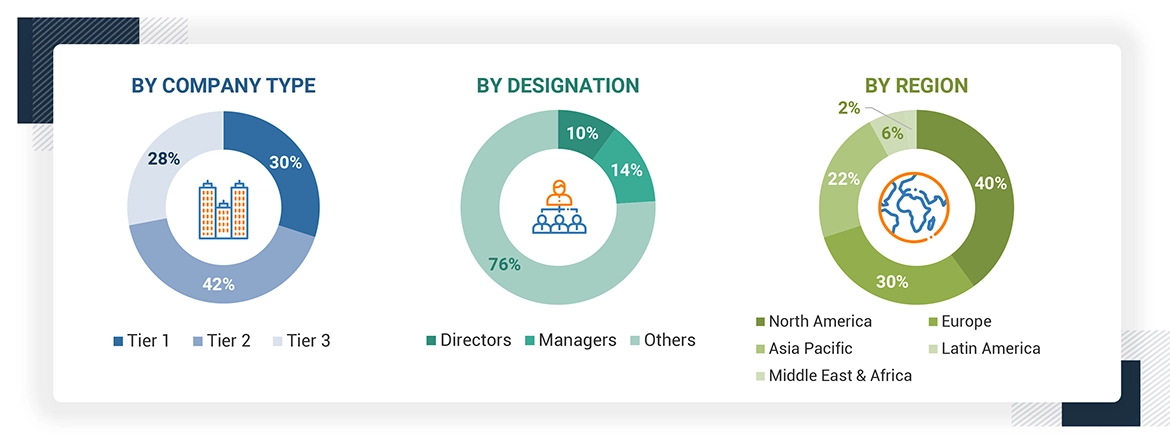
*Others include sales managers, marketing managers, business development managers, product managers, distributors, and suppliers.
The tiers of the companies are defined based on their total revenue. As of 2023: Tier 1 => USD 1 billion, Tier 2 = USD 200-500 million to USD 1 billion, and Tier 3 =< USD 200 million
To know about the assumptions considered for the study, download the pdf brochure
Market Size Estimation
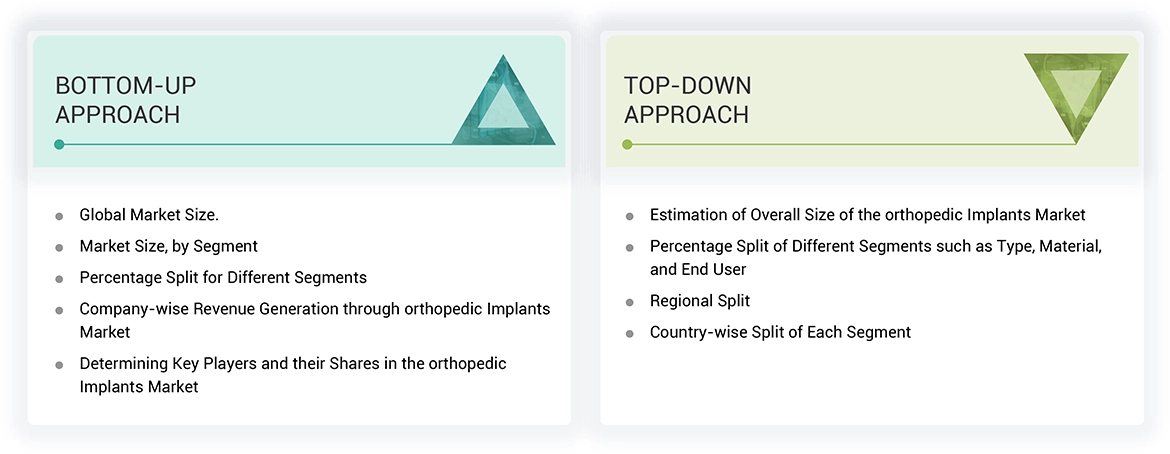
Both top-down and bottom-up approaches were used to estimate and validate the total size of the orthopedic implants market.These methods were also used extensively to estimate the size of various subsegments in the market . The research methodology used to estimate the market size includes the following:
Data Triangulation
After arriving at the overall market size from the market size estimation process explained above, the orthopedic implants market was split into segments and subsegments. Data triangulation and market breakdown procedures were employed to complete the overall market engineering process and arrive at the exact statistics for all segments and subsegments. The data was triangulated by studying various factors and trends from both the demand and supply sides. Additionally, the orthopedic implants market was validated using top-down and bottom-up approaches.
Market Definition
An orthopedic implant is a medical device used to correct bone, joint, and other tissue disorders, injuries, or diseases. The implants are utilized for multiple applications, including fractures and related surgeries, where a support or replacement part is installed in the bone. These implants are manufactured using biocompatible materials such as metals and metal alloys, polymers, ceramics, and hybrid materials. The primary end users of this market are hospitals, surgical centers, ambulatory surgical centers, and trauma care centers.
Stakeholders
- Orthopedic implant Manufacturers
- Trauma care centers
- Ambulatory surgical centers
- Hospitals
- Orthopedic implants distributors and suppliers
- Orthopedic surgeons
Report Objectives
- To define, describe, and forecast the orthopedic implants market based on type, material, end user, and region
- To provide detailed information regarding the major factors influencing the growth of the market (drivers, restraints, opportunities, and challenges)
- To strategically analyze micro markets with respect to individual growth trends, prospects, and contributions to the total market
- To analyze opportunities in the market for stakeholders and provide details of the competitive landscape for market leaders
- To forecast the revenue of the market segments with respect to five regions, namely, North America, Europe, the Asia Pacific, Latin America, Middle East and Africa
- To profile the key players and comprehensively analyze their market ranking and core competencies
- To benchmark players within the market using a proprietary competitive leadership mapping framework, which analyzes market players on various parameters within the broad categories of market share and product footprint
Get the Full Orthopedic Implants Market Report
Full forecast, segment splits, and company analysis for all Orthopedic Implants Market.
- Canada Orthopedic Implants Market
- US Orthopedic Implants Market
- Germany Orthopedic Implants Market
- France Orthopedic Implants Market
- UK Orthopedic Implants Market
- Italy Orthopedic Implants Market
- Spain Orthopedic Implants Market
- Japan Orthopedic Implants Market
- China Orthopedic Implants Market
- India Orthopedic Implants Market
- Australia Orthopedic Implants Market
- South Korea Orthopedic Implants Market
- Brazil Orthopedic Implants Market
- Mexico Orthopedic Implants Market
- Rest Of Europe Orthopedic Implants Market
- Rest Of Asia Pacific Orthopedic Implants Market
- Rest Of Latin America Orthopedic Implants Market
Need a Tailored Report?
Customize this report to your needs
Get 10% FREE Customization
Customize This Report
