
Asia Pacific Palletizer Market (2024-2029)

The Asia Pacific Palletizer Market was valued at $962.3 Million in 2024 and projected to reach to $1311.3 Million by 2029, representing a compound annual growth rate of 6.4%. The Asia Pacific palletizer market is positioned for sustained expansion through 2029, with the region's dominance in global semiconductor and electronics production serving as a primary growth catalyst.


| Market Size in | USD 26.32 MN |
| Market Forecast in | |
| CAGR | |
| Forecast Period | |
| Units Considered | Value (USD MN) |
Asia Pacific Palletizer Market Trends and Insights
- Asia Pacific's semiconductor and electronics manufacturing base is driving demand for automated palletization solutions, as producers seek to enhance operational efficiency and reduce labor costs.
- The region's rapid industrialization, coupled with increasing adoption of Industry 4.0 technologies, positions Asia Pacific as a critical growth engine for the global palletizer market. Key markets within Asia Pacific, including China, Japan, South Korea, and Southeast Asia, are investing heavily in automation infrastructure to support electronics production and supply chain optimization.
- Asia Pacific's palletizer market benefits from rising e-commerce activity, expanding manufacturing capacity, and government initiatives promoting smart manufacturing.
- Between 2024 and 2029, Asia Pacific is expected to outpace global growth trends, driven by competitive labor markets and the region's dominance in semiconductor fabrication and consumer electronics assembly..
Key Market Statistics
- CAGR (2024-2029) 6.4% CAGR
- Market Size, 2024 ~USD 962.3 Million
- Forecast, 2029 ~USD 1311.3 Million
- Geography Asia Pacific
Asia Pacific Palletizer Market Overview
Fastest Growing Regional Market :
Asia Pacific's palletizer market is expanding at 6.4% CAGR, outpacing the global growth rate of 5.2%, driven by accelerating semiconductor and electronics manufacturing across the region.
China's Manufacturing Dominance :
China leads Asia Pacific with $535.0 million in market value, leveraging its position as the world's largest electronics manufacturer and increasing automation investments in production facilities.
Labor Cost Reduction Driver :
Rising labor costs across Asia Pacific economies are compelling semiconductor and electronics producers to adopt automated palletization solutions to maintain competitive margins and operational efficiency.
Emerging Market Opportunities :
India and Rest of Asia Pacific regions represent high-growth opportunities with combined market value of $466.8 million, as electronics manufacturing expands beyond traditional hubs.
Asia Pacific Palletizer Market Dynamics
- Manufacturers across China, Japan, India, and Southeast Asia are increasingly investing in automation technologies to address labor shortages, reduce operational costs, and improve production throughput.
- The forecast growth from $962.3 million to $1,311.3 million reflects strong demand for advanced palletization systems that integrate with Industry 4.0 initiatives. Key drivers include rising wages in developed Asia Pacific economies, stringent quality control requirements in electronics manufacturing, and government incentives promoting industrial automation.
- The region's competitive advantage in electronics production, combined with technological advancements in robotic palletization, positions Asia Pacific as the fastest-growing market globally.
- Investment in smart factories and supply chain optimization will continue to fuel demand for integrated palletization solutions through the forecast period..
Market Ecosystem
Related Ecosystem
Industrial Automation
- Sensors
- Image Sensors
- Manufacturing Execution System (MES)
- Actuators
- Flow Sensors
- Siemens ag
- ABB India Limited
- Emerson Electric Co.
- HONEYWELL INTERNATIONAL INC.
- SCHNEIDER ELECTRIC SE
Consumer Fandb
- Bakery Products
- Animal-Based Sealants
- Dairy Products
- Actuators
- Azo Pigments
- AZELIS HOLDINGS SA
- VENTURA FOODS, LLC
- Amway
- UNILEVER PLC
- Nestle s.a
Key Takeaways
- Asia Pacific palletizer market valued at $962.3M in 2024, growing to $1,311.3M by 2029 at 6.4% CAGR, outpacing global growth.
- Asia Pacific's semiconductor and electronics manufacturing dominance drives strong demand for automated palletization solutions.
- Industry 4.0 adoption and smart manufacturing initiatives across Asia Pacific accelerate palletizer technology integration.
- China, Japan, South Korea, and Southeast Asia lead Asia Pacific growth through expanded automation infrastructure investments.
Palletizer Market Report Scope
| Report Metric | Details |
|---|---|
| Base Year | 2024 |
| Fastest Growing Segment | PHARMACEUTICALS (Industry) |
| Forecast Period | 2024-2029 |
| Growth Rate | CAGR of 5.2% from 2024 to 2029 |
| Largest Segment | CONVENTIONAL PALLETIZERS (Technology) |
| Market Size Base Year (Billions) | ~USD 3.18 (2024) |
| Revenue Forecast (Billions) | ~USD 4.1 (2029) |
| Segments Covered | Technology, Type, Product Type, Industry, Offering, Payload Capacity |
Asia Pacific Palletizer Market Report Segmentation
6 segment dimensions are covered across the global market.
By Technology
- Conventional Palletizers
- Robotic Palletizers
By Type
- Cobot Palletizers
- High-Level Palletizers
- Low-Level Palletizers
- Traditional Robot Palletizers
By Product Type
- Bags
- Boxes And Cases
- Other Product Types
- Pails And Drums
By Industry
- Chemicals
- Cosmetics & Personal Care
- E-Commerce
- E-Commerce And Retail
- Food & Beverage
- Food & Beverages
- Healthcare
- Logistics
- Manufacturing
- Pharmaceuticals
- Retail
- Textiles
By Offering
- Hardware
- Software & Services
By Payload Capacity
- 100-500 Kg
- <100 Kg
- >500 Kg
Target Audience
- Palletizer Equipment Manufacturers : Manufacturers need Asia Pacific market intelligence to identify high-growth countries, assess competitive positioning, and develop region-specific product strategies for semiconductor and electronics applications.
- Semiconductor & Electronics Producers : Production facilities across Asia Pacific require market insights to benchmark automation investments, evaluate palletization technology options, and optimize capital allocation for operational efficiency.
- Logistics & Supply Chain Operators : Third-party logistics providers and supply chain companies need regional market data to understand automation trends, anticipate customer demands, and plan infrastructure investments across Asia Pacific.
- Private Equity & Investment Firms : Investors targeting Asia Pacific's automation and manufacturing sectors require detailed market sizing, growth forecasts, and competitive analysis to evaluate acquisition targets and portfolio opportunities.
- Systems Integrators & Automation Consultants : Integration firms need Asia Pacific market intelligence to identify client opportunities, understand regional technology preferences, and develop tailored automation solutions for local manufacturers.
Countries within Asia Pacific - compare and drill down
| Country | 2025 size (native) |
|---|---|
| China | USD 535 Million |
| Japan | USD 309.5 Million |
| India | USD 212.4 Million |
| Rest Of Asia Pacific | USD 254.4 Million |
Country market size visualization
Reasons to Buy this Report
- Regional Market Sizing & Forecasts : Access precise market valuations for Asia Pacific and individual country breakdowns (China: $535.0M, Japan: $309.5M, India: $212.4M) with 5-year projections to support investment decisions.
- Competitive Landscape Analysis : Understand market dynamics specific to Asia Pacific, including key players, market share distribution, and competitive strategies tailored to regional manufacturing ecosystems.
- Growth Driver Identification : Identify region-specific growth catalysts including labor cost pressures, electronics export growth, government automation incentives, and Industry 4.0 adoption rates across Asia Pacific.
- Country-Level Opportunity Assessment : Evaluate market potential across 11 Asia Pacific countries to prioritize market entry, expansion, or partnership strategies based on localized demand and growth trajectories.
- Strategic Planning & Risk Mitigation : Leverage Asia Pacific-focused insights to develop market-entry strategies, assess regulatory environments, and identify emerging risks and opportunities in the region's semiconductor and electronics sectors.
Frequently asked questions
What is the current size of the Asia Pacific palletizer market?
The Asia Pacific palletizer market was valued at $962.3 million in 2024 and is projected to reach $1,311.3 million by 2029.
What is the growth rate for palletizers in Asia Pacific?
Asia Pacific's palletizer market is growing at a compound annual growth rate (CAGR) of 6.4% from 2024 to 2029.
Which countries drive the Asia Pacific palletizer market?
China, Japan, South Korea, and Southeast Asian nations are the primary drivers of Asia Pacific's palletizer market growth due to their semiconductor and electronics manufacturing capabilities.
Why is Asia Pacific's palletizer market growing faster than the global average?
Asia Pacific's 6.4% CAGR exceeds the global 5.2% rate due to rapid industrialization, Industry 4.0 adoption, labor cost pressures, and the region's dominance in electronics manufacturing.
What industries in Asia Pacific are driving palletizer demand?
The semiconductor, consumer electronics, and e-commerce logistics sectors in Asia Pacific are primary drivers of palletizer adoption and investment.
RESEARCH METHODOLOGY
The study involves four major activities that estimate the size of the palletizer market. Exhaustive secondary research was conducted to collect information related to the market. Following this was validating these findings, assumptions, and sizing with the industry experts across the value chain through primary research. Both top-down and bottom-up approaches were employed to estimate the overall size of the palletizer market. Subsequently, market breakdown and data triangulation procedures were used to determine the extent of different segments and subsegments of the market.
Secondary Research
Secondary sources in this research study include corporate filings (such as annual reports, investor presentations, and financial statements); trade, business, and professional associations; white papers, certified publications, articles from recognized authors; directories; and databases. The secondary data were collected and analyzed to estimate the overall market size, further validated by primary research. The relevant data is collected from various secondary sources, it is analyzed to extract insights and information relevant to the market research objectives. This analysis has involved summarizing the data, identifying trends, and drawing conclusions based on the available information.
Primary Research
In the primary research process, numerous sources from both the supply and demand sides were interviewed to obtain qualitative and quantitative information about this report. The primary sources from the supply side included various industry experts such as Chief X Officers (CXOs), Vice Presidents (VPs), and Directors from business development, marketing, product development/innovation teams, and related key executives from palletizer providers, (such as KION GROUP AG, KHS Group, BEUMER Group, Krones AG) research organizations, distributors, professional and managed service providers, industry associations, and key opinion leaders. Approximately 25% of the primary interviews were conducted with the demand side and 75% with the supply side. These data were collected mainly through questionnaires, emails, and telephonic interviews, accounting for 80% of the primary interviews.
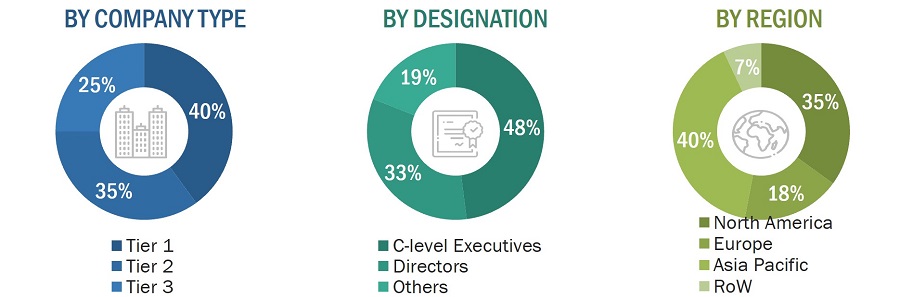
To know about the assumptions considered for the study, download the pdf brochure
Market Size Estimation
In the market engineering process, both top-down and bottom-up approaches were implemented, along with several data triangulation methods, to estimate and validate the size of the palletizer market and other dependent submarkets listed in this report.
- The key players in the industry and markets were identified through extensive secondary research.
- Both the supply chain of the industry and the market size, in terms of value, were determined through primary and secondary research.
- All percentage shares, splits, and breakdowns were determined using secondary sources and verified through primary sources.
Market Size Estimation Methodology-Bottom-Up Approach
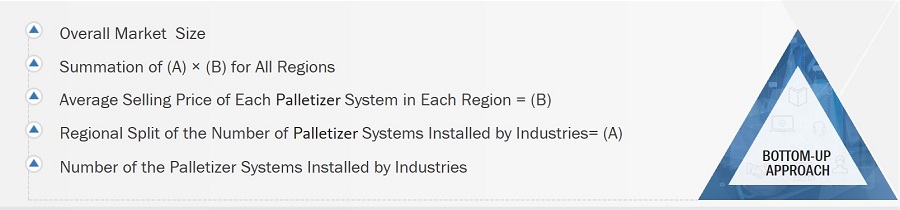
Market Size Estimation Methodology-Top-Down Approach
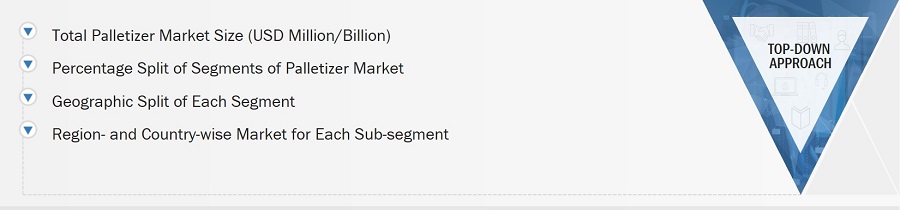
Data Triangulation
After estimating the overall market size, the total market was split into several segments. The market breakdown and data triangulation procedures were employed wherever applicable to complete the overall market engineering process and gauge exact statistics for all segments. The data were triangulated by studying various factors and trends from both the demand and supply sides. The market was also validated using both top-down and bottom-up approaches.
Market Definition
A palletizer is an automated material handling machine designed to automatically sort, transfer, and stack cases of products onto a pallet in a consistent and organized manner. The palletizer can stack several products, such as cartons, trays, cases, and bags, onto pallets. They are mainly used by companies engaged in large-volume manufacturing. Companies in the palletizer market offer different types of technologies, such as conventional and robotic palletizers. They are commonly used in manufacturing, warehousing, and distribution facilities to streamline palletization, replacing manual labor with a more efficient and precise automated system.
Stakeholders
- Associations, forums, and alliances related to the palletizer ecosystem
- Assembly and packaging vendors
- Electronic design automation (EDA) and design tool vendors
- Palletizers manufacturers and distributors
- Industries such as automotive, chemical, e-commerce, retail, food & beverages, healthcare, pharmaceuticals, cosmetics & personal care, and textiles
- Component manufacturers
- Raw material and manufacturing equipment suppliers
- Original equipment manufacturers (OEMs)
- Integrated device manufacturers (IDMs)
- Original design manufacturers (ODMs)
- Robotic arm provider
- System integrators
- Government and other regulatory bodies
- Technology investors
- Research institutes and organizations
- Market research and consulting firms
The main objectives of this study are as follows:
- To describe and forecast the palletizer market based on technology, product type, industry, and region, in terms of value
- To describe and forecast the palletizer market, in terms of volume
- To describe and forecast the market for four key regions: North America, Europe, Asia Pacific, and Rest of the World (RoW), along with their respective countries, in terms of value
- To analyze the impact of the recession on the growth of the market and its segments
- To forecast the overall palletizer market till 2029
- To strategically analyze the micromarkets1 with respect to individual growth trends, prospects, and contribution to the overall palletizer market
- To strategically profile key players and comprehensively analyze their market position in terms of ranking and core competencies2
- To provide detailed information regarding the drivers, restraints, opportunities, and challenges influencing the growth of the palletizer market
- To analyze the opportunities in the palletizer market and provide details of the competitive landscape for market leaders
- To analyze competitive developments such as acquisitions, collaborations, partnerships, expansions, and product launches, along with research and development (R&D), in the palletizer market
Available Customizations:
With the given market data, MarketsandMarkets offers customizations according to the specific requirements of companies. The following customization options are available for the report:
Country-wise Information:
- Analysis for additional countries (up to five)
Company Information:
- Detailed analysis and profiling of different market players (up to five)
Get the Full Palletizer Market Report
Full forecast, segment splits, and company analysis for all Palletizer Market.
Need a Tailored Report?
Customize this report to your needs
Get 10% FREE Customization
Customize This Report
