
Brazil Particle Counters Market (2024-2029)

The Brazil Particle Counters Market was valued at $9.8 Million in 2024 and projected to reach to $14.3 Million by 2029, representing a compound annual growth rate of 7.9%. Brazil's particle counters market is positioned for steady expansion driven by pharmaceutical manufacturing growth and regulatory compliance mandates.


| Market Size in | USD 26.32 MN |
| Market Forecast in | |
| CAGR | |
| Forecast Period | |
| Units Considered | Value (USD MN) |
Brazil Particle Counters Market Trends and Insights
- This expansion reflects Brazil's increasing investment in pharmaceutical manufacturing quality control and cleanroom monitoring standards.
- Brazil's healthcare infrastructure modernization and regulatory compliance requirements are driving adoption of advanced particle counting technologies across pharmaceutical, biotechnology, and medical device manufacturing facilities. The 7.9% compound annual growth rate in Brazil demonstrates strong market momentum as local manufacturers and international players establish operations to serve the region's growing demand.
- Brazil's position as Latin America's largest pharmaceutical market creates substantial opportunities for particle counter deployment in sterile manufacturing environments.
- Between 2024 and 2029, Brazil is expected to see increased penetration of automated and real-time particle monitoring systems as healthcare facilities prioritize contamination control and regulatory adherence..
Key Market Statistics
- CAGR (2024-2029) 7.9% CAGR
- Market Size, 2024 ~USD 9.8 Million
- Forecast, 2029 ~USD 14.3 Million
- Country Brazil
Brazil Particle Counters Market Overview
Market Valuation :
Brazil's particle counters market is valued at USD 9.8 million in 2024, with a projected CAGR of 7.9% through 2029, reaching USD 14.3 million by forecast end.
Pharmaceutical Quality Control :
Increasing investment in Brazilian pharmaceutical manufacturing facilities is driving demand for advanced particle counting solutions to meet stringent quality control and cleanroom monitoring standards.
Regulatory Compliance Growth :
Brazil's healthcare infrastructure modernization and enhanced regulatory compliance requirements are compelling manufacturers to adopt particle counter technologies for contamination monitoring.
Healthcare Sector Expansion :
The Brazilian healthcare sector's modernization initiatives are creating sustained demand for particle counters across pharmaceutical, biotechnology, and medical device manufacturing facilities.
Brazil Particle Counters Market Dynamics
- The country's healthcare infrastructure modernization efforts are accelerating adoption of contamination monitoring technologies across cleanroom environments.
- With a 7.9% CAGR, the market reflects Brazil's commitment to quality assurance standards and international pharmaceutical manufacturing benchmarks. The forecast period through 2029 will see increased penetration in mid-sized pharmaceutical manufacturers and contract manufacturing organizations (CMOs) across Brazil.
- Rising awareness of cleanroom contamination risks and stricter ANVISA (Brazilian Health Authority) regulations will further propel market growth, positioning Brazil as a key growth market within Latin America's particle counter sector..
Market Ecosystem
Related Ecosystem
Analytical And Scientific Instrumentation
- Environmental Testing
- Gas Chromatography
- Polymerase Chain Reaction (PCR)
- Automated Liquid Handling Systems
- Flow Cytometry
- Thermo Fisher Scientific Inc.
- Danaher Corporation
- Agilent Technologies, Inc.
- Shimadzu Corporation
- Merck KGaA
Key Takeaways
- Brazil's particle counters market is valued at USD 9.8 million in 2024 and will grow to USD 14.3 million by 2029, representing a 7.9% CAGR.
- Brazil's pharmaceutical manufacturing sector is the primary driver, with increasing regulatory requirements for cleanroom monitoring and contamination control.
- Brazil's healthcare infrastructure modernization is accelerating adoption of automated particle counting systems across sterile manufacturing facilities.
- Brazil's strategic position as Latin America's largest pharmaceutical market creates significant expansion opportunities for particle counter vendors through 2029.
Particle Counters Market Report Scope
| Report Metric | Details |
|---|---|
| Base Year | 2024 |
| Fastest Growing Segment | PHARMACEUTICAL AND MEDICAL DEVICE INDUSTRY (End User) |
| Forecast Period | 2024-2029 |
| Growth Rate | CAGR of 9.5% from 2024 to 2029 |
| Largest Segment | AIR PARTICLE COUNTERS (Type) |
| Market Size Base Year (Billions) | ~USD 0.63 (2024) |
| Revenue Forecast (Billions) | ~USD 0.99 (2029) |
| Segments Covered | Type, Application, End User |
Brazil Particle Counters Market Report Segmentation
3 segment dimensions are covered across the global market.
By Type
- Air Particle Counters
- Benchtop Particle Counters
- Liquid Particle Counters
- Offline Particle Counters
- Online Particle Counters
- Other Liquid Particle Counter
- Other Liquid Particle Counters
- Other Particle Counters
- Portable Particle Counters
- Remote Particle Counters
By Application
- Aerosol Monitoring & Research
- Aerosol Monitoring And Research
- Chemical Contamination Monitoring
- Cleanroom Monitoring
- Contamination Monitoring Of Liquids
- Drinking Water Contamination Monitoring
- Indoor Air Quality Monitoring
- Liquid Contamination Monitoring
- Other Applications
By End User
- Aerospace Industry
- Automotive Industry
- Chemical & Petrochemical Industry
- Chemical Petrochemical Industry
- Food & Beverage Industry
- Life Sciences & Medical Device Industry
- Pharmaceutical & Medical Device Industry
- Pharmaceutical And Medical Device Industry
- Research Institutes & Laboratories
- Semiconductor & Electronics Industry
- Semiconductor Industry
BRAZIL: PARTICLE COUNTERS MARKET, BY END USER, 2022–2029
| Segment | 2022 | 2023 | 2024 | 2025 | 2026 | 2027 | 2028 | 2029 | CAGR (%) |
|---|---|---|---|---|---|---|---|---|---|
| AEROSPACE INDUSTRY | 0.94 | 0.95 | 0.97 | 1.01 | 1.05 | 1.11 | 1.18 | 1.28 | 5.7 |
| AUTOMOTIVE INDUSTRY | 1.55 | 1.58 | 1.63 | 1.7 | 1.79 | 1.9 | 2.05 | 2.23 | 6.5 |
| CHEMICAL PETROCHEMICAL INDUSTRY | 0.84 | 0.86 | 0.88 | 0.92 | 0.97 | 1.04 | 1.12 | 1.22 | 6.6 |
| FOOD & BEVERAGE INDUSTRY | 0.9 | 0.91 | 0.92 | 0.95 | 0.98 | 1.03 | 1.1 | 1.18 | 5.1 |
| PHARMACEUTICAL & MEDICAL DEVICE INDUSTRY | 6.21 | 6.45 | 6.79 | 7.22 | 7.74 | 8.41 | 9.22 | 10.27 | 8.6 |
| RESEARCH INSTITUTES & LABORATORIES | 0.49 | 0.49 | 0.5 | 0.52 | 0.54 | 0.57 | 0.6 | 0.65 | 5.2 |
| SEMICONDUCTOR & ELECTRONICS INDUSTRY | 2.86 | 2.95 | 3.08 | 3.25 | 3.46 | 3.74 | 4.08 | 4.51 | 7.9 |
| TOTAL | 13.79 | 14.18 | 14.79 | 15.56 | 16.54 | 17.79 | 19.34 | 21.35 | 7.6 |
Target Audience
- Pharmaceutical Manufacturers : Brazilian and multinational pharmaceutical companies require particle counter market intelligence to optimize cleanroom investments, ensure ANVISA compliance, and maintain manufacturing quality standards.
- Medical Device Manufacturers : Medical device producers operating in Brazil need market data to evaluate particle counting technology adoption for contamination control and regulatory compliance in manufacturing facilities.
- Contract Manufacturing Organizations : CMOs serving Brazilian pharmaceutical clients require market insights to justify cleanroom monitoring investments and competitive positioning in the growing outsourced manufacturing sector.
- Equipment Suppliers & Distributors : Particle counter manufacturers and distributors targeting Brazil need localized market data to identify growth segments, assess demand drivers, and develop region-specific sales strategies.
- Healthcare Consultants & Investors : Business consultants and investment firms evaluating Brazil's healthcare sector require particle counter market analysis to support due diligence, market assessments, and portfolio decisions.
Reasons to Buy this Report
- Market-Specific Growth Data : Access Brazil-specific valuation metrics, CAGR projections, and forecast data essential for investment decisions and market entry strategies in South America's largest healthcare economy.
- Regulatory Landscape Insights : Understand ANVISA compliance requirements and Brazilian healthcare standards driving particle counter adoption, enabling compliant product positioning and market penetration strategies.
- Pharmaceutical Manufacturing Trends : Identify growth opportunities within Brazil's expanding pharmaceutical manufacturing sector, including cleanroom modernization initiatives and quality control investments by local and multinational producers.
- Competitive Positioning : Benchmark your market presence against competitors in Brazil's particle counter landscape, with insights into market dynamics specific to Brazilian healthcare infrastructure development.
- Strategic Market Entry Planning : Develop targeted go-to-market strategies for Brazil with data-driven insights on market size, growth trajectories, and sector-specific demand drivers through 2029.
Frequently asked questions
What is the current size of Brazil's particle counters market?
Brazil's particle counters market was valued at USD 9.8 million in 2024 and is projected to reach USD 14.3 million by 2029.
What is the expected growth rate for particle counters in Brazil?
Brazil's particle counters market is expected to grow at a compound annual growth rate (CAGR) of 7.9% from 2024 to 2029.
Which sectors drive particle counter demand in Brazil?
Brazil's pharmaceutical manufacturing, biotechnology, and medical device industries are the primary drivers of particle counter demand due to strict cleanroom and contamination control requirements.
Why is Brazil's particle counters market growing faster than some global markets?
Brazil's market growth is driven by increased pharmaceutical manufacturing investments, regulatory compliance requirements, and healthcare infrastructure modernization initiatives across the country.
What technologies are gaining adoption in Brazil's particle counters market?
Automated and real-time particle monitoring systems are increasingly adopted in Brazil as healthcare facilities prioritize contamination control and regulatory adherence in sterile manufacturing environments.
RESEARCH METHODOLOGY
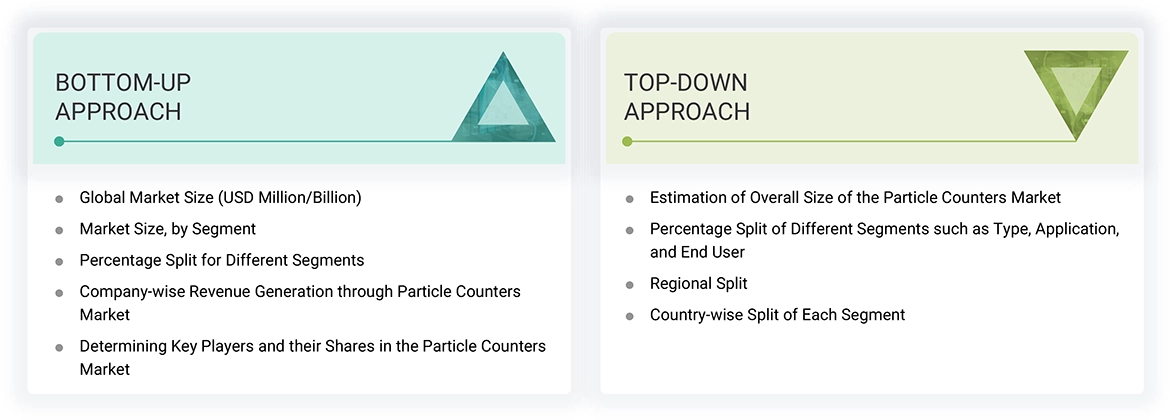
To make a balance between primary and secondary research for the particle counters market, different market variables for small and medium-sized businesses and major businesses were analyzed as part of this study. The next step involved primary research with industry experts along the value chain to validate these findings, assumptions, and market sizing. Many different methodologies were used for estimating the overall market size, involving the top-down and bottom-up approaches. The study consists of significant market segments, evolving patterns, regulatory frameworks, and competitive environments. This study also considers leading market players and the strategies they deploy in this market. In conclusion, the total market size was estimated through top-down and bottom-up approaches along with data triangulation to reach the number for the final market size. Primary research was conducted throughout the study to validate and test each hypothesis.
Secondary Research
During the study, secondary research employed a variety of sources, including directories and databases such as Bloomberg Businessweek, D&B Hoovers, and Factiva. Additional materials included white papers, annual reports, SEC filings, and investor presentations. This research approach was used to collect and generate data that offers comprehensive, technical, and market-focused insights into the particle counters market. The data provides insights into key players and market segmentation based on recent industry trends, as well as significant developments in the market. A database comprising leading industry figures was also created through this secondary research.
Primary Research
Primary research involved activities aimed at obtaining qualitative and quantitative data. A range of personalities from both supply and demand sides were questioned during this phase. For the supply side, folks from key designations like CEOs, vice presidents, directors of marketing and sales, directors of technology and innovation, and other important leaders were interviewed by key players. Among the demand-side primary sources were academic institutions, and research organizations. To validate market segmentation, identify prominent market participants, and gain insights into significant industry trends and market dynamics of the real-world primary study was carried out.
A breakdown of the primary respondents is provided below:
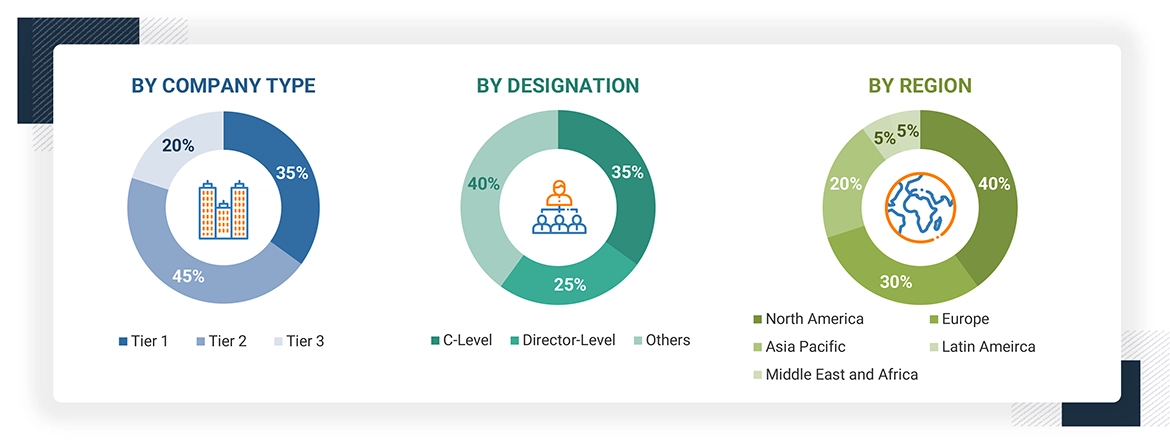
*Others include distributors, suppliers, product managers, business development managers, marketing managers and sales managers.
Note: Companies are categorized into tiers based on their total revenue. As of 2023, Tier 1 = >USD 1,000 million, Tier 2 = USD 500–1,000 million, and Tier 3 = < USD 500 million.
To know about the assumptions considered for the study, download the pdf brochure
Market Size Estimation
As per the review of prominent companies and their revenue shares, market size of the global particle counters market was calculated in this report. Key players with significant share in the market were identified as part of secondary research and their particle counters business revenue was calculated, the same was validated by primaries. Analyzing the annual and financial reports of the leading market participants was one aspect of secondary research. On the other hand, in-depth interviews with important thought leaders, including directors, CEOs, and marketing executives, were a part of the primary study.
For calculation of global market value, segmental revenue was calculated in the basis of revenue mapping of service/product providers. Process involved below mentioned steps:
- List of key players that operate in the particle counters market on regional or on country level.
- Formation of product mapping of manufacturers of particle counters and related product lines at regional and country level
- Revenue mapping for listed players from particle counters and related product and services.
- Revenue mapping of major players to cover at least ~70% of the global market share as of 2023. Revenue mapping for major players that cover nearly 70% of the global market share for year 2023.
- Revenue mapping extrapolation for players will drive the global market value for the respective segment.
- Summation for market value for all segment and subsegment to achieve actual value of the global value of particle counters market.
Data Triangulation
After getting the overall market size from the market size estimation process mentioned above, the Particle counters market was split into segments and subsegments. Data triangulation and market segmentation procedures were used to complete the overall market engineering process and arrive at the exact statistics for all segments and subsegments. The data was triangulated by studying and analyzing various factors and trends from both the demand and supply sides. Additionally, the Particle counters market was verified and validated using both top-down and bottom-up approaches.
Market Definition
Particle counters are monitoring instruments that work on light scattering or light obscuration and measure the particle size and concentration in air or liquid medium samples or environments. Particle counters are an indispensable Quality Assurance (QA) and Quality Control (QC) tool for pharmaceutical and biotechnology product testing, semiconductor testing, medical device testing, and food & beverage testing, among other applications. The market consists of particle counters that are used for environmental monitoring, process control, and quality assurance by various end–users.
Stakeholders
- Pharmaceutical Industry
- Medical Device Industry
- Manufacturers and suppliers of particle counters.
- Product suppliers, distributors, and channel partners
- Semiconductor & Electronics Industry
- Food & beverage industry
- Chemical Industry
- Academic & research institutes
- Community centers and hospitals
- Regulatory authorities and industry associations
- Venture capitalists and investment firms
Report Objectives
- To define, describe, and forecast the market for particle counters based on the types of samples they can detect particles.
- To give detailed information regarding factors influencing the growth potential of the particle counters market (drivers, restraints, opportunities, challenges, and trends)
- To study the micro markets by considering individual growth trends, future prospects, and contributions to the particle counters market
- To study and analyze crucial growth opportunities in the particle counters market for prominent stakeholders and to give insights into the competitive landscape for market leaders.
- To forecast the size of market segments and/or subsegments with respect to five major regions, namely, North America (US and Canada), Europe (Germany, France, the UK, Italy, Spain, and the RoE), Asia Pacific (Japan, China, India, and the RoAPAC), Latin America (Brazil, Mexico, and RoLATAM), and the Middle East & Africa
- To profile the key players in the global particle counters market and deeply analyze their market shares and core capabilities.
- To study, track, and analyze the competitive developments undertaken in the global particle counters market, such as product launches; agreements; expansions; and mergers & acquisitions.
Get the Full Particle Counters Market Report
Full forecast, segment splits, and company analysis for all Particle Counters Market.
- Canada Particle Counters Market
- US Particle Counters Market
- Germany Particle Counters Market
- UK Particle Counters Market
- France Particle Counters Market
- Italy Particle Counters Market
- Spain Particle Counters Market
- Japan Particle Counters Market
- China Particle Counters Market
- India Particle Counters Market
- Australia Particle Counters Market
- South Korea Particle Counters Market
- Mexico Particle Counters Market
- Rest Of Europe Particle Counters Market
- Rest Of Asia Pacific Particle Counters Market
- Rest Of Latin America Particle Counters Market
- GCC Region Particle Counters Market
- Rest Of Mea Particle Counters Market
Need a Tailored Report?
Customize this report to your needs
Get 10% FREE Customization
Customize This Report
