
Rest Of Asia Pacific Patient Experience Technology Market (2025-2030)

The Rest Of Asia Pacific Patient Experience Technology Market was valued at $20.74 Million in 2025 and projected to reach to $38.47 Million by 2030, representing a compound annual growth rate of 13.2%. Rest Of Asia Pacific's patient experience technology market is positioned for significant growth, expanding from $20.74 million in 2025 to $38.47 million by 2030.


| Market Size in | USD 26.32 MN |
| Market Forecast in | |
| CAGR | |
| Forecast Period | |
| Units Considered | Value (USD MN) |
Rest Of Asia Pacific Patient Experience Technology Market Trends and Insights
- Rest Of Asia Pacific is emerging as a high-growth region driven by increasing healthcare digitalization, rising patient expectations, and expanding healthcare infrastructure across developing economies.
- The region's growth trajectory outpaces global averages, reflecting accelerating adoption of digital patient engagement platforms, telemedicine solutions, and feedback management systems throughout Rest Of Asia Pacific. Rest Of Asia Pacific's patient experience technology market benefits from a large patient population, growing middle-class healthcare consumers, and government initiatives promoting digital health adoption.
- Between 2025 and 2030, Rest Of Asia Pacific will witness significant investment in patient-centric technologies, including mobile health applications, appointment scheduling systems, and real-time communication platforms.
- The competitive landscape in Rest Of Asia Pacific is intensifying as both regional and global vendors recognize the market's potential, driving innovation and service expansion tailored to Rest Of Asia Pacific's unique healthcare ecosystem..
Key Market Statistics
- CAGR (2025-2030) 13.2% CAGR
- Market Size, 2025 ~USD 20.74 Million
- Forecast, 2030 ~USD 38.47 Million
- Country Rest Of Asia Pacific
Rest Of Asia Pacific Patient Experience Technology Market Overview
Rapid Market Expansion :
Rest Of Asia Pacific's patient experience technology market is growing at 13.2% CAGR, outpacing the global average of 11.8%, driven by accelerating digital health adoption across developing economies in the region.
Healthcare Digitalization Wave :
Increasing investments in healthcare infrastructure and digital transformation initiatives across Rest Of Asia Pacific countries are creating substantial opportunities for patient experience technology solutions and platforms.
Rising Patient Expectations :
Growing middle-class populations and increased healthcare awareness in Rest Of Asia Pacific are driving demand for enhanced patient engagement, telemedicine, and personalized care experiences.
Emerging Market Potential :
Developing economies in Rest Of Asia Pacific present untapped markets with expanding healthcare systems seeking cost-effective patient experience technology solutions to improve operational efficiency and patient satisfaction.
Rest Of Asia Pacific Patient Experience Technology Market Dynamics
- This robust 13.2% CAGR reflects the region's accelerating digital health transformation and increasing healthcare infrastructure investments.
- Developing economies are rapidly adopting patient experience solutions to meet rising consumer expectations and improve healthcare delivery efficiency. The region's growth trajectory is supported by expanding internet penetration, smartphone adoption, and government healthcare digitalization initiatives.
- Healthcare providers across Rest Of Asia Pacific are increasingly recognizing the value of patient experience technology in enhancing engagement, reducing operational costs, and improving clinical outcomes.
- This momentum is expected to continue as healthcare systems mature and patient-centric care becomes a competitive differentiator..
Market Ecosystem
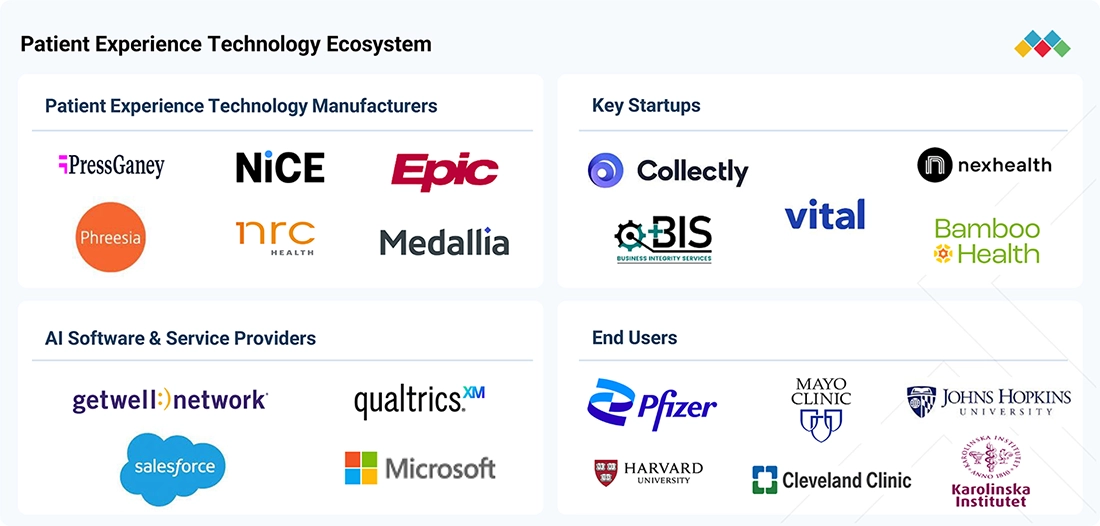
PATIENT EXPERIENCE TECHNOLOGY MARKET: COMMERCIAL USE CASES ACROSS INDUSTRIES
| COMPANY | USE CASE DESCRIPTION | BENEFITS |
|---|---|---|
 |
Integrated patient portals, MyChart apps, telehealth, and scheduling tools that connect with EHRs to support appointment booking, visit summaries, and secure messaging | Streamlined access, better care coordination, higher patient satisfaction |
 |
Track satisfaction across inpatient, outpatient, and digital touchpoints for quality improvement in hospitals. It also supports post-discharge feedback, physician performance tracking, and experience optimization across telehealth and mobile platforms. | Enables healthcare providers to capture real-time patient feedback and uncover actionable insights using AI and NLP analytics. It helps improve service quality, personalize care experiences, and automate issue resolution across the patient journey. |
 |
Patient experience measurement platforms providing real-time feedback, healthcare consumer insights, and loyalty analytics to help hospitals and health systems understand community needs and patient expectations | Deeper patient insights, stronger loyalty, community trust, and improved care personalization. |
 |
Real-time patient feedback, satisfaction surveys, and reputation management platforms integrated with care delivery systems | Continuous quality improvement, stronger loyalty, reputation enhancement |
 |
Experience management (XM) platforms offering patient and caregiver surveys, sentiment analysis, and AI-powered dashboards that integrate with EHR and CRM systems for actionable insights across the care journey | Actionable experience insights, improved satisfaction, better decision-making, and higher care quality |
Logos and trademarks shown above are the property of their respective owners. Their use here is for informational and illustrative purposes only.
Related Ecosystem
Healthcare It
Key Takeaways
- Rest Of Asia Pacific's patient experience technology market will grow from $20.74M (2025) to $38.47M (2030) at a 13.2% CAGR, outpacing global growth rates.
- Rest Of Asia Pacific is driven by digital health adoption, expanding healthcare infrastructure, and rising patient expectations across developing economies.
- Rest Of Asia Pacific's large patient population and growing middle-class healthcare consumers create significant market opportunities for vendors.
- Rest Of Asia Pacific's competitive landscape is intensifying as regional and global players invest in patient-centric solutions tailored to the region.
Patient Experience Technology Market Report Scope
| Report Metric | Details |
|---|---|
| Base Year | 2025 |
| Fastest Growing Segment | CLOUD-BASED SOFTWARE (Type) |
| Forecast Period | 2025–2030 |
| Growth Rate | CAGR of 11.8% from 2025 to 2030 |
| Largest Segment | SOFTWARE (Offering) |
| Market Size Base Year (Billions) | ~USD 0.66 (2025) |
| Revenue Forecast (Billions) | ~USD 1.16 (2030) |
| Segments Covered | Offering, Type, Service, Function, End User |
Rest Of Asia Pacific Patient Experience Technology Market Report Segmentation
5 segment dimensions are covered across the global market.
By Offering
- Services
- Software
By Type
- Cloud-Based Software
- Hospitals & Health Systems
- Hybrid Software
- Long-Term Care & Post-Acute Care Facilities
- Managed Services
- On-Premise Software
- Other Healthcare Providers
- Outpatient & Ambulatory Care Centers
- Physicians & Group Practices
- Professional Services
By Service
- Managed Services
- Professional Services
By Function
- Appointment Scheduling
- Billing
- Feedback Management
- Other Functions
- Patient Communication
- Patient Engagement
- Patient Registration
- Virtual Care
By End User
- Healthcare Payers
- Healthcare Provider
- Healthcare Providers
- Other End Users
- Pharma & Biotech Companies
Target Audience
- Healthcare Technology Vendors : Patient experience technology providers need Rest Of Asia Pacific market intelligence to identify growth opportunities, tailor solutions for regional needs, and develop localized go-to-market strategies.
- Healthcare Providers & Hospital Networks : Hospital systems and healthcare organizations across Rest Of Asia Pacific require market insights to benchmark performance, evaluate technology investments, and understand competitive positioning in their markets.
- Private Equity & Investment Firms : Investors targeting healthcare technology in Rest Of Asia Pacific need comprehensive market data to evaluate acquisition targets, assess growth potential, and make informed capital allocation decisions.
- Healthcare Consultants & Advisors : Management consulting firms and healthcare advisors serving Rest Of Asia Pacific clients require detailed market analysis to support strategic recommendations and validate business cases for digital transformation initiatives.
- Government & Healthcare Policymakers : Healthcare regulators and government agencies in Rest Of Asia Pacific need market intelligence to inform digital health policies, infrastructure investments, and healthcare system modernization strategies.
Key Companies in the Rest Of Asia Pacific Patient Experience Technology Market
| Company | HQ | Ownership | Strongest segments |
|---|---|---|---|
| PRESS GANEY | United States | Private Company | Patient Experience Measurement & Analytics,Caregiver Engagement & Alignment,Clinical & Quality Solutions (Nursing Indicators, PROMs, Core Measures), |
| NATIONAL RESEARCH CORPORATION | United States | Public Company | Patient Experience Solutions,Market Experience and Brand Solutions,Employee Experience Solutions, |
| MEDALLIA INC. | United States | Private Company | Customer Experience (CX) Platform & Subscriptions,Employee, Citizen, and Patient Experience,Professional Services (Design, Implementation, Enhancements), |
| PHREESIA | United States | Public Company | Digital intake and clinical data capture (including PhreesiaPads and Arrivals Kiosks),Integrated payment and financing solutions,Patient engagement, activation, and communications (including AI-based smart answering), |
| NICE | Israel | Public Company | Customer Engagement (CXone Mpower and related CX/analytics),Financial Crime and Compliance (Actimize, X-Sight, Xceed),Digital Evidence and Investigations (Evidencentral, intelligent investigations), |
| R1 | United States | Private Company | Enterprise solutions (full-service RCM outsourcing),Revenue recovery,Revenue optimization, |
| IQVIA | United States | Public Company | Technology & Analytics Solutions,Research & Development Solutions,Contract Sales & Medical Solutions, |
| QUALTRICS | United States | Private Company | CustomerXM (customer experience),EmployeeXM (employee experience),DesignXM & research services, |
PRESS GANEY
Press Ganey is a private healthcare company founded in 1985 with 1,058 employees in the United States. The company specializes in patient experience and healthcare quality solutions.
NATIONAL RESEARCH CORPORATION
National Research Corporation is a publicly traded U.S. company founded in 1981 with 357 employees. It provides healthcare market research and patient experience measurement services.
MEDALLIA INC.
Medallia Inc. is a private company founded in 2001 with 2,037 employees based in the United States. The company offers customer experience management and feedback solutions across multiple industries.
PHREESIA
Phreesia is a publicly traded U.S. company founded in 2005 with 1,789 employees. It provides cloud-based patient intake and engagement solutions for healthcare providers.
NICE
NICE is a publicly traded Israeli company founded in 1986 with 9,626 employees. The company develops customer engagement software and analytics solutions for enterprises globally.
R1
R1 is a private U.S. company founded in 2003 with 29,650 employees. It provides healthcare revenue cycle management and business process outsourcing services.
IQVIA
IQVIA is a publicly traded U.S. company with 93,000 employees. It provides clinical research, data analytics, and healthcare consulting services to the pharmaceutical and life sciences industries.
QUALTRICS
Qualtrics is a private U.S. company founded in 2002 with 5,300 employees. The company offers experience management software and survey platforms for organizations across various sectors.
Reasons to Buy this Report
- Regional Market Sizing & Forecasts : Obtain precise market valuations and growth projections specific to Rest Of Asia Pacific, enabling accurate business planning and investment decisions in this high-growth region with 13.2% CAGR.
- Competitive Landscape Intelligence : Understand market dynamics, key players, and competitive positioning within Rest Of Asia Pacific's patient experience technology sector to identify partnership and expansion opportunities.
- Growth Driver Analysis : Gain insights into region-specific factors driving market expansion, including healthcare infrastructure development, regulatory changes, and patient behavior shifts unique to Rest Of Asia Pacific economies.
- Investment & Entry Strategy : Develop informed market entry strategies and investment theses for Rest Of Asia Pacific with data-driven insights on market maturity, adoption rates, and emerging opportunities across developing economies.
- Segment & Vertical Opportunities : Identify high-potential segments and healthcare verticals within Rest Of Asia Pacific where patient experience technology adoption is accelerating and ROI potential is strongest.
Frequently asked questions
What is the market size of patient experience technology in Rest Of Asia Pacific?
Rest Of Asia Pacific's patient experience technology market is valued at $20.74 million in 2025 and is projected to reach $38.47 million by 2030.
What is the CAGR for patient experience technology in Rest Of Asia Pacific?
Rest Of Asia Pacific's patient experience technology market is expected to grow at a compound annual growth rate (CAGR) of 13.2% from 2025 to 2030.
What are the primary growth drivers in Rest Of Asia Pacific?
Rest Of Asia Pacific's growth is driven by increasing healthcare digitalization, rising patient expectations, expanding healthcare infrastructure, and government digital health initiatives across developing economies.
Which technologies are gaining traction in Rest Of Asia Pacific?
Rest Of Asia Pacific is seeing increased adoption of mobile health applications, telemedicine solutions, appointment scheduling systems, real-time communication platforms, and patient feedback management systems.
Who are the key players competing in Rest Of Asia Pacific?
Rest Of Asia Pacific's competitive landscape includes both regional healthcare technology vendors and global players expanding their presence to capture the region's growing market opportunities.
RESEARCH METHODOLOGY
The study involved significant work to estimate the current size of the patient experience technology market. Exhaustive secondary research was done to collect information on the patient experience technology market. The next step was to validate these findings, assumptions, and sizing with industry experts across the value chain using primary research. Different approaches, such as top-down and bottom-up, were employed to estimate the total market size. After that, the market breakup and data triangulation procedures were used to estimate the market size of the segments and subsegments of the patient experience technology market.
Secondary Research
This research study relied heavily on secondary sources, including directories and databases such as Dun & Bradstreet, Bloomberg Businessweek, and Factiva; white papers, annual reports, and company house documents; investor presentations; and SEC filings. The market for companies offering patient experience technology solutions was determined using secondary data from paid and unpaid sources, analyzing the product portfolios of major companies in the ecosystem, and rating companies by performance and quality. Various sources were referred to in the secondary research process to identify and collect information for this study. Secondary sources included annual reports, press releases, company investor presentations, white papers, journals, certified publications, and articles from recognized authors, directories, and databases.
Various secondary sources were referred to in the secondary research process to identify and collect information related to the study. These sources included annual reports, press releases, investor presentations of patient experience technology vendors, forums, certified publications, and whitepapers. Secondary research was used to obtain critical information on the industry’s value chain, the total pool of key players, market classification, and segmentation from market- and technology-oriented perspectives.
Primary Research
In the primary research process, various sources from both the supply and demand sides were interviewed to obtain qualitative and quantitative information for this report. Primary sources mainly included industry experts from core and related industries, as well as preferred suppliers, manufacturers, distributors, technology developers, researchers, and organizations across all segments of this industry’s value chain. In-depth interviews were conducted with primary respondents, including key industry participants, subject-matter experts (SMEs), C-level executives of key market players, and industry consultants, among other experts, to obtain and verify critical qualitative and quantitative information and assess prospects.
Primary research was conducted to identify segmentation types, industry trends, key players, and key market dynamics such as drivers, restraints, opportunities, challenges, and strategies adopted by key players.
After completing market engineering (calculations for market statistics, market breakdown, market size estimations, market forecasting, and data triangulation), we conducted extensive primary research to gather information and verify and validate the critical numbers.
In the complete market engineering process, the top-down and bottom-up approaches and several data triangulation methods were extensively used to perform the market estimation and market forecasting for the overall market segments and subsegments listed in this report. Extensive qualitative and quantitative analysis was performed on the complete market engineering process to list the key information/insights throughout the report.
Breakdown of the Primary Respondents:
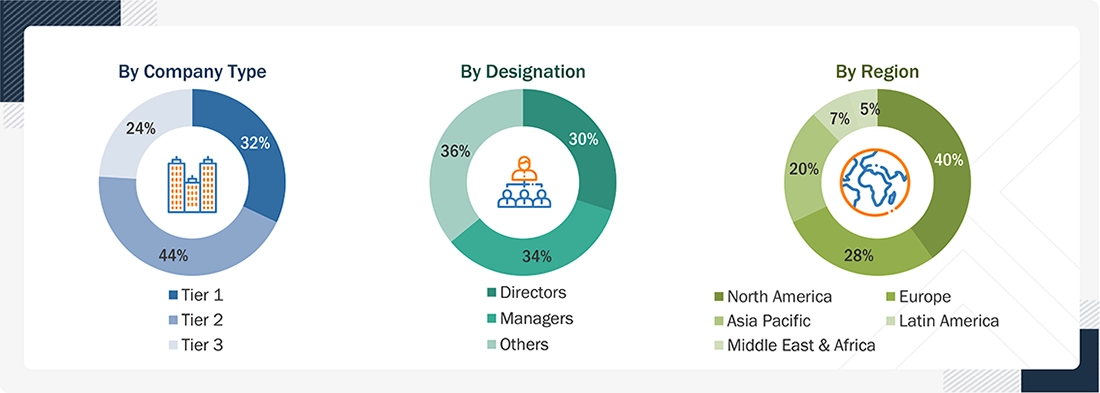
Note: Other designations include sales managers, marketing managers, and product managers.
Note: Tiers are defined based on a company’s total revenue as of 2025: Tier 1 = >USD 1 billion, Tier 2 = USD 500 million to USD 1 billion, and Tier 3 = <USD 500 million.
To know about the assumptions considered for the study, download the pdf brochure
Market Size Estimation
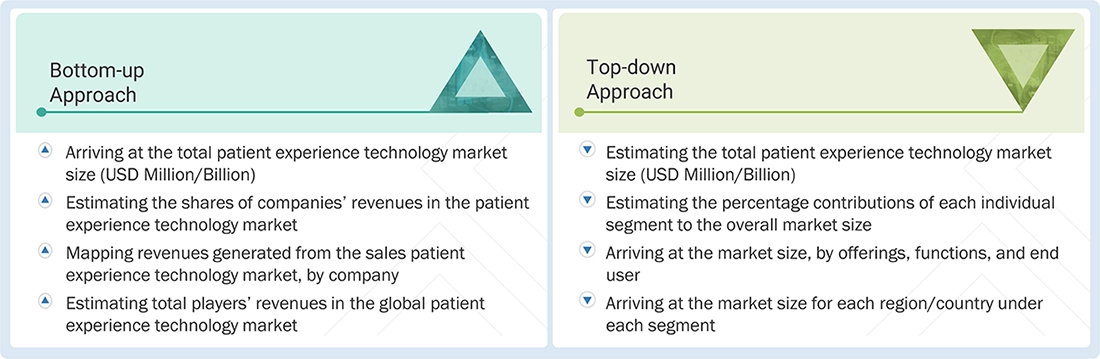
The market size estimates and forecasts in this study are derived through a mix of the bottom-up approach (revenue share analysis of leading players) and the top-down approach (assessment of utilization/adoption/penetration trends by offerings, functions, end user, and region).
Patient Experience Technology Market: Bottom-Up Approach
Data Triangulation
After arriving at the overall market size using the market size estimation processes, the market was split into several segments and subsegments. To complete the overall market engineering process and arrive at the exact statistics of each market segment and sub-segment, the data triangulation and market breakdown procedures were employed, wherever applicable. The data were triangulated by studying various factors and trends on both the demand and supply sides of the patient experience technology market.
Market Definition
The patient experience technology market refers to the range of digital solutions and platforms designed to enhance every interaction a patient has with a care provider across the patient journey. It focuses on improving convenience, transparency, and satisfaction through tools such as appointment scheduling, digital check-ins, wayfinding, real-time updates during care, billing transparency, and post-care feedback management.
By integrating real-time data, analytics, and interoperability with electronic health records, these technologies create seamless care journeys and informed decision-making. They empower patients and providers alike, fostering collaboration, transparency, and better adherence to treatment plans across the continuum of care.
Key Stakeholders
- Healthcare Providers
- Patient Experience Technology Vendors
- Government Bodies & Regulators
- Healthcare IT & EHR Vendors
- Patients and Caregivers
- Startups & Innovators
- Healthcare Associations/Institutes
- Payers & Insurance Companies
- Venture Capitalists & Private Equity
- System Integrators & Service Providers
- Distributors & Channel Partners
- Advocacy Groups & Patient Rights Organizations
- Investors and Financial Institutions
- Industry Associations & Trade Groups
Report Objectives
- To define, describe, and forecast the global patient experience technology market based on offerings, function, end user, and region.
- To provide detailed information regarding the factors influencing the growth of the market (such as the drivers, restraints, opportunities, and challenges)
- To strategically analyze micromarkets with respect to individual growth trends, prospects, and contributions to the overall patient experience technology market
- To analyze market opportunities for stakeholders and provide details of the competitive landscape for market leaders
- To forecast the size of the patient experience technology market in five main regions (along with their respective key countries): North America, Europe, the Asia Pacific, Latin America, and the Middle East & Africa
- To profile key players and comprehensively analyze their product portfolios, market positions, and core competencies in the market
- To track and analyze competitive developments such as product & service launches; expansions; partnerships, agreements, and collaborations; and acquisitions in the patient experience technology market
- To benchmark players within the patient experience technology market using the Company Evaluation Matrix framework, which analyzes market players on various parameters within the broad categories of business strategy, market share, and product offering
Available customizations:
With the provided market data, MarketsandMarkets offers customizations to meet your company’s specific needs. The following customization options are available for the report:
Company Information
- Detailed analysis and profiling of additional market players (up to 5)
Geographic Analysis
- Further breakdown of the Rest of Europe’s patient experience technology market into Denmark, Norway, and others
- Further breakdown of the Rest of Asia Pacific patient experience technology market into Vietnam, New Zealand, Australia, South Korea, and others
Get the Full Patient Experience Technology Market Report
Full forecast, segment splits, and company analysis for all Patient Experience Technology Market.
- US Patient Experience Technology Market
- Canada Patient Experience Technology Market
- UK Patient Experience Technology Market
- Germany Patient Experience Technology Market
- France Patient Experience Technology Market
- Italy Patient Experience Technology Market
- Spain Patient Experience Technology Market
- Japan Patient Experience Technology Market
- China Patient Experience Technology Market
- India Patient Experience Technology Market
- South Korea Patient Experience Technology Market
- Australia Patient Experience Technology Market
- Brazil Patient Experience Technology Market
- Mexico Patient Experience Technology Market
- Saudi Arabia Patient Experience Technology Market
- UAE Patient Experience Technology Market
- South Africa Patient Experience Technology Market
- Rest Of Europe Patient Experience Technology Market
- Rest Of Latin America Patient Experience Technology Market
- GCC Countries Patient Experience Technology Market
Need a Tailored Report?
Customize this report to your needs
Get 10% FREE Customization
Customize This Report
