
China Payment Gateway Market (2024-2029)

The China Payment Gateway Market was valued at $3881.1 Million in 2024 and projected to reach to $7262.5 Million by 2029, representing a compound annual growth rate of CAGR 13.4%. China's payment gateway market is positioned for sustained double-digit growth through 2029, driven by the country's digital economy expansion and government initiatives promoting cashless payments.


| Market Size in | USD 26.32 MN |
| Market Forecast in | |
| CAGR | |
| Forecast Period | |
| Units Considered | Value (USD MN) |
China Payment Gateway Market Trends and Insights
- This accelerated growth in China reflects the country's rapid digital transformation, increasing e-commerce penetration, and rising adoption of mobile payment solutions across both urban and emerging markets.
- China's payment gateway sector is being driven by regulatory support, technological innovation, and the proliferation of fintech platforms that are reshaping how businesses and consumers conduct transactions. The forecast period through 2029 demonstrates China's strategic importance in the global payment ecosystem.
- China's market expansion outpaces the global average of 12.6% CAGR, underscoring the country's position as a critical growth engine for payment infrastructure.
- Key factors propelling China's market include the dominance of mobile wallets, cross-border e-commerce growth, and increasing merchant adoption of integrated payment solutions.
- China's competitive landscape features both established financial institutions and innovative fintech companies competing to capture market share in this high-growth segment..
Key Market Statistics
- CAGR (2024-2029) CAGR 13.4%
- Market Size, 2024 ~USD 3881.1 Million
- Forecast, 2029 ~USD 7262.5 Million
- Country China
China Payment Gateway Market Overview
Market Valuation & Growth :
China's payment gateway market reached USD 3,881.1 million in 2024 and is projected to grow to USD 7,262.5 million by 2029, with a robust CAGR of 13.4%, outpacing the global average of 12.6%.
Digital Payment Adoption :
Rapid digital transformation across China is driving accelerated adoption of mobile payment solutions, with both urban and rural markets increasingly embracing cashless transactions and digital wallets.
E-commerce Expansion :
China's booming e-commerce sector continues to fuel payment gateway demand, as online retail penetration deepens across consumer segments and cross-border transaction volumes surge.
Mobile-First Market Dynamics :
The dominance of mobile payment platforms in China creates unique opportunities for payment gateway providers to capture growth in smartphone-based transactions and fintech integration.
China Payment Gateway Market Dynamics
- The market's 13.4% CAGR reflects strong momentum from e-commerce platforms, mobile payment adoption, and increasing financial inclusion in tier-2 and tier-3 cities. Looking ahead, emerging technologies such as blockchain integration, AI-powered fraud detection, and API-based payment solutions will reshape the competitive landscape.
- Cross-border payment capabilities and integration with China's digital yuan initiatives present additional growth vectors, while intensifying competition among domestic and international players will drive innovation and service differentiation..
Market Ecosystem
Related Ecosystem
Software And Services
- Natural Language Processing (NLP)
- Machine Learning
- Supply Chain Management
- Predictive Analytics
- Image Sensors
- International Business Machines Corporation
- MICROSOFT CORPORATION
- Oracle Corporation
- SAP SE
- Amazon.com, Inc.
Connected Car
- Light Commercial Vehicles (LCVs)
- Battery Electric Vehicle (BEV)
- Fuel Cell Electric Vehicle (FCEV)
- Cellular Network
- Sensors
- BOSCH LIMITED
- Visteon Corporation
- Jabil Inc.
- DENSO Corporation
- VALENS SEMICONDUCTOR LTD.
Key Takeaways
- China's payment gateway market will nearly double from USD 3,881.1 million in 2024 to USD 7,262.5 million by 2029, driven by digital commerce expansion and fintech innovation.
- China's 13.4% CAGR exceeds the global average of 12.6%, positioning China as the fastest-growing major payment gateway market in the Asia Pacific region.
- Mobile payment dominance and cross-border e-commerce are primary growth catalysts in China, with merchants increasingly adopting integrated payment solutions.
- China's regulatory environment and technological infrastructure create competitive advantages for both traditional financial institutions and emerging fintech players in the payment gateway space.
Payment Gateway Market Report Scope
| Report Metric | Details |
|---|---|
| Base Year | 2024 |
| Fastest Growing Segment | MEDIA & ENTERTAINMENT (Vertical) |
| Forecast Period | 2024-2029 |
| Growth Rate | CAGR of 12.6% from 2024 to 2029 |
| Largest Segment | DOMESTIC (Transaction Type) |
| Market Size Base Year (Billions) | ~USD 26.74 (2024) |
| Revenue Forecast (Billions) | ~USD 48.4 (2029) |
| Segments Covered | Type, Vertical, Solution, Transaction Type, Payment Mode, Payment Method |
China Payment Gateway Market Report Segmentation
6 segment dimensions are covered across the global market.
By Type
- Hosted
- Other Types
- Self-Hosted
By Vertical
- Bfsi
- Government And Utilities
- Healthcare
- It & Ites
- Media & Entertainment
- Media And Entertainment
- Other Verticals
- Real Estate
- Retail
- Retail & E-Commerce
- Retail & Ecommerce
- Telecom
- Transportation & Logistics
- Travel & Hospitality
- Travel And Hospitality
By Solution
- Other Solutions
- Payment Gateways
- Payment Processors
- Payment Wallet
- Pos
By Transaction Type
- Cross Border
- Domestic
By Payment Mode
- Ach Transfer
- Cards
- Digital Wallet
- Other Payment Modes
By Payment Method
- Ach
- Credit Card
- Debit Card
- Ewallet
- Other Payment Methods
CHINA: PAYMENT GATEWAY MARKET, BY VERTICAL, 2024–2029
| Segment | 2024 | 2025 | 2026 | 2027 | 2028 | 2029 | CAGR (%) |
|---|---|---|---|---|---|---|---|
| BFSI | 720.3 | 827.1 | 947 | 1077.7 | 1220.6 | 1377 | 13.8 |
| HEALTHCARE | 372.2 | 428.2 | 491.2 | 560 | 635.5 | 718.3 | 14.1 |
| IT & ITES | 408.3 | 468.1 | 535.2 | 608.2 | 687.9 | 774.9 | 13.7 |
| MEDIA & ENTERTAINMENT | 350.5 | 409.1 | 476 | 550.3 | 632.9 | 724.8 | 15.6 |
| OTHER VERTICALS | 368.7 | 422 | 481.6 | 546.3 | 616.8 | 693.6 | 13.5 |
| RETAIL & E-COMMERCE | 947.8 | 1075.2 | 1216.1 | 1367.2 | 1529.7 | 1704.5 | 12.5 |
| TELECOM | 280.2 | 319.5 | 363.2 | 410.4 | 461.6 | 517.1 | 13 |
| TRAVEL & HOSPITALITY | 433.1 | 488.1 | 548.4 | 612.2 | 680.1 | 752.4 | 11.7 |
| TOTAL | 3881.1 | 4437.4 | 5058.8 | 5732.3 | 6465.2 | 7262.5 | 13.4 |
Target Audience
- Payment Gateway Providers : Fintech companies and payment processors need China-specific market data to evaluate expansion opportunities, benchmark performance, and develop localized product strategies in this high-growth market.
- E-commerce & Retail Businesses : Online retailers and marketplace operators require insights into China's payment gateway landscape to optimize checkout experiences, reduce transaction friction, and improve customer conversion rates.
- Investment & Private Equity Firms : Investors evaluating opportunities in China's fintech and digital payment sectors need validated market sizing and growth forecasts to assess deal valuations and portfolio company potential.
- Technology & Software Companies : SaaS and enterprise software providers entering China's market need payment gateway market intelligence to identify integration opportunities, partnership potential, and customer acquisition strategies.
- Management Consultants & Analysts : Strategy consultants and market researchers require China-specific payment gateway data to support client advisory work, competitive analysis, and market entry recommendations.
Reasons to Buy this Report
- Market Size & Growth Validation : Obtain precise market valuation data for China (USD 3,881.1M in 2024) and verified 5-year forecasts to support investment decisions, business planning, and competitive positioning in this high-growth market.
- Regional Performance Benchmarking : Compare China's 13.4% CAGR against global benchmarks (12.6%) to identify outperformance drivers and assess relative market attractiveness for expansion or partnership strategies.
- Segment & Trend Analysis : Access detailed insights into China-specific payment gateway segments, including mobile payments, e-commerce integration, and cross-border solutions to identify high-potential niches and customer opportunities.
- Competitive Intelligence : Understand the competitive dynamics, market consolidation trends, and emerging players specific to China's payment ecosystem to inform go-to-market strategies and partnership development.
- Strategic Planning & Forecasting : Leverage China-specific market projections through 2029 to develop long-term business strategies, resource allocation plans, and revenue forecasts with confidence in localized market data.
Frequently asked questions
What is the current size of China's payment gateway market in 2024?
China's payment gateway market is valued at USD 3,881.1 million in 2024, reflecting strong demand for digital payment infrastructure across the country.
What is the projected market size for China's payment gateway market by 2029?
China's payment gateway market is forecast to reach USD 7,262.5 million by 2029, representing nearly a doubling of market value over the five-year period.
What is the CAGR for China's payment gateway market?
China's payment gateway market is expected to grow at a compound annual growth rate of 13.4% from 2024 to 2029, outpacing the global average.
What are the primary drivers of growth in China's payment gateway market?
Key growth drivers in China include rapid e-commerce expansion, mobile wallet adoption, cross-border transaction growth, fintech innovation, and supportive regulatory policies.
How does China's payment gateway market compare to global trends?
China's 13.4% CAGR exceeds the global payment gateway market CAGR of 12.6%, demonstrating China's accelerated growth trajectory and strategic market importance.
RESEARCH METHODOLOGY
This research study involved the extensive use of secondary sources, directories, and databases, such as Dun & Bradstreet (D&B) Hoovers and Bloomberg BusinessWeek, to identify and collect information useful for a technical, market-oriented, and commercial study of the payment gateway market. The primary sources have been mainly industry experts from the core and related industries and preferred suppliers, manufacturers, distributors, service providers, technology developers, alliances, and organizations related to all segments of the value chain of this market. In-depth interviews have been conducted with various primary respondents, including key industry participants, subject matter experts, C-level executives of key market players, and industry consultants to obtain and verify critical qualitative and quantitative information.
Secondary Research
The market for companies offering payment gateway solutions and services to different verticals has been estimated and projected based on the secondary data made available through paid and unpaid sources, as well as by analyzing their product portfolios in the ecosystem of the market. It also involved rating company products based on their performance and quality. In the secondary research process, various sources such as Journal of Electronic Commerce Research (JECR), International Journal of Electronic Commerce (IJEC), and Electronic Commerce Research and Applications (ECRA) have been referred to for identifying and collecting information for this study on the payment gateway market. The secondary sources included annual reports, press releases investor presentations of companies, white papers, journals, and certified publications and articles by recognized authors, directories, and databases. Secondary research has been mainly used to obtain key information about the supply chain of the market, the total pool of key players, market classification, segmentation according to industry trends to the bottommost level, regional markets, and key developments from both market- and technology-oriented perspectives that have been further validated by primary sources.
Primary Research
In the primary research process, various primary sources from both the supply and demand sides were interviewed to obtain qualitative and quantitative information on the market. The primary sources from the supply side included various industry experts, including Chief Experience Officers (CXOs); Vice Presidents (VPs); directors from business development, marketing, and product development/innovation teams; related key executives from payment gateway solution vendors, SIs, professional service providers, and industry associations; and key opinion leaders. Primary interviews were conducted to gather insights, such as market statistics, revenue data collected from solutions and services, market breakups, market size estimations, market forecasts, and data triangulation. Primary research also helped in understanding various trends related to technologies, applications, deployments, and regions. Stakeholders from the demand side, such as Chief Information Officers (CIOs), Chief Technology Officers (CTOs), Chief Strategy Officers (CSOs), and end users using payment gateway solutions, were interviewed to understand the buyer’s perspective on suppliers, products, service providers, and their current usage of payment gateway solutions which would impact the overall payment gateway market.
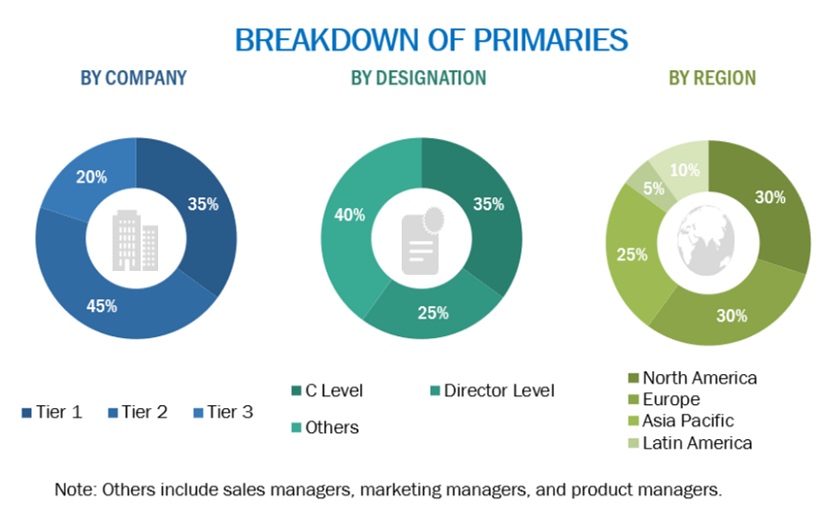
To know about the assumptions considered for the study, download the pdf brochure
Market Size Estimation
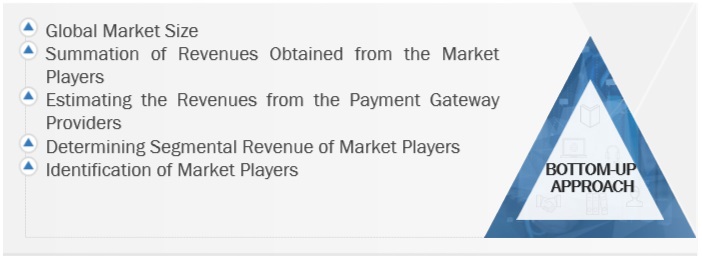
Multiple approaches were adopted to estimate and forecast the size of the payment gateway market. The first approach involves estimating market size by summing up the revenue generated by companies through the sale of payment gateway offerings.
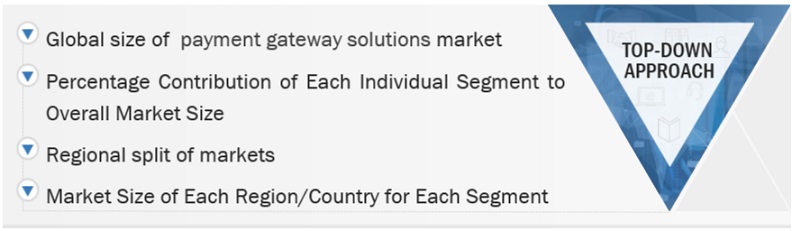
Both top-down and bottom-up approaches were used to estimate and validate the total size of the market. These methods were extensively used to estimate the size of various segments in the market. The research methodology used to estimate the market size includes the following:
- Key players in the market have been identified through extensive secondary research.
- In terms of value, the industry’s supply chain and market size have been determined through primary and secondary research processes.
- All percentage shares, splits, and breakups have been determined using secondary sources and verified through primary sources.
Market Size Estimation Methodology-Bottom-up approach
To know about the assumptions considered for the study, Request for Free Sample Report
Market Size Estimation Methodology-Top-Down Approach
Data Triangulation
After arriving at the overall market size, the payment gateway market was divided into several segments and subsegments. A data triangulation procedure was used to complete the overall market engineering process and arrive at the exact statistics for all segments and subsegments, wherever applicable. The data was triangulated by studying various factors and trends from the demand and supply sides. Along with data triangulation and market breakdown, the market size was validated by the top-down and bottom-up approaches.
Market Definition
The payment gateway market refers to the sector of the financial technology (fintech) industry focused on providing technology solutions that facilitate the secure transmission of payment data between merchants, consumers, and financial institutions. Payment gateways serve as the intermediary that authorizes and processes electronic transactions, enabling businesses to accept various forms of payment, such as credit cards, debit cards, digital wallets, and alternative payment methods, for goods and services purchased online, in-store, or via mobile devices. These solutions play a crucial role in ensuring the smooth and secure transfer of funds, while also offering features such as fraud prevention, encryption, and compliance with industry standards and regulations such as PCI DSS (Payment Card Industry Data Security Standard). The payment gateway market encompasses a wide range of providers, including traditional financial institutions, fintech startups, and third-party payment service providers, catering to the diverse needs of merchants across various industries and regions.
Key Stakeholders
- Payment Gateway Providers
- Merchant
- Customers
- Financial Institutions
- Card Networks
- Payment Processors
- Government Agencies
- Investment Firms
- Payment gateway Alliances/Groups
Report Objectives
- To determine, segment, and forecast the payment gateway market by type, vertical, and region in terms of value
- To forecast the size of the market segments with respect to 5 main regions: North America, Europe, Asia Pacific, Middle East & Africa, and Latin America
- To provide detailed information about the major factors (drivers, restraints, opportunities, and challenges) influencing the growth of the market
- To study the complete value chain and related industry segments and perform a value chain analysis of the market landscape
- To strategically analyze the macro and micro-markets with respect to individual growth trends, prospects, and contributions to the total market
- To analyze the industry trends, pricing data, patents, and innovations related to the market
- To analyze the opportunities for stakeholders by identifying the high-growth segments of the market
- To profile the key players in the market and comprehensively analyze their market share/ranking and core competencies
- To track and analyze competitive developments, such as mergers & acquisitions, product launches & developments, partnerships, agreements, collaborations, business expansions, and R&D activities
Available Customizations
With the given market data, MarketsandMarkets offers customizations as per the company’s specific needs. The following customization options are available for the report:
- Country-wise information
- Analysis for additional countries (up to five)
Company Information
- Detailed analysis and profiling of additional market players (up to 5)
Get the Full Payment Gateway Market Report
Full forecast, segment splits, and company analysis for all Payment Gateway Market.
- Canada Payment Gateway Market
- US Payment Gateway Market
- UK Payment Gateway Market
- Brazil Payment Gateway Market
- France Payment Gateway Market
- Germany Payment Gateway Market
- Italy Payment Gateway Market
- Rest Of Europe Payment Gateway Market
- Spain Payment Gateway Market
- India Payment Gateway Market
- Japan Payment Gateway Market
- Rest Of Asia Pacific Payment Gateway Market
- Mexico Payment Gateway Market
- Rest Of Latin America Payment Gateway Market
- Ksa Payment Gateway Market
- Rest Of GCC Countries Payment Gateway Market
- UAE Payment Gateway Market
Need a Tailored Report?
Customize this report to your needs
Get 10% FREE Customization
Customize This Report
